ANOTHER ELECTRICAL QUESTION

/ ANOTHER ELECTRICAL QUESTION #81  
I have run into many cases where I want to plug a fixed device into a UPS for instance. Like Automatic doors that are normally wired into a building.

Like, how would you take a circuit in your house, and plug end it to plug into a UPS?

There doesn't really seem to be any way to do this to code. Cab tire and extension cords are not for permanent use. And you can't put a plug on the end of some BX, although I do. One of those metal ones. But not to code.
 
/ ANOTHER ELECTRICAL QUESTION #82  
Yep, it is crazy. And that is one for a subpanel, the ones for main panels are a lot more heavy-duty but a manual or automatic transfer switch is definitely the choice for myself.

All you need is a double-pole breaker in the first positions near your disconnect to take power from the generator, and a slide device to prevent the double-pole from being turned on if the disconnect is on. Pretty much anyone could look at an existing design and make their own with some sheet metal screws and a piece of plexiglass or metal for about $10. It's extremely inexpensive, and is a 100% isolation of the two power sources. The main disconnect has to be turned off before the interlock can be slid out of the way allowing the double-pole generator breaker to be made hot. Likewise, the main cannot be turned back on until the generator breaker is turned off.

Yet every time this great solution comes up, there's a couple members in particular that insist you need a transfer switch. You don't. ;)
 
/ ANOTHER ELECTRICAL QUESTION #83  
I have run into many cases where I want to plug a fixed device into a UPS for instance. Like Automatic doors that are normally wired into a building.

Like, how would you take a circuit in your house, and plug end it to plug into a UPS?

There doesn't really seem to be any way to do this to code. Cab tire and extension cords are not for permanent use. And you can't put a plug on the end of some BX, although I do. One of those metal ones. But not to code.

Put a twist-lock connector on its power cord. We did that with the furnace and well pumps in several houses.
 
/ ANOTHER ELECTRICAL QUESTION #84  
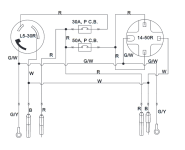
Here is the wiring diagram for the generator link device:
ParalellKit.PNG
Looks like both hot wires (one from each generator) come in, feed into the 30 and 50 amp breakers, then go out to the hot on the 30 amp receptacle and both hots on the 50 amp receptacle.
The neutrals are connected together and to the neutral terminals on the receptacles and the grounds are similarly connected to the ground pins of the receptacles.
That gives it 120v from either hot to neutral and 0v from hot to hot (vs the 240v that is normal).
As such, anything that uses 240v only will see 0v and wont work (most will have a 3 wire cord). Anything that uses both 120v and 240v (most will have a 4 wire cord) will have the 120v part work, but not the 240v part.

I would love to use an interlock kit rather than a transfer switch. Much cheaper and easier and just as safe. However, my sub-panel (Siemens) does not have a main, only branch circuit breakers. The main for the sub-panel is in the outside panel.

OK, I have another confession to make. I do own a 5500 watt 240 volt generator. It is loud as all get out and the voltage fluctuates pretty wildly when a load is applied (like a compressor starting on a refrigerator, freezer or window ac). I'm very concerned about my electronics using this generator. I CAN use it if I have to. I just don't really want to if I can help it.

The 240v generator has a bonded neutral. (I just checked it) I know the smaller ones have a floating neutral. (Checked them too) If I do buy the 100 amp transfer switch I still do not know how to hook up the neutrals or grounds from either generator. That has been my only question from the beginning of this post. THANKS for your help and advice. I really do appreciate it.
Given that the generator will be running outside, I would install (or given your apparent experience level, perhaps have an electrician install) a transfer switch outside (after the breaker in the outdoor breaker panel), or with an interlock on the main breaker of the outdoor panel with a NEMA 14-50 inlet such as: Conntek GISB5-25 NEMA 14-5 Power Inlet Box & Power Cord Combo
then plug your generators into that, or a larger generator down the road.

Aaron Z
 
/ ANOTHER ELECTRICAL QUESTION #85  
I have run into many cases where I want to plug a fixed device into a UPS for instance. Like Automatic doors that are normally wired into a building.

Like, how would you take a circuit in your house, and plug end it to plug into a UPS?

There doesn't really seem to be any way to do this to code. Cab tire and extension cords are not for permanent use. And you can't put a plug on the end of some BX, although I do. One of those metal ones. But not to code.


What where you trying to type with "cab tire"?
 
/ ANOTHER ELECTRICAL QUESTION #86  
It's what flexible rubber cord is called here. Yes, dumb founded me too, when starting as an apprentice. Did a little looking. No one seems to know where the name originates.

So twist locks are OK for permanent service? On the end of rubber cord????
 
/ ANOTHER ELECTRICAL QUESTION #87  
It's what flexible rubber cord is called here. Yes, dumb founded me too, when starting as an apprentice. Did a little looking. No one seems to know where the name originates.

So twist locks are OK for permanent service? On the end of rubber cord????

Per: The History of Electric Wires and Cables - Robert Monro Black - Google Books (result #2) the St Helens Cable and Rubber Company used the same rubber extrusion process for rubber cord as they used to make rubber tires for cabs and carriages and they may have been the first to market with a rubber cord (vs some other type of insulator).

Aaron Z
 
/ ANOTHER ELECTRICAL QUESTION #88  
Thanks. I always feared dying, never knowing. lol
 
/ ANOTHER ELECTRICAL QUESTION #89  
It's what flexible rubber cord is called here. Yes, dumb founded me too, when starting as an apprentice. Did a little looking. No one seems to know where the name originates.

So twist locks are OK for permanent service? On the end of rubber cord????

Pretty much every piece of equipment at the Newspaper I worked at for 30 years was on twist lock connectors. All production equipment. All of the computer servers had twist lock connectors that went into receptacles on the back of UPS's. The UPS's had twist lock connectors that plugged into mounted outlet boxes that were fed from breaker panels.

Literally hundreds of pieces of machinery and computer hardware, all on twist lock plugs.
 
/ ANOTHER ELECTRICAL QUESTION #90  
Sure. Seen it too. But all the machines, even if they would be in place forever, are deemed NOT part of the building.
 
/ ANOTHER ELECTRICAL QUESTION
  • Thread Starter
#91  
Your cheapest way is with extension cords to your existing generators. Fool proof (well, fool resistant at least :rolleyes:), with no chance of backfeeding another circuit by accident.

That may very well be what I do. Go to Costco and load my buggy down with extension cords. Then bring them home and listen to the fussing.
 
/ ANOTHER ELECTRICAL QUESTION #92  
Sure. Seen it too. But all the machines, even if they would be in place forever, are deemed NOT part of the building.

It's still legal. And residential generator use code for temporary power is very lenient compared to commercial.
 
/ ANOTHER ELECTRICAL QUESTION #93  
That may very well be what I do. Go to Costco and load my buggy down with extension cords. Then bring them home and listen to the fussing.

Someone won't be fussing when they can flush the toilet or take a shower when all the other neighbors are sitting stinking in the dark.... :laughing:

We had a power outage the morning before that big wind that wiped out much of the midwest last week. I had the generator up and running within 10 minutes so my wife could take a shower and go to work, because she couldn't work from home because we had no internet for her. Hubby to the rescue. :D
 
/ ANOTHER ELECTRICAL QUESTION
  • Thread Starter
#94  
It's been 15 years since I've had a lengthy power outage but it was not fun. At my age I may never see another one but I would like to be prepared just in case. The essential things I want to provide power to add up to way less than half the capacity of my two 3400 watt generators. As a matter of fact the essentials would run on ONE of my 3400 generators. It would be nice if I could run an extension cord (of the proper size) to these essentials but they are scattered all over the house and garage. I could probably get my "essentials" down to a 120v circuit of less than 15 amps if I really was stingy with the things I use. Surely there is a way to power this tiny load with the generators I have and not endanger my home or outside people in the process. I understand completely about back feeding current to the power company's service. I am not one of these folks that would back feed power through my dryer outlet. I WILL NOT do this, no matter what. I thought I had made that clear. Apparently I didn't.
 
/ ANOTHER ELECTRICAL QUESTION
  • Thread Starter
#95  
Someone won't be fussing when they can flush the toilet or take a shower when all the other neighbors are sitting stinking in the dark.... :laughing:

We had a power outage the morning before that big wind that wiped out much of the midwest last week. I had the generator up and running within 10 minutes so my wife could take a shower and go to work, because she couldn't work from home because we had no internet for her. Hubby to the rescue. :D

I can buy enough extension cords to power my freezer, refrigerator and window ac I use in an outage, no problem. The lights are all fed from my sub-panel. Without powering that my wife will still be pooping in the dark. Personally I like to poop in the dark. My wife, not so much.
 
/ ANOTHER ELECTRICAL QUESTION #96  
We have been missing the easiest and one of the nicer ways to do this,
do you need all twelve circuits?
A 10 circuit transfer switch is a lot less money and much easier to find then a 12-16 circuit unit.
Manual Transfer Switches - Electric Generators Direct
There are several 10 circuit manual transfer switches available from a multitude of vendors.
The 10 and 12 circuit units can handle the power from your paralleled system and would do away with all the safety issues.
Or get real fancy and install two six or eight circuit units and run each generator to it's own.

Good luck
 
/ ANOTHER ELECTRICAL QUESTION #97  
Pooping in the dark is fun. Cleaning yourself not so much.

Makita could learn a thing or two about cab-tire I think. My favourite grinder had such a nice cord over my other Chinesium units. Their cords are still as stiff and ugly as new though. Happened when not that old. I have nice flexible cab-tire as old as me!

DSC00224.JPG


So I hve a circuit leaving my elecrical panel that I wish to have on a UPS. How to do that by code? Remove Romex from panel, intall in a junction box. Run cab tire out of junction box to UPS outlet. I don't think that's to code?
 
/ ANOTHER ELECTRICAL QUESTION #98  
The picture I posted shows that its just a 120 circuit. Just because there's 2 120v slots on the plug makes it no different than having 10 receptacles in a room and thinking you have 100 amps of power! The 120v leg is being divided into 2. Trying to cobble this setup to a sub panel isn't worth all the hassles and potential for a fire or mishap to take place! Get a generator that provides 240v and generator sub panel or transfer switch. It'll be safer and what if someone else has to hook it up due to you being out of commission!
 
/ ANOTHER ELECTRICAL QUESTION #99  
Someone won't be fussing when they can flush the toilet or take a shower when all the other neighbors are sitting stinking in the dark.... :laughing:

We had a power outage the morning before that big wind that wiped out much of the midwest last week. I had the generator up and running within 10 minutes so my wife could take a shower and go to work, because she couldn't work from home because we had no internet for her. Hubby to the rescue. :D
Setup the little generator during a power outage the other day, ran a fan and a window AC and made the wife happy. Something about no power when its 85 with 90% humidity...

The picture I posted shows that its just a 120 circuit. Just because there's 2 120v slots on the plug makes it no different than having 10 receptacles in a room and thinking you have 100 amps of power! The 120v leg is being divided into 2. Trying to cobble this setup to a sub panel isn't worth all the hassles and potential for a fire or mishap to take place! Get a generator that provides 240v and generator sub panel or transfer switch. It'll be safer and what if someone else has to hook it up due to you being out of commission!

No, 2 28.8 amp 120v legs (3400W/120V=28.888888A) are being combined into 1, run through a 50 amp breaker, then its being made available to both legs of the plug.
Cant pull more than 50 amps at 120V or it will trip the breaker.
Set the panel up like I said and there wont be a risk of a fire or other catastrophe and the OP will be ready for a larger generator down the road if needed.

Aaron Z
 
/ ANOTHER ELECTRICAL QUESTION #100  
That generator link device putting the same 120 volt phase on both hot legs worries me. I know it will work for what the OP has described, but it will be a hazzard on a multi wire circuit since the neutral will be carrying the sum of the 2 hot wires. And multi wire circuits are not obvious when you look in the breaker panel.
 

Marketplace Items

1991 International 4900 Box Truck (A55315)
1991 International...
(2) UNUSED 31" X 8 MM EXCAVATOR TRACKS W/ PINS (A60432)
(2) UNUSED 31" X 8...
2022 New Holland C327 Compact Track Loader (A61306)
2022 New Holland...
Yamaha Golf Cart (A57149)
Yamaha Golf Cart...
Sakai SV505 (A60462)
2022 Vermeer 573 (A55973)
2022 Vermeer 573...
 
Top