Splicing underground wire

/ Splicing underground wire #21  
Found myself thinking that way, too, but if you brought to the surface, wouldn’t the wire be too short?

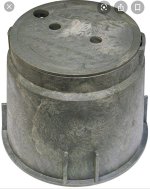
The wire doesn’t have to come to the surface.....just the lid of the box. And they make box extensions if you don’t want to make something to be below the box.

Adjustments.jpg
 
/ Splicing underground wire #22  
If the appropriate slice is used, no worries. Make sure to have some slack (don't stretch the cable tight) so if there is any contraction or expansion it is not pulling the slice apart. It is done all the time, both with underground wires and wires down in water wells. The splice connecting the pump to the feed wires has both movement and water and they work well..
 
/ Splicing underground wire
  • Thread Starter
#23  
Thanks for the ideas. I have plenty of wire to work with on this. But there would be three wires all coming together so it would be difficult to use some of the less expensive ways. I found these after I gave it more thought
https://www.homedepot.com/p/Water-S...p-Wire-Compression-Splice-Kit-SK320/203990041

I guess im a Hoarder lol I know I saved a few of these but cant find them. I know once I buy a set and use then ,the next day I will spot them.
I do remember years ago when I had to replace my pump, (it was professionally installed) All he used was solder and shrink wrap and some black tape. And there was never a problem with that connection.Perhaps im overthinking this.lol
Again thanks for all the advice
 
/ Splicing underground wire #24  
Who said anything about being above ground?

It痴 interesting you would use my quotes that include the reasons why I would put a box in and then say their is no reason to use a box. Also note my response was in direct response to a question as to why I would use a box. Also note that my comments (including my first) reference what I would do. Not what anyone must do. In fact I point out that many will do it different ways!

You either didn稚 read the thread or you were mentally off when you did......so confused by your response.....

This is what you said in post #6. Do above and put it in a box that comes to the surface. I wouldn稚 splice and bury!

By that comment and your further comments that I quoted I assume you think the bad spot should come to the surface and be spliced in a box?

I'm sure you weren't mentally off in your comments. So it was surely me.
 
/ Splicing underground wire #25  
I did the same thing but I think I used 2 1/2", old electrician buddy said conduit is cheaper than replacing that wire, and in the event you ever do have to replace it the conduit already in place will be cheaper than a trencher rental.
The wiring to my horse barn I had to replace last year. I had used overhead triplex wire in conduit simply because I had it, it didn't last long. I first lost one leg and just lifted that leg on each end then when the other went I replaced it with direct burial. Being the conduit was already there it made it less than a hour job for my dad and I for a 150' run.

Putting direct burial wire in conduit de-rates the ampacity. Code does not allow it. Direct burial rated wire alone or conduit with THWN/THHN or XHHW wire are code.

Ron
 
/ Splicing underground wire #26  
Putting direct burial wire in conduit de-rates the ampacity. Code does not allow it. Direct burial rated wire alone or conduit with THWN/THHN or XHHW wire are code.

Ron
Please cite the section of the NEC that prohibits using UF in conduit.

Reading Article 340 I find:
https://www.electriciantalk.com/f5/nm-b-uf-cable-pvc-conduit-10655/ said:
Article 340 UF Cable
340.10
Uses Permitted. Type UF cable shall be permitted as follows:

(1) For use underground, including direct burial in the earth. For underground requirements, see 300.5.
(2) As single-conductor cables. Where installed as singleconductor cables, all conductors of the feeder grounded conductor or branch circuit, including the grounded conductor and equipment grounding conductor, if any, shall be installed in accordance with 300.3.
(3) For wiring in wet, dry, or corrosive locations under the recognized wiring methods of this Code.

(4) Installed as nonmetallic-sheathed cable. Where so installed, the installation and conductor requirements shall comply with Parts II and III of Article 334 and shall be of the multiconductor type.
Nothing about not putting it in conduit.

Aaron Z
 
/ Splicing underground wire #27  
I have to somehow splice three pieces of 12 2 direct burial.does anyone know the least expensive way to do this?it will be buried about 2 foot in dirt and won't be live all the time.thanks

Thanks for the ideas. I have plenty of wire to work with on this. But there would be three wires all coming together so it would be difficult to use some of the less expensive ways.

This is where more information is better than less. Nowhere does it mention if this is a break/damage/repair or new installation. Nor does it mention is any of these three line are already in the ground and maybe one is being added.

The posts mentioning wires being 'too short' are thinking this is a break in or addition to existing lines. At first I thought it was about using three pieces of wire to make a new run, splicing them together end to end instead of a single longer piece. Now we see the bit about three lines coming together at a single point ('T' or 'Y' configuration). If that's the case, I would definitely use an underground rated box that I could open up later if necessary.

I prefer conduit whenever possible and practical for added protection from critters and tools. I don't see how it's possible to affect capacity ratings of any cable by using PVC conduit. Steel conduit ... maybe.

He also mentions it will be two feet deep, so a box extension won't accomplish much if he doesn't extend all three lines to the surface.
 
/ Splicing underground wire
  • Thread Starter
#28  
This is where more information is better than less. Nowhere does it mention if this is a break/damage/repair or new installation. Nor does it mention is any of these three line are already in the ground and maybe one is being added.

The posts mentioning wires being 'too short' are thinking this is a break in or addition to existing lines. At first I thought it was about using three pieces of wire to make a new run, splicing them together end to end instead of a single longer piece. Now we see the bit about three lines coming together at a single point ('T' or 'Y' configuration). If that's the case, I would definitely use an underground rated box that I could open up later if necessary.

I prefer conduit whenever possible and practical for added protection from critters and tools. I don't see how it's possible to affect capacity ratings of any cable by using PVC conduit. Steel conduit ... maybe.

He also mentions it will be two feet deep, so a box extension won't accomplish much if he doesn't extend all three lines to the surface.

There was a small shack that is being moved. So im left with two lines and plenty of extra to comment. I plan to add another line ,so there would be three lines of wire coming together.I have seen some pictures of people who have just used a special wire nut with silicone .But im not to thrilled with that. I found the sleeved connectors as I posted from Home Depot So I think I will use those and also shrink wrap the wires inside. My one concern is that the one end that will have to have two strands come out of it will not seal around the 'o' ring. If I had a shrink wrap that would fit over the who assembly I would use that also. But Ill just use rubberized tape as a secondary precaution.
 
/ Splicing underground wire #29  
I thought that code called for all splices, connections, be accessible and not hidden or buried as well as to be in a 'box'.
Now perhaps than is only in buildings and not buried lines.

On the practical side, I'd solder and use the hot glue shrink sleeve to render a waterproof joint.
 
/ Splicing underground wire #30  
On joints that are not possible to get a good heat shrink seal on there is a product called liquid tape that works very well.
It will get into places that can't be taped or heat shrunk well and protects the connection and wiring very well.
 
/ Splicing underground wire #31  
On joints that are not possible to get a good heat shrink seal on there is a product called liquid tape that works very well.
It will get into places that can't be taped or heat shrunk well and protects the connection and wiring very well.
For something like this, I would only use the heat shrink that has glue on the inside, that stuff is almost impossible to get off once it's installed and does a really good job of filling in the cracks between multiple wires.

Aaron Z
 
/ Splicing underground wire #32  
Please cite the section of the NEC that prohibits using UF in conduit.

Reading Article 340 I find:

Nothing about not putting it in conduit.

Aaron Z

Aaron,

I probably have been wrong, I do not have a copy of the code anymore much less the current one. Somewhere I picked up on, probably from an electrician friend that if you put any of the sheathed cables in conduit you have to use the 60 degree ampacity tables. You never want to overlook the table notes either. I used to be involved in a lot of electrical work but it has been awhile and codes change.

More in the back of my mind was the cost factors involved in combining cable into conduit especially UF or USE. Agreed it has value for future replacement purposes. The discussion on an access box for splices if not code is common practice. You can do end to end splice and still have the box called "Hand Hole" in underground work.

Thanks for the clarification, Ron
 
/ Splicing underground wire #33  
I put my underground electrical in conduit from the meter pedestal to my shop (50ft) and to the house (75ft) so that in a couple years when I'm digging a post hole for some decorative thing in the back yard for my wife I don't pierce my underground electrical cable.
 
/ Splicing underground wire #34  
I put my underground electrical in conduit from the meter pedestal to my shop (50ft) and to the house (75ft) so that in a couple years when I'm digging a post hole for some decorative thing in the back yard for my wife I don't pierce my underground electrical cable.

I do the same thing now when installing underground electrical with UF and 3/4" PVC conduit with a digital photo of the trench and exact location.

22 years ago I ran 2 10-2 UF circuits to the barn, no conduit and yes I know within 2' where not to dig based on my property map, but installing with conduit would have been so much smarter - live and learn!
 
/ Splicing underground wire #35  
I do the same thing now when installing underground electrical with UF and 3/4" PVC conduit with a digital photo of the trench and exact location.

22 years ago I ran 2 10-2 UF circuits to the barn, no conduit and yes I know within 2' where not to dig based on my property map, but installing with conduit would have been so much smarter - live and learn!

I took Drone videos of my utilities as I installed them. Also took physical measurements.

My conduit protection is for when I am old and forgetful and "think" I know where it is without looking at all the data I saved...….. :rolleyes:
 
/ Splicing underground wire #36  
The drone is definitely the way to go for mapping. Most of my stuff was "pre-drone era" but I was an early adopter of the Parrott AR Drone in 2012 timeframe with primitive controls and flight time of a few minutes, and after flying it into the trees getting it stuck etc., I gave up on drones.
 
/ Splicing underground wire #37  
You guys, underground power lines are so easy to locate. You just hook up a spark plug wire from an old running truck to the ground wire and listen for the static in an old transistor radio. Who needs maps!

Actually it does work but I like the idea of maps better!
 
/ Splicing underground wire
  • Thread Starter
#38  
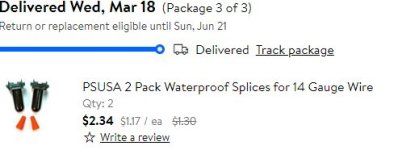
Thanks for all the info and suggestions. I ended up using these.


They have silcone inside that gooshes over the wire nuts.but I also wrapped it all with rubber tape.

We shall see. lolwire.JPG
 
/ Splicing underground wire #39  
I just spliced a 10-2 wire I had going to my barn that I hit with the backhoe. Being in a hurry and not wanting to wait for delivery or to take a trip to Home Depot, I used what I had on hand. I spliced the wire and cut a piece of pvc pipe that was just big enough to go over the splice then I filled it with silicone. Added a short piece of wire, put the pvc over the wire, spliced it and filled with silicone.

Maybe this is not the best thing to do but I bet it will last for many years.
 
/ Splicing underground wire #40  
I hear people calling for silicone for wiring splices.
I would use a latex caulk compound or just a dielectric grease then lots of tape.
"Silicone" is corrosive if you can smell the acetic acid smell it will corrode.
 

Marketplace Items

John Deere 7410 (A53317)
John Deere 7410...
YANMAR VIO55-6A EXCAVATOR (A59823)
YANMAR VIO55-6A...
2016 UTILITY 53X102 REEFER TRAILER (A59905)
2016 UTILITY...
2025 14ft. Bi-Parting Driveway Gate (A59231)
2025 14ft...
2016 26ft T/A Dovetail Flatbed Equipment Trailer (A59228)
2016 26ft T/A...
2001 WELLS CARGO 8' X 32' TOY HAULER DBL AXLE TRL (A57192)
2001 WELLS CARGO...
 
Top