How would you build this bridge?

/ How would you build this bridge? #1  

jymbee

Platinum Member
Joined
Sep 20, 2011
Messages
632
Location
Upstate, NY
Tractor
Massey 1652, 1949 Farmall H
I've got two sections of railroad track-- about 20 feet long each-- spanning a small stream, resting on two very large rocks at each end. Next step is to add some planking but not sure just how the best way might be to do that. Pretty hard driving nails or screws into that iron! :D

I'm thinking the final bridge should be around five feet wide. The heaviest load on it would be our John Deere 748 garden tractor. Any suggestions?
 
/ How would you build this bridge? #2  
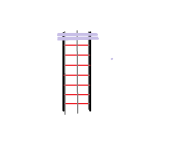
If you can secure the track where it will not separate you could cut 2bys to span inside the rail and then run another 2by6 beside the rail to give you a stringer to nail too. then your planks can lay on top and fasten
 
/ How would you build this bridge? #3  
ladder bridge.png

Pardon the rudimentary drawing but you should get the drift .
 
/ How would you build this bridge?
  • Thread Starter
#4  
Right. I had thought about something like that. Keeping the rails from separating is another issue that I'd like to incorporate into the final structure as well. I suppose some kind of cross section welded in would accomplish that but I don't have a welder and it's in a pretty remote spot to get at.

In the past we've had a pretty simple wooden bridge here but the stream really rises with a good rain storm and that washed away often. The iron is quite a bit higher now and given the extra weight the hope is that even if the water were to get that high it would stay in place. Probably add some kind of "anchors" to make sure of that.
 
/ How would you build this bridge?
  • Thread Starter
#5  
Looks interesting but not quite sure what I'm looking at with respect to materials?
 
/ How would you build this bridge? #6  
If the rails were upside down it would simple to lay the planks and attach a cleat to the under side to secure them and much cheaper
 
/ How would you build this bridge? #7  
<img src="http://www.tractorbynet.com/forums/attachment.php?attachmentid=507571"/> Pardon the rudimentary drawing but you should get the drift .

Interesting project. How long is the span? Maybe you could drill holes in the bottom part of each railing, and then bolt something across the bottom every 4 feet or maybe 8 feet. Then bolt A few boards in between the channel, and then run your main boards longitudinally.
 
/ How would you build this bridge?
  • Thread Starter
#8  
Interesting project. How long is the span? Maybe you could drill holes in the bottom part of each railing, and then bolt something across the bottom every 4 feet or maybe 8 feet. Then bolt A few boards in between the channel, and then run your main boards longitudinally.

Might be really tough to drill any size hole through the rails? They're pretty darned "dense". I think the issue with the longitudinal route would be simply a matter of strength. I envisioned setting the distance between the rails to match the wheelbase of the tractor thus providing maximum load bearing.
 
/ How would you build this bridge? #9  
I would think that once you figure out how to keep the rails separate (welding angle iron spacers would work if you have a welder), you could attach a plywood base with U bolts, and nail or bolt planking to that?
 
/ How would you build this bridge? #10  
I don't think I would recommend using those rails for beams. You better check the bending deflection and have enough bracing to prevent the rails from rolling. While in theory they may seem ideal, the distribution of the material in the cross section isn't quite right for a beam application. I'm not saying it can't be done, its just no ideal. What type of weights are you thinking about running across this bridge?
 
/ How would you build this bridge?
  • Thread Starter
#11  
I don't think I would recommend using those rails for beams. You better check the bending deflection and have enough bracing to prevent the rails from rolling. While in theory they may seem ideal, the distribution of the material in the cross section isn't quite right for a beam application. I'm not saying it can't be done, its just no ideal. What type of weights are you thinking about running across this bridge?

Interesting observation. I'm by no means an engineer when it comes to things like bending deflection. But I do understand the general implications when it comes to the difference between the rail being able to support a train when anchored to a rail bed as opposed to a spanning application such as this.

Mostly it would be a footbridge but ideally be safe to drive across with our John Deere 748 garden tractor.

These particular rails were salvaged from the same kind of bridge construction built many years ago to cross the stream at another point. I assume back them all manner of critters & vehicles used it.
 
/ How would you build this bridge? #12  
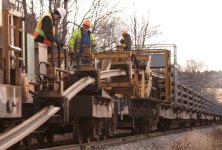
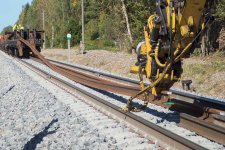
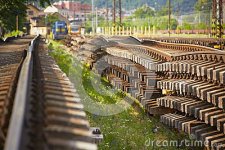
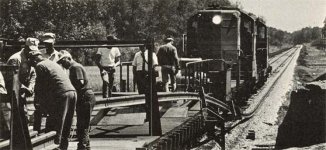
Most people only have hands-on experience with short pieces of rail. Longer rails are more flexible than most people think. In use, they seldom span more than 2 feet.

continuouswelded.jpg railflex.jpg track-panels-stacked.jpg railbend.jpg railtruck.jpg

If you have enough rails, you can build a strong bridge. :)

RailBridge.jpg

Bruce
 
/ How would you build this bridge? #13  
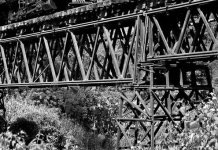
Here is how I would use the rails for a light duty bridge. Keep it narrow so someone in the future doesn't try to drive a large truck or tractor over it.

railbridgetruss.jpg

Maybe 4x8 cross beams and 1/4x2 straps.

Bruce
 
/ How would you build this bridge? #14  
What we did with ours was to flip the rails upside down. drill some holes through the flange area and bolt a treated 2x6 length wise to the rails. Then we just screwed the 2x6 decking boards to the bolted down 2x6's.
Ours runs about 20ish feet. We drive our 4 wheelers and side x sides across it, it doesn't bow or bounce or bend under the weight of these. However we are mindful of how much weight we run across it.
 
/ How would you build this bridge? #15  
Keep it narrow so someone in the future doesn't try to drive a large truck or tractor over it.

Bruce

Around my gang that's most important!!!! I have built two bridges in my timber. An ATV bridge using two 8" I-beams and decked with heavy corrugated steel 5' wide. A larger bridge using four 12" I-beams and decked with 4"x12" treated planks 8' wide. Both will easily hold whatever can fit on them. :)
 
/ How would you build this bridge? #16  
What is the real span over this creek? I see you have 20 ft rails but is that the real span?
I think you will put a lot of effort making these rails work for you. Treated 6" round for posts, treated 2x12's 1 ft on center for spans. If you google rail road truss bridges, you can see it's a real simple concept and real strong.
 
/ How would you build this bridge? #17  
Rail sucks for a substitute for a real beam. Not what its made for. And without knowing what the real span is....who knows?

And saying you have two pieces of rail its like saying I have two pieces of wood and want to span 20'.

There are many different sizes of rail. DO you have 8 pound rail? or 175 pound rail? or something in between? (rail is sized by pounds/yard)

Obviously heavier stuff would be better. And actual rail track is usually pretty heavy. But alot of stuff out there used for "crane rail" is the same shape just lighter. My shop crane has either 30# or 40# rail. (cant really remember now). But its only about as tall as a 2x4 joist. And I wouldnt trust it spanning 5' and crossing it with a nearly 1200 pound machine
 
/ How would you build this bridge? #18  
i would heed previous advice on deflection of rail. It is designed to be evenly support the full length (note the flex shown in the pictures. I guarantee as soon as that narrow light weight bridge is complete you will kick your self for not making it wider when you need to drive something bigger or heavier over it. I always plan on 10' wide on bridges I have built. I use 16' RR ties with wide dimension vertical for stringers, 3-4 at least then plank over. That makes a bridge span 14-15' long setting on a well supported sill logs/walls. I have driven a 1 ton dually with 8-10 K # of gravel in it with no deflection. Never pays to build to minimum, use creep always comes along. Last project I did was about $600 worth of materials.

Ron

Ron
 
/ How would you build this bridge? #19  
I've got two sections of railroad track-- about 20 feet long each-- spanning a small stream, resting on two very large rocks at each end. Next step is to add some planking but not sure just how the best way might be to do that. Pretty hard driving nails or screws into that iron! :D

I'm thinking the final bridge should be around five feet wide. The heaviest load on it would be our John Deere 748 garden tractor. Any suggestions?


[ If your actual free span is 10' or less, I think it could work for you.
If your free span is greater than 10' you need a new plan, with a much deeper web dimension than railroad rails.[/I]
 
/ How would you build this bridge? #20  
Make sure the beams are braced
As ld1 said figure out what rail you have , and there determine properties
Seat of the pants will show deflection problem before it becomes structural on small span
You can attach wood deck by bolting through timber at edge of beam flange. Use washer on the bolt
 

Marketplace Items

2022 EZ-GO ELITE ELECTRIC GOLF CART (A63276)
2022 EZ-GO ELITE...
PULL TYPE YARD SPRAYER (A64278)
PULL TYPE YARD...
2023 Bobcat T595 Compact Track Loader Skid Steer (A64553)
2023 Bobcat T595...
PACER 2" PUMP, BRIGGS & STRATTON ENGINE, HOSE (A64276)
PACER 2" PUMP...
SCAN TO RECEIVE TEXT UPDATES (A65053)
SCAN TO RECEIVE...
1000 GALLON FLAT BOTTOM POLY TANK (A64278)
1000 GALLON FLAT...
 
Top