Grounding wire question

/ Grounding wire question #1  

Richard

Super Member
Joined
Apr 6, 2000
Messages
5,074
Location
Knoxville, TN
Tractor
International 1066 Full sized JCB Loader/Backhoe and a John Deere 430 to mow with
Went to Home Depot other day to get couple filters for whole house filter. When I got in the area..I noticed the softners display. Saw a mockup display of water "path" from pipe into house, though each step. When I saw the whole house filter, I noticed they had a grounding wire grounding from each side of the water line to the filter. In other words, the plastic filter housing broke the continuity of the copper, so they grounded each side of copper to the other with a grounding wire bolted on. As I was then unable to find anyone who really seemed to know anything.. I decided to post that here..

I do NOT have my (self installed) filter grounded like that. I simply installed my filter in line.. As I was looking at display, I failed to see WHY it's needed. After all, won't the water in the line/housing ITSELF act as a bridge to ground any current this wire might theoritically bridge? I know the $$ are few, but the cynic in me saw this as simply marketing. But then..what do I know! (about marketing /w3tcompact/icons/grin.gif )

So..any merit in putting grounding strap from one side of the connection to the other? Easy, cheap to do..but necessary? (or wise)

Richard
 
/ Grounding wire question #2  
Richard,
Always install a wire around any plastic "interuption" of your houses metal pipes. All metal water pipes in the house need to be connected to the ground of your electric supply. That even includes the dielectric unions/nipples on your hot water heater. Water will not carry fault current like metal water pipes will. If you have 10' of metal water line underground, that should be the ground for your electric system. If you have plastic underground and metal inside, they still need bonded to the ground for safety.
 
/ Grounding wire question #3  
In many older homes steel water pipes were used for electrical grounding. Today most repairs on steel pipe are performed with PVC or plastic tubing therefore, the electrical ground path should be maintained by installing a bonding strap across the plastic repair just in case wiring in the house has never been updated. Leaving this bonding jumper off could be overlooked very easily and potently be very dangerous if your pipes are used as a ground conductor.
 
/ Grounding wire question #4  
What about houses that have plastic water pipes?

I'm not sure grounded pipes are the safety feature that people think they are. Think about it-- if you manage to get connected with a live wire, do you want a good ground available to complete the circuit? It seems to me that a person would be better off with nothing grounded whenever electric sockets and plumbing fixtures are in close proximity. Unless you are in contact with either a ground or neutral, touching a hot wire does nothing.
 
/ Grounding wire question #5  
I think I'd prefer KNOWING where that shock hazard is going.......right out to the ground like it should.
 
/ Grounding wire question #6  
If your house has plastic water lines inside, then you do have less shock potential.
 
/ Grounding wire question #7  
With different appliances, etc. there are opportunities for piping to end up (unintentionally) connected to a "hot" wire. If the piping system is grounded, one of two things will happen. Either the fuse / circuit breaker will open the circuit if the current is high enough, or a small fault will be "drained" to ground.

With an ungrounded piping system, the piping will become energized. Coming in contact with a bare copper pipe (or faucet, water heater, or outside hose bib) and something grounded is fairly dangerous. Hate to have the kid try to stand on damp earth and connect the garden hose to an energized piece of metal....................chim
 
/ Grounding wire question #8  
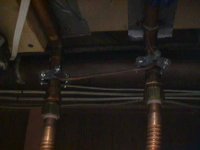
Jumper around the hot water heater
 

Attachments

  • 8-153217-MVC-001S.JPG
    8-153217-MVC-001S.JPG
    15 KB · Views: 187
/ Grounding wire question #9  
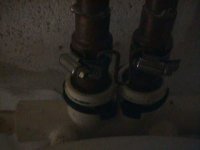
manufacturers jumper that was supplied with the water softener. It is too small to meet the requirements of the National Electrical Code, so it was supplemented with one the correct size.
 

Attachments

  • 8-153218-MVC-002S.JPG
    8-153218-MVC-002S.JPG
    13.3 KB · Views: 151
/ Grounding wire question #10  
Electric code varies throughout the country, grounding is just about the most complex of electrical code. The ultimate grounding in homes today is a ufer ground. A piece of number 4 rebar (1/2"), 20' long imbedded in concrete about 3" from the bottom of the footing where the most moisture is. A 8' copper coated rod is a second choice but not always accepted as moisture is the issue and there are instances where not enough "ground" is available to effectively ground out a system. The last and least reliable soource is a water line. Utilitity companies don't always use metal water line and often a 1" PVC or larger line is run to supply the domestic water to many homes built today. The ground is effectively non existent in water lines and although water itself may carry a small amount of grounding potential, it is still a lousy conductor compared to copper, steel or aluminum. Any break in metal piping by a non conductor should always be bonded for safety sake. I cannot think of any reason where it would present more of a hazard to do it. As was mentioned, the last thing you want is a energized faucet, freezer, gas pipe etc. Better that these have a dead short and trip a breaker then have a person touch it and pass a mere couple of milliamps through their body, it doesn't take much depending on how well a person is grounded. Bare feet, moist ground a few milliamps and you or someone else may be dead. RAT...
 
/ Grounding wire question #11  
I installed a jumper grounding wire when I put in my whole house filter. It provides continuity from the hot water heater to my well head. When the water lines and electricity were installed, the pump man ran a heavy guage copper wire from the well head to pressure tank. From the pressure tank to the hot water heater, the lines are copper and which extended the grounding. I saw this and said there must a good reason, so I just spent the $5 or so dollars to extend the grounding.

I worked around mainframe computers during the computing stone age (wink) and everything was tied to a centralized grounding grid in the computer room. They used braided copper strapping to make sure every piece of equipment or any mechanical appliance was grounded. The bigger issue was static electricity of course but I can imagine that it also had to do with having a common ground for any kind of fault.

Terry
 
/ Grounding wire question #12  
Richard, pure water it's self in NOT a conducter of electricity.
It is the minerals in the water that make it a conducter. Depending on it's mineral content, water can go from being a lousy to a somewhat decent conducter.
Because of it's residual minerals, well water is generally a better conducter then rain or melted snow water.

cheers,
 
/ Grounding wire question #13  
Terry
Similar experience with good grounds when installing a research computer in the early 70's - almost stone age. We needed a separate ground and had a well driller put in a hole that served as our ground into water. The head electrician didn't think much of the idea, and sent one of his men to "test" the ground (by shorting 110v to the ground to see if it would blow a 30A fuse in the line). This "test" was done without disconnecting the $100K computer from the ground being tested. Poooof!

The computer survived better than the rest of the circuits, allowing the 5v logic to float on top of the 110 volts it was subjected to. But the several thousands of dollars of research circuitry didn't fare so well. Essentially all the resistors became toast, along with many other parts.

As soon as the electrician touched blew the 30A fuse, it dawned on him that he should have let us know to disconnect the computer first.

You are right, good grounds in those days were hard to come by.
 

Marketplace Items

Neckover GL24-2-7K Gooseneck Trailer  24ft Deck, Dual 7K Axles, 14K GVWR (A61307)
Neckover GL24-2-7K...
Commercial Lawn Mower 652R (A56859)
Commercial Lawn...
2007 John Deere 6615 (A60462)
2007 John Deere...
CASE IH MAXXUM 115 TRACTOR (A62130)
CASE IH MAXXUM 115...
2021 MULTIQUIP WHISPER PORTABLE AC GENERATOR (A59823)
2021 MULTIQUIP...
Iranch IRGC40 (A60463)
 
Top