Elementary Light Wiring

/ Elementary Light Wiring #1  

lakngulf

Veteran Member
Joined
Oct 15, 2009
Messages
1,096
Location
Lake Martin Alabama
Tractor
Kioti CK30
When wiring a light and switch I have always run the hot to the switch and then to the light fixture. On a current project of lighting a storage area, I could use a lot less wire if I brought the hot thru the lights first. I want to have four light fixtures off one switch...nothing fancy.

Will this work if I cut and attach the white at each light, and let the black run continuous to the switch? Then both white and black attach to the switch?

Seems simple enough but I googled the concept and the first find hooked a hot black to the light, and the white from the switch to the side of the light. Then the other black and white were wired together. And the white was marked black, and attached to the switch on bottom, where I would have assumed black would be connected.

Help!
 
/ Elementary Light Wiring #2  
Inserting the light into either the white or black wire only sounds like you get a series circuit. You want the lights in parallel--light across black and white.
 
/ Elementary Light Wiring #3  
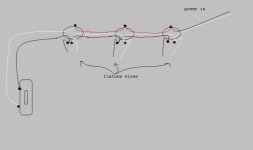
I think this is what you are trying to do.

three.jpg

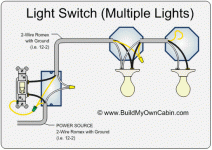
But I think it's easier to just run wires parallel like dave1949 states

wiring-multiple-lights.gif
 
/ Elementary Light Wiring #4  
just run a "switch leg"...you can still break the hot regardless of where it is fed from...
 
/ Elementary Light Wiring
  • Thread Starter
#5  
Found the following while researching the best method. I think I will just stick with power to switch and then to multiple lights. I know how to do that. The instructions below sound way to complicated, and why is 14/3 needed?

here is how it goes;

from power source 14/2 to ceiling box...... 14/3 to next box........14/3 to next box .........14/3to next box..........14/2 to single-pole switch and box.

black from power source wire nutted to black in all ceiling boxes and the 14/2 black to the switch.

white from power source wire nutted to white from light and to 14/3 white to next light then nutted to next light white and 14/3 to next light etc. This white stops at the last light white wire.

black light wire in first box is nutted to 14/3 red wire.. second light black wire nutted to the 2 red.....3rd light black nutted to red and the white from the 14/2 to the switch. this white wire should have black electrical tape on both ends to show it is being used as a black (hot) wire.

in switch box the black and the remarked white goes to the single pole switch screws.
 
/ Elementary Light Wiring #6  
I think this is what you are trying to do.

View attachment 363351
Found the following while researching the best method. I think I will just stick with power to switch and then to multiple lights. I know how to do that. The instructions below sound way to complicated, and why is 14/3 needed?

here is how it goes;

from power source 14/2 to ceiling box...... 14/3 to next box........14/3 to next box .........14/3to next box..........14/2 to single-pole switch and box.

black from power source wire nutted to black in all ceiling boxes and the 14/2 black to the switch.

white from power source wire nutted to white from light and to 14/3 white to next light then nutted to next light white and 14/3 to next light etc. This white stops at the last light white wire.

black light wire in first box is nutted to 14/3 red wire.. second light black wire nutted to the 2 red.....3rd light black nutted to red and the white from the 14/2 to the switch. this white wire should have black electrical tape on both ends to show it is being used as a black (hot) wire.

in switch box the black and the remarked white goes to the single pole switch screws.

I think your written description is the same thing as slvda00's sketch.

It is really worth it for safety's sake to switch the hot before the lights, it's probably code anyways. When the switch is off, there is no power at any light.

The third wire is passing the hot from the power source to the switch, just passing through each light box with no connection to a light fixture.
 
/ Elementary Light Wiring
  • Thread Starter
#7  
I think your written description is the same thing as slvda00's sketch.

It is really worth it for safety's sake to switch the hot before the lights, it's probably code anyways. When the switch is off, there is no power at any light.

The third wire is passing the hot from the power source to the switch, just passing through each light box with no connection to a light fixture.

Thanks for your help. I have wired several lights and switches, with power to switch first. I plan to do this project that way. Saving a few feet of wire is not worth it.
 
/ Elementary Light Wiring #8  
Lakngulf,

You have one light with one switch and power goes to light instead of switch right?

Run a 14/2 from the switch box to the light box. In the light box, hook the black from power wire to white of switch wire. Hook the black from the switch wire to the light and white of power wire to the light.

At the switch box, hook the switch across white and black. Done.

If you want to add another light across the room, connect a 14/2 from the new light to the black and white on the old light. The switch will control both lights.
 
/ Elementary Light Wiring
  • Thread Starter
#9  
Lakngulf,

You have one light with one switch and power goes to light instead of switch right?

Run a 14/2 from the switch box to the light box. In the light box, hook the black from power wire to white of switch wire. Hook the black from the switch wire to the light and white of power wire to the light.

At the switch box, hook the switch across white and black. Done.

If you want to add another light across the room, connect a 14/2 from the new light to the black and white on the old light. The switch will control both lights.

Now that sounds simple enough. I do want to have about four lights off the one switch
 
/ Elementary Light Wiring #10  
Just keep hooking the new lights to the old lights. If you draw out what I said, you will see the power will come into the light box and immediately go down the white to the switch, and back on the black to the light. It gets trickier when you want to add another switch.

Now that sounds simple enough. I do want to have about four lights off the one switch
 
/ Elementary Light Wiring #11  
The wiring in the picture is correct for that situation. But I usually would use the red between lights (less confusing for the novice). But even less confusing would be to put the power into the left light and run to the right two switches. This would also eliminate the need for 3 wire cable.
in the wiring with 2 wire in all boxes, the white (marking it with a wrap of black tape) would be used to carry the power to the switch and the black would be used for the switch to light conductor.
 
/ Elementary Light Wiring #12  
I think this is what you are trying to do.

View attachment 363351

But I think it's easier to just run wires parallel like dave1949 states

View attachment 363352

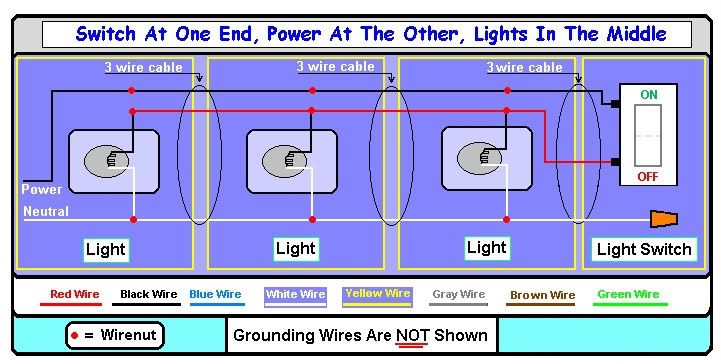
Apparently "Code" now requires running "hot" ( BLACK!!) thru the switch FIRST then coming back using 3 wire.
New-3LightsWithSwitchAtTheEnd.jpg


From the power source (near fixture #1 I presume), run a switch loop to the switch. By the way, the NEC now requires switch loops to be 14/3, so there is a neutral at the switch. So the power flow is as follows: Hot from source, to black on switch loop wire, through switch, back to souce box on red wire of switch loop, then to the string of lights.

If you want to run 14/3 between the fixtures as buzz suggested, use the black conductors to pass power down the string to the last fixture, then make a switch loop to the switch. Upon returning to the last fixture from the switch loop, power the string of fixtures on the red conductors.

Read more: Need Diagram: supply power to multiple lights with switch at the end of circuit - DoItYourself.com Community Forums

Is this going to be an insured building?
 
/ Elementary Light Wiring #13  
Just keep hooking the new lights to the old lights. If you draw out what I said, you will see the power will come into the light box and immediately go down the white to the switch, and back on the black to the light. It gets trickier when you want to add another switch.

Easiest way doing it like Rick says. Usually you only need 14/3 when you have another switch for the same light circuit. Like in a hallway, stairs ect tra
 
/ Elementary Light Wiring #14  
I am not an electrician. I do have an annotated electrical code book from when I built my house 18 years ago. Code has been rewritten many times since my book was written. Code says your switch breaks the black hot leg. This is so you are not working on a light fixture that you think has dead hot leg and you get zapped. You can get zapped by a hot leg to the ground in the Romex or the ground of your body to earth. Always break/switch the hot leg.

When you use the white conductor of your Romex as part of the switch, you make it a black conductor. You are supposed to either paint both ends of that white wire black or wrap both ends with quality black tape to signify that it is now a black hot conductor. It appears that the recolored wire is supposed to supply the switch and the power from the switch goes up to the fixture. rmorey mentions this but did not make it a big point. See this discussion from some electrical pros about wires. Note that my Avast antivirus went off when I clicked that link saying that it blocked a virus from the site I mention. Romex to a switch, white wire only supply? - Electrician Talk - Professional Electrical Contractors Forum If you opened a breaker panel on a 3 phase circuit you will see 4 conductors with 4 different colors of tape. Electricians buy their big gauge wire in one color, black. They have to mark the three phases properly and the neutral with the appropriate tape. There is another discussion that you cannot remark wire less than 4 gauge except for switches but that is a discussion for industrial and commercial electricians, not a homeowner adding a light fixture.
 
 
Top