Do battery cables go bad?

   / Do battery cables go bad?
  • Thread Starter
#81  
The truck is a Chevy 3500 6.5 turbo diesel. I’m leaning towards the heat is the problem. The truck just very recently developed cold start issues which I think is a bad battery. They both load tested good at 500 amps but that was a couple weeks again and the batteries were at a fresh charge at that point. I’m really thinking it’s not the cables. Especially since when it does decide to turn over it cranks good. I think the heat shield and further investigation into the batteries is needed. And I didn’t have much trouble from the truck last winter. If the pattern continues that will further enforce the not bad cables idea.
 
   / Do battery cables go bad? #82  
The truck is a Chevy 3500 6.5 turbo diesel. I知 leaning towards the heat is the problem. The truck just very recently developed cold start issues which I think is a bad battery. They both load tested good at 500 amps but that was a couple weeks again and the batteries were at a fresh charge at that point. I知 really thinking it痴 not the cables. Especially since when it does decide to turn over it cranks good. I think the heat shield and further investigation into the batteries is needed. And I didn稚 have much trouble from the truck last winter. If the pattern continues that will further enforce the not bad cables idea.

If it cranks good once it cranks first thing I would suspect is high current switch on back of solenoid....

Dale
 
   / Do battery cables go bad?
  • Thread Starter
#83  
If it cranks good once it cranks first thing I would suspect is high current switch on back of solenoid....

Dale

It’ll either crank and start properly or just click with no in between. Both starters did the same thing and the old one was worse.
 
   / Do battery cables go bad? #84  
   / Do battery cables go bad? #85  
Some vehicles had known starter issues... like high compression large GM engines in the late 60's...

We had a nearby starter/generator shop that specialized on custom or modified starters for these applications...

I was young at the time but he explained how heat would come into play and by providing commutator "Clearance" or something like that the modified starter would work when hot... I asked why didn't all cars have problems and was told High Compression engines taxed the OEM starters.
 
   / Do battery cables go bad? #87  
The truck is a Chevy 3500 6.5 turbo diesel. I’m leaning towards the heat is the problem. The truck just very recently developed cold start issues which I think is a bad battery. They both load tested good at 500 amps but that was a couple weeks again and the batteries were at a fresh charge at that point. I’m really thinking it’s not the cables. Especially since when it does decide to turn over it cranks good. I think the heat shield and further investigation into the batteries is needed. And I didn’t have much trouble from the truck last winter. If the pattern continues that will further enforce the not bad cables idea.
Sounds like a 19.95 heat shield would be a good experiment
 
   / Do battery cables go bad? #88  
Humans! One extreme or another. My Gator is 48 volts and that is a bit Scary. I think 24 volts would have been much better, all around, if getting away from 12 volts.
 
   / Do battery cables go bad? #89  
I think battery cables should have an expiration date on them...it would really boost sales. Look what it did for the food and drug industry! Heck, even my plastic wheel chocks have an expiration date!
 
   / Do battery cables go bad? #90  
But first make them biodegradable! Then weld the hood shut and put a sticker, saying, no user serviceable parts inside.

Anybody else have battery cable Ads, across the top of your screen when viewing this thread? Can that be a coincidence? Makes me think of Mr. Hanie, on Green Acres who always showed up with stuff to sell in the back of his truck, in a timely manner.
 
   / Do battery cables go bad? #91  
How do you load test a cable without the battery drop ruining the test?

You start your diagnostic routine by placing the meter leads on the battery terminal posts to start with. NOT on the cable clamps on the post, but the post themselves. Have your assistant attempt to crank the starter. If you have a large voltage drop on the posts, then your battery has a high internal resistance and is likely defective. You could attempt charging the battery first before condemning it, if you think there is a reason for it to be discharged.

Then if the voltage does not drop excessively and the battery seems to be ok, put your leads on the terminal clamps themselves and test again. If you see an excessive voltage drop during the high current draw of the starter attempting to spin up, the connection between the clamps and the post are likely corroded and therefore high resistance leading to the voltage drop from the posts and clamps. Then if that is all good move on out to the other end of the cables. Testing each part of the chain, for excessive voltage drop. Of course if you find an excessive voltage drop right on the battery posts, there isn't much point in testing further down the chain until the battery is either charged, or replaced. Usually replacement.
 
Last edited:
   / Do battery cables go bad? #92  
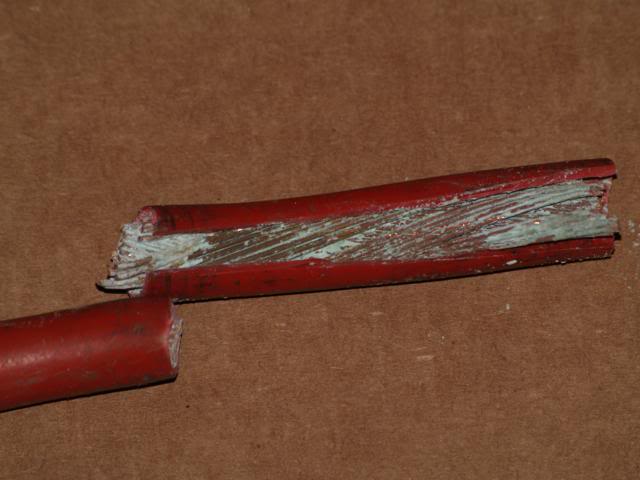
For what its worth, my V3500 (6.2L diesel) was having starting issues too. Different than yours though. It would turn over so slowly that it would need a boost to start. Hot or cold. I replaced the starter, replaced the batteries and still no difference. I finally smoked the battery cable from starter to passenger side battery.

Replaced the battery cables (all) and it starts like a newish truck. Every one of those cables were de-laminating from the insulation and corroding. I could not see any damage to the insulation, but can tell you that the ends were in decent shape and the cable lengths were very corroded.
 
   / Do battery cables go bad? #93  
Go to GOOGLE Images and use search string "corrosion inside battery cable"

45788d1501383975-corroded-battery-terminal-corrosion2.jpg


Dale
 
   / Do battery cables go bad? #95  
If in doubt, get a voltmeter and go down the connections measuring across them when rolling the starter. If you have a bad one you will get a voltage drop across it. Considering a fully charged battery of adequate AH capacity, 12.8 volts with the starter needing at least 10V across it, at 300A give or take amperes, only leaves you 12.8-10 = 2.8V/300A = .0093 ohms for the entire interconnect from the starter to the battery (plus the battery internal resistance) and back...... and folks, that taint much.
 
   / Do battery cables go bad? #96  
I had a Warn Winch do the same thing.
Ground from the Winch motor to the battery.
No more problems.
 
   / Do battery cables go bad? #97  
Every so often I need some smaller gauge wire for a project only to find perhaps the 6 or 10 inches from the ends are black from corrosion.
Also strip back any old aluminum wire you might still have around and you'll be surprised.

A friend brings me battery chargers from time to time hoping that I can salvage them. was surprised to discover that many now have aluminum wound transformers and that 90% of the failures was due to wherever the aluminum made contact with the copper and generally that was a crimped joint or connector.
Makes you wonder if it is calculated life span or simple ignorance.
 
   / Do battery cables go bad? #98  
It's good as it goes out the door, and nowadays, with a 90 day warranty being typical, they are safe. Consumers have such short memory, and are even GLAD if they have a reason to go out and buy something NEW!

Nothing like throwing out that big, heavy dirty, manually operated high quality thing and replacing it with a "digital" lightweight total piece of junk!
 
   / Do battery cables go bad? #99  
This is from the November Rock Auto newsletter, good information about this subject.
"Voltage Drop Testing

[https://www]

Check the condition of the wiring and ground connections before rushing to replace a starter motor. How do you do that? Your trusty multi-meter can help.

Resistance (ohms) is NOT the multi-meter setting to use. The reading will very likely be zero ohms when the multi-meter's probes are placed at the ends of a cable or on each side of a grounding point. Unfortunately, a zero resistance reading does not mean a cable or ground connection is in good condition. It just means that there is at least one tiny strand of functional wire left in that nasty old cable or one nanometer of relatively clean metal in that corroded grounding point.

Instead, set the multi-meter to read DC volts and measure voltage drop while the circuit is under load (the starter is switched on). If the circuit is not switched on then there will be no current flowing and zero voltage change. Use a*Remote Starter*or have an assistant turn the ignition key to switch on the starter motor and consecutively put multi-meter probes at both ends of cables and across ground connections while watching for significant voltage. It varies, but a voltage greater than 0.5 volts is considered to be significant on most vehicles.

Some example tests:

Put the multi-meter probes at both ends of the large cable running from the battery to the starter motor. Switch on the starter motor and a voltage reading greater than 0.5 volts might indicate the cable is frayed internally or its connection points are corroded.Put the multi-meter probes on the battery positive terminal and the thinner wire (S terminal) on the starter solenoid. If the voltage reading stays greater than 0.5 volts when the starter is switched on, then there could be a problem with the ignition switch, a relay, wiring or some other component in the ignition switch circuit.Put the multi-meter probes on the battery negative terminal and the metal body of the starter. A voltage drop greater than 0.5 volts could indicate corrosion or a contaminant like engine oil is preventing the starter body from making a good ground connection with the engine. Perhaps the battery terminal connection or ground wire between the battery and the engine block is corroded or loose.

Voltage drop testing can also be similarly used to test alternator, radio and other circuits. Frayed wires, corroded connections and failing relays add resistance to the circuit, thereby creating an unusually high voltage across the failing component as electrical current flows.

Tom Taylor,
RockAuto.com"
 
   / Do battery cables go bad? #100  
This is from the November Rock Auto newsletter, good information about this subject.
"Voltage Drop Testing

[https://www]

Check the condition of the wiring and ground connections before rushing to replace a starter motor. How do you do that? Your trusty multi-meter can help.

Resistance (ohms) is NOT the multi-meter setting to use. The reading will very likely be zero ohms when the multi-meter's probes are placed at the ends of a cable or on each side of a grounding point. Unfortunately, a zero resistance reading does not mean a cable or ground connection is in good condition. It just means that there is at least one tiny strand of functional wire left in that nasty old cable or one nanometer of relatively clean metal in that corroded grounding point.

Instead, set the multi-meter to read DC volts and measure voltage drop while the circuit is under load (the starter is switched on). If the circuit is not switched on then there will be no current flowing and zero voltage change. Use a*Remote Starter*or have an assistant turn the ignition key to switch on the starter motor and consecutively put multi-meter probes at both ends of cables and across ground connections while watching for significant voltage. It varies, but a voltage greater than 0.5 volts is considered to be significant on most vehicles.

Some example tests:

Put the multi-meter probes at both ends of the large cable running from the battery to the starter motor. Switch on the starter motor and a voltage reading greater than 0.5 volts might indicate the cable is frayed internally or its connection points are corroded.Put the multi-meter probes on the battery positive terminal and the thinner wire (S terminal) on the starter solenoid. If the voltage reading stays greater than 0.5 volts when the starter is switched on, then there could be a problem with the ignition switch, a relay, wiring or some other component in the ignition switch circuit.Put the multi-meter probes on the battery negative terminal and the metal body of the starter. A voltage drop greater than 0.5 volts could indicate corrosion or a contaminant like engine oil is preventing the starter body from making a good ground connection with the engine. Perhaps the battery terminal connection or ground wire between the battery and the engine block is corroded or loose.

Voltage drop testing can also be similarly used to test alternator, radio and other circuits. Frayed wires, corroded connections and failing relays add resistance to the circuit, thereby creating an unusually high voltage across the failing component as electrical current flows.

Tom Taylor,
RockAuto.com"

I could not have said it better.
 

Tractor & Equipment Auctions

2015 GENIE GTH-1056 TELESCOPIC FORKLIFT (A59823)
2015 GENIE...
2025 GPS Equipment Trailer (A56859)
2025 GPS Equipment...
2018 Toro Groundsmaster 7200 72in Zero Turn Commercial Mower (A59228)
2018 Toro...
2010 Deere 318D (A60462)
2010 Deere 318D...
John Deere 5100M (A53317)
John Deere 5100M...
2012 International WorkStar 7300 AWD Altec DC47TR Insulated Digger Derrick Truck (A60460)
2012 International...
 
Top