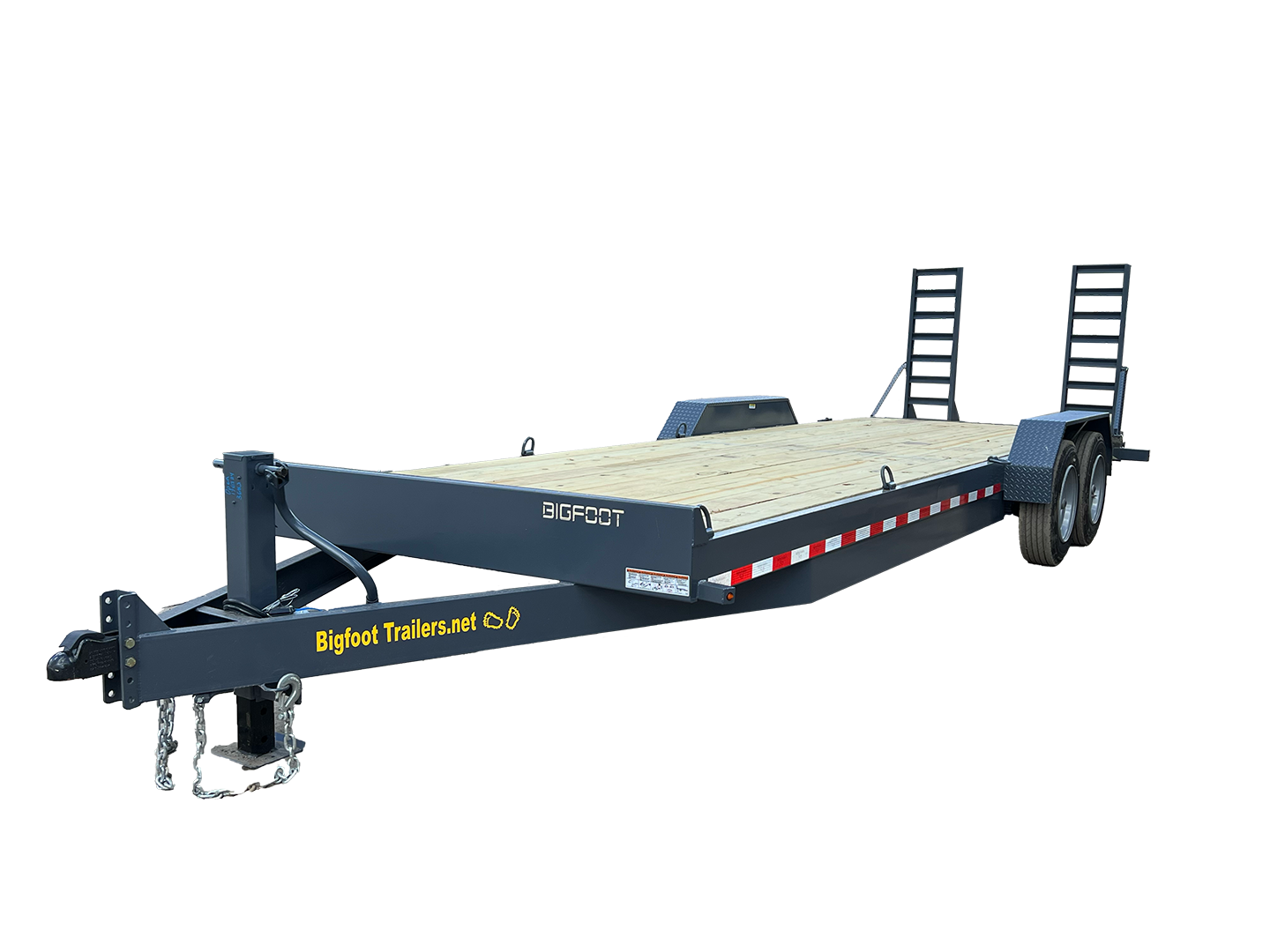
16k trailer with 14500 payload.

/ 16k trailer with 14500 payload. #21  
LD1 shared some very good information above. But we need to clarify this part:

And while you MAY have a truck that can handle the 3350# tongue weight.....the problem is the load will probably need shifted forward enough that you will actually overload the FRONT axle of the trailer. Like maybe 8k on the front axle and 6k on the rear and 3350 on the hitch.

For this to be true you would have to rotate the oscillator to the max angle. Which will be almost impossible. Until the oscillator rotates to it's max angle the weight percentage on each axle does not change. If the original design was to share the load between the two axles 50% to 50%, that remains regardless where the weight is on the trailer. The axles actually are not affected by the location of the load on the trailer floor. They are only affected by the load placed on the oscillators.
 
  • Good Post
Reactions: bgr
/ 16k trailer with 14500 payload.
  • Thread Starter
#22  
Thanks for all the replies! I'm going to call them today.
 
/ 16k trailer with 14500 payload. #23  
synthetic grease(y)
My old GN trailer has oil bath axles. After having seals go bad twice and soaking the brakes with oil I switched to grease.

I use JD Polyurea Grease. It is designed for extreme load, high temperature, high speed loads with a temperature range of -15F to 380F.

The reason for oil bath bearings is they pull slightly easier. Something you would never detect. But after a million miles of use on a commercial trailer it would have a measurable difference in "power" required, thus fuel savings.
 
/ 16k trailer with 14500 payload. #24  
Makes me wonder what the actual profit margins are for the cardboard and staples that passes for an RV these days
Lots lots lots. LOL

I used to haul brand new RV trailers from the factories back in 2008. So I got to see all the paperwork.
Back then even with the $80,000 trailers there were none that were over $25,000.

I'd say that is a pretty good markup.

In 2005 I bought a 27 footer to tow behind the dump truck in my avatar when I worked out of town. It was $31,000 on the lot. dealer "gave" it to me for $24,000. I thought wow, what an awesome dealer! Until I started hauling them to dealers with my highway truck and found out it was a $15,000 trailer, LOL
 
/ 16k trailer with 14500 payload. #25  
Lots lots lots. LOL

I used to haul brand new RV trailers from the factories back in 2008. So I got to see all the paperwork.
Back then even with the $80,000 trailers there were none that were over $25,000.

I'd say that is a pretty good markup.

In 2005 I bought a 27 footer to tow behind the dump truck in my avatar when I worked out of town. It was $31,000 on the lot. dealer "gave" it to me for $24,000. I thought wow, what an awesome dealer! Until I started hauling them to dealers with my highway truck and found out it was a $15,000 trailer, LOL
And the same thing is happening with new vehicles.
 
/ 16k trailer with 14500 payload. #26  
LD1 shared some very good information above. But we need to clarify this part:

And while you MAY have a truck that can handle the 3350# tongue weight.....the problem is the load will probably need shifted forward enough that you will actually overload the FRONT axle of the trailer. Like maybe 8k on the front axle and 6k on the rear and 3350 on the hitch.

For this to be true you would have to rotate the oscillator to the max angle. Which will be almost impossible. Until the oscillator rotates to it's max angle the weight percentage on each axle does not change. If the original design was to share the load between the two axles 50% to 50%, that remains regardless where the weight is on the trailer. The axles actually are not affected by the location of the load on the trailer floor. They are only affected by the load placed on the oscillators.
That may be true. And I have heard that before that sharing equal load is how they are "supposed" to work.

Based on my unscientific observations with different loads, and loading and unloading equipment, and observing tire sidewall flex....I think equal loading is just theory.

I actually have to see a trailer on scales and moving a load and observing the results to actually believe it.
 
/ 16k trailer with 14500 payload. #27  
If it's not a spec typo, it sure seems like deliberate deception on the part of the manufacturer which would make me wonder what else they are being deceptive on
I've heard of manufacturers using "unsprung weight" by subtracting the weight of the running gear for example
 
Last edited:
/ 16k trailer with 14500 payload. #28  
That may be true. And I have heard that before that sharing equal load is how they are "supposed" to work.

Based on my unscientific observations with different loads, and loading and unloading equipment, and observing tire sidewall flex....I think equal loading is just theory.

I actually have to see a trailer on scales and moving a load and observing the results to actually believe it.
I've never tested this mathematical theory with a scale. But mathematics don't lie. The design is to intentionally equalize the load on the axles. Until the oscillator reaches it's limit. Then everything changes.

If this theory doesn't hold up, then an over the road trailer that slides the trailer axles would quickly overload the front trailer axle or the rear trailer axle. And the DOT scales would have to weigh each axle separately to determine if they were legal. Which they do not. :)
 
/ 16k trailer with 14500 payload. #29  
If it's not a spec typo, it sure seems like deliberate deception on the part of the manufacturer which would make me wonder what else they are being deceptive on
I've heard of manufacturers using "unsprung weight" by subtracting the weight of the running gear for example
These incidents are "word salad". Commonly used in advertising today.

I understand "unsprung weight" very well. In this discussion the only weight that doesn't have an impact on the axle's ability to carry it would be the tires/wheels/hub assemblies. Everything from the wheel bearings up, including the weight of the bearings, counts against the axle's capacity.

DOT doesn't give us that tolerance though. Because they are concerned about the amount of weight applied to the roadbed.
 
/ 16k trailer with 14500 payload. #30  
I've never tested this mathematical theory with a scale. But mathematics don't lie. The design is to intentionally equalize the load on the axles. Until the oscillator reaches it's limit. Then everything changes.

If this theory doesn't hold up, then an over the road trailer that slides the trailer axles would quickly overload the front trailer axle or the rear trailer axle. And the DOT scales would have to weigh each axle separately to determine if they were legal. Which they do not. :)
I dunno. But I think semi's axles are not really the same design....

I get the "theory" of equalizing the load. And they do when compared to a torsion axle or independent axles.

But the fact that they are only "equalizing" the load placed on the middle hanger. The weight on that center bolt of the equalizer is indeed shared equally between both front and rear axle.

But the front eye of the front axle and rear eye of the rear axle springs are not shared.

I have not been able to find anything at all or any sources that state BOTH axles have equal weight in a tandem trailer with equalizer/double-eye springs.

I HAVE been able to find people posting that when scaling their tandem trailer with this type of suspension that they are seeing HIGHER front axle loads than rear (on an empty trailer). Which makes sense because they are tongue heavy when empty.

So while I think: That the load placement on the trailer does indeed change individual axle loads.....the point of the equalizer is NOT to make the weights equal. The point is to make the weights of the individual axles NOT CHANGE when going over bumps or uneven terrain.

I could be way off.....but have yet to find definitive proof either way. Just my real-world observations.

But not trying to get off topic.......to the OP......if you want to haul 14.5k.....RUN AWAY from ANYTHING with dual 7k axles PERIOD
 
/ 16k trailer with 14500 payload. #31  
I dunno. But I think semi's axles are not really the same design....

I get the "theory" of equalizing the load. And they do when compared to a torsion axle or independent axles.

But the fact that they are only "equalizing" the load placed on the middle hanger. The weight on that center bolt of the equalizer is indeed shared equally between both front and rear axle.

But the front eye of the front axle and rear eye of the rear axle springs are not shared.

I have not been able to find anything at all or any sources that state BOTH axles have equal weight in a tandem trailer with equalizer/double-eye springs.

I HAVE been able to find people posting that when scaling their tandem trailer with this type of suspension that they are seeing HIGHER front axle loads than rear (on an empty trailer). Which makes sense because they are tongue heavy when empty.

So while I think: That the load placement on the trailer does indeed change individual axle loads.....the point of the equalizer is NOT to make the weights equal. The point is to make the weights of the individual axles NOT CHANGE when going over bumps or uneven terrain.

I could be way off.....but have yet to find definitive proof either way. Just my real-world observations.

But not trying to get off topic.......to the OP......if you want to haul 14.5k.....RUN AWAY from ANYTHING with dual 7k axles PERIOD
Good stuff LD1.

In rethought, I should not have used the OTR trailer example. The tandem suspension system is not the same as the trailer in this discussion. It is designed to equally apply the load to the pavement though. And the ratio carried by each axle will remain the same even though the total load will change by sliding the axle. I used that example to simplify moving the load on the trailer floor. My mistake.

I've never measured the distance from the front spring eyebolt to the center of the oscillator compared to the distance from the rear spring eyebolt to the cent of the oscillator. There may be a difference built in. If not, then they will share the load equally. Mathematics.

I'll do some measuring on my BP trailer.

I completely agree with your last statement!!! :)
 
/ 16k trailer with 14500 payload.
  • Thread Starter
#32  
But not trying to get off topic.......to the OP......if you want to haul 14.5k.....RUN AWAY from ANYTHING with dual 7k axles PERIOD
Yeah, that makes sense to me. Going to look at one of these next week, they can de rate it to 16k so I'm under cdl weight.

 
/ 16k trailer with 14500 payload. #33  
I also have not weighed the different loads on the axles of a pivoting axle trailer, but I can say that when I worked at a rental yard that rented dump trailers it was only ever the rear axle that bent. I asked the trailer rep why that was and he said they see it all the time. According to him it is because even if the trailer is not overloaded, when the trailer is dumped (still attached to the tow vehicle obviously) it can overload the rear axle. The math may say no, but real world experience says different. We had the rear axle bend on one dump trailer 3 times before we replaced them both with heavier axles.
 
/ 16k trailer with 14500 payload. #34  
Yeah, that makes sense to me. Going to look at one of these next week, they can de rate it to 16k so I'm under cdl weight.

Oooohhhh,,,, I like that trailer!!!! I prefer the jack back against the front of the bed. Otherwise I like everything about it. :cool:
 
/ 16k trailer with 14500 payload. #35  
I also have not weighed the different loads on the axles of a pivoting axle trailer, but I can say that when I worked at a rental yard that rented dump trailers it was only ever the rear axle that bent. I asked the trailer rep why that was and he said they see it all the time. According to him it is because even if the trailer is not overloaded, when the trailer is dumped (still attached to the tow vehicle obviously) it can overload the rear axle. The math may say no, but real world experience says different. We had the rear axle bend on one dump trailer 3 times before we replaced them both with heavier axles.
Yep. I've saw that too. During dump the weight is removed from the tongue to the point the oscillators max out and all the weight is on the rear axle.
 
/ 16k trailer with 14500 payload. #36  
I also have not weighed the different loads on the axles of a pivoting axle trailer, but I can say that when I worked at a rental yard that rented dump trailers it was only ever the rear axle that bent. I asked the trailer rep why that was and he said they see it all the time. According to him it is because even if the trailer is not overloaded, when the trailer is dumped (still attached to the tow vehicle obviously) it can overload the rear axle. The math may say no, but real world experience says different. We had the rear axle bend on one dump trailer 3 times before we replaced them both with heavier axles.
That's because the angle of the frame changes when the weight shifts to the back as it dumps.
IF the trailer frame stays at the same angle (relative to the axles), the equalizer will even out the load.
If the trailer frame angle changes, the "split" between the axles will change because the horizontal distance between the pivot of the equalizer and the axle changes.

Aaron Z
 
/ 16k trailer with 14500 payload. #37  
That's because the angle of the frame changes when the weight shifts to the back as it dumps.
IF the trailer frame stays at the same angle (relative to the axles), the equalizer will even out the load.
If the trailer frame angle changes, the "split" between the axles will change because the horizontal distance between the pivot of the equalizer and the axle changes.

Aaron Z
The trailer frame does stay basically the same. The tongue stays on the ball hitch of the tow vehicle and the frame of the trailer stays horizontal and all four tires stay on the ground, only the dump bed changes angles. It might raise the hitch a couple inches as the dump bed raises, but basically it stays horizontal.
 
/ 16k trailer with 14500 payload. #38  
I dunno. But I think semi's axles are not really the same design....

I get the "theory" of equalizing the load. And they do when compared to a torsion axle or independent axles.

But the fact that they are only "equalizing" the load placed on the middle hanger. The weight on that center bolt of the equalizer is indeed shared equally between both front and rear axle.

But the front eye of the front axle and rear eye of the rear axle springs are not shared.

I have not been able to find anything at all or any sources that state BOTH axles have equal weight in a tandem trailer with equalizer/double-eye springs.

I HAVE been able to find people posting that when scaling their tandem trailer with this type of suspension that they are seeing HIGHER front axle loads than rear (on an empty trailer). Which makes sense because they are tongue heavy when empty.

So while I think: That the load placement on the trailer does indeed change individual axle loads.....the point of the equalizer is NOT to make the weights equal. The point is to make the weights of the individual axles NOT CHANGE when going over bumps or uneven terrain.

I could be way off.....but have yet to find definitive proof either way. Just my real-world observations.

But not trying to get off topic.......to the OP......if you want to haul 14.5k.....RUN AWAY from ANYTHING with dual 7k axles PERIOD

Yeah he needs 8k oil baths and 17.5’s.
 
/ 16k trailer with 14500 payload. #40  
I'm shopping 16k trailers and I found a company making one with an advertised 14500 payload. It has dual 7k axles and weighs 3100lbs. How is this possible? Seems like it would have to have 8k axles and only weigh 1500lbs to make this happen. What am I missing?
Something doesn’t add up with the trailer specs..Error I hope?
I own multiple trailers, 7000, 10000 GVW rated and the 7k has 3500 lb axles and the 10k has 5200 lb axles.
Never seen a trailer rated lIke this.
All this on 15” tires? Max tire rating on this tire is 6100 lbs with 7000 lb axles?
A trailer this size usually has standard 16“ tires. I would never buy a trailer this size with 15” tires and it will pull hard.
None of this adds up.
Would compare these specs to other makes for sure.
EM
 
  • Good Post
Reactions: bgr

Marketplace Items

2015 MACK GU713 DUMP TRUCK (A59823)
2015 MACK GU713...
Schulte SBW800 Rock Windrower (A61307)
Schulte SBW800...
2020 CATERPILLAR 306CR EXCAVATOR (A60429)
2020 CATERPILLAR...
TANK MANIFOLD (A55745)
2015 CATERPILLAR 930M LOADER (A58214)
2015 CATERPILLAR...
John Deere 4044M (A60462)
John Deere 4044M...
 
Top