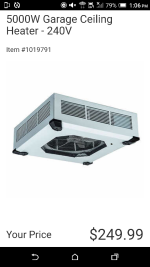
Shop/Garage Heater

/ Shop/Garage Heater #2  
Their are online calculators that will size the unit based on the climate zone, insulation levels of the building and size of the building. The calculator will give you a BTU amount. From there you can convert or size the electric heater based on BTUs.
 
/ Shop/Garage Heater #3  
Anxious to hear replies of experience.

Electric heaters have increased in efficiency. Curious to hear a realistic account of usage.

At your location I'd think the heating costs would be easy to swallow. Of course that statement doesn't apply today....... ;)
 
/ Shop/Garage Heater #4  
I have a gas heater in my shop and a electric heater in my garage. The gas heater is 70,000btu and the electric heater is 5,000 watt. I think it’s operation cost is about 60 cents an hour. They neither one see frequent use and I think you’re right that it would take a long time to to equal the higher installation cost. Pros to the gas heater. Cheaper to operate.
Warms the shop up faster.
Still doesn’t run without electricity but is easier to run off a generator.
Pros of electric.
Operates quieter.
Cheaper installation.
 
/ Shop/Garage Heater #5  
I live in Canada and have two garages that are close to the size of yours: one is 28 x 32 by 13ft ceilings and the other is 24x29 by 10 ft ceilings.

The smaller garage has a 5000w (wall mount style that pushes air "forward") forced air Heater and the other has a 4500w forced air heater (wall mount) with a secondary 4500w ceiling mount heater ( blows air down).

Consumption wise they are EXPENSIVE. Even though electricity is 0.058$/kwh to 0.085$/kwh, they rack up on their own about 1-3$ a day in electricity with the garages closed and the equipment inside. If you take the things in and out of the garages then the consumption will increase. If you want more specific kw/month consumption and average air temperatures I can look it up for you. The walls are R30 and the ceiling around R50 in both garages.
The only downside is that say when you keep your garage at 5-10C or 40-50f and then you want to bump it up to 17c or 60-65f it takes HOURS.

This year I installed propane overhead heaters, one being a 40000 btu and the other being oversized at 200000BTU, and the time it takes to heat up the garage from 40f to 68f takes 15-20 minutes in one garage and 4 minutes in the other. Price wise propane is 2.50$/gallon in the summer and around 3.70$/gallon in the winter, despite this big cost difference I am saving $ (and time) unless propane reaches 4.50$/gal.

Maybe propane could be a cheaper alternative to natural gas? You'll save on plumbing but will have a slightly increased cost of running when compared to natural gas.

In brief, was I happy with electric heating? Yes, as long as you keep the temperature you want and use them to maintain that temperature. But if you're planning on working in the shop or garage and want to bump up the heat or will open the garage door to get the tractor/car in and out of the garage, you will need to pack almost twice the heating elements. Most calculators only calculate the required wattage to maintain the garage and not to heat it up after a big temperature difference.

For your garage size, depending on ceiling , insulation and how often you close /open the. Garage door I would put a 5000w wall mounted heater or a 4500w ceiling mount to maintain the temperature desired but you'll need atleast 2 more heaters of 5000w if you plan on bumping up the temperature when working.

Consumption wise figure one 5000w heater will work 10-12-14h a day to maintain the temperature (if it can even maintain it, sometimes they overheat and shut off, running close to 20h in a day) and two 4500s will work around 8h a day. Depending on the temperature difference and cfm. Multiply that by the rate that they charge per kw/h and you'll have a daily consumption.

Hope this helps
 
/ Shop/Garage Heater #6  
Electric heaters have increased in efficiency. Curious to hear a realistic account of usage.

My guess is electric resistance heaters efficiency is exactly where it's always been - 100%. :laughing: In a moderate climate, the electric unit may be a good freeze protection option. For actually working, I would add a propane or diesel torpedo heater to quickly bring the temperature up. I think you would have to bump the electric heater up hours ahead to make it comfortable.
 
/ Shop/Garage Heater #7  
Good stuff shui.

It's my belief that if a garage/shop is going to be used daily, or even two or three times a week it's cheaper to keep it heated rather than try to raise the temp. Maybe a constant of 55-60F degrees for example.

I primarily heat with wood and backup with 70K propane furnace. I keep the thermostat set on 62F degrees. I stoke the wood stove the last time each day at 5-6p.m. Restoke at 8a.m. Last year I burned 115 gallons of propane. Doesn't take much for the propane furnace to maintain a warm shop.

Kind of a side track from the question at hand. But something to consider about maintaining an environment that can be used to work in.

Discard all my comments if all you are after is to keep a temp above freezing, say 40F degrees or so.
 
/ Shop/Garage Heater #8  
My 3,600 sq ft garage is not yet completed, but the spec calls for four Qmark electric heaters. They are for freeze protection, not comfort heating. They will kick on at 40 degrees.
 
/ Shop/Garage Heater #9  
My guess is electric resistance heaters efficiency is exactly where it's always been - 100%. :laughing: In a moderate climate, the electric unit may be a good freeze protection option. For actually working, I would add a propane or diesel torpedo heater to quickly bring the temperature up. I think you would have to bump the electric heater up hours ahead to make it comfortable.

Yeah, after I said that I realized how stupid that was..... :ashamed:

What I meant to say is their design has improved and they can generate more heat from a kw than they used to. An example is those little Pure Eden heaters.
 
/ Shop/Garage Heater #10  
My 3,600 sq ft garage is not yet completed, but the spec calls for four Qmark electric heaters. They are for freeze protection, not comfort heating. They will kick on at 40 degrees.

This brings up another complexity.

If I were building a new shop my primary concern would be the efficiency of the building. If I nail that, my heat source becomes much less significant.

If I were modifying an existing structure to create a warm space I would apply the same principle. I'd insulate the snot out of it first, then consider heat source.
 
/ Shop/Garage Heater #11  
If you're wanting to maintain 55-60F in your garage throughout the week then it's a good alternative, assuming your insulation is good and you won't be heating the outside.

In this case I would install two 4500w units, one on the wall type that circulates air by pushing it towards the garage door and a second that is on the ceiling and pushes hot air down. Set the ceiling one at the desired temperature and the other abit higher by a degree so it kicks in less frequently.

The point is to have two different airflow circuits so that you get heat evenly throughout the garage and the ceiling mounted one helps push the hot air back down. The wall mounted type pushes air in a certain direction to create circulation since they are far better at pushing air than the ceiling type but can cause too much circulation which prematurely turns off the heater, leaving most of the heat building up at the top.

How high are your ceilings?
 
/ Shop/Garage Heater #12  
If you're wanting to maintain 55-60F in your garage throughout the week then it's a good alternative, assuming your insulation is good and you won't be heating the outside.

In this case I would install two 4500w units, one on the wall type that circulates air by pushing it towards the garage door and a second that is on the ceiling and pushes hot air down. Set the ceiling one at the desired temperature and the other abit higher by a degree so it kicks in less frequently.

The point is to have two different airflow circuits so that you get heat evenly throughout the garage and the ceiling mounted one helps push the hot air back down. The wall mounted type pushes air in a certain direction to create circulation since they are far better at pushing air than the ceiling type but can cause too much circulation which prematurely turns off the heater, leaving most of the heat building up at the top.

How high are your ceilings?

Very valid points.

If you are constantly heating a closed building a ceiling fan is your best friend. Mine runs on low all Winter long.
 
/ Shop/Garage Heater #13  
This is the ceiling Heater that I am referring to Screenshot_20180104-130626.png

And a wall type of heater such as this oneScreenshot_20180104-130523.png

Unless your ceiling is 8.5ft or less, the ceiling unit helps a LOT.
 
/ Shop/Garage Heater #14  
Yeah, after I said that I realized how stupid that was..... :ashamed:

What I meant to say is their design has improved and they can generate more heat from a kw than they used to. An example is those little Pure Eden heaters.

Are these really all they’re supposed to be? I don’t see how 100 percent efficiency can be improved upon.
 
/ Shop/Garage Heater #15  
Just another thought if you're not 100% definite on gas. I don't have natural gas in my area and large propane tanks cost a lot to fill here. I contacted a local heating home furnace repair guy. He routinely does home furnace upgrades for people and removes the old furnace. I was able to buy a used 80,000 BTU oil fired mobile home furnace from him cheap for my garage and set it up in my garage. Next to it I have a 17 gallon plastic tank for a fuel supply. I have three 275 gallon fuel oil tanks on my property but due to furnace location I couldn't get one near enough to use as a supply so I refill the 17 gal. tank with 5 gallon containers and a battery operated pump. I keep the garage at 45 deg. F all winter and bump it up to 60 when I need to work in there. It works great and only uses about 3 gallons a day at 45 deg setting. to heat roughly 1200 sq ft. Electric heaters would be to costly to run here and I don't have a supply for wood so I was limited to propane or oil. Coal fired was another option but had no place to store a ton of coal.
 
/ Shop/Garage Heater #16  
Ive been installing electric heaters in garages for years. I can tell you one thing, most people complain about elect bill and shut them off. We pay about $0.06/kwh here and thats still too expensive. A 5000 watt heater needs to run a long time to keep even a small shop warm. A 5000 watt elect heater produces around 15,000 btu as i recall. My gas shop heater produces 125,000 btu. I turn it on for 20 minutes and it takes the chill out of the shop. Id have to leave an electric one on. How much would it cost to add a propane tank at shop.
 
/ Shop/Garage Heater #17  
Are these really all they’re supposed to be? I don’t see how 100 percent efficiency can be improved upon.

I can't testify to their value. Lot's of people swear by them.
 
/ Shop/Garage Heater
  • Thread Starter
#18  
This is for keeping the shop temp above freezing for various items stored there. The upstairs will not be heated. This is not a shop that I make a living in. Just storage and hobbies. During the winter I might spend one day a week tinkering around for four to six hours. I could use the smaller electric which hopefully could maintain 35-40F and use my larger portable propane to bring it up to 60-70F to work in. Or go out and turn the electric up a couple hours before going out to play.

The shop is separate from the house. It is insulated and has twin insulated garage doors and double pane windows. The ceiling is insulated but the upstairs is not. I will have to build a wall around the steps and install a door in it or all the heat will go up and out thru the roof vents. I intend to mount the heater in the back corner on the same wall as the steps but facing 90-degree away from them and blowing toward the overhead doors. That is the area I usually work in.

The second area I want to heat is the garage. It is attached to the house and usually contains both vehicles. The outside walls and ceiling of the garage are not insulated and that is a project I intend to start on next week. I intend for the heater to be mounted on the ceiling centered opposite the overhead doors. I think it blowing down between the vehicles would tend to heat the concrete floor and that would help maintain the temp.

Thanks to all who have replied so far. You have all given me some good ideas. Keep them coming.

And I did look up the calculators. I may have been planning on using too small heaters and will have to upsize.

RSKY
 
/ Shop/Garage Heater #20  
As long as you considered NG and that doesn't seem to be working out, I would go with propane.

East to install and although not as cheap as NG ceiling hung heaters to buy they are nice to operate. I would put a ceiling hanging one of 40k BTU. They are out of the way in a corner more than likely. In Kentucky they will warm a shop up fairly quickly enough to start manual working in 5 minutes or so.
 
 
Top