120-Volt Mig welder.

Status
Not open for further replies.
/ 120-Volt Mig welder. #121  
Sodo - looks like you dialed it in pretty darn good for your machine.
Were you able to get the knife edge to fully melt or did a straight line remain?


As I understand it, reducing wire speed makes the joint 'hotter' as well as increasing voltage.

The very short version:
Voltage sets the arc length and resulting bead profile.
Wire feed speed sets the welding amperage and penetration.


It's all about the proper balance of voltage to wire feed speed.

For example, I was building some gates for a customer this weekend out of his old galvanized fence pipe, the recommended setting had a little too much voltage so it would try and blow out the thin edge of the t-joints.
Dropping to the next recommended setting down fixed the voltage issue, increasing my wire feed speed a little gave me the penetration needed.
(the recommended settings on my machine are for an input voltage of 230 volts AC, my electrical service provides 244 volts AC - so they tend to be a little hot - normally just turning down my WFS fixes the problem on thicker metal)

From Miller:
1. Material thickness determines amperage. As a guideline, each 0.001 inch of material thickness requires 1 amp: 0.125 in. = 125 amps.

2. Select proper wire size, according to amperage. Since you don't want to change wire, select one for your most commonly used thicknesses.

* 30-130 A: .023-in.

* 40-145 A: 0.030 in.

* 50-180 A: 0.035 in.

* 75-250 A: 0.045 in.

3. Set the voltage. Voltage determines height and width of bead. If no chart, manual or specifications are available for setting the correct voltage, you can try this: while one person welds on scrap metal, an assistant turns down the voltage until the arc starts stubbing into the work piece. Then, start welding again and have an assistant increase the voltage until the arc becomes unstable and sloppy. A voltage midway between these two points provides a good starting point.

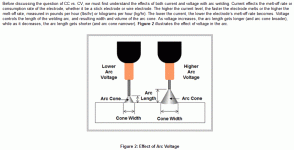
There is a relationship between arc voltage and arc length. A short arc decreases voltage and yields a narrow, "ropey" bead. A longer arc (more voltage) produces a flatter, wider bead. Too much arc length produces a very flat bead and a possibility of an undercut.

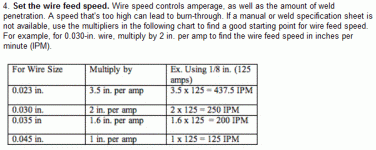
4. Set the wire feed speed. Wire speed controls amperage, as well as the amount of weld penetration. A speed that's too high can lead to burn-through. If a manual or weld specification sheet is not available, use the multipliers in the following chart to find a good starting point for wire feed speed. For example, for 0.030-in. wire, multiply by 2 in. per amp to find the wire feed speed in inches per minute (IPM).
wire feed speed chart.GIF

arc votage effect.GIF
 
/ 120-Volt Mig welder. #122  
Sodo - looks like you dialed it in pretty darn good for your machine.
Were you able to get the knife edge to fully melt or did a straight line remain?

Hi Dave,

I didn't do any dialing in, just set it and welded. I had just a few minutes yesterday at my shop in the woods, and had to hustle. Plus I didn't want to waste my materials stock out there but its worthwhile if 120v discussion is now legalized.

Here's a pic of the backside. Thanks very much for the 120v tips they are appreciated!
 

Attachments

  • 3_8thk-4.jpg
    3_8thk-4.jpg
    137.2 KB · Views: 200
/ 120-Volt Mig welder. #123  
Hi Dave,

I didn't do any dialing in, just set it and welded. I had just a few minutes yesterday at my shop in the woods, and had to hustle. Plus I didn't want to waste my materials stock out there but its worthwhile if 120v discussion is now legalized.

Here's a pic of the backside. Thanks very much for the 120v tips they are appreciated!

That's looking pretty good - almost fused the whole root. :)
It gets mostly second nature to watch for the root to fully fuse while you weld.
When it's fused like that, without visible straight lines of the parent metal, you're good to go.

When you bend it, if the machine didn't have the power to penetrate into the base metal, the weld will tear out of the v-groove in some areas.
In extreme cases, the weld will pop out of the groove on one side and it will come apart.

Edit: forgot to add - a bend fixture isn't really needed for home use, just a big vise and a good size adjustable wrench will bend it 90 degrees and check it pretty well. That's what I do when I quick check a student's welds. Sometimes they just break apart.
 
/ 120-Volt Mig welder. #124  
Sodo - looks like you dialed it in pretty darn good for your machine.
Were you able to get the knife edge to fully melt or did a straight line remain?


The very short version:
Voltage sets the arc length and resulting bead profile.
Wire feed speed sets the welding amperage and penetration.


It's all about the proper balance of voltage to wire feed speed.

For example, I was building some gates for a customer this weekend out of his old galvanized fence pipe, the recommended setting had a little too much voltage so it would try and blow out the thin edge of the t-joints.
Dropping to the next recommended setting down fixed the voltage issue, increasing my wire feed speed a little gave me the penetration needed.
(the recommended settings on my machine are for an input voltage of 230 volts AC, my electrical service provides 244 volts AC - so they tend to be a little hot - normally just turning down my WFS fixes the problem on thicker metal)

From Miller:
1. Material thickness determines amperage. As a guideline, each 0.001 inch of material thickness requires 1 amp: 0.125 in. = 125 amps.

2. Select proper wire size, according to amperage. Since you don't want to change wire, select one for your most commonly used thicknesses.

* 30-130 A: .023-in.

* 40-145 A: 0.030 in.

* 50-180 A: 0.035 in.

* 75-250 A: 0.045 in.

3. Set the voltage. Voltage determines height and width of bead. If no chart, manual or specifications are available for setting the correct voltage, you can try this: while one person welds on scrap metal, an assistant turns down the voltage until the arc starts stubbing into the work piece. Then, start welding again and have an assistant increase the voltage until the arc becomes unstable and sloppy. A voltage midway between these two points provides a good starting point.

There is a relationship between arc voltage and arc length. A short arc decreases voltage and yields a narrow, "ropey" bead. A longer arc (more voltage) produces a flatter, wider bead. Too much arc length produces a very flat bead and a possibility of an undercut.

4. Set the wire feed speed. Wire speed controls amperage, as well as the amount of weld penetration. A speed that's too high can lead to burn-through. If a manual or weld specification sheet is not available, use the multipliers in the following chart to find a good starting point for wire feed speed. For example, for 0.030-in. wire, multiply by 2 in. per amp to find the wire feed speed in inches per minute (IPM).

View attachment 387946

View attachment 387945
Thanks Dave... good stuff! What I was trying to say/ask is if it is true that slowing the wire speed makes a hotter join (less cold lap)? I realize voltage and travel speed are factors but assuming those being constant.
 
/ 120-Volt Mig welder. #125  
Thanks Dave... good stuff! What I was trying to say/ask is if it is true that slowing the wire speed makes a hotter join (less cold lap)? I realize voltage and travel speed are factors but assuming those being constant.

I don't think I would put it that way - lowering wire feed speed lowers the welding amperage and lessens the penetration.
I'm a firm believer in adjusting volts and amps for the proper balance.

My reasoning:
1. for a particular metal thickness and weld position, a proper range for amperage can be determined
2. for each wire size the wire feed speed gives the welding amperage desired
3. the voltage gives the weld profile desired at that amperage - more volts makes it wider and wetter until it becomes spattery and unstable and/or undercuts

The amps and voltage combined give the desired result - a little tweaking here and there is expected.

Is that closer to what you were looking for?
 
/ 120-Volt Mig welder. #126  
I don't think I would put it that way - lowering wire feed speed lowers the welding amperage and lessens the penetration.
I'm a firm believer in adjusting volts and amps for the proper balance.

My reasoning:
1. for a particular metal thickness and weld position, a proper range for amperage can be determined
2. for each wire size the wire feed speed gives the welding amperage desired
3. the voltage gives the weld profile desired at that amperage - more volts makes it wider and wetter until it becomes spattery and unstable and/or undercuts

The amps and voltage combined give the desired result - a little tweaking here and there is expected.

Is that closer to what you were looking for?
Gotcha... thanks.
 
/ 120-Volt Mig welder. #129  
When you bend it, if the machine didn't have the power to penetrate into the base metal, the weld will tear out of the v-groove in some areas.
In extreme cases, the weld will pop out of the groove on one side and it will come apart.

OK here's how the 3/8 thick test plate (welded with 120v) bent.

I bent only weld#2, the weld discussed earlier. It was very strong, had to reef on that 20T press to bend it to the 90-ish deg as shown.

From what I can see looking at weld #2 it's pretty obvious that:

---> #1 will be weaker
---> #3 will be stronger

But even though weld #2 was not 100%, it would not let trailer parts loose on the highway, it was firkin' strong.
 

Attachments

  • 3_8thk-5-6.jpg
    3_8thk-5-6.jpg
    126.6 KB · Views: 227
  • 3_8thk-7bend.jpg
    3_8thk-7bend.jpg
    90 KB · Views: 195
  • 3_8thk-9.JPG
    3_8thk-9.JPG
    153.8 KB · Views: 221
Last edited:
/ 120-Volt Mig welder. #131  
You're very welcome guys - hope the info helps :)
After a while, a guy tends to make the small adjustments kind of automatically just based on how the puddle and arc are behaving themselves :)


OK here's how the 3/8 thick test plate (welded with 120v) bent.

I bent only weld#2, the weld discussed earlier. It was very strong, had to reef on that 20T press to bend it to the 90-ish deg as shown.

From what I can see looking at weld #2 it's pretty obvious that:

---> #1 will be weaker
---> #3 will be stronger

But even though weld #2 was not 100%, it would not let trailer parts loose on the highway, it was firkin' strong.

Very nice testing - you can clearly see where the root that wasn't fully fused started splitting apart, but the fused part stayed together. Nicely done :)

Over time, the cracks that start in the non-fused part tend to "zipper" through the rest.
It generally takes a very long time - but if well hidden tend to let go without warning.
Many of have seen this when we analize a broken item that comes in and the 6" crack is rusted all the way except the last 1" that suddenly broke the rest of the way.

If I had any advise, I'd try making that cover pass in two or three smaller beads - on the screen it looks as if your machine had a hard time carrying a bead that wide. No way to tell from my couch of course - you'd be the only one who could see it as it went in.

Any way you could do a face bend of one of the other welds to see if the cover pass stays together, splits in the middle, or pulls away from the bevel?
 
/ 120-Volt Mig welder. #132  
After a while, a guy tends to make the small adjustments kind of automatically just based on how the puddle and arc are behaving themselves :)

Yes Dave I know what you mean. Arc's been behaving as of late, but who's "the puddle"?
:laughing::laughing::laughing:


Over time, the cracks that start in the non-fused part tend to "zipper" through the rest. It generally takes a very long time - but if well hidden tend to let go without warning.

"Tend to (crack)",,,,, ONLY if there is stress or flexure in the weld joint. Steel doesn't tend to grow cracks on its own. And, if this was used in real life the prudent weldOR would bevel and weld it on both sides.

If I had any advise, I'd try making that cover pass in two or three smaller beads - on the screen it looks as if your machine had a hard time carrying a bead that wide. No way to tell from my couch of course - you'd be the only one who could see it as it went in.

Any way you could do a face bend of one of the other welds to see if the cover pass stays together, splits in the middle, or pulls away from the bevel?

Remember it's 120volts welding 3/8" steel, the machine's got to be near a limit of sorts. But I think most people can see that 1/4" steel is well within the capacity (for this type of beveled weld).

If I cut it at weld#2, I could bend the others.
 
/ 120-Volt Mig welder. #134  
So you are happy with this weld?
Actually, yes, it is perfect because upon bending it shows the difference between full penetration and not. It was very strong, almost as strong as virgin flatbar, to bend it took some serious pumping on that 20T press. I think weld #3 might be better.will bend it someday.
 

Attachments

  • 3_8thk-5-6.jpg
    3_8thk-5-6.jpg
    126.6 KB · Views: 172
/ 120-Volt Mig welder. #135  
To me it would demonstrate that it was incomplete weld. While the part that had complete fusion to the root was strong much of the length was not fully welded. Maybe that is good enough.
I was hoping this thread would generate some scientific testing (controlling variables, replication etc). Your sample of 1 tested weld is promising but inconclusive at best.
 
/ 120-Volt Mig welder. #136  
Actually, yes, it is perfect because upon bending it shows the difference between full penetration and not. It was very strong, almost as strong as virgin flatbar, to bend it took some serious pumping on that 20T press. I think weld #3 might be better.will bend it someday.

To help with bending, cut 1" coupons.
 
/ 120-Volt Mig welder. #137  
To me it would demonstrate that it was incomplete weld. While the part that had complete fusion to the root was strong much of the length was not fully welded. Maybe that is good enough.
I was hoping this thread would generate some scientific testing (controlling variables, replication etc). Your sample of 1 tested weld is promising but inconclusive at best.

Skylark, this weld's entire reason for being on this earth,,,, is for instructional purposes. Weld #2 displays a "fault" that can be discussed, an example that members can see and understand, so it's more than good enough, it's "perfect".

I too was hoping this thread would generate some scientific testing, controlling variables, replication. But who's willing to do that work on a hobby/maintenance forum? Just Shield Arc, and Sodo. Now Just Sodo, who offered up 30 minutes of cutting, welding, and a couple hours of pics, typing & attention.

"Good enough" may be all you get. Unless this forum can attract someone else to step in and help - but they need thick skin.

To help with bending, cut 1" coupons.

Yup Dan, that would have been easier bend but takes more time which I did not have. Who does have the time for free instruction? Lots do, but it really takes more time than you'd think.

So for now it seems to be only me welding and posting pics, but I'm not an instructor, I shouldn't be spending my time like this, and my eqpt is 100+ miles away. I'm appreciating that MinnDave is stepping up though!
 
/ 120-Volt Mig welder. #138  
Skylark, this weld's entire reason for being on this earth,,,, is for instructional purposes. Weld #2 displays a "fault" that can be discussed, an example that members can see and understand, so it's more than good enough, it's "perfect".

I too was hoping this thread would generate some scientific testing, controlling variables, replication. But who's willing to do that work on a hobby/maintenance forum? Just Shield Arc, and Sodo. Now Just Sodo, who offered up 30 minutes of cutting, welding, and a couple hours of pics, typing & attention.

"Good enough" may be all you get. Unless this forum can attract someone else to step in and help - but they need thick skin.


Yup Dan, that would have been easier bend but takes more time which I did not have. Who does have the time for free instruction? Lots do, but it really takes more time than you'd think.

So for now it seems to be only me welding and posting pics, but I'm not an instructor, I shouldn't be spending my time like this, and my eqpt is 100+ miles away. I'm appreciating that MinnDave is stepping up though!

Thanks for the test, Sodo. Good job! :thumbsup:
It's interesting that part of the root had complete fusion and some wasn't quite completely fused.

That makes me wonder that if fluxcore wire was used, perhaps there would have been complete root fusion throughout, since it is said that fluxcore does penetrate better than solid wire?
 
/ 120-Volt Mig welder. #139  
Yup Dan, that would have been easier bend but takes more time which I did not have. Who does have the time for free instruction? Lots do, but it really takes more time than you'd think.
Isn't that the truth. I have a Lincoln SP125+ with .035 flux core. If i get a chance this weekend I could try welding up a joint. I would have to make a jig to bend it on, but I do have the 20T press.

Can you recomend a type of joint/thickness. Not sure what I have on hand though.
 
/ 120-Volt Mig welder. #140  
The 'variation' that I intended to test (in welds 1,2,3) is the separation of the 2 plates. Weld#1 was 'together'. Weld #2 was about 1/16 apart, weld #3 about 3/32" apart. Not scientifically controlled or measured, just goin' at it for 3 welds, then pack up and go home. I did not expect it to work out this well, with 1=fail, 2=half fail, 3=success. (assuming 3 = success)

Anyway, welding any steel with a fusion type method you must have a 'puddle' or melt or it's just a blob resting on steel, not fused. In this case the 3/8" thick metal will draw the paltry 120v heat away so you need an 'excuse' to keep the trigger pressed longer.

Separation of the material increases the time that heat is applied to the piece, takes longer to fill the gap, and thus increases the time the trigger is pulled = more heat input. And (I think) MUST be part of your methodology in using a 120v on material thicker than whats printed on the box. Not having any pro or genuinely interested instructors involved makes this kind of a crapshoot but conclusions can be drawn from the test and the pics. And that's about all we have available currently.

I wish MinnDave, Dan, or some new (interested) member had some time to show some of this stuff.
 
Status
Not open for further replies.

Marketplace Items

2018 New Holland C227 Compact Track Loader (A61307)
2018 New Holland...
2013 INTERNATIONAL DURASTAR 4300 (A60736)
2013 INTERNATIONAL...
2012 SOUTHERN 130 BBL VACUUM TRAILER (A60736)
2012 SOUTHERN 130...
HYDRAULIC THUMB CLAMP FOR MINI EXCAVATOR (A58214)
HYDRAULIC THUMB...
2014 Bolens 11A-020W765 20in Push Mower (A60352)
2014 Bolens...
2012 PETERBILT 367 (A60736)
2012 PETERBILT 367...
 
Top