Roofing discussion!!!

/ Roofing discussion!!! #101  
at least one vent vertical through the roof. New home, 2 bathrooms. all vents connected, one vent. vent is for gas and to help water drain properly.
yes, when vented, the air pressure pushes the water down the drain, like gravity, it pushes but.......

If vented to the attic, the drain is exposed to the same air pressure so....it is vented, just not to the outside.

In my case i don't really care that much, i just want to understand.
 
/ Roofing discussion!!! #102  
There's no P trap on the main stack vent, so you're dumping methane into your attic. Also moisture. It's a very bad idea to vent directly into an ,attic.
There's no P trap on the main stack vent, so you're dumping methane into your attic. Also moisture. It's a very bad idea to vent directly into an attic.
i think that did it.

i'm guessing the p traps stop the gasses from re entering the specific room, ie bathroom or kitchen but once the waste is in the "main line", the gasses then escape thru the main vent?

now...... i did vent a washer drain into the attic and that was up to code. in portland oregon, 10 years ago. i guess gasses associated with the washer are not in the same league as bathroom gasses?

They have not got a whiff of my tee shirts after nailing up siding all day in this heat and humidity!
 
/ Roofing discussion!!! #103  
From Frankenkubota "i'm guessing the p traps stop the gasses from re entering the specific room, ie bathroom or kitchen but once the waste is in the "main line", the gasses then escape thru the main vent?"

Yes I would say that's the purpose of the "main line".

I agree on there being no P trap in the main stack.

The purpose of the vent is so that the P traps don't get their water siphoned out by the flowing waste water.

A toilet is it's own P trap.

What about a sink in an island? I've heard about a special kind of vent that can be installed right beside the sink in the island so that you don't need to connect to the main stack.
 
/ Roofing discussion!!! #104  
From Frankenkubota "i'm guessing the p traps stop the gasses from re entering the specific room, ie bathroom or kitchen but once the waste is in the "main line", the gasses then escape thru the main vent?"

Yes I would say that's the purpose of the "main line".

I agree on there being no P trap in the main stack.

The purpose of the vent is so that the P traps don't get their water siphoned out by the flowing waste water.

A toilet is it's own P trap.

What about a sink in an island? I've heard about a special kind of vent that can be installed right beside the sink in the island so that you don't need to connect to the main stack.
yea!

I love your forum name.
 
/ Roofing discussion!!! #105  
That's why I keep asking for explanations. Easy to condemn a method if you don't have to explain reasons and cost to do it the "right" way.

I have done many renovation and the jackpot I've seen is out of this world, 4 floor over each other, two, three set of shingles over each other just passing the cost and problem to the future. It can only work for so long, one day or the other it will have be done right which is to remove it all. If I redo a roof and the owner doesn't want to remove the old shingles I don't take the job. Why you are asking,..
Reason 1, the increase in weight (dead load) of the old shingles plus the new shingles on the roof and if you get more snow one year then your reginal historical average your roof could collapse.
Reason 2, (you don't get snow in your region fine) you cant tell if there is rotten board underneath, or it could be tongue and groove wood planks, which when dry it split when screwed in so your thin is actually not holding like it should and you could loose sheet in high wind or lets say you decide to shingles over existing shingles but there is already shingles underneath these shingles how thick are these shingles you might just be using 1 1/2 '' nails and these nails are not penetrating enough in the plywood underneath and 5 years after spending $7000 for a new roof a wind storm comes by and the whole thing rips apart then you would wish you would've don't it right and remove the old shingles.
reason 3, as mentioned above pushing the cost to the future one day or the other this old material will have to be remove maybe not by you but it will be by someone you cant indefinitely keep adding material. I have seen so many people thinking they wont be there to deal with it but ended up having to deal with it and where kicking themselves in nuts for making that mistake.
 
Last edited:
/ Roofing discussion!!! #106  
My question is re the gasses. if you refer to the humidity i agree but again, the nasty gasses from the kitchen or bathroom are trapped by the.....P trap? No?
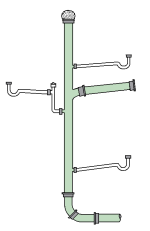
No, the P trap stops the gases from getting into the house, but the vent lines are clear all the way to the septic tank, or in town, all the way to the manhole.

A quick search of images found this picture. You can see how the trap is close to the sink, or whatever you are using. Then it flows into the main line. The main line is open from under the house, to above the house.

SoilStack.png
 
/ Roofing discussion!!! #107  
...

What about a sink in an island? I've heard about a special kind of vent that can be installed right beside the sink in the island so that you don't need to connect to the main stack.
That's called a studor valve, or air infiltrator valve. I have several in my very old house that at some point the original owner eliminated a main vent stack and moved it to the other side of the house. He never vented the kitchen sink, or the powder room sink. They'd gurgle when anything else was drained. I installed the Studor valves and that resolved that. Might want to check if acceptable to local codes.

 
/ Roofing discussion!!! #108  
What is the best way to vent a oven through roof or wall?

I can do either and the wall is an upper section rather than the main end wall of the house.
 
/ Roofing discussion!!! #109  
What is the best way to vent a oven through roof or wall?

I can do either and the wall is an upper section rather than the main end wall of the house.

I don't know if you get any snow out in your area but if you do I would avoid using the roof to vent the oven it melts the snow and cause ice dam and it will eventually leak. use the least resistant path (Shortest distance with the lease amount of bends)
 
/ Roofing discussion!!! #110  
That's called a studor valve, or air infiltrator valve. I have several in my very old house that at some point the original owner eliminated a main vent stack and moved it to the other side of the house. He never vented the kitchen sink, or the powder room sink. They'd gurgle when anything else was drained. I installed the Studor valves and that resolved that. Might want to check if acceptable to local codes.

We have used those as well for sinks under a countertop; a main vent line should exit the roof to vent as per Eddie's post.
 
/ Roofing discussion!!! #111  
Located in South Carolina, so no snow issues.

the roof vent would be straight up with no bends, the wall will have one 90 degree bend.
 
/ Roofing discussion!!! #112  
Located in South Carolina, so no snow issues.

the roof vent would be straight up with no bends, the wall will have one 90 degree bend.
attach is one example, I like the length from the exhaust to the roof on this one but see your hardware store look at your options as long as they have a back draft damper, a screen so nothings goes in and a decent pipe diameter. (at least 4'' diameter) Use hard line pipe and not flex pipe as flex increase resistance.

I don't know your house configuration here but if its a finish house the roof might be easier to install you simply have to cut the hole through the sealing to the addict then through the roof and shingles and you just slip that in. for the wall you might have to deal with fitting it under the siding which can be lots of work … but you also could bring it to the addict and pipe it to a gable which could be easier then the wall … but again the major components for resistance are diameter, distance and corners. Resistance = less airflow...
1627836604806.png
 
/ Roofing discussion!!! #113  
That's called a studor valve, or air infiltrator valve. I have several in my very old house that at some point the original owner eliminated a main vent stack and moved it to the other side of the house. He never vented the kitchen sink, or the powder room sink. They'd gurgle when anything else was drained. I installed the Studor valves and that resolved that. Might want to check if acceptable to local codes.


Thanks for the info. Going to try one for a plumbing problem.
 
/ Roofing discussion!!! #114  
No, the P trap stops the gases from getting into the house, but the vent lines are clear all the way to the septic tank, or in town, all the way to the manhole.

A quick search of images found this picture. You can see how the trap is close to the sink, or whatever you are using. Then it flows into the main line. The main line is open from under the house, to above the house.

View attachment 707855
multi gracie to you and the others. I usually like to understand something first.

i still don't understand why i can vent a washer into the attic seeing that the washer drain is connected to the main drain line but....

i get it except the washer vent in the attic part.

thx all
 
/ Roofing discussion!!! #115  
If the washer drain is connected to the main drain, that's a path for gasses coming from your septic or municipal sewer system. So the P trap in the washer drain should block those gasses from coming back into the laundry room through that path. The vent for the washing drain is now the path for those gasses. You don't want sewer gas venting into your attic. You need a vent on the washer drain for proper drainage.

You have several choices. Three I can think of are:

- Tie your laundry vent into the main stack vent somewhere in your attic.
- Or, poke a hole in the roof and vent it separately out the roof.
- Or, put a Studor valve (air infiltrator valve) on a riser next to the stand pipe for the washer drain, making sure it's higher than the stand pipe. (this is the easiest way to do it, in my opinion, if it's legal in your location per code).

Never vent anything into your attic.
 
/ Roofing discussion!!! #116  
That's called a studor valve, or air infiltrator valve. I have several in my very old house that at some point the original owner eliminated a main vent stack and moved it to the other side of the house. He never vented the kitchen sink, or the powder room sink. They'd gurgle when anything else was drained. I installed the Studor valves and that resolved that. Might want to check if acceptable to local codes.

In some places it's also referred to as an air admittance valve.

There are 2 other ways that are usually allowed by code to vent island sinks. 1) use a 4" pipe from the main drain all the way to the sink with the vertical piece capped just under the counter top with the sink drain coming into the side of the 4" pipe. 2) use 2 drain pipes connected in a U formation and the sink drains into only 1 of them. The idea behind these is that the pipes are large enough that a slug of water will not fill the pipe and air can pass over the slug so a vacuum will not form behind the water slug.
 
/ Roofing discussion!!! #117  
In some places it's also referred to as an air admittance valve.

There are 2 other ways that are usually allowed by code to vent island sinks. 1) use a 4" pipe from the main drain all the way to the sink with the vertical piece capped just under the counter top with the sink drain coming into the side of the 4" pipe. 2) use 2 drain pipes connected in a U formation and the sink drains into only 1 of them. The idea behind these is that the pipes are large enough that a slug of water will not fill the pipe and air can pass over the slug so a vacuum will not form behind the water slug.
Yes, I've seen those, but did not want to recommend it, and, would have trouble describing it without a picture.
 
/ Roofing discussion!!! #118  
There was talk of skylights!

I always figured it was not 'IF' they leak, but rather 'When' will they.
Worst example was a client that insisted they wanted one over their bath tub.
I used shower type plasterboard to house the cavity as I figured it would sweat and drip due to condensation. (like hot steamy air hitting cold skylight)
That was a good call.
Later the clients complained about all the dead flies in their tub.
LOL they'd, flies that is, head for the light to escape, find no food and die and drop into the tub.
Oh, while it did not leak per say, the condensation did create nice cold water drips.
 
/ Roofing discussion!!! #119  
If the washer drain is connected to the main drain, that's a path for gasses coming from your septic or municipal sewer system. So the P trap in the washer drain should block those gasses from coming back into the laundry room through that path. The vent for the washing drain is now the path for those gasses. You don't want sewer gas venting into your attic. You need a vent on the washer drain for proper drainage.

You have several choices. Three I can think of are:

- Tie your laundry vent into the main stack vent somewhere in your attic.
- Or, poke a hole in the roof and vent it separately out the roof.
- Or, put a Studor valve (air infiltrator valve) on a riser next to the stand pipe for the washer drain, making sure it's higher than the stand pipe. (this is the easiest way to do it, in my opinion, if it's legal in your location per code).

Never vent anything into your attic.
i got it

what i was missing was ....

while the p traps stop the gasses from reentering the specific room they are in, once the gasses get in the main line, they can move around.

the washer vented to the attic was 10 years ago.

anyway, time to cut a hole in the roof.

Now, if someone can tell me how to keep the flange in the sink from leaking. I've tried everything except what the instructions suggest! Plumbers putty, various o rings and flat washers, even caulk. All 3 of my bathroom sinks leak down past the edge of the flange.

The pro plumber installed 1 sink about 1 month ago. I checked yesterday. His install does the same, sink won't hold water, leaks around the edge of the flange.

Today i buy what the DELTA instructions suggest, silicone.

Man do i
image.jpg
hate plumbing!
 
/ Roofing discussion!!! #120  
When I put in a flange in a sink, I use 100% silicone caulk/sealant. It's the only thing I use 100% silicone for. Also, keep in mind that if you ever have to re-caulk something with 100% silicone, all the old stuff has to be removed mechanically (i.e. sandpaper) it does not stick to itself. I do not reuse anything that's had silicone caulk on it unless I have to.

When you put the flange in, once the sealant is in contact with both the flange and sink, twist it a little to be sure the caulk does not have any gaps in it. (just like you do with PVC pipe fittings)
 

Marketplace Items

2019 Ram 2500 4x4 Crew Cab Pickup Truck (A60352)
2019 Ram 2500 4x4...
UNKNOWN  20 FLATBED GOOSENECK (A58214)
UNKNOWN 20...
Giyi GY-STB47 QA Telescopic Boom (A60463)
Giyi GY-STB47 QA...
Kubota Snow plow with subframe
Kubota Snow plow...
John Deere 855DXUV Gator (A57148)
John Deere 855DXUV...
2005 LEEBOY 685B MOTORGRADER (A62129)
2005 LEEBOY 685B...
 
Top