OP

jodebg
Platinum Member
Would it be possible to insert a smaller (tight fitting) tube or channel into the 1.5 x 3 tube for maybe the first third of the length?

Would it be possible to insert a smaller (tight fitting) tube or channel into the 1.5 x 3 tube for maybe the first third of the length?
Sure. But sounds like too much work to me. And not as much benefit for the weight. The closer you get to the neutral axis (center), the less effect it has.
that is why solid steel is ALOT heavier, for not much stronger than the same dimension of a hollow section member
Where can I reference the weight of these different materials?

If you welded receivers near the outside ends, would you be able to use this with a set of removeable forks?
Not really,,,,,
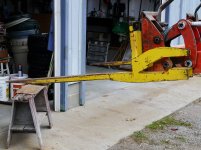
1) the pic is with the 3-pt at lowest, which is 11 inches above ground. Each tine would need a 10" dogleg to set at ground level.
2) the 2x2x1/8" sq tube would not be strong enough to resist the torsion from a fork tine at the outside ends.
Would it be possible to insert a smaller (tight fitting) tube or channel into the 1.5 x 3 tube for maybe the first third of the length?
 Do you have a welder that can penetrate 1/4" - thats a tall order for a newbie. There are times to overbuild and times not to, and not having an understanding of material strengths, that alone may be a good reason to overbuild.
In general there is never a "tight fitting tube" available, for the most part, only disappointment comes from that classic metal-fab desire. If you weld a 1/4" flatbar on the outside (top and bottom) for the first third the tine can rival the strength of 2x2x1/4. With 1/8" Flatbar at top & bottom third it will be 25% stronger than 2x2x 1/4. Agreed square looks funny for a "fork" but choosing rectangular, your sockets all have to be custom-made because there is no ("seems like never") a tube to fit it, but sometimes you cn fit them with shims welded on. The plans use the 2.5" for the 2x2 sq. tine because that combination is one of the few "fitting" sizes. And even then, you may have to fuss with the weld flash (which is not a big deal on a short receiver) or look for the special "2.53" receiver size. Anyway, square is easier.
**What are the size options for the square 2.53 tubing that I can use as receivers. This seems like a very good option. Is there a 2.53 option for the 3x1 1/2, 2x2, 2x3, or 2x4? The avilabilty may make it easier to decide on fork dimension.
On forums, despite no pics of (reasonable) attachments actually failing you will find very little support for building that attachment appropriate to its usage, and huge support for overbuilding - it's just the way members interact on forums. Don't wanna start a "Bull Engineers in full mortal combat" over your project but you might keep in mind that the recommended max 3-pt implement weight for a 7800 is 500 lbs. Your initial desire to leave some capacity for cargo has validity. I will take a guess that the 7800 is unable to lift 900 lbs (two 55 gal drums of water) but I bet Kubota doesn't want it traveling with more than 500 lbs. Just IMHO.
**Where does the 1650 lb lift capacity come into this? I'm confused. After building this at 160-190lbs, I will only be able to lift approx. 700 lbs, and haul much less? This is not good.
To weld 1/4" thick material be sure to bevel the joints otherwise you won't get the additional strength you paid for (and will carry around). Unless you have capacity to weld with 3/16" rod etc.
*Fortunately I have a neighbor who was has welded for years and has a very large welder. He hires out at very affordable rates and is going to do this fabrication. I would have to ask him the above.
If built per the drawing ----Sodo---- would use 1/8" material for a compact tractor and don't lend it out. If you prefer overbuilt, 3/16" will be 50% heavier, cost 50% more, and be more than 50% stronger, handle the next size bigger tractor etc seems quite reasonable and prudent. Sizing that for a tractor with 1 ton lift capacity when the tractor you have weighs only 1800 lb only has downsides, (to me).
I'd buy steel locally. But I have some good suppliers. Doesnt hurt to check both online and locally.
Fabbing up a receiver shouldnt be hard. Or you can just buy some 5x3x1/2 wall tubing. Its 20# per ft, but you would only need a foot or so. (6" each side)
If can think of some heavy (known) weight and a way to lift on it, I'd try it for you.


That is not how a 3PH works.
A 3PH is a parallelogram style linkage. There is no loss of lift force IF it is kept to a true parallel lift. Which is indeed possible on lots of hitches with adjustment of the linkages and toplink.
You do loose a little force the father from parallel the lift is, but it isnt like a simple lever. If you set up the 3PH so that the pallet forks raise in a level manner (heal raises the exact same amount as the tip), the capacity at the tip is the same as at the ball ends. (provided you have enough weight on the front of the tractor to keep it on the ground).