Generator wiring

   / Generator wiring #1  

tree grower

Silver Member
Joined
Dec 29, 2007
Messages
210
Location
Cuttingsville, VT
Tractor
Ford 1210, Bobcat 742B, John Deere 1050
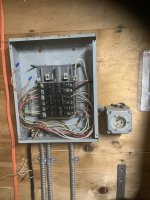
This is a little off topic, but I bet some of you know the answer. I just bought a house built in 1979. It has a generator hook-up, but the realtor said it has never been used--not part of the issue. It was installed and wired by a reputable local electrician. Attached to the generator cable connection box is a 12-circuit load panel with a double 60 being incoming power from the main load center and a double 20 being incoming from the generator connection. The remaining 12 breakers (some are tandems) are wired to individual circuits in the main panel.

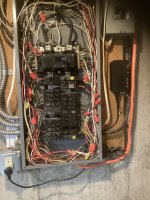
What this amounts to is circuit A being a black and white wire leaving the main panel, (but still long enough to go around the perimeter of the panel as originally wired) , but powered by a yellow (or any other color) wire from a breaker in the gen panel to the black wire, and a white wire from the gen panel to the white wire in the circuit A. With 12 out-going breakers in the gen panel there are 24 additional wires entering the main panel and wire-nutted to the existing black and white out-going wires PLUS there are circuits in the main panel that are not connected to the gen panel. The congestion of wires in the main panel is beyond anything I have ever seen.

Despite having power outages a few times per year, I have never felt it necessary to buy a generator, and I have no experience with them. I would think that a generator would just push juice into the main panel replacing what normally comes from the grid. Clearly the gen won't put out the everyday amperage, so the homeowner needs to determine what he wants to run--the water pump, freezer, refrig and furnace , but not every light and appliance in the house.

I would love to disconnect (and ultimately remove) all connections to individual circuits from the gen panel to the main panel. I am not an electrician, but I feel perfectly comfortable inside a 30 circuit 150 amp panel. Is there some good reason why I must retain this multi-colored bowl of spaghetti in my load center?
 
   / Generator wiring #2  
They've had big and less complicated (and expensive) improvements in 40+ years.
One of those is available at big box orange and probably blue. It's a device that goes into your main panel and powers it and safely isolates it from the grid. You'll need to have room for an appropriate breaker and this "kit" is panel specific afaik. I have one for my backup generator if I have an issue with my main generator. 😆
Iirc it's called a generator interlock or something similar, if you're using an electrician he'll be familiar. There's a little more hardware that's involved, basically a new wire and recptical to connect the generator to the panel... properly without a cheesy cord running through an open window or door.
I'll look for a YouTube link.
 
   / Generator wiring #5  
If I understand correctly, you really want to remove all the extra wiring and not bother with any generator connection. You are not looking for a better generator connection.

IF I understand the current wiring, you would have to disconnect the breaker on the utility side before closing the breaker on the generator side if you wanted to use a generator. IOW if both breakers were closed at the same time, the generator would backfeed the utility line. If my understanding is correct, that is dangerous and illegal. Modern code require some sort of interlock that prevents both from being closed at the same time.
 
   / Generator wiring #6  
I'm a do-it-yourselfer also with everything (almost). If I were faced with this it would be one of those (almost) times. I think about all the money I've saved over the years doing things but this is a case where paying an electrician I would do. I bet it wouldn't take that long to do or be that expensive. They would do it differently than I would and it would meet code plus peace of mind it's done properly and safely.
 
   / Generator wiring #7  
This is a little off topic, but I bet some of you know the answer. I just bought a house built in 1979. It has a generator hook-up, but the realtor said it has never been used--not part of the issue. It was installed and wired by a reputable local electrician. Attached to the generator cable connection box is a 12-circuit load panel with a double 60 being incoming power from the main load center and a double 20 being incoming from the generator connection. The remaining 12 breakers (some are tandems) are wired to individual circuits in the main panel.

What this amounts to is circuit A being a black and white wire leaving the main panel, (but still long enough to go around the perimeter of the panel as originally wired) , but powered by a yellow (or any other color) wire from a breaker in the gen panel to the black wire, and a white wire from the gen panel to the white wire in the circuit A. With 12 out-going breakers in the gen panel there are 24 additional wires entering the main panel and wire-nutted to the existing black and white out-going wires PLUS there are circuits in the main panel that are not connected to the gen panel. The congestion of wires in the main panel is beyond anything I have ever seen.

Despite having power outages a few times per year, I have never felt it necessary to buy a generator, and I have no experience with them. I would think that a generator would just push juice into the main panel replacing what normally comes from the grid. Clearly the gen won't put out the everyday amperage, so the homeowner needs to determine what he wants to run--the water pump, freezer, refrig and furnace , but not every light and appliance in the house.

I would love to disconnect (and ultimately remove) all connections to individual circuits from the gen panel to the main panel. I am not an electrician, but I feel perfectly comfortable inside a 30 circuit 150 amp panel. Is there some good reason why I must retain this multi-colored bowl of spaghetti in my load center?
Yeah, I can think of two good reasons. One, you may one day decide you need a generator. Not for convenience, but for necessity. Two, if the current situation (like that pun?) doesn't require changing things then why take the chance of goofing things up? You can certainly undo all the wire nuts and put the wires into their respective breakers in the main panel, it won't hurt anything. But if the wires are not showing any distress from overheating wire nutted connections why change things? My generator sub panel is set up similar to yours. I wired it myself and passed inspection. Got the signed green sticker from L&I and everything. There are a lot of wires and wire nuts. But I did a neat job, it meets or exceeds code, and will not cause me any problems later on. Your installation sounds, from your description, as if it has been working for a long time trouble free. But hey, if it offends you that much then go ahead and remove the generator panel wiring.
Eric
 
   / Generator wiring #8  
This is a little off topic, but I bet some of you know the answer. I just bought a house built in 1979. It has a generator hook-up, but the realtor said it has never been used--not part of the issue. It was installed and wired by a reputable local electrician. Attached to the generator cable connection box is a 12-circuit load panel with a double 60 being incoming power from the main load center and a double 20 being incoming from the generator connection. The remaining 12 breakers (some are tandems) are wired to individual circuits in the main panel.

What this amounts to is circuit A being a black and white wire leaving the main panel, (but still long enough to go around the perimeter of the panel as originally wired) , but powered by a yellow (or any other color) wire from a breaker in the gen panel to the black wire, and a white wire from the gen panel to the white wire in the circuit A. With 12 out-going breakers in the gen panel there are 24 additional wires entering the main panel and wire-nutted to the existing black and white out-going wires PLUS there are circuits in the main panel that are not connected to the gen panel. The congestion of wires in the main panel is beyond anything I have ever seen.

Despite having power outages a few times per year, I have never felt it necessary to buy a generator, and I have no experience with them. I would think that a generator would just push juice into the main panel replacing what normally comes from the grid. Clearly the gen won't put out the everyday amperage, so the homeowner needs to determine what he wants to run--the water pump, freezer, refrig and furnace , but not every light and appliance in the house.

I would love to disconnect (and ultimately remove) all connections to individual circuits from the gen panel to the main panel. I am not an electrician, but I feel perfectly comfortable inside a 30 circuit 150 amp panel. Is there some good reason why I must retain this multi-colored bowl of spaghetti in my load center?
If the 12 circuit looks something like this, what you have is an automatic transfer switch.
B1D59E69-3974-4FD1-8E77-F2B679972904.png
 
   / Generator wiring #9  
If you want to remove it, all you do is disconnect all the white and black wires coming from transfer switch and reland all the house white wires back onto the neutral buss on house panel, and land the black circuit wires back onto to empty house panel breakers.
then remove the 60 amp circuit feeding the generator panel from the house panel.

Simple job.
 
   / Generator wiring #10  
Houses with generators that power household circuits through the Load Center are required to have an approved Transfer Switch which positively disconnects the house from the grid when the generator is running. That is so your generator doesn't fry the guys working on the grid by "backfeeding" the power lines.

That Transfer Switch can be manual or automatic and looks like a smaller version of a load center. If manual, it will have a large manual switch on the side. If it is the automatic type it will not have a switch but will have several relays inside, along with a subcircuit to keep the battery in the generator charged. An automatic transfer switch would explain the reason for the extra wiring in the main load center.

If you have any doubts, the safe way is to disconnect the generator from your load center so it is totally independent of your household wiring. Then simply use the generator to power a couple of extension cords rather than being connected to houshold wiring.

Then when you have time to understand your system a little better you can always hook it back up to an approved transfer switch.

rScotty
 
   / Generator wiring
  • Thread Starter
#11  
First of all, thanks for all the feedback. For me the opportunity to bounce an idea around is just as valuable as the right answer in the first place.

Attached photos show my situation. Just to clarify, I don't wish to disconnect the generator feed- I might need it. Also, I subconsciously have wondered about the risk of feeding juice back into the grid. The 4 square box to the right of the gen panel appears to be only a receptacle, not a switch. The instructions to the right imply that the transfer must be done manually--?? by switching off the feed from the main, and switching on the feed from the gen ??

In tracing wires between the panels and from the main panel out into the house, it appears that the electrician and/or homeowner just chose which circuits to include and which to leave out.

What I think I really want is an automatic transfer from the generator to the main panel w/o having any individual circuits connected between the two. If this is not possible I won't fight it, but I would like know why.
 

Attachments

  • IMG_1621.JPG
    IMG_1621.JPG
    2.9 MB · Views: 691
  • IMG_1622.JPG
    IMG_1622.JPG
    2.6 MB · Views: 643
  • IMG_1623.JPG
    IMG_1623.JPG
    2.3 MB · Views: 254
   / Generator wiring #12  
What I think I really want is an automatic transfer from the generator to the main panel w/o having any individual circuits connected between the two. If this is not possible I won't fight it, but I would like know why.

That type of isolated automatic system is not possible. How would the generator know when to turn itself on and make an automatic transfer if it was not able to constantly sensing the incoming power to be able to tell when it failed? And to do that it has to be connected to the main panel.

If you want completely isolated circuits what you want is a less expensive and less complicated manual transfer switch wired between the the incoming lines to your house and the main panel. Installing that will require an electrician and also an inspection. Then you can positively disconnect the main when it connects the generator.

What you have now looks like somebody's homebrew & dangerous system that can backfeed the grid. You could be liable if that happens. I'd either put in a transfer switch or isolate it completely.
I know that's not what you want to hear, but better that you know.
 
Last edited:
   / Generator wiring #14  
THink you need to call electrician (one who specializes in generators/transfer switches) and have them come take a look and explain to you what you have... And may any changes you require if you want to make system operate differently...

I went totally simple, manual transfer switch for well only (240V) because is you have water everything else is easy.... Just run 12 gauge extension cord from generator to fridge and computers and go into "camping mode".... Survived 8 days this way due to power outage from wildfire while local utilities work almost non stop to restore power...

After seeing the profusion of wire nuts in main panel, I don't think I would venture in there....

img_1621-jpg.771875


What I see here is a series of breakers that one set needs to be turned off, and another turned on to transfer power... WITH NO SAFETY INTERLOCK.... Call electrician....

img_1622-jpg.771876
 
Last edited:
   / Generator wiring #15  
First of all, thanks for all the feedback. For me the opportunity to bounce an idea around is just as valuable as the right answer in the first place.

Attached photos show my situation. Just to clarify, I don't wish to disconnect the generator feed- I might need it. Also, I subconsciously have wondered about the risk of feeding juice back into the grid. The 4 square box to the right of the gen panel appears to be only a receptacle, not a switch. The instructions to the right imply that the transfer must be done manually--?? by switching off the feed from the main, and switching on the feed from the gen ??

In tracing wires between the panels and from the main panel out into the house, it appears that the electrician and/or homeowner just chose which circuits to include and which to leave out.

What I think I really want is an automatic transfer from the generator to the main panel w/o having any individual circuits connected between the two. If this is not possible I won't fight it, but I would like know why.
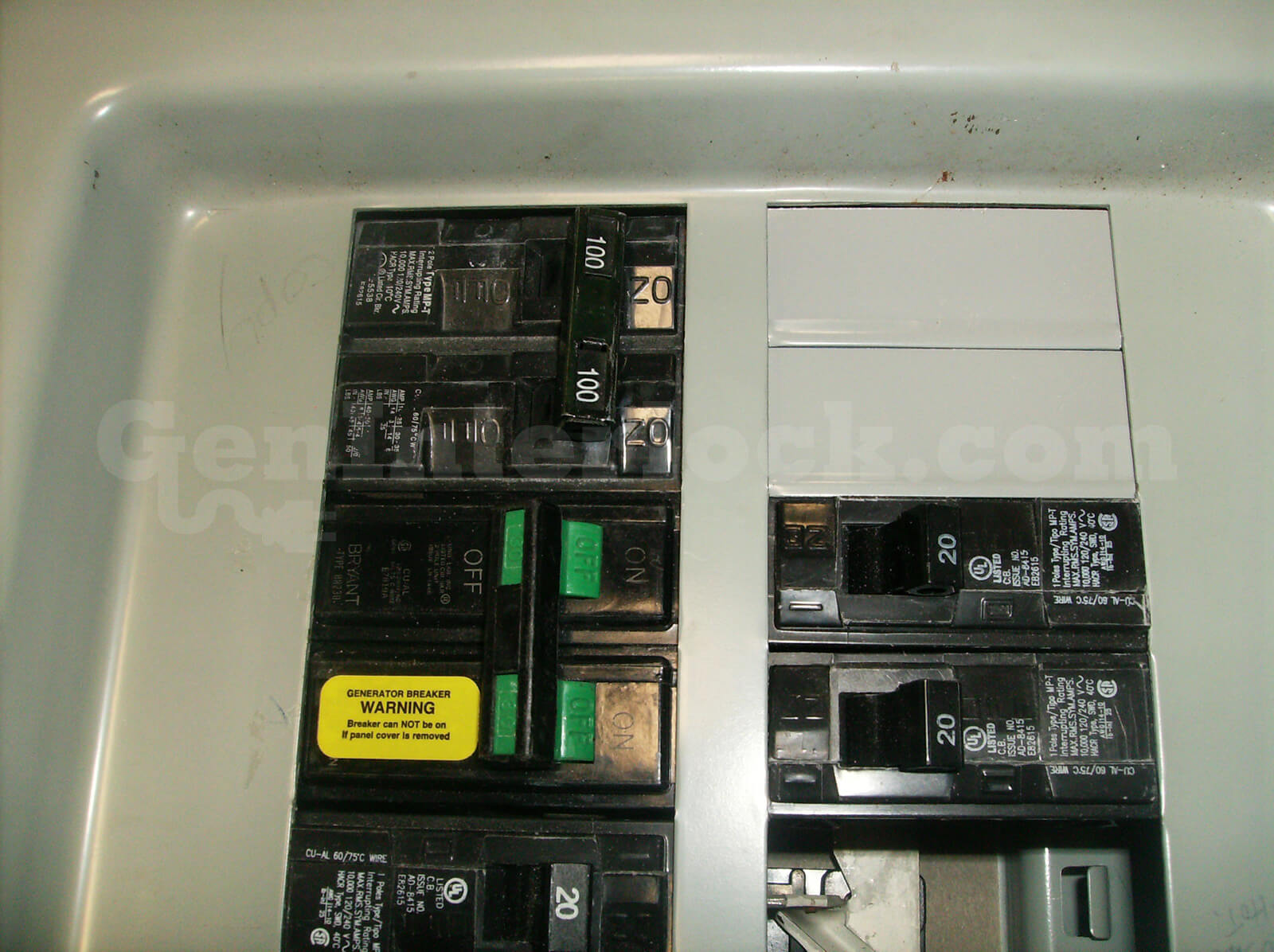
The system that you currently have has just a few circuits on the generator power feed. Does the cover for the generator panel have an interlock device to prevent the 2 "main" breakers being on at the same time?
If it doesn't it does not meet code or general safety guidelines.

If you wish to have a whole house transfer switch in will need to be installed before your primary incoming panel.
It can be an auto or manual transfer switch. If auto it will sense the incoming voltage, and on fail start the generator then transfer from the utility to generator power.

If you wish to have a smaller standby generator to handle a few dedicated circuts you would need a panel similar to what you have now but with a built in manual transfer switch.
similar to this;
1669394026628.png


Your existing system could be upgraded with an inter lock so only the main or only the generator breaker could be on at any time.
similar to these,
Interlock Kit & Accessories For Your Home | Generator Interlock Kit

1669394313813.png
 
   / Generator wiring #16  
I have a (side load) generator panel that has 6 circuits that I power with a 7500 watt dual fuel portable generator .each breaker has 3 positions
Line -from JNEC
Off- Off to work on circuit
Gen- Power from generator

This is wired into main breaker box so that no power will ever back feed. It’s a manual system you have to plug in generator and throw the switches for the circuits you want to power but at the time it was the best method for us.
 

Attachments

  • image.jpg
    image.jpg
    2.3 MB · Views: 143
   / Generator wiring #17  
I fool with generators often. First one is an Allis Chalmers 50 kw at my shop. It does single and three phase with a brushless generator. Second one I just put a circuit board in because it wasn't coming on weekly for its self check, 175 kw. Then after I had it working, the power went off two days later. The pull on solenoid was not holding throttle open. It was 21 years old, so I had a dandy of a time finding one. Finally did, but it was different. Had to use the guts out of old one and magnet coil from new one to make it work. Had to fix it, farm owner was ready to pull the trigger on another lightly used one for 30 grand. Third one is fine. Welder needed a circuit board. I have another welder, a few years older, that needs an exciter or stuck brushes, have not investigated it yet. Runs fine but no weld, only sparks. Electricians call me to go on big farm generator calls, because they don't know much about them. So when you have 25,000 chickens that Tyson wants $23.00 each for, it becomes critical. Generator runs two houses. 12,500 birds in each house. If you get them automatic transfer switches, ants love them things. They won't work with ants around. Just had two houses die a few months ago, not me, a customer. Chickens dead in 30 minutes. Their houses are full tunnel and don't have the side curtains like the one pictured. Side curtains have an automatic drop in case of a no power situation. So, power went off, gen was not on, no fans moving air, all birds died. Generator did not come on. Turns out they were using fuel from generator tank to run the tractors. Plus the weekly self check uses fuel too. Generator tank was empty and I can't fix that problem. That is their responsibility as a farm owner to keep the tank full. Which, they had 6 houses, I just tore down three of theirs that collapsed in the 18" snow we had. I'm fine with them using fuel out of gen tank because it keeps fresh fuel in there. But, it has to be kept topped off.

I don't see a problem with the situation you have. Maybe look into understanding it instead of undoing it. Since generators became popular, power companies ground out the wires they are working on. That will toast your generator. Just turn utility main off on your side of meter. Crank generator and turn the breakers on that you need. When power comes back on, turn off generator breakers, turn on utility breakers. I see no problem with that. Seems a simple trouble free experience. Or, you can go automatic, and it gilflirts when you need it, and you wait on a "specialized technician" that can figure out all the load sensors. Then when it (technician) shows up, you done froze for a week and power is back on anyway. That 1979 stuff ain't so bad. I drove to Alaska and everywhere else I want to go in a 1976 pickup, recently. If I leave my driveway and turn south, 21 miles to Louisiana.
 

Attachments

  • IMG_20221110_171822.jpg
    IMG_20221110_171822.jpg
    2.4 MB · Views: 157
  • IMG_20220619_204636_1CS~2.jpg
    IMG_20220619_204636_1CS~2.jpg
    2.1 MB · Views: 153
  • IMG_20220619_204341.jpg
    IMG_20220619_204341.jpg
    2.1 MB · Views: 147
  • IMG_20220904_175942.jpg
    IMG_20220904_175942.jpg
    2.6 MB · Views: 166
   / Generator wiring
  • Thread Starter
#18  
More feedback = more valuable. Regarding an automatic transfer, I wasn't thinking of a generator that would come on automatically, but a device that would automatically switch the panels from incoming grid juice to gen juice when the generator is started up with a pull cord. This isn't the first time I have imagined devices that don't exist.

The concept of a manual transfer switch is most appealing. IMHO manual anything is almost always better than automatic. The comment that my system appears to backfeed the grid may be enough proof that it has never been used. The observation that the well pump is all that is truly necessary is spot on, but maybe add the refrig.
 
   / Generator wiring #19  
You can add a manual interlock to the system in pictures, and you can use it as is. Leaving it without the interlock is very dangerous. If someone turns on the 2 pole 20 breaker attached to the twistlock generator supply outlet, you have a death trap (Open, exposed terminals)


MUR100PUL-1200x897.jpg


there is no automatic transfer switch that works on manual start generator. Least, ive never seen one.
 
Last edited:
   / Generator wiring #20  
The few times I run our 9kW portable generator I simply go in this order:
1) Turn main and all breakers off in main panel box, (except to garage 250 ft.away.)
2) Connect generator to welder outlet, leaving just garage main and welder breaker on.
3) Run generator.
4) At house turn well pump and water heater breaker on, as well as refrigerator.
5) Meter display let's me know when power is restored. A pilot light on main breaker meter side does same thing.
6) Shut generator off.
7) Disconnect generator.
8) Garage breakers on.
9) Main breaker on and others in main box.
 

Tractor & Equipment Auctions

500BBL WHEELED FRAC TANK (A58214)
500BBL WHEELED...
25 DUAL AXLE GOOSENECK TRAILER (A58214)
25 DUAL AXLE...
HYDRAULIC TILTING BUCKET FOR MINI EXCAVATOR (A58214)
HYDRAULIC TILTING...
2025 MACK GRANITE GR64F DUMP TRUCK (A59823)
2025 MACK GRANITE...
KJ 20' Metal Farm Driveway Gate (A53314)
KJ 20' Metal Farm...
2015 LOAD TRAIL 24+6 GOOSENECK TRAILER (A58214)
2015 LOAD TRAIL...
 
Top