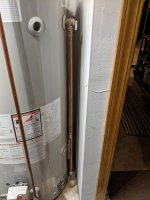
Flushing Hot Water Tank

/ Flushing Hot Water Tank #22  
@ultrarunner do you brass nipples instead of dielectric isolator; if so, how long are they?

I am looking at replacing some rusting dielectric isolation nipples, and would welcome any tips before I drag out my 36" pipe wrenches....

All the best,

Peter
 
/ Flushing Hot Water Tank #23  
Dielectric with dissimilar metals... primarily copper to steel.

I have a very old heater with a copper tank and left it copper to copper.

Galvanized to steel just plain union.

Most flex lines provide isolation due to the nylon bushing.

Strapping here is a big deal... first it was one and then two and heard recently three but have not verified.

Also securing venting with three sheet metal screws per joint... plus insulating exposed pipe which I do not think necessary in a heated space but required for inspection...
 
/ Flushing Hot Water Tank #24  
I have a small 5 gallon hot water heater in my shop. After a year of use the hot water stank like a son of a gun. Checking into it, if you have a magnesium heating element and non-chlorinated well water that has even minute trace amounts of sulfur content, this is a fairly common issue (I have all three conditions). I was told that I just need to add a little hydrogen peroxide once in a while to the inlet in a while to clean the element and eliminate the odor. (it works). I am told I could change to an aluminum heating element to solve the problem, but one isn't available for this particular unit.
I have never flushed or cleaned the hot water heater in my house and have never had a problem with it.
 
/ Flushing Hot Water Tank #25  
I have a small 5 gallon hot water heater in my shop. After a year of use the hot water stank like a son of a gun. Checking into it, if you have a magnesium heating element and non-chlorinated well water that has even minute trace amounts of sulfur content, this is a fairly common issue (I have all three conditions). I was told that I just need to add a little hydrogen peroxide once in a while to the inlet in a while to clean the element and eliminate the odor. (it works). I am told I could change to an aluminum heating element to solve the problem, but one isn't available for this particular unit.
I have never flushed or cleaned the hot water heater in my house and have never had a problem with it.
Just get the pipe thread dimensions (most are 3/4"NPT, which is not 3/4", table here), and length. If it were me, I would try an RV dealer, who often have small anode rods for RV heaters. You can cut it to length, as there will be a wire inside the magnesium that you can use for length.

If you get the dimensions and can't find one, PM me. I might have one the right size.

All the best,

Peter
 
/ Flushing Hot Water Tank #26  
If you have water in the tray, you either have a pipe leak or tank leak, with my bet on a leaking tank.

Unless your water quality is poor, you shouldn't need to drain your tank, unless you are going through anode rods quickly. (You check your anode rod every six months to a year, right? Almost nobody does, but you should, unless you have an electronic anode. Probably the most overlooked service check in the world of plumbing.)

All the best,

Peter


Regarding anode rods.... my understanding is if your heater has a (example) 5 year warranty.....and the next one has a 10 or 15 year warranty..... the longer warranty unit usually has TWO verses one anode rods in them.

So, if you are going to replace it/them.... you might want to be sure to know if you have one or two inside there.


Now.....here's a question for the masses..... (note that I have a lot of calcium buildup in mine)

I take my tank out every couple years and scoop as much calcium out as I can. I pulled the drain OFF and replaced it with a different shutoff/drain that has a through diameter of (something like) 1/2 or 5/8 inch verses the chokedown that the stock unit has.

So.... my point/question is.... if you get calcium buildup, wouldn't it work to pour (no idea) 1-gallon, 4 gallons??? of vinegar into the tank so the vinegar can help dissolve the calcium, then attach hose to drain bib and attempt to wash it out??

I've always wondered about this but never tried it.
 
/ Flushing Hot Water Tank #27  
I use CLR in pails at work... never tried for domestic water heater but does make a difference...
 
/ Flushing Hot Water Tank #28  
Last time I tried to drain mine it was clogged and blowing back in the hose didn't free it. That was probably 10 years ago and I haven't thought about it since.

I have replaced the lower element once and the sediment wasn't up to the top but at that time it would drain. I suspect my lower element is submerged in sediment by now.
 
/ Flushing Hot Water Tank #29  
Mine will be drained when I toss it out. Maybe when I replace this one I'll give it better access to do so. No hot water when I went to wash all my bacon racks from smoking yesterday. Burned wire inside. It would have helped if they would have tightened the wires...
 
/ Flushing Hot Water Tank #30  
I've been here 25 years almost. WH was here before that, probably late 80s or so. I think I've drained it once or twice and found nothing of note, though I may not have known what to look for. No idea what these rods are or where they might be if mine has any. I don't use a lot of HW either because it runs the electric usage up so much.


I know this post just jinxed me .....
 
/ Flushing Hot Water Tank #31  
I've been here 25 years almost. WH was here before that, probably late 80s or so. I think I've drained it once or twice and found nothing of note, though I may not have known what to look for. No idea what these rods are or where they might be if mine has any. I don't use a lot of HW either because it runs the electric usage up so much.


I know this post just jinxed me .....
Here's a quick video with the details.

 
/ Flushing Hot Water Tank #32  
I needed a breaker bar to remove my anode. I don't know if they simply had an ape tighten it or if they had a sealant (like super glue perhaps lol)
 
/ Flushing Hot Water Tank #33  
I had to use an impact driver on mine
 
/ Flushing Hot Water Tank #34  
Just a couple comments from experience. I service my electric heater at least once per year to remove sediment and check the anode rod. Did my one year old Rheem about a month ago and found so much sediment in the tank I'll now do the service every six months.
A beneficial option is changing the crappy compression drain valve from the factory with a 3/4 ball valve specifically designed for draining .... about 25 dollars that saves a lot of aggravation.
I'm on a well with a new pump so I also flush the crap out of the pressure tank first. (Our one year old tank had a lot of "mud" and crap in it)
Then ... drain the heater and remove the elements ( I always replace them as a preventative measure cause they're cheap ). I use a wet vac with a length of heater hose to vacuum out the sediment through the bottom element hole..... Also check the condition of the anode through the same bottom element hole. Haven't replaced mine yet but have two anode rods available for when mine shows deterioration. ( I regret not removing the anode once before installation to make sure the factory seal can be loosened. )
We live in a mobile home so the project involves moving furniture and a wall panel to get at the system ....... but after 30 plus years we now have it down to about two hours.
 

Attachments

  • DRAIN.jpg
    DRAIN.jpg
    334.3 KB · Views: 113
  • IMG_0178.JPG
    IMG_0178.JPG
    171.4 KB · Views: 129
Last edited:
/ Flushing Hot Water Tank #35  
Greetings,

I was brought up to flush the HW annually. Recently, a plumber told me that it isn't done routinely anymore. Do you do it or have you heard its not needed.

Also, the tray under the tank has a bit of water in it. I'm assuming this is from condensation. But how much is too much -- when does it indicate a leak or other problem?
Ours is calendared in Outlook to do quarterly or every 6 months. Don't remember. Just have to open the valves for a minute or 2.
 
/ Flushing Hot Water Tank #36  
Something to ponder about the "quick flush". Opening a compression type valve does not remove much of any sediment .... at least that's been my experience over the years. I've drained the tank numerous times and when the lower element is removed I find a significant amount of crap.
Even with the dedicated 3/4" ball valve the crap still remains within the tank. This last time it was almost to the level of the bottom rod.
My perception is that it's a "feel good" measure that does not accomplish much of anything. I suspect the type of water you have is critical ....... ours is "hard" well water.
I'm personally glad we do not have a gas unit because the sediment build up & longevity of the tank is predetermined by water quality.
 
/ Flushing Hot Water Tank #37  
I've always heard to drain and flush once per year UNTIL I moved into this here house of mine with a new high-efficiency heater. I drained a couple times, then found the instructions to water heater which say to just drain off a few gallons via drain valve once/month. In my mind that's brilliant, makes way more sense (and way less work) to get out sediment regularly rather than having it build up throughout the year. 1st of the month, I just open the valve wide open for 30 secs or so, end of story. I don't even detach the hose, I just leave it there as is. So easy.

PXL_20211205_160242655.jpg


As far as the water collecting under the tank, check your pressure relief valve. I used to occasionally get water collecting down there, thought I had a problem too, and then finally realized it's the relief valve occasionally leaking. This is what a I do now:

PXL_20211205_160251385.jpg


With well water, once you pop that relief valve (which I was doing to drain the tank), that thing will never sit back down quite right again. So that's where the water would occasionally leak from. I started putting the plastic cup down there, just drain that off when it gets water in in it. No more water under the tank.
 
/ Flushing Hot Water Tank #39  
Greetings,

I was brought up to flush the HW annually. Recently, a plumber told me that it isn't done routinely anymore. Do you do it or have you heard its not needed.

Also, the tray under the tank has a bit of water in it. I'm assuming this is from condensation. But how much is too much -- when does it indicate a leak or other problem?
Usually water in the pan is a leaking T&P valve, easily replaced. Far as flushing goes, that depends on the amount of minerals in your water (if it's well water). I flush mine monthly because we have a lot of calcium in the water, yours may be different. My personal view is plumbers caution against flushing a HWH because they are looking at premature replacement. I'd ignore that entirely.

Even with our well water and mineral content, our HWH will last a minimum of 10 years, but then again, it gets flushed monthly.

My opinion, take it or leave it, your choice entirely.
 
/ Flushing Hot Water Tank #40  
Usually water in the pan is a leaking T&P valve, easily replaced. Far as flushing goes, that depends on the amount of minerals in your water (if it's well water). I flush mine monthly because we have a lot of calcium in the water, yours may be different. My personal view is plumbers caution against flushing a HWH because they are looking at premature replacement. I'd ignore that entirely.

Even with our well water and mineral content, our HWH will last a minimum of 10 years, but then again, it gets flushed monthly.

My opinion, take it or leave it, your choice entirely.


Do you throw out and replace the entire HWH when the element fails. Do the minerals eat through the tank? What’s in the water that does this and do you drink it?

I have 4 water heaters in house and apartments. I have calcium / limestone “chunks and flakes” that form in my “HWHs”. I’ve never flushed my hot water heaters in between changing out the elements. Elements need changing about once every 10 years when they get buried in minerals , overheat, and burn out. ).

Perhaps if I did flush it every month the “flakes” would be small enough to travel out, but I doubt it. The “chunks” are so big, sometimes they will only barley fit out the opening for the heater element or need to be broken up first. Only my trusty ShopVac with some tubing duct taped to suction can clean it out.
Once, I had to replaced the thermostat. I’ve never had to replace the tank.

P.s. I’m sure everyone knows that they’re not really HWH’s, they heat cold water. -Sort of like: Say “toast” ten times fast. Now answer: What do you put in a toaster?
 
Last edited:

Marketplace Items

2024 Blue Diamond Skid Steer Vibratory Roller (A63116)
2024 Blue Diamond...
2018 22ft. Tycorp Vector Belt VB-16H (A60352)
2018 22ft. Tycorp...
(4) Trail Quest 235/80R/16 Tires and Rims (A64047)
(4) Trail Quest...
60in Bucket Skid Steer Attachment (A61567)
60in Bucket Skid...
Yamaha Golf Cart (A57149)
Yamaha Golf Cart...
John Deere 302A 50HP Front Loader Utility Tractor (A61572)
John Deere 302A...
 
Top