Flushing Hot Water Tank

/ Flushing Hot Water Tank #1  

DrRod

Platinum Member
Joined
Apr 25, 2005
Messages
894
Location
Ellicott City, MD - Farm in Orbisonia PA (south ce
Tractor
John Deere 4110
Greetings,

I was brought up to flush the HW annually. Recently, a plumber told me that it isn't done routinely anymore. Do you do it or have you heard its not needed.

Also, the tray under the tank has a bit of water in it. I'm assuming this is from condensation. But how much is too much -- when does it indicate a leak or other problem?
 
/ Flushing Hot Water Tank #2  
Tray should be dry after initial fill and fire.

Everytime I have found water in pan after the next day there was a problem.

My heaters all inside so can't comment if outside.
 
/ Flushing Hot Water Tank #3  
I’ve heard some say it’s not necessary. Personally I still do, it’s easy preventative maintenance in my opinion and doesn’t hurt it.

If you have water in the tray it may be from the pressure relief valve, might want to have a look at it.
 
/ Flushing Hot Water Tank #4  
Want to add that I have added brass hose bib caps to all hose bibs not in use where a leak would cause damage...

It comes from being a property manager and experiencing kids fooling around with water heater and washing machine hydrants...

Sometimes water heater flush hydrants will seep or drip after flushing...
 
Last edited:
/ Flushing Hot Water Tank #5  
I would not assume condensation unless it's on the input line to the heater. Moisture doesn't tend to condense on a warmer surface than the surrounding air. I'd look for leaks or drips somewhere. The drain valve could be dripping. The input or output locations could be seeping a bit. The pressure relief could be another point. Less likely but still a possibility are the heating elements. Water in the pan is NEVER a good sign.
 
/ Flushing Hot Water Tank #6  
I flush ours every couple of years because we have very hard water;certainly is needed in our case.
 
/ Flushing Hot Water Tank #7  
I also have hard water and used to do a semiannual drain. I got lazy on the last water heater, never did a drain/flush and it was still working fine at 15+ years old, when I replaced it with a high efficiency unit. If the new unit is as good as the last one, I will be happy - 15+ years without replacing heating elements or anodes.

Two water heaters ago I did have a dripping drain valve after doing my semi annual drain. It slow dripped for a few days and then stopped.
 
/ Flushing Hot Water Tank #8  
I recently had to drain my water heater and there was so much sediment it clogged the drain. I ended up having to blow in compressed air and having it drain through the cold water side. Once the water level got below the dip tube it wouldn't drain any further so I unscrewed the drain valve and tried to screw in a straight piece of pipe fast enough to catch most of the water. Tried.

The reason I had drained it was the thermostat was covered in sediment and no longer maintaining temperature. With the drain out I was able to flush it, replace the thermostat and anode and I was good to go.

So don't do what I did. But frankly anode replacement is probably more important.
 
/ Flushing Hot Water Tank #9  
My well water is filtered and softened prior to the water heater so there has never been a sand or sediment problem. I do have to change out the anode rod every couple of years though.
 
/ Flushing Hot Water Tank #10  
I've dealt with hundreds of plumbers and amongest other things I've learned is they rarly give advice that help's you avoid hireing them.
 
/ Flushing Hot Water Tank #11  
Never changed rod yet.... average between 16-20 years in city water although have some pushing 30..

All installed by me and all with pans and on city water with 40% now 100 year old galvanized pipe and rest copper... pin hole leaks in 60 year copper more problem than galvanized so far.
 
/ Flushing Hot Water Tank #12  
Greetings,

I was brought up to flush the HW annually. Recently, a plumber told me that it isn't done routinely anymore. Do you do it or have you heard its not needed.

Also, the tray under the tank has a bit of water in it. I'm assuming this is from condensation. But how much is too much -- when does it indicate a leak or other problem?
If you have water in the tray, you either have a pipe leak or tank leak, with my bet on a leaking tank.

Unless your water quality is poor, you shouldn't need to drain your tank, unless you are going through anode rods quickly. (You check your anode rod every six months to a year, right? Almost nobody does, but you should, unless you have an electronic anode. Probably the most overlooked service check in the world of plumbing.)

All the best,

Peter
 
/ Flushing Hot Water Tank #13  
Tray should be dry after initial fill and fire.

Everytime I have found water in pan after the next day there was a problem.

My heaters all inside so can't comment if outside.

If they don’t have an expansion tank in the circuit they can puke water out the pressure relief valve.
 
/ Flushing Hot Water Tank #14  
Here by code the PTRV must be piped to daylight... Not doing so is a fail any normal PVC is also a fail.

Just about everytime I replace a water heater it always come with condensation on the first fill/cycle...

Not a lot but enough to notice... 40-50 gallons of cold water in a cold tank typically off the kitchen and always gas fired...
 
/ Flushing Hot Water Tank #15  
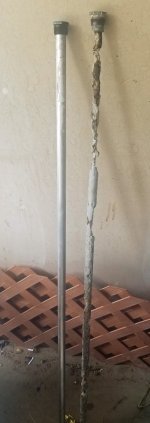
i didnt even think that gas water heaters had anodes. i always thought that those were reserved for electric units. after a plumber told me otherwise i went and looked at my 10YO dual gas water heaters. i had to remove an inspection cap but i found the anode rods.

i ordered 2 new ones from WH company and proceeded to replace them. good thing i did,as there wasnt much remaining of the old rods. i flushed tanks and all is well again. i have always flushed mine every year as a precaution.

Attachments

  • 20210512_113411.jpg
    20210512_113411.jpg
    853.5 KB · Views: 140
 
/ Flushing Hot Water Tank #16  
Mine is 26 years old with softened well water. I flush it once a year, but I've never seen any sediment.
 
/ Flushing Hot Water Tank #17  
PTRVs are a royal pain in the tookus but a necessary evil in any pressure vessel. They must be tested but will eventually leak and fail to seal. You are not allowed to install a valve between the vessel and the PTRV to aid in their replacement when they start to leak either. That would create a bomb if the water heater or boiler controls failed.

Please, no shortcuts where pressure vessels are concerned!
 
/ Flushing Hot Water Tank #18  
Installed many because not a single water heater from to 50's and 60's I was the replacing had one... not a single one.

Then the PTR have caused call backs when I never had before.

Most of the homes here have 160-180 psi and no regulators... how it has always been.

With the PTRV I had to install regulators which caused more issues.

One because the landscape irrigation all sized for the higher pressure...

So when I installed regulators to less than half pressure more stations had to be added for irrigation which meant new timers, etc...

By the way when toilet valves were bronze and under sink supply lines copper and irrigation valves bronze the higher pressure was not an issue...

Plastic toilet valves and sprinkler valves not suited to 180psi static which can pulse higher.

For awhile I installed a more expensive PTRV which could be adjusted but harder to find...
 
/ Flushing Hot Water Tank #19  
safer to add pressure regulators to houses. also, less possibility for old plumbing to burst.
 
/ Flushing Hot Water Tank #20  
I'm now replacing regulators I installed 20-25 years ago...
 

Marketplace Items

429872 (A61166)
429872 (A61166)
2014 Freightliner Bucket Truck (A56438)
2014 Freightliner...
2020 CAT FORKLIFT TL1255D (A63569)
2020 CAT FORKLIFT...
Sullair 185DPQ 100psi Towable Air Compressor (A61572)
Sullair 185DPQ...
Rotary SPOA9-200 Automotive Lift (A59228)
Rotary SPOA9-200...
2014 Jeep Grand Cherokee 4X4 SUV (A61574)
2014 Jeep Grand...
 
Top