220A welding circuit question

/ 220A welding circuit question #1  

wstf2

Member
Joined
Jul 24, 2011
Messages
26
I will be taking a beginning MIG welding class at our local JC in about a month . My question is after looking into the single 220A dedicated circuit in my garage at the 50A-250V 6-50R three prong receptical which is a foot below the garage sub panel and #6 wired to a 50A curcuit breaker in the sub panel, there are four wires in the sub panel and only three wires in the outlet receptical box??
The sub panel is fed via a 100A circuit breaker from the main panel at the house-less than 70 feet away.
The 50A outlet has a black wire at the smaller of the two vertical rectangular inlet prongs and a red wire at the larger rectangular inlet prong that feed from a 50A circuit breaker in the sub panel. The ground inlet prong has a bare copper wire. Match that to the photo (green arrows) of the subpanel and you will see a (4th) white wire from the same outlet loom attached to what I think is a neutral connection but not in the outlet box?? Is this o.k.? Possible abandoned white wire to create a three wire 220A circuit? I'm looking at a Hobart Handler 210MVP as my plug-in.
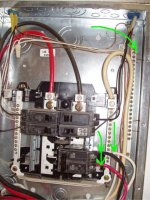
 

Attachments

  • Sub Panel (4).JPG
    Sub Panel (4).JPG
    145.3 KB · Views: 1,297
/ 220A welding circuit question #2  
is the bare wire going down to plug the same gauge as the white?
you said those are 6 gauge going down to the plug? or is it 6 gauge feeding the pictured box?
you can abandon the white beings this is a 240 volt circuit.
3 wire plug for 240 volt requires 2 hots and a ground, ground can I believe be white, would be better to put some green tape on the ends, or it can be bare.

white/neutral in your box is same as ground as is case in most applications
your 2 buss bars are tied together at the bottom.

modular/mobile homes have 4 wire service with separate ground I'm not up on it.
I am not an electrician, few eras ago worked as a helper but have done fair amount of wiring and pretty much do it by the book
take care and have a great safe cone!
Paul

PS #12=20 amps; #10 =30; #8 = 40; #6 =50;
 
/ 220A welding circuit question
  • Thread Starter
#3  
is the bare wire going down to plug the same gauge as the white?
you said those are 6 gauge going down to the plug? or is it 6 gauge feeding the pictured box?
you can abandon the white beings this is a 240 volt circuit.
3 wire plug for 240 volt requires 2 hots and a ground, ground can I believe be white, would be better to put some green tape on the ends, or it can be bare.

white/neutral in your box is same as ground as is case in most applications
your 2 buss bars are tied together at the bottom.

modular/mobile homes have 4 wire service with separate ground I'm not up on it.
I am not an electrician, few eras ago worked as a helper but have done fair amount of wiring and pretty much do it by the book
take care and have a great safe cone!
Paul

PS #12=20 amps; #10 =30; #8 = 40; #6 =50;

The bare copper wire going down to the plug looks to be of the same size as the other three with the exception that it is solid and the red, black and white are braided. The bare copper is in the same wire jacket as the rest.
The 240 circuit is #6 wire from the 50A breaker to the plug below. The larger three red, black and white wires at the upper part of the box is the feed from the 100A main over at the house.
Since the #6 white seems to be only attached at the neutral, I know it isn't inside the plug box, should I just leave it alone?
Thanks for responding.
CORRECTION: The solid bare copper ground wire is about or more than half the diameter of the other three braided wires, compaired copper to copper.
 
Last edited:
/ 220A welding circuit question #4  
By NO means am I a electrician , But the white , ( sometimes called a " Common " ) is the same as the bare Ground . When we put the new panel in our shop , the bare grounds all went in one row of those connectors to the right in your picture while all the white commons went to the connectors just to the left of the other . If you look at the bottom of those connectors , they should be connected by a large , for a better word , Connector . I , myself , when I wired my 50 amp welder / plasma plug , Used the White common wire for the ground rather than the bare wire since I prefered the 3 wires going into the 3 wire welder plug all be coated .

Fred H.
 
/ 220A welding circuit question #5  
Insulated wires carry voltage [ black, red, blue, white]. The bare, in your case copper wire is the ground safety lead. The two black lines in the panel are hot, the voltage measured will be 240v line to line. Any of the two black lines to white will measure 120v. Who ever wired the panel made a slight goof, one of the black lines should have been red or marked with a piece of red tape to identify that line as a the second line of a 240v circuit.
What ever plug/receptacles you choose, you will need only to connect what you use, two hots, black and black-red, then ground. Some wielders use 120v and in that case you need the white. Do you have a volt meter?
 
/ 220A welding circuit question #6  
By NO means am I a electrician , But the white , ( sometimes called a " Common " ) is the same as the bare Ground . When we put the new panel in our shop , the bare grounds all went in one row of those connectors to the right in your picture while all the white commons went to the connectors just to the left of the other . If you look at the bottom of those connectors , they should be connected by a large , for a better word , Connector . I , myself , when I wired my 50 amp welder / plasma plug , Used the White common wire for the ground rather than the bare wire since I prefered the 3 wires going into the 3 wire welder plug all be coated .

Fred H.

H e L L no! Never equate common/neutral with ground. Common/neutral carries the return current for 120v circuits were as the ground will carry the fault current to trip the breaker. Sometimes equipment will have a slight leakage current, not enough for a full fault and the ground keeps the case at zero v so you do not get blown out of your socks.
If you want the ground lead insulated it must be marked as a ground lead, Green or green-yellow or green tape as per code.
 
/ 220A welding circuit question #7  
H e L L no! Never equate common/neutral with ground. Common/neutral carries the return current for 120v circuits were as the ground will carry the fault current to trip the breaker. Sometimes equipment will have a slight leakage current, not enough for a full fault and the ground keeps the case at zero v so you do not get blown out of your socks.
If you want the ground lead insulated it must be marked as a ground lead, Green or green-yellow or green tape as per code.

That's only on a ground fault breaker. Normally they just provide a case ground in case of faulty equipment.

On this 220 circuit, red and black are hot and white is neutral. If they have the bare wire hooked up in place of the white down at the receptacle, it should be changed. It will be handling the return and you don't want that bare wire arcing to whatever it happens to touch en route. The bare wire should be attached to the ground screw on the outlet box if it's metal and folded back out of the way if it isn't.

Ian
 
/ 220A welding circuit question #8  
To the OP, your outlet is correctly wired using only black, red and bare. The white wire that is attached to the neutral/common bus in the panel is probably cut off at the point it enters the outlet box. While this is not going to break your outlet, I would not leave it that way. It should be capped off at one or both ends.

-rus-
 
/ 220A welding circuit question #9  
I recall when we made the adaptor and extension cord for the welder, we just used the black the red and the green, and just put a twist cap thing (forget what they are called) over the white. We were using a 4 gauge cable for the extension cord (the new guy at the cable dealer gave us the wrong cable, we payed for 20 feet of 8 gauge, and he gave us 25 feet of 4 gauge:thumbsup:) hooked up to a dryer plug as an adaptor. (wish we had 220v in the shop, have to run a cable through the basement from the laundry room to weld) So all you have to do is hook up the 2 hot wires, and the ground, the white is not needed.
 
/ 220A welding circuit question #10  
Haywire, at Transit we work to higher standards. Our power comes in at 680, 440, 240 and 120 single or multi phase Y and Delta depending on the building location. We do not take short cuts, conduit may be grounded to the equipment, but we do not depend on that being the only source for ground path.

Ever look into a major building switch gear panel? At NYC Penn Station every circuit has a ground line and the switch gear cabinets are also at ground.
About two years ago we had a problem in a very old, 100 year old tunnel room.
We found that a circuit was grounded through the couplings in thin wall conduit. After pulling a ground led all was fixed. Yes, short cuts will work, why take a chance when wire is cheep insurance.
 
/ 220A welding circuit question #11  
Back to myTech College days and basic electricity, although different standards, very little difference, neutral, at or about earth (ground) potential, the neutral should only just move a multimeter needle when there's a load on the circuit, measured from neutral to ground.
NEC allows for either the neutral to be grounded at the consumers breaker box or be floating, depending on the local utility's rules. Doesn't make a deal of difference really as it is grounded by the utility at the meter box.

Don't leave the neutral "hanging loose" in the outlet!! Either insulate it or connect it. Never did much house wiring, more HV armoured cable work and machine maintenance myself in my 40 plus years in the trade.

Also, IF IN DOUBT, find an electrician, even we elecs get burned now and then and we are supposed to know better!
 
/ 220A welding circuit question #12  
most residential panels are 3 wire that is 2 hots and a neutral there is a ground wire from ground rods driven into ground. The thing is unless it is a mobile / modular home, the neutral buss bar in box is same as the ground buss bar.if there are 2 buss bars in the box they are linked together as they are in the pictured box above.
in commercial wiring I believe they usually are separate ground and neutral circuits.
it is true in 4 wire(3 + ground)that if you are going to use the white wire instead of bare it should have green (phase) electrical tape on each end of it that can be seen as soon as you can see wire when taking cover off at any connection. otherwise it could be possibly be mistaken by someone as 2-120 volt circuits.

quote John47 "Don't leave the neutral "hanging loose" in the outlet!" that is correct!
someone else suggested unhooking it in the panel I think it needs to be cut where it enters there and where it enters the outlet box to be correct.

FYI; common mistake it is 240 volt not 220 volt {120 x 2=240}
and never try hooking those 2 wires together 240 volt does not work that way, but panel fires can.
 
Last edited:
/ 220A welding circuit question #13  
We have to agree on one thing, the NEC may be read many ways.

As for 240 [2 x 120] there has been a progression of voltages, 2 x 110 = 220, 2 x 115 = 230 and those are the ideal values, loading and power brown outs will change that too.
 
/ 220A welding circuit question
  • Thread Starter
#14  
Thanks for all of the responses but as a non-electrician I can't decipher all of what is being said. Is it o.k. to use it the way it is for my soon to be new MIG welder?
 
/ 220A welding circuit question #15  
Thanks for all of the responses but as a non-electrician I can't decipher all of what is being said. Is it o.k. to use it the way it is for my soon to be new MIG welder?
wstf2, you've gotten both good and bad information, as usual when it comes to electric. But from your picture and your description, your 50A 240V receptacle is wired correctly. If a grounded conductor (sometimes called the neutral) was needed, it would be a 50A 120/240V 4 wire receptacle.
 
/ 220A welding circuit question #16  
I'm no industrial electrician.. I'm an aircraft electrician. Worlds apart. That said, from a logic standpoint, if I had a choice of using either an insulated conductor or a bare conductor for neutral, the insulated conductor is the no-brainer, regardless of how the code is written. :confused3:

Ian
 
/ 220A welding circuit question
  • Thread Starter
#17  
wstf2, you've gotten both good and bad information, as usual when it comes to electric. But from your picture and your description, your 50A 240V receptacle is wired correctly. If a grounded conductor (sometimes called the neutral) was needed, it would be a 50A 120/240V 4 wire receptacle.
This may or may not make a difference but the wire from the house main panel to the garage sub panel is 4-wire red, black, white and bare copper, all of which are attached in the sub panel.
 
/ 220A welding circuit question #18  
This may or may not make a difference but the wire from the house main panel to the garage sub panel is 4-wire red, black, white and bare copper, all of which are attached in the sub panel.
That would be the correct wiring for a sub-panel.
 
/ 220A welding circuit question
  • Thread Starter
#19  
Back to myTech College days and basic electricity, although different standards, very little difference, neutral, at or about earth (ground) potential, the neutral should only just move a multimeter needle when there's a load on the circuit, measured from neutral to ground.
NEC allows for either the neutral to be grounded at the consumers breaker box or be floating, depending on the local utility's rules. Doesn't make a deal of difference really as it is grounded by the utility at the meter box.

Don't leave the neutral "hanging loose" in the outlet!! Either insulate it or connect it. Never did much house wiring, more HV armoured cable work and machine maintenance myself in my 40 plus years in the trade.

Also, IF IN DOUBT, find an electrician, even we elecs get burned now and then and we are supposed to know better!
The white neutral isn't hanging loose in the outlet box. It must be higher up above the outlet box and below the sub panel in the wall cavity.
 
/ 220A welding circuit question
  • Thread Starter
#20  
1. For peace of mind and since it appears to be doing nothing, should I detach the white wire at the neutral bar and cap it off?
2. Should I pull the existing complete #6 four wire out (it's only about three feet long) and replace it with #6 hot black, hot white and ground green, following the exact sub panel connection path as the existing hot red, hot black and bare copper ground?
3. Leave it as is?
Again, thanks all, just want it to be safe and right for the three pronged connection welder.
 

Marketplace Items

2011 Infiniti QX56 Multipurpose Vehicle (MPV), VIN # JN8AZ2NEXB9001685 (A61165)
2011 Infiniti QX56...
2019 John Deere Z930R (A60463)
2019 John Deere...
2002 Kenworth T300 TMA Truck (A55973)
2002 Kenworth T300...
2012 PROCO 130BBL VAC TRAILER (A58214)
2012 PROCO 130BBL...
2009 IC Corporation PB105 School Bus (A60352)
2009 IC...
2015 Peterbilt 367 T/A Wet Kit Sleeper Cab Truck Tractor (A56858)
2015 Peterbilt 367...
 
Top