Wheel ruts at barn entrance

   / Wheel ruts at barn entrance #1  

WinterDeere

Super Star Member
Top Poster Of Month
Joined
Sep 6, 2011
Messages
12,781
Location
Philadelphia
Tractor
John Deere 3033R, 855 MFWD, 757 ZTrak; IH Cub Cadet 123
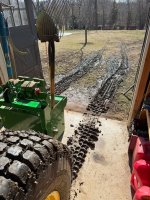
I've been dealing with the problem of wheel ruts at my shed entrance for too long. This was yesterday:
IMG_4779.jpg

It's just the first 6 yards from the door going out, and this happens every year, as the sun always softens the frozen earth in this area. Yesterday was 9F - 19F, or something close to that, yet the area just outside this barn door was too soft with a bit of solar heating, to carry the load of the tractor.

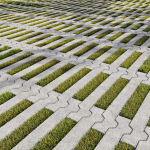
My thinking is to pick up some 8' long concrete lintels or parking stops, and set them into the ground across this path, maybe 4" lintels on 8" spacings or 6" parking stops on 10" spacings. This will still allow me to grow grass here, like some of those concrete grid areas you see used in high traffic lawn areas:

1740024929276.png

I'm figuring an 8' wide lintel or barrier should be sufficient, lowering the soil pressure at least 4x - 6x by their length alone, but even more so because I'd excavate a bit deeper than the concrete objects and use cinder to level them, which spreads the load even more. Perhaps most importantly, the soil they're sitting on, 8" or 10" down, won't be daily warmed by the sun.

I found a photo of close to what I'm thinking, minus the fancy interlocking 2D array, I'd be doing just be a single row of "ribs":
1740025255176.png

Thoughts? Predictions of success or failure? Possible sources for cheap lintels or parking stops at 8' widths?

My other option is of course to just form and pour myself, which could be done in-place. But I'm thinking that with forming wood and rebar, the actual $$ saved is probably not worth all the effort, esp. since I'd have to hand mix or rent a mixer. Would like to hear others' thoughts on this, though.
 
   / Wheel ruts at barn entrance #3  
Do what they do around here for the roundabouts that they don't make big enough for the tractor trailers, bury fancy cinder blocks. That way when they drive over the island they don't screw up the grass nor do they screw up their tires and wheels.
1740049766766.png
 
   / Wheel ruts at barn entrance #5  
I helped a guy on the farm across the valley with a similar problem. I dug shallow ditches in the mud with my hoe and we put down used railroad ties about a foot apart. A defunct railroad was removing track in the area and we got them for cheap.

That was 11 years ago. The ties have deteriorated a bit, but are still sound. The grass has grown up around them and they are hardly noticeable.
 
   / Wheel ruts at barn entrance
  • Thread Starter
#6  
Not interested in gravel, if only for the having to mow this area, and keeping it out of the grass.

Besides, I've owned gravel driveways, and they rut almost as badly as mud, when your driving pattern is constrained to one narrow lane with no variation. I'm shooting a doorway, wheels always follow same track, within an inch or two.

The grids posted by mrmikey are along the lines of what I'm planning, but with 8' long sections. I suspect the smaller grids would have a tendency to sink in the narrow wheel tracks, versus a longer continuous concrete lintel or parking stop, which should spread the load better.

bdhsfz6's railroad tie idea is exactly inline with my thinking, I'm just shooting for a more rot-resistant variation on that theme.
 
   / Wheel ruts at barn entrance #7  
bdhsfz6's railroad tie idea is exactly inline with my thinking, I'm just shooting for a more rot-resistant variation on that theme.
You get nice quality ties and they will last a long time. 20+ years. I have also seen composite ties now being made.
 
   / Wheel ruts at barn entrance
  • Thread Starter
#8  
Oh, I'm sure! But every time I choose a 20-year material, I just end up hating myself for that decision, about 20 years later. I suspect reinforced concrete in this application (no road salt) will probably out-live me.

That little carriage barn was built between 1734 and 1775. I'm not sure if re-inforced concrete will have that sort of longevity, but that's the sort of time scale I like to consider, whenever I choose building materials.

I wonder if they'll still have CUT's in the year 2250? They won't be necessary, but it's already not necessary to heat with firewood now, that being my primary use of the tractor. I suspect there will still be some nut living here, with some illogical romantic ties to the ways of the past, when this house is 500 years old.

Still interested in thoughts on forming and pouring in place, versus just buying lintels or parking stops and setting them on crushed fines, before back-filling with dirt between them.
 
Last edited:
   / Wheel ruts at barn entrance #9  
Gravel (to fill in the ruts only) will squash down and not really be an issue to mow over, unless you put too much down. You could also dig a bit and put these (12x12 pavers) in.
1740065688652.jpeg
 
   / Wheel ruts at barn entrance #10  
Will the frost heave or move the concrete blocks requiring leveling them again? I know that frost moved the 16 x 24 x 2” blocks I used for a sidewalk between buildings.
 
   / Wheel ruts at barn entrance #11  
I have a similar problem at my gate where I bring in round bales for my animals. It started last year, and this year it's become a small pond. My cheap solution is to dig up all the mud and bring in dry clay so there is a mound that I can compact and get the water to flow away. I think it's a short term solution that I will not be happy with. The long term solution is to pour a concrete pad that will solve this issue for ever.

In your case, since it's where you drive to get in and out of your building, the only solution that you will do once and never mess with again is concrete. You can do it in two pours and just do where your tires go, or do a big pad that you can also use when working on projects.
 
   / Wheel ruts at barn entrance #12  
Interesting idea it would work, but would probably crack and break if it’s settles, some ground work to get a good base would still need to be done. I would still remove a few feet of materiel and put sand with a 5/10 inch of gravel on top then put these and you should be good to go.
 
   / Wheel ruts at barn entrance #13  
Interesting idea it would work, but would probably crack and break if it’s settles, some ground work to get a good base would still need to be done. I would still remove a few feet of materiel and put sand with a 5/10 inch of gravel on top then put these and you should be good to go.
All good points. I would also add in highway fabric under the base materials to stabilize everything. If the OP really wants to pour concrete, he certainly can, but the dirt work under gravel or concrete is still going to have to be done for success, i.e., digging down, adding substrate, etc. Frost heave will always be a consideration as well and points to depth required. But there are many areas around buildings (well, at least mine) that when finished deep enough and with dense grade on top that flatten out quite well over time, with no evident compression from heavy traffic.

And a short stretch of concrete or whatever will just push the mud approach a little further out, not eliminate it...

To be honest, I have a fenced area next to the shop to park tractors covered in mud until I can spray them off or find a dry day to "run off the mud."
 
   / Wheel ruts at barn entrance
  • Thread Starter
#14  
The concrete lintels or parking stops would probably not break, they're rebar'd appropriately. If I did my own pour, you'd better believe it'll have several full-length rebars in each plinth. It won't break.

The issue I have with individual pavers or grid sections is that they do very little to actually spread the load. Figure I have 1000 - 1500 lb. per tire, with a contact patch of roughly 6x6 inches on front tire (~30 PSI) and maybe 10x10 inches on rear tire (~15 PSI). A 12x12 paver would indeed lower the impact of the front tires, maybe as much as 4x if I center the tire on the thing. But it really wouldn't change the soil loading much of the rear tires, whose contact patch is already nearly as large as the paver itself.

A parking plinth that has a footprint of 8" x 96" would be spreading the load of two tires over an 8" x 48" section, knocking front tire impact down from roughly 30 PSI to less than 3 PSI. A 4x8x96 lintel stood on edge (strong direction) would be half that footprint, so 6 PSI... still infinitely better than a 12x12 paver 18" or 24" grid sections. All that matters in these situatiosn is soil PSI, and maximizing footprint of the concrete is usually the best solution.

I had also thought of highway fabric, just as MMC suggests. It might be a good addition, if it doesn't make forming more of a challenge than it's worth. I have some ideas for forming this, my primary goal being to ensure there's still some drainage of the soil between ribs. This area gets a ton of sun, and tends to be dry and hard as concrete in July, but always soggy in cooler weather. Really tough soil conditions for frequent tractor and mower traffic.
 
   / Wheel ruts at barn entrance #16  
I don't know. I've had gravel drives for a long time, and not rutted them. It probably depends on whether you do it right. Simply throwing down gravel wouldnt work... But excavated it, throw down some coarse material and throw 38s on top. We have really wet clay here, and it holds up supremely well
 
   / Wheel ruts at barn entrance #17  
Ground becomes soft from poor drainage.

No matter what you fill it in with, it's still going to be soft ground, until you improve the drainage.

Ideally, you already have any water coming off the building, draining some where else.

Then, ideally, you dig out a section in front of the door, lay geo fabric, and put down mixed stone, including fines to fill in any voids. Compact each layer, and top with a layer of 3/4" gravel, that ends up being slightly above grade. The total depth depends on the ground. Ideally, you get below the topsoil.

Then, you put a drain tile with a sock, (holes down), on each side of the stone, at a depth lower than the lowest point of the stone. Total depth depends on soil conditions. In clay, water doesn't move through it well, so you won't have to go real deep. In soft soils, you may have to go deep. It doesn't matter if you fill the tile trench with stone, or dirt, unless you get standing water there. If you do get standing water, use washed 3/4" gravel all the way to the surface.

The drain tile will keep the stone pad, and the ground dry, and it will all eventually, become nearly as hard a concrete.

All that being said, it's obviously not always possible to do all that. So, you have to work with what you can do. Maybe that means, digging some swails to divert water away from the area, if you can't tile it.
 
   / Wheel ruts at barn entrance #18  
If you live in an area where the ground freezes it is almost always mushy and sloppy on top as the frost goes out. Depending on frost depth it may be just the top inch but still sloppy even with well packed gravel.
 
   / Wheel ruts at barn entrance #19  
I have been buying "under 2 inch " gravel by the truck load. Mixture of fines and up to 2" crushed rock.

Eliminates far worse ruts than you have, i.e. ruts so deep the front axle of my 70 HP tractor drags. Dig down the slop, pack the 2" in, sets solid and isn't loose, will even grass over a little bit.
 
   / Wheel ruts at barn entrance
  • Thread Starter
#20  
If you live in an area where the ground freezes it is almost always mushy and sloppy on top as the frost goes out. Depending on frost depth it may be just the top inch but still sloppy even with well packed gravel.
Exactly. I've owned a few gravel drives, and have driven on many hundreds (thousands?) more. They don't work particularly well in our climate, as our ground and roads go through freeze/thaw cycles almost every single day, all winter long. Compact it as tightly as you like in the summer, redo it every summer if you like, but the daily freeze/thaw cycle will loosen it up after just the first few freezing nights each fall.

Besides, I already said I don't want to mow over gravel, or deal with having it in the grass... or even look at it. Been there, done that. Gravel ain't gonna happen, folks.
 

Tractor & Equipment Auctions

2011 KOMATSU D65PX-16 CRAWLER DOZER (A60429)
2011 KOMATSU...
SKID STEER ATTACHMENT PICKER (A58214)
SKID STEER...
2012 VOLVO VNL (A55745)
2012 VOLVO VNL...
NEW Woods 6ft Finish Mower (A56438)
NEW Woods 6ft...
2021 Chevrolet Silverado 1500 4x4 Crew Cab Pickup Truck (A59230)
2021 Chevrolet...
2013 CHEVROLET SILVERADO EXT CAB TRUCK (A60430)
2013 CHEVROLET...
 
Top