48x39x14 shop build

/ 48x39x14 shop build
  • Thread Starter
#241  
Yeah Greg, I started a thread. I'm on my phone and not smart enough to link you. Maybe search for threads started by me.

Yep, weather has crotch kicked us a couple times. Have the walls up. Hope to set trusses next week. Who the He** builds a house in the Winter anyway....... :)
 
/ 48x39x14 shop build #242  
Ive had a little exposure to in-floor radiant heat, as my friend the beeman has it in the floor of his new section of his building, about 50'x100' wood shop, and 20'x100' lobby/commons area/lunch room. Powered by wood fired boiler/heater. My dad helped design and install the original system about 15 years ago, I helped maintain it and modified a few things when I worked for him about 5 years ago, but its been a reliable system that he's quite happy with. But this is a commercial situation, business use, heating about 10k feet, all with wood fired boiler, supplemented by a wood stove in the older section.

Ive been trying to absorb what you all have shared, and hope I can use the info someday.

Richard, how's the house project coming? Do you have a thread on it alone? I havent noticed one, but read your posts in other threads that mention it... I'm sure winter weather is slowing down progress.
Here is the house build thread.

New House Build
 
/ 48x39x14 shop build #244  
Yeah Greg, I started a thread. I'm on my phone and not smart enough to link you. Maybe search for threads started by me.

Yep, weather has crotch kicked us a couple times. Have the walls up. Hope to set trusses next week. Who the He** builds a house in the Winter anyway....... :)

My foundation and basement walls were poured December 23, 1997. The good thing about building in the winter is not having bugs invade the house before it gets enclosed.
 
/ 48x39x14 shop build
  • Thread Starter
#245  
My foundation and basement walls were poured December 23, 1997. The good thing about building in the winter is not having bugs invade the house before it gets enclosed.

Yep. No bug worries here. :)
 
/ 48x39x14 shop build #246  
I wonder if systems using boilers operating in the 160-170 range using hard water would have even more problems?

Ah boilers. This is the source of religious wars in radiant heating circles: boilers vs tankless. Anyone who is a pro in the HVAC field and installs or designs radiant heat systems will tell you that only an idiot would use a tankless heater for this as they are not designed for it as they are supposed to take cold water and heat it hot, not warm return water and heat it a bit more. And it will void your warranty. Plus - all those tiny internal passages that they have to get the water to heat up so fast will create too much flow restriction. And all the people that are using tankless will tell them "but mine works just fine" ...And then the screaming starts...

Thing is, my unit has 2 parts to one of the sections in the manual. One is labeled DHW use and the other is labeled Heating Applications. So the manufacturer seems to think they will work. They have different warranty terms for the 2 applications, as the heating usage will make it run far more than a DHW unit would. but it is still warrantied for heating applications.

Then the "tiny passages". Well if you recall my super long post above, I had my DHW heater fail as the heat exchanger had hard water scale build up in it. After I had confirmed with the manufacturer that they did not want it back, I asked about cutting it open and he said go crazy. The first thing you see is that the HX is basically a 1/2" copper tube that is snaked back and forth through tightly packed copper fins. I cut lengthwise through a couple of the tubes to see what it looked like inside. Lo and behold it is a clear copper pipe with one twist - they wind a very thin wire inside it like a wide open spring which you can see the marks inside the tubes in the photo below. You can also see the whitish hard water scale on the right side inside those 2 tubes that are sliced through lengthwise. That was enough to kill this HX. But what you do not see is any "tiny passages". Now my theory on the spiral wire is that it is a fluid dynamics engineering trick to eliminate the laminar flow boundary layer and make it turbulent for better heat transfer, and that probably raises the back pressure of the system over a pure clear pipe, but again - no tiny passages.

The holy war rages on, unabated... I have had to learn waaaay too much about radiant heat and tankless heaters the past few years. :censored::banghead:

Heat exchanger (3) (Large).jpg
 
/ 48x39x14 shop build #247  
Off topic add to a previous comment above. Radiant heat will provide a less dusty environment than forced air if the air handler or ductwork is located in a vented attic or crawlspace. This is because most of the leakage tends to be on the more complicated and lengthy supply side and therefore when leakage occurs it takes air from in the living space and allows it to escape to the outdoors. The air that replaces that lost indoor air will carry dust, pollen, humidity and temperature loss with it. This affect on indoor air quality is the best argument about unvented attics or in this case radiant heat.
 
/ 48x39x14 shop build
  • Thread Starter
#248  
Dave,

Another excellent post!!!

Are you convinced then that hard water is why you had problems? Certainly appears that way.

Would a corrosion inhibitor injected into the system be worthwhile?

I am using a Rinnai tankless heater. My installer said to be sure and register the warranty as DHW useage.

In my current home I use a tank type electric water heater. Twice I've had electrode failures over the past 20 years. I contribute both to water quality. The build up on the electrode prevents it from transferring heat into the water efficiently. Thus the electrode overheats and fails.

This discussion makes me wish I had installed a softener in my shop....

Thanks again Dave for excellent input. Please add any other comments you want.
 
/ 48x39x14 shop build #249  
These are all tankless

Shop radiant - 120F
House radiant 130F
House DHW - 140F

I started the house radiant at 120F but was having low flow issues (maybe also related to the hard water) so i ended up bumping it up 10 deg as pretty much the only lever i had left to pull on. It worked.
The above temps are high, when a radiate floor system is designed and working correctly you do not need temps this high! My son and myself looked at your pex layout for your shop and house. If for both that is the final lay out before pouring you do not have enough tubing in your floor. this is why you are having to run a higher water temp. The pex should be 8 to 12 on the outside walls 12-18 on the rest and loop back and forth.

Also, boilers do not like gycol(anti freeze) I would not run gycol in/through any boiler. Yes over time in your type of boiler hard water would be an issue. As for hard water, I do not have a boiler but the water in our system is as hard as it gets, been there for 18 years, we are just now having issues in the house garage's flow control.

As an example we have 28 x 32 attached garage, over head door opens maybe 4 times a day. At 32 outside temp I can heat that garage with a 40 gal electric water heater, to 60 degrees. Over thanksgiving, we can get it to 68 without opening the door. I know we just did it. When the 40 gal unit can't keep up I supplement with a geo unit. The water temp going to the floor is 85. The recovery is poor but for that application we do not need it.

Our shop which is 30 x 60 one zone, water temp going into that floor is 100. We heat this with a geo unit, then have water to air exhanger for office. Then chill the water in that for cooling in the summer.

So your question is great how do i fix it. One if there is gycol in the system remove it. if you do not want to do that put water to water exchanger in. thinking out load I wonder if I buffer tank would help your situation? Basically use a hot water heater, and make the tankless tanked., that and a water to water exchanger you could leave the gycol in. You are stuck with having to run those high temps.
 
/ 48x39x14 shop build #250  
Ovrszd,
The manifold in your shop..... not good. You need a manifold that has flow indicator on the inlet and control valves on the outlet. When your system first started up with that manifold there is no way they could have gotten the air out. It will come out over time, due to the air separator, but how long! We maintain you still have air in your tubing in the floor. With that type of manifold the tubing would have to be exactly the same length and same number of bends to get even flow and that is not possible. Make them replace it and bleed it right, now. If you do not when you go to replace anything getting the air out....

For your house ask to see the tubing layout. Then check to make sure it is laid out that way. You do not need a lot of zones if the tubing is laid out correctly, and it is radiant. Also, I would ask to see the plumbing layout, if they do not have either, consider finding another contractor. When a radiate floor system is designed typically the supplier of the components will do it. Your shop looks like someone that typically does plumbing did it. We believe those are potable water manifolds, not radiate heat manifolds.
 
/ 48x39x14 shop build #251  
Dave,

Another excellent post!!!

Are you convinced then that hard water is why you had problems? Certainly appears that way.

Would a corrosion inhibitor injected into the system be worthwhile?

I am using a Rinnai tankless heater. My installer said to be sure and register the warranty as DHW useage.

In my current home I use a tank type electric water heater. Twice I've had electrode failures over the past 20 years. I contribute both to water quality. The build up on the electrode prevents it from transferring heat into the water efficiently. Thus the electrode overheats and fails.

This discussion makes me wish I had installed a softener in my shop....

Thanks again Dave for excellent input. Please add any other comments you want.
Flush the shop system with software water from the house when it is done. If it is not separated from the potable water you should be able to make it that way. Also, model number on shops tankless. We have concerns about the correct flow through the boiler. There should be a separate pump that only circulates water through the boiler. Then there is a pump that circulates through the floor. Then a mixing valve between the two. There could be separate pump in boiler..... just questions we have. What you have there will work, but if you are concerned about long Gevity of the boiler. There is a reason why he is asking you to warranty as DMW. Not trying to bum you out it is just that I wished somebody would have told me this stuff 18 years ago.
 
/ 48x39x14 shop build #252  
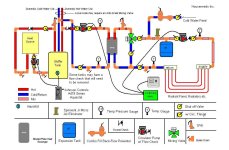
tankless-heat-domestic-water-closed-wm.jpg
The above is the more correct system other things will work. There is however trade offs. They do not show flow control on floor loops. If you do not have antifreeze in your floor you could delete the exchanger.
 
/ 48x39x14 shop build
  • Thread Starter
#253  
Ovrszd,
The manifold in your shop..... not good. You need a manifold that has flow indicator on the inlet and control valves on the outlet. When your system first started up with that manifold there is no way they could have gotten the air out. It will come out over time, due to the air separator, but how long! We maintain you still have air in your tubing in the floor. With that type of manifold the tubing would have to be exactly the same length and same number of bends to get even flow and that is not possible. Make them replace it and bleed it right, now. If you do not when you go to replace anything getting the air out....

For your house ask to see the tubing layout. Then check to make sure it is laid out that way. You do not need a lot of zones if the tubing is laid out correctly, and it is radiant. Also, I would ask to see the plumbing layout, if they do not have either, consider finding another contractor. When a radiate floor system is designed typically the supplier of the components will do it. Your shop looks like someone that typically does plumbing did it. We believe those are potable water manifolds, not radiate heat manifolds.

I appreciate all your comments and concerns.

We got all the air out except a small amount by pushing water thru the system with the floor inlet manifold disconnected from the pump. For the first hour of operation if you listened very closely you would hear small amounts of air moving thru the pump. 12hrs later you hear nothing. Haven't heard any since. It's so quiet you can't hear the pump run.

Why do you think we still have air? Would air in the system be obvious beyond noise at the pump?

And what would be the purpose in a flow indicator and/or valves?

As to the house. It's laid and buried under concrete. The same guy did both floors. He is meticulous about loop length and shape. The house has 3,000ft of pipe covering 2450 sq ft.

What is the difference in brass potable water manifolds versus radiant heat manifolds? What is the impact of those differences? How would I know which they are by looking at them?

I'll stick with my contractors if that's okay with you? Thanks for your concerns though. :)
 
/ 48x39x14 shop build
  • Thread Starter
#254  
Flush the shop system with software water from the house when it is done. If it is not separated from the potable water you should be able to make it that way. Also, model number on shops tankless. We have concerns about the correct flow through the boiler. There should be a separate pump that only circulates water through the boiler. Then there is a pump that circulates through the floor. Then a mixing valve between the two. There could be separate pump in boiler..... just questions we have. What you have there will work, but if you are concerned about long Gevity of the boiler. There is a reason why he is asking you to warranty as DMW. Not trying to bum you out it is just that I wished somebody would have told me this stuff 18 years ago.

How about adding a corrosion prohibitor in the system?

I don't recall ever seeing a system with a separate pump at the boiler and a mixing valve connecting it to the radiant pump? Can you post some pics of yours so we can all learn from this?

You aren't bumming me out at all. Look forward to seeing yoir pics and discussing your system in further detail.
 
/ 48x39x14 shop build
  • Thread Starter
#255  
View attachment 581050
The above is the more correct system other things will work. There is however trade offs. They do not show flow control on floor loops. If you do not have antifreeze in your floor you could delete the exchanger.

How would this design apply to my setup since I'm only providing radiant heat, no domestic use? Which parts of that would be unnecessary?
 
/ 48x39x14 shop build #256  
How would this design apply to my setup since I'm only providing radiant heat, no domestic use? Which parts of that would be unnecessary?
A lot because you are not using anti freeze in your system. Only other question I would have is does your boiler require a guaranteed flow. Provide make and model on the boiler and we will look up.
 
/ 48x39x14 shop build #257  
Wow. A lot here to respond to and I will not be able to cover all of it. As I noted, radiant can become a religious war...

Hard water is the root of all evil with tankless heaters. They warn about it significantly in the manuals, but with all the CYA warnings in there, it is hard to know which ones are real, and which ones are just CYA. This one is REAL. If you are running hard water through a tankless (radiant or DHW) you will have to descale with vinegar or similar on a regular schedule (probably annually, but depends on hardness). Hard water and corrosion are two separate issues. Soft water will not by itself stop corrosion, and corrosion inhibitors will not stop hard water from causing scale buildup. I suspect in a closed loop that you will not need to descale after some point as the minerals would eventually be depleted, but I am not sure how you would know when that point is reached. I doubt you can measure hardness if you have added glycol or corrosion inhibitors to a system. I have no knowledge of this.

Glycol in the system made a significant impact as I noted, but I did it for 2 reasons: Anti corrosion and system survival (freezing). I did make 1 mistake in the shop tubing in that I did not use oxygen barrier tubing. That, I believe, has lead to corrosion causing the filter to plug up and kill my flows several times. That plus if anything bad happened in the winter, it could destroy the radiant system on straight water. The house uses oxygen barrier PEX but I also run it into the garage, so another system survival issue IMO.

The amount of tubing in both the shop and the house was designed by one of the online PEX suppliers based on what I gave them for building specs including insulation, etc. The shop is a slab on grade with R10 below it and a frost-protected shallow footing design for the perimeter. There are 9 loops of 300' 1/2" PEX for a total of 2700' of tubing covering 2560 sf (32x80) in a nominal 5" slab. All lines are within a few feet of each other for total length, so they are pretty uniform. I think it was about 12" spacing, more or less. I do not believe in wasting the time to make runs laser straight as the heat don't care. So they are "straight enough" and cover all the area. It works perfectly fine. I could run a lower temp, it would just run more often. Honestly, the heater comes set for 120F and I left it there. Didn't really put a lot of thought into it, but I will say that the return water comes in pretty cool - closer to 60-65 I think (not 100% on that but sounds about right) in the shop.

Truckdiag - The system you show is very complex and covers both DWH and radiant in a combined system and pretty clearly uses a boiler. Thus the need for the heat exchanger for that whole set of radiant loops. I didn't want to mess with that so I separated DHW from radiant. I have not dealt with boilers directly, but my understanding is that boilers heat the water to very high temps (they gotta call them BOILERS for a reason, no?) and thus require mixing valves to temper the loop water with return water so you aren't sending 180+ deg water to the floors. One of the things that makes using a tankless (or even a regular tank HW heater) work nicely for radiant, is this reduction in complexity. You don't need mixers or other complexity as you can supply more moderate temp water directly. And you don't need additional controls as the tankless lights up when it sees flow (a zone kicks on) or a tank heater lights up when the thermostat says the water temp is low enough to need heat. 120F is not that hot. It violates some radiant engineering rule as I know they like the outgoing and returning water temps to be only like 20 deg different, but it still works. Again that holy war issue...

Zone flow indicators are nice as they help you ensure that you are getting flow in each zone, and you can help balance the zones better. I used a Calleffi manifold in the house system like the link below after realizing how helpful it would have been in the shop, which I did first:
6687M5S1A - Caleffi 6687M5S1A - 1-1/4" TwistFlow Manifold w/ Temp Gauge (11 Outlets)

As for zones, put zones where you want to control the temp. Period. In the shop, it is split in 2, so I have 2 zones. The front is where the garage doors are, so that is best on it's own zone. It is a bit big for only one zone, too. The house is split by what made sense. The great room/kitchen is all one zone. It's one big room, so one zone. Each BR and full bath is it's own zone. And then the remainder as they made sense per the layout. I ended up with 13 total (and 2 got trashed during construction, so 11 in the end), but our house is in the 3600 sf size zone, so it is significantly larger than what you (ovrszd) is building.

Another thing to remember about thermostats is that you should not really trust the readings from them. What I mean is that if you mount 5 thermostats right next to each other you would get 3-5 different temp readings from them. So use the actual number as a guideline to start. Try 68F for example. Not warm enough? Raise it a degree or two, depending on if it seems just a little cool or worse than that. Wait, and check again in a day. Adjust again if needed. When you find the right temp for that Tstat, write it down. One room could be set at 72 and the next room at 70 and they could feel the same. If you replace a tstat, you may need to find a new setpoint. These are not precision calibrated NIST traceable units. They only cost a few bucks... Plus different floor coverings make a difference. So set them where it ends up feeling about right for comfort, and ignore the actual number.

For getting air out, I used a pump (basically a portable submersible pump) and recirculated water through the system, isolating one loop at a time using a large tub for water. the air comes out pretty quick. the air separator takes out minor residual air, but you should check to make sure the pressure in the system stays up for a few days, as you may need to repressurize a bit to compensate for eliminated air. If you have significant air in the system or in a loop, you don't get flow. If you have a nicely heated floor, you have flow. This is where the flow indicators are nice to help debug.

I do believe that tankless heaters are higher pressure drop than boilers (probably - no firsthand experience) based on the relatively low flows I am seeing. i also belive that they make for a simple system and installation.

This is why I do not often post on some of these technically complex issues so much anymore. I feel the need to fully explain what I know and have done, and the reasoning behind it, and it gets to be quite long and takes a lot of time. Plus my knowledge comes from my own experience and reading, which is limited, by definition. I am not a fluids or HVAC engineer (though I am a mechanical/polymer engineer...). There are rules that are sacrosanct (gravity seems pretty solid) and there are rules with more flex (the temp you feed a radiant slab) ...Trying not to turn TBN into a chore, but I also feel the need to share and give back where I can.

If you want more details than you can handle or care about, my house build blog is in my Sig below. Go crazy. It has tons of pics and all of my complaining about crappy subs plus a lot of detail.
 
/ 48x39x14 shop build #258  
Truckdiag - The system you show is very complex and covers both DWH and radiant in a combined system and pretty clearly uses a boiler. Thus the need for the heat exchanger for that whole set of radiant loops.
The exchanger is there because you do not want the gycol going through a tankless boiler or any boiler for that matter. Once again your system working proves that it will work without. You have stated that hard water is the route to all evil in a tankless boiler system. We are saying gycol coming in direct contact with the heat exchanger in the tankless boiler may very well play a bigger roll in tankless boiler failures. He(son) seems to think that the direct contact is causing the gycol to break down. That has been my sons experience and he has replaced a lot and re-piped and installed the exchangers. The buffer tank he did not want to explain or maybe couldn't all I got was a 40 gal electric hot water heater is cheap, why not use it.... I'm not convinced you need it with a tankless boiler and I will not be using one in the barn addition.

"Typical Radiant Heat Floor System Operating Temperatures. Typical radiant floor systems operate at 85 - 125 ーF water temperature entering the tubing, and put the floor surface temperature about 5 degrees above the room thermostat set temperature."
We googled it your water temps seem high especially for your home. I can see higher temps for a shop where you get times of high heat lose. 120 still seems high. My son and I discussed this at length also, a system could be designed for those temps. IMO at those temps it will cause a feeling of on and off or warm and cold in the home and therefore not get the true benefit of what radiate heat has to offer. 80-90 degree water circulating through a concrete slab should keep a home toasty warm, such that you never know it is there. Giving you the true benefit of radiant heat. With radiant heat you can actually set the thermostat lower than with forced air.
 
/ 48x39x14 shop build
  • Thread Starter
#259  
Truckdiag, I don't use a boiler. I don't believe Dave does either.

As Dave explained Boilers heat the water much hotter than a tankless heater.

I didn't think heating to that degree was necessary so chose a heater.

I've got my thermostat on 68F. That's too warm. I'm going to follow Dave's suggestion and adjust one degree every couple days until I find the sweet spot.

I'm building and hanging wood storage shelves today in a T-shirt and am sweating.
 
/ 48x39x14 shop build #260  
Truckdiag, I don't use a boiler. I don't believe Dave does either.

As Dave explained Boilers heat the water much hotter than a tankless heater.

I didn't think heating to that degree was necessary so chose a heater.

I've got my thermostat on 68F. That's too warm. I'm going to follow Dave's suggestion and adjust one degree every couple days until I find the sweet spot.

I'm building and hanging wood storage shelves today in a T-shirt and am sweating.
T-shirt, mid winter with that size of building? Huge success!
 

Marketplace Items

213135 (A64276)
213135 (A64276)
NEW Wolverine ADB-13-1218R, Skid Steer Auger (A62679)
NEW Wolverine...
(INOP) 2022 MACK MD6 WATER TRUCK (A64280)
(INOP) 2022 MACK...
HD Bale Ring w/ Hay Saver (A66408)
HD Bale Ring w/...
New 5400LB, Rachet Binders and G70 Chains (A62679)
New 5400LB, Rachet...
2024 SILVERBACK 53CH3A TRI/A CAR TRAILER (A59914)
2024 SILVERBACK...
 
Top