Thoughts on this used welder?

   / Thoughts on this used welder?
  • Thread Starter
#101  
your dc welds are cold.weld a few passes with the dc turned all the way up.then swap the cables and try a few more.post them and let me look . also clean your welding plugs.i use a car battery brush.check your 220 receptacle and make sure it has enough voltage.

Yup. Cold is exactly what I was thinking when the metal was beading up. Molten metal flows to the heat, so if it is beading up it means that the work piece is not getting enough heat. For what it's worth, I tried turning the welder all the way to its hottest setting, and the results were the same, so I don't think that's the issue. I have also checked the output of the receptacle, and it's dead-on 240.
 
   / Thoughts on this used welder? #102  
Post some pictures of the diodes so we can reference the style and maybe a part #.
 
   / Thoughts on this used welder? #103  
When I first started to bubblegum metal on metal, I bought a too small unit. it was a bear to strike and arc.
Got a bigger unit, but had no power supply.
bought an engine driven one.... lower powered but laid a beautiful bead (for me anyways) until the rod came out the side of the engine.
finally got proper power, and started using the 220 unit. AC only....

here is what I learned as a NOOB!
1) listen to the experienced guys
2) read on proper rods, and use only those to learn on
3) clean the metal well. I like an angle grinder with a brush AND and angle grinder with a sanding wheel AND an angle grinder with a grinding wheel (Yes, I have all three handy.... Learning is easier when you have everything you need handy)
4) play with the lowest settings that will give you nice welds... easy to burn using higher power. Technique reallly develops when you force yourself to pay attention to speed, distance etc...
5) Clean the metal well.
6) Clean the metal well.
7) Auto darkening helmets are GREAT... but don't work well in bright sunshine. Set up a shade of some sort.
8) Welding can be a lot of fun, And VERY useful!

Hope you get the bugs worked out of the DC.
I don't have one, but borrow a Miller Dialarc, and an engine driven straight DC once in awhile, and know DC is nice.
I LOVE the engine driven welder!
 
   / Thoughts on this used welder?
  • Thread Starter
#104  
Post some pictures of the diodes so we can reference the style and maybe a part #.

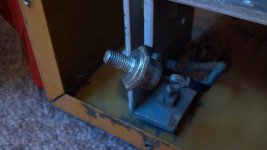
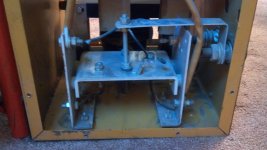
The diodes are labeled IR 70HF30, and then on the other side, 80 32. A little google searching turns up this thread on WeldingWeb. The innards of that welder look identical to mine and the label on the diodes matches.

Photos below show my entire rectifier array, and then a single diode.

2012-09-23 14.21.17.jpg2012-09-23 14.18.03.jpg

Looks like that WedldingWeb thread has links to replacements. That may be my next step. I'm a little befuddled because the diode test function on my multimeter shows a "correct" value of about 4-5 volts for the diodes, but the resistance function shows 2-4 Mega-ohms, which my understanding is should be treated as an open. I don't know how to resolve that. If I had to jump right this minute, I would say, "Well, it doesn't weld right on DC. We know the AC transformer is good. What else could it be than the diodes?" It looks like there is an additional transformer as part of the DC circuitry. Is there some way I can test that? What other tests could narrow down the problem before I just pull out my wallet and cross my fingers?
 
   / Thoughts on this used welder? #105  
The diodes are labeled IR 70HF30, and then on the other side, 80 32. A little google searching turns up this thread on WeldingWeb. The innards of that welder look identical to mine and the label on the diodes matches.

Photos below show my entire rectifier array, and then a single diode.

View attachment 281870View attachment 281873

Looks like that WedldingWeb thread has links to replacements. That may be my next step. I'm a little befuddled because the diode test function on my multimeter shows a "correct" value of about 4-5 volts for the diodes, but the resistance function shows 2-4 Mega-ohms, which my understanding is should be treated as an open. I don't know how to resolve that. If I had to jump right this minute, I would say, "Well, it doesn't weld right on DC. We know the AC transformer is good. What else could it be than the diodes?" It looks like there is an additional transformer as part of the DC circuitry. Is there some way I can test that? What other tests could narrow down the problem before I just pull out my wallet and cross my fingers?

Joshua, that "other transformer" is likely just a choke. In other words a coil with a iron core. An inductor.. Should just have 2 leads.. and they should have a very low resistance, maybe an ohm or less. I would check the diodes by un-soldering one connection to each of them and make sure they conduct one direction (low resistance)and reverse the leads and they should look open. I always use an analog meter, for checking semi-conductors, less confusing that way. I would use the Rx100 scale. Part of being a good diagnostic tech is being totally familiar with your equipment and from checking hundreds of diodes and transistors, knowing exactly what a defective one and what a good one look like on the meter. Easy for me to say, having checked thousands of semiconductors. But if you do have some known good silicon diodes, you could compare them to your International Rectifier 70HF30 diodes to be sure before you invest in new ones. Have you found a schematic for the unit, to verify for sure that this other device is a choke? Hopefully we can get this machine going again and get you some welding practice.

70HF30 - SOLID STATE - DO5 70 Amp Silicon Rectfier | Newark


James K0UA
 
   / Thoughts on this used welder?
  • Thread Starter
#106  
Joshua, that "other transformer" is likely just a choke. In other words a coil with a iron core. An inductor.. Should just have 2 leads.. and they should have a very low resistance, maybe an ohm or less.

I think you're right about that. I will double-check, but I think you're right.

I would check the diodes by un-soldering one connection to each of them

Since the diodes are soldered on on side and bolted on the other, can I just un-bolt the "bolt" side and avoid desoldering? Or do I need to completely disassemble the diode from the array?

Easy for me to say, having checked thousands of semiconductors. But if you do have some known good silicon diodes, you could compare them to your International Rectifier 70HF30 diodes to be sure before you invest in new ones.

Coincidentally, I just a few months ago had to replace the rectifier on a motorcycle, which is basically the exact same thing we're doing here, so I have some idea what a good diode should look like. In that case, though, they gave a specific voltage range that the diode should read on the diode test function of the multimeter. Here, we only have nominal values to go off of. In my previous test, I found the following:

The rectifier bridge has four diodes as near as I can tell. Two of them show 3.3 MOhms through them and 0.44 volts drop using the multimeter's diode test function. The other two show 2.5 MOhms and 0.41 volts drop.

That was with the diodes connected to the array. I un-screwed the nut from one of the diodes and half-way disconnected it from the array (would have to desolder to do the other side) and verified that the result was the same. If I need to desolder the diode and test it on the bench, I can do that too.

Have you found a schematic for the unit, to verify for sure that this other device is a choke? Hopefully we can get this machine going again and get you some welding practice.

No schematic at this time.


Yup--that's the one. Too bad I have to order 100 of them! I found a diode that someone suggested as a suitable replacement. Only difference is that it is 70HF40--400 volts, not 300. I assume that only means it's a bit more rugged and would still be okay.

I wonder if I could increase the reliability of my welder by putting in higher-amperage diodes. Would that be worth considering? It really seems like they are the weak link in the DC duty cycle. They overheat and die, as diodes always do when you overheat them.
 
   / Thoughts on this used welder? #107  
I think you're right about that. I will double-check, but I think you're right.


Since the diodes are soldered on on side and bolted on the other, can I just un-bolt the "bolt" side and avoid desoldering? Or do I need to completely disassemble the diode from the array?


Coincidentally, I just a few months ago had to replace the rectifier on a motorcycle, which is basically the exact same thing we're doing here, so I have some idea what a good diode should look like. In that case, though, they gave a specific voltage range that the diode should read on the diode test function of the multimeter. Here, we only have nominal values to go off of. In my previous test, I found the following:


That was with the diodes connected to the array. I un-screwed the nut from one of the diodes and half-way disconnected it from the array (would have to desolder to do the other side) and verified that the result was the same. If I need to desolder the diode and test it on the bench, I can do that too.


No schematic at this time.


Yup--that's the one. Too bad I have to order 100 of them! I found a diode that someone suggested as a suitable replacement. Only difference is that it is 70HF40--400 volts, not 300. I assume that only means it's a bit more rugged and would still be okay.

I wonder if I could increase the reliability of my welder by putting in higher-amperage diodes. Would that be worth considering? It really seems like they are the weak link in the DC duty cycle. They overheat and die, as diodes always do when you overheat them.

Just the unbolting should be fine for the ohm test. The higher voltage rating will be fine.. In fact more than fine.. better,, as well as a higher current rating would be good. But first lets ascertain for sure that the diodes are in fact defective. They are most likely the culprit, but we need to know for sure.

James K0UA
 
   / Thoughts on this used welder? #108  
Joshua, one thing you could do if you want to rig up a "testbed" is get a 12 volt battery or 12 volt power supply, and at least a #57 lamp (typical old fashioned taillight) or a headlight from an old car, and put the diode in series with the circuit. One direction the lamp does not light at all. the other the lamp lights to near full brilliance (slight voltage drop). Just an idea, should not take too long to set up if you have these things. But this would test these diodes under a little bit of a load.

James K0UA
 
   / Thoughts on this used welder?
  • Thread Starter
#109  
Joshua, one thing you could do if you want to rig up a "testbed" is get a 12 volt battery or 12 volt power supply, and at least a #57 lamp (typical old fashioned taillight) or a headlight from an old car, and put the diode in series with the circuit. One direction the lamp does not light at all. the other the lamp lights to near full brilliance (slight voltage drop). Just an idea, should not take too long to set up if you have these things. But this would test these diodes under a little bit of a load.

Okay. Well, I've got good news. I did as you suggested with a tail-light and a 12 volt battery. I disconnected the post-end of each diode from the array and ran the bulb through it, then used the diode-check function of my multimeter. The results were different! Three of the diodes, the tester showed 0.702 volts. The third one, it showed 0.695. As I understand it, that's dead-on right for silicon diodes. I also checked the resistance of the diodes while the 12 volt bulb was running, and they showed 0.00 ohms. This seems to indicate that all the diodes are working correctly.

I also ran the bulb through the whole rectifier array, with the hot lead clamped on the wire leading into the array and the negative lead plugged into the + lug on the welder, and the bulb lit up brightly.

So... where does that leave us?!
 
   / Thoughts on this used welder? #110  
Okay. Well, I've got good news. I did as you suggested with a tail-light and a 12 volt battery. I disconnected the post-end of each diode from the array and ran the bulb through it, then used the diode-check function of my multimeter. The results were different! Three of the diodes, the tester showed 0.702 volts. The third one, it showed 0.695. As I understand it, that's dead-on right for silicon diodes. I also checked the resistance of the diodes while the 12 volt bulb was running, and they showed 0.00 ohms. This seems to indicate that all the diodes are working correctly.

I also ran the bulb through the whole rectifier array, with the hot lead clamped on the wire leading into the array and the negative lead plugged into the + lug on the welder, and the bulb lit up brightly.

So... where does that leave us?!
So basically the current will only go thru the diode in one direction and not the other, that's important.
The voltage drop across the diode looks good. They usually fail by shorting or open circuit. Open would have full voltage drop across it in either direction and short would be no or very little drop. Sometimes, as James, alluded to, they will appear to be ok until a decent amount of current is passing.
 
   / Thoughts on this used welder?
  • Thread Starter
#111  
Sometimes, as James, alluded to, they will appear to be ok until a decent amount of current is passing.

When you say, "a decent amount of current," are we talking about the few amps of the tail-light, or are we talking about the 50+ amps of the welder? If the latter, it seems that one test that could be performed would be to get a rod that is designed to work at the welder's lowest setting, to see if that improved things. But honestly, other than shorting the leads through a resistor (would have to be a mighty big resistor to resist the welder's amperage) and then measuring the voltage drop through the diode, I don't know how one could detect a diode that was only failing under heavy load like that.
 
   / Thoughts on this used welder? #112  
When you say, "a decent amount of current," are we talking about the few amps of the tail-light, or are we talking about the 50+ amps of the welder?
Sure, like James said to use as a test. Sometime the current flow used in diode testers won't reveal a problem so i would think a few amps would be a good test. Technically, a diode current flow may change at any and including a damaging voltage/current. I've seen larger diodes, like the ones used in the rectifiers of something like a welder have even had mechanical problems that don't show up until heated or cooled but those typically are situations where the problem is transitory.
 
   / Thoughts on this used welder? #113  
I am pretty convinced that the diodes are good, If they pass a fair amount of current (couple of amps) one direction and none the other way, and show the proper .7 volts of drop.. yeah I think they are OK. So does current flow thru that choke? Connections clean on the sockets and plugs? I am starting to run out of ideas here... something else causing a voltage drop out of the transformer?

James K0UA
 
   / Thoughts on this used welder?
  • Thread Starter
#114  
Well, I think if we can conclude the diodes are good, I am going to call that a good pausing point for now. I am actually just about to be without Internet from Wednesday of this coming week to next Monday, and I'd hate to leave y'all hanging in suspense! More troubleshooting when I am back.
 
   / Thoughts on this used welder? #115  
I do not feel the 50 amp machine will provide any comfort at all. Try for one of the 180 to 250 amp machines that will have to amperage you need for all work. Remember that size of electrodes determine necessary amperage and not the thickness of metal you are welding. Thicker metal requires more passes but a battleship can be built with 1/8" electrodes if you have the patience. If funds are available, go with a 220 amp machine and have the power when you need it. Welding is my passion so I tend to go for the better side of needs rather than the get by side.
docgrubbs
 
   / Thoughts on this used welder? #116  
I use a little Hobart Stickmate LX. This is an AC/DC buzz box 230A on AC and 165A on DC.
I have built some tractor stuff made from 1/2" 4" angle and it is fine with multiple passes and 5/32" 7018 on the 1/2".
I have done as a low limit for me 14 gauge using 3/32 7018 it's basically hunt and peck at 50A or so.
My eyesight is not good anymore so it is hard to do a good clean weld because I have problems viewing the puddle.
New this machine can be had for around $400.
If you can find one look for a used Lincoln Idealarc; one of the best stick welder ever assembled especially if you want a serious high current (300A) welder but a used one cost more than a new Hobard stickmate.
I was watching a 6.875 natural gas main going in the other day. I questioned the welder and observed the equipment.
On schedule 40 gas line he was running 160 +- amps using 5/32 6012 rod. I ask about 7018, he said it was not necessary and cost too much for him!
This is a 360 degree weld, so it a portion that is overhead, out in the open field. No jigs no fancy adapters no nothing except a man a stick and a helper to run the wire brush.
Really wish I could have learned to weld like that.
He was running an old Hobart 400A amp gas powered welder.
Every weld has to be xrayed he said normally he is running 99% pass but there are times when things just don't go right and welds run at 50% pass.
Just goes to show that welding is an art that people with all the practice in the world never consistantly get to 100%..
 
   / Thoughts on this used welder? #117  
A bonded 3 wire appliance will not energize grounds, this is from the service main its bonded at the panel, all service mains, new or old. Josh has his 3 wire dryer correct, must be bonded. One other thing,, in a 120V circuit the white is not a neutral, it lands at the service main connected to a neutral, as part of a 120V it is a grounded conductor. A ground wire ends up back at service main also but is insulated from the grounded conductors, this keeps current from flowing on the chassis.
 
   / Thoughts on this used welder?
  • Thread Starter
#118  
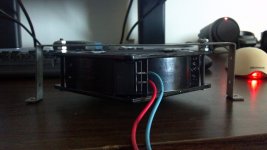
Well, I'm back from my trip, and I have a small update. I got the new fan installed! It came with no leads, so I just soldered on the leads from the dead motor. I will always be thankful to my dad for teaching me to solder years and years ago. It has come in handy more times than I can say.

I had to put the fan on the opposite side of the mounting bracket, in order to leave room for the amperage slider to go up and down. To keep the airflow going the same way and to keep the fan from rubbing on the bracket, I shimmed it out with some extra nuts that I had laying around. I also re-used the bolts that held the original fan on.

2012-10-05 15.21.36.jpg

On suggestion of the Internet, I also rewired the fan so it is on the service side of the welder's main switch. This keeps the fan running even after the welder is shut off, so that it continues to cool the transformer. I find this particularly useful because I usually turn the welder off in between rods, just to keep any little accidents from happening. I know this may not be strictly necessary, but at least until I am more familiar with the process, it makes me a little more comfortable.

EDIT TO ADD: An additional benefit, at least while I'm jacking around inside the darn thing, is that the running fan serves as a reminder that the welder is plugged in, and the service poles of the main switch are hot. At least once, I have gone to reach inside the box while it was plugged in and had to smack myself when I realized what I was about to do.

Here it is, working away!

 
Last edited:
   / Thoughts on this used welder?
  • Thread Starter
#119  
Also: now that it's the 1st, I have a bit of pocket money again, and will probably buy an auto-darkening helmet. Maybe also a small box of fresh rods, just to rule that out as a possible cause of the DC problems.
 
   / Thoughts on this used welder?
  • Thread Starter
#120  
I got an auto-darkening helmet today, and boy howdy is that a treat. Only thing is, now I have to remember to make sure it's turned on again when I get done grinding. There's an accident waiting to happen. Maybe I should use a different face shield when I grind. So far, I just look away and tap the work piece to confirm that the lens darkens before I start welding in earnest.

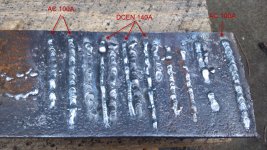
Anyway, here's today's work.

2012-10-06 17.43.32.jpg

I went out and bought a brand new box of 1/8" E6013 just to rule out bad rods as a source of my DC problems. All of the above beads were run with those rods. I was able to consistently get a DC arc struck, but I had to run the welder all-out at 140 amps to do it, which seems higher than would normally be recommended. The DC beads also seem taller than they should be, to my amateur eye. Bear in mind this is on a piece of about 3/8" thick T-stock, if that's relevant. On the AC side, I think the 6013 runs a little nicer than the 6011 I was using, although the auto-darkening hood and my slight increase in experience probably play in.
 

Tractor & Equipment Auctions

2025 CE SB05 Hydraulic Breaker Mini Excavator Attachment (A59228)
2025 CE SB05...
2019 KENWORTH T680 TANDEM AXLE SLEEPER (A59905)
2019 KENWORTH T680...
2006 Acura RL Sedan (A59231)
2006 Acura RL...
2023 CATERPILLAR 120 MOTORGRADER (A60429)
2023 CATERPILLAR...
2020 Peterbilt 367 Weldco Hydra-Lift WHL45TC100 45 Ton Tri Axle Telescopic Crane Truck (A55973)
2020 Peterbilt 367...
2016 CATERPILLAR TL1055D TELESCOPIC FORKLIFT (A60429)
2016 CATERPILLAR...
 
Top