Trailer Winch Wiring

/ Trailer Winch Wiring
  • Thread Starter
#61  
To the lad who wants to pull a race car with a 3400# ATV winch, realizes that 3400# is on the first roll of the cable on the winch drum.Just a thought, don't know if you knew that or not.

Most 3400 pound winches will pull a 3500# car up a trailer ramp with ease. Rolling load, small incline.

I cancelled my eTrailer order. Went to Northern Tool and bought a Warn 4000# utility winch. Ordered a cheap wireless remote from Amazon that I will wire into the solenoid. I ended up spending about $75 more dollars but probably got a better winch than the eTrailer "Bulldog". The remote from eTrailer looked better and was plug-in-play but twice as much as the Amazon one. All of this stuff, including the Warn, is made in China.

Going to get my trailer so I can install the ingenious bolt-on removable mount that I referred to earlier. If it works, I am brilliant. But, I've felt brilliant before many projects that I felt like an idiot after the project. We'll see. Will post results in a separate thread.

I will order cable and such on my truck once I get the winch installed.

One of the big differences in the Warn vs the eTrailer Bulldog winch is amp draw. The Bulldog winch draws #350 amps at maximum load. The Warn draws #140 amps at maximum load. Granted, the Warn is rated at 4000# and the Bulldog is rated at 4400# but that is a big difference in maximum amp draw. I think I will be fine with 4 AWG cable and a 200 amp fuse.
 
/ Trailer Winch Wiring
  • Thread Starter
#62  
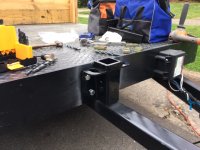
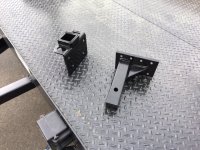
Okay, here is my little bolt-on solution for a removable winch mount. It required two parts from Northern Tool. The first part is a box hitch receiver made to bolt on the underside of a step bumper. It is a fairly beefy part. The second part is a pintle hitch adapter that fits in a box receiver. It is very beefy; too much so in fact. The shaft is solid steel and it is heavy and makes the whole winch assembly heavy when moving it. Both parts are shown here and cost about $65:

IMG_0595.JPG

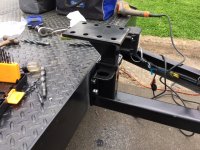
My trailer has a fairly thick , 6" high panel across the front. I drilled holes and mounted the hitch receiver facing up as shown:

IMG_0597.JPG

The pintle adapter just drops down into the hitch receiver. The winch will be mounted on the pintle plate:

IMG_0598.JPG

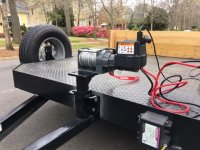
Here is the whole thing in place. Works really well and when the winch is removed there is nothing on my trailer deck and nothing in the way. Winch can be locked in my toolbox or a locking hitch pin can make it secure when in place.

IMG_0599.JPG

Problems: 1) Ruined a handful of cheap drill bits drilling through the thick pintle plate and took a good 30-40 minutes. No big deal. 2) Pintle adapter is heavy and makes the whole thing heavy. 3) There is still no way to hook the thing up to my truck hitch receiver since it would be oriented wrong if I used the pintle adapter shaft. I will solve this problem with a hitch mount made for winches. It will mount between the winch and the pintle plate. It will have handles (which will help with the awkwardness and a hitch shaft that projects rearward, about $50.

A lot of trouble and expense but it keeps the winch off my trailer deck, makes it removable and able to use it on the back of my truck as well. If I had welding capability Icould have fab'ed up something cheaper but probably not as neat.

Wireless remote arrives tomorrow.

Will put wiring harness in truck sometime next week. Total project about $500.
 
/ Trailer Winch Wiring #63  
The winch's max draw is 350 amps.

I read through this jumbled mess up until this point. Post #38. Four pages to get to the first mention that I could find of the most important fact that needs to be known before any talk of wire size makes any sense.

Until you know the current draw (amperage) and the length of the conductor, you have no businesss talking about wire size.

Once you have that, you can look up tables that will tell you the correct wire size. There's no room for, "I think this should work....".


N80, the reason you have gotten so much conflicting information (as you mentioned), is that most people are in the same boat as you - they don't understand electricity. Nothing wrong with that - we can't all be experts at everything. The problem comes in when people who have no understanding start throwing around uneducated opinions. "I did it this way!" "Some guy told me to do it that way!"

I didn't see how this discussion finally wound up, but I'll just comment on the fuse issue. If you are sure that you can smell the smoke, get to the hood release latch, release it, pop the hood, and throw the disconnect switch before a fire starts, go ahead and use a disconnect switch instead of a fuse. On the other hand, if you are mortal and you don't live in a perfect world where everything always goes right, go with the fuse. 400 amps, not 350. You want some headroom for what is called, "inrush current".
 
/ Trailer Winch Wiring
  • Thread Starter
#64  
I read through this jumbled mess up until this point. Post #38. Four pages to get to the first mention that I could find of the most important fact that needs to be known before any talk of wire size makes any sense.

Until you know the current draw (amperage) and the length of the conductor, you have no businesss talking about wire size.

That's the point of a thread like this. I started knowing nothing at all about how to do this. Now I've got a pretty good idea.

Once you have that, you can look up tables that will tell you the correct wire size.

Well, sort of. The tables I was able to find say very little about duty cycles etc. so they don't really address the actual application all that well. Granted, they would lead you to larger wire sizes, but that can be unnecessary and pretty expensive too.

The problem comes in when people who have no understanding start throwing around uneducated opinions. "I did it this way!" "Some guy told me to do it that way!"

Its usually not that hard to sort out the good advice. And sometimes it can be harder to sort out the overkill advice.

I didn't see how this discussion finally wound up, but I'll just comment on the fuse issue. If you are sure that you can smell the smoke, get to the hood release latch, release it, pop the hood, and throw the disconnect switch before a fire starts, go ahead and use a disconnect switch instead of a fuse. On the other hand, if you are mortal and you don't live in a perfect world where everything always goes right, go with the fuse. 400 amps, not 350. You want some headroom for what is called, "inrush current".

It hasn't wound up yet because I'm not done. It has been my intent to put a fuse in. Not 400 or 350 in the case of this winch since max draw is less than 200. If I do a switch it will be in addition to the fuse but I probably won't.

Just talked to a buddy this evening who is a welder and just installed a (similar) winch on his vehicle. He told me about a local welding shop (that I was not aware of) with better wire prices (good, flexible, all copper) than what I'm seeing on the internet. I'll head over there next week.
 
/ Trailer Winch Wiring #65  
Well, sort of. The tables I was able to find say very little about duty cycles etc. so they don't really address the actual application all that well. Granted, they would lead you to larger wire sizes, but that can be unnecessary and pretty expensive too.

Forget duty cycles. Pay attention to voltage drop.


It hasn't wound up yet because I'm not done. It has been my intent to put a fuse in. Not 400 or 350 in the case of this winch since max draw is less than 200. If I do a switch it will be in addition to the fuse but I probably won't.


Earlier you said it was 350. ??


A welder is probably a great bet for wire at cut rates. Just in case, though, compare them against BestBoatWire.com. Good stuff.
 
/ Trailer Winch Wiring
  • Thread Starter
#66  
Earlier you said it was 350. ??

Different winch. But I quoted the wrong specs for the winch I actually bought. Max amp draw is 250. Still, better than 350 of the first winch I was considering.

This puts me back in the 2 AWG wire range rather than 4. About $75 bucks on Amazon with ring connectors included.

A welder is probably a great bet for wire at cut rates. Just in case, though, compare them against BestBoatWire.com. Good stuff.

Thanks I'll check them out.
 
/ Trailer Winch Wiring #67  
I have found that most of the off brand winches made in china have higher amp draws than the name brand winches made in china. I think you are ahead buying the warn over the E trailer off brand .
I can't remember the size welding cable I used. I have been able remove it when I've traded trucks and install it on others.
 
/ Trailer Winch Wiring #68  
Get another piece of 2" receiver tube.
Remove the winch from the plate its currently on.
Weld the 2" receiver tube to that plate in the same orientation as the one on your truck.
Use the winch mount for receivers that you are going to get, and mount the winch to it.
Now you can use it in your truck, or on the trailer adapter, and it will always be in the correct orientation, and you can remove the stand from the trailer when not needed, as you wish.

Make sense?

I just welded a tube to my trailer last fall so a friend could use a portable winch mount on my trailer. I have a 6" high bumper bar across the front of my trailer, so I welded it to the top of that and put a brace under it to keep the bumper from bending when pulling.
 
/ Trailer Winch Wiring #69  
Different winch. But I quoted the wrong specs for the winch I actually bought. Max amp draw is 250.

Okay, so go with a 300 amp fuse, and you'll be good. You never want to size your fuse for the maximum draw, you need some headroom.
 
/ Trailer Winch Wiring #70  
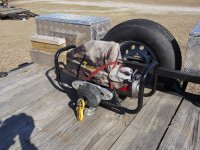
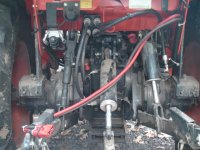
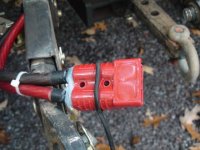
Here is my setup. All of my standard jumper cables are 1 gauge CCA or solid copper 25' in length, with Anderson type QDs on both ends. My truck and Jeep batteries also have mating QDs and winches mounted. And the jumper cable alligator jaws also have QDs. Very flexible setups.

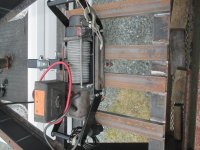
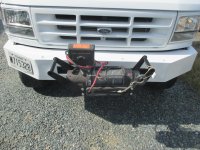
My 20+2 equipment trailer has a 9k# winch in a portable mount. The winch was used recently used to pull an old Ford tractor with low/flat tires that had been sitting in a field for quite awhile. Lots of physical resistance that really tested the 9k# winch setup. Less capable winches would be okay for ideal situations with a rolling load on a hard surface.

I welded a truck step bumper 2" 5000# receiver to the trailer's front structural assembly. I would not consider using less than 2 gauge battery cable and 0 gauge would be better as the available voltage drops the longer the cable is due to wire resistance. And for the most part, the larger the cable diameter the less resistance to current flow.

Added photos of tractor/winch setup. All the same wiring principle.

_EM51610.JPG_EM51612.JPGDSC00601.JPGDSC00603.JPG
 
/ Trailer Winch Wiring
  • Thread Starter
#71  
Get another piece of 2" receiver tube.
Remove the winch from the plate its currently on.
Weld the 2" receiver tube

I don't weld.

But, I had some old 2" receiver tubing lying around so I cut it to length and bolted it coming off the back of the pintle plate to hook onto my truck. Works well. A bit awkward but free.
 
/ Trailer Winch Wiring
  • Thread Starter
#72  
Here is my setup.

Nice. I've got to learn to weld. Although, I'm actually pretty pleased with how this turned out.
 
/ Trailer Winch Wiring #73  
Here is my setup. All of my standard jumper cables are 1 gauge CCA or solid copper 25' in length, with Anderson type QDs on both ends. My truck and Jeep batteries also have mating QDs and winches mounted. And the jumper cable alligator jaws also have QDs. Very flexible setups.

My 20+2 equipment trailer has a 9k# winch in a portable mount. The winch was used recently used to pull an old Ford tractor with low/flat tires that had been sitting in a field for quite awhile. Lots of physical resistance that really tested the 9k# winch setup. Less capable winches would be okay for ideal situations with a rolling load on a hard surface.

I welded a truck step bumper 2" 5000# receiver to the trailer's front structural assembly.

i just finished doing something similar.... i've never thought i/of doing it the way the OP did (and now it won't work with my tube on the car trailer). as for wiring i have an extra battery that i use and if i need more juice i have a set of long heavy duty jumper cables I can run to the truck battery

IMG_1390.JPG

IMG_1207.JPG
 
/ Trailer Winch Wiring
  • Thread Starter
#74  
I've ordered my wire and connectors for wiring up to my truck battery. Got all copper 2 AGW wire, a 300 amp fuse and holder, Anderson style quick connect and some ring terminals.

So my first problem is this: How do I cut 2-AWG wire?

My second problem is this: Crimping vs soldering wire ends on (ring terminals and Anderson terminals). I do not have a crimp tool that large. My soldering iron is cheap and I'm terrible at it. So here is a question: Could I make a DIY crimp tool out of a vice? I'm thinking that a nail on either side of the connector then squeezed in the vice. Would this work? Or, I might just have to buy a soldering gun but even the Weller guns like at the big box stores ($25-$30) get so-so reviews. Would prefer not to buy a crimp tool ($40) that I'll never use again. Would prefer not to spend $30 on a soldering gun that I wouldn't use often and which wasn't very good to begin with.

Open to suggestions here.
 
/ Trailer Winch Wiring #75  
Use a propane torch to solder them.

Cut with good bolt cutters, hack saw, whatever.
 
/ Trailer Winch Wiring
  • Thread Starter
#76  
Use a propane torch to solder them.

Cut with good bolt cutters, hack saw, whatever.

I've got bolt cutters. No torch. I bought a bunch of ring connectors so I might try my DIY vice crimp tool or my sorry soldering iron.

The more time I spend on TBN the more I realize I don't have nearly enough tools.....and I have a lot of tools....
 
/ Trailer Winch Wiring #77  
I've got bolt cutters. No torch. I bought a bunch of ring connectors so I might try my DIY vice crimp tool or my sorry soldering iron.

The more time I spend on TBN the more I realize I don't have nearly enough tools.....and I have a lot of tools....
For a torch, just a basic 10 or $15 one from Lowe's, Home Depot or wherever should work fine. Just needs to be a basic propane torch.

Aaron Z
 
/ Trailer Winch Wiring #78  
Use a propane torch to solder them.

Cut with good bolt cutters, hack saw, whatever.

Yup on the propane torch. I just went through this process last summer. Bought a bunch of Anderson style connectors off eBay and Amazon, a lot of #6 copper wire, a lot of #2 wire, some #6 jumper cables, a Harbor Freight Hydraulic Wire Crimping Tool (about $40 after discount), a pair of HF 10 in. Cable Cutters, miscellaneous ring ends etc.

I then proceeded to make about 5 different "cable sets" so I have flexibility to hook up my different vehicles and winches (I've a little 2.5K and a 12K) all which require drastically different lengths of cable.

Matter of fact just used a set today with the small winch.

The HF $40 crimper works well, but note although it may fit #0 gauge wire it definitely does NOT fit over the terminal that goes over the 0 gauge wire to insert into the connector.

I wanted the crimper to get better crimps on a lot of #6 through #10 stuff I'm wanting to do. If I was only going to do a few crimps it wouldn't have been worth it.
 
/ Trailer Winch Wiring #79  
I've ordered my wire and connectors for wiring up to my truck battery. Got all copper 2 AGW wire, a 300 amp fuse and holder, Anderson style quick connect and some ring terminals.

So my first problem is this: How do I cut 2-AWG wire?

My second problem is this: Crimping vs soldering wire ends on (ring terminals and Anderson terminals). I do not have a crimp tool that large. My soldering iron is cheap and I'm terrible at it. So here is a question: Could I make a DIY crimp tool out of a vice? I'm thinking that a nail on either side of the connector then squeezed in the vice. Would this work? Or, I might just have to buy a soldering gun but even the Weller guns like at the big box stores ($25-$30) get so-so reviews. Would prefer not to buy a crimp tool ($40) that I'll never use again. Would prefer not to spend $30 on a soldering gun that I wouldn't use often and which wasn't very good to begin with.

Open to suggestions here.
Standard electric solder gun woudn't touch it. You need propane torch. Crimping in a wise will not work well either. The idea is to have air tight conection and that would require pressure from all sides like crimping tool does.
Soldering is by far the most reliable connection. Heat the connector, give it dab of flux and saturate the end of cable with the solder. Alternatively you could use gas cooktop, gas grill etc. to heat it up.
 
/ Trailer Winch Wiring #80  
16 Ton Hydraulic Wire Terminal Crimper Battery Cable Lug Crimping Tool W/dies 16 Ton Hydraulic Wire Terminal Crimper Battery Cable Lug Crimping Tool W/dies - - Amazon.com I'm sure it's the same as the Harbor Freight crimper. Not great, but plenty to do a few crimps occasionally & is only $40. The hammer type crimpers or a vice won't do a good job crimping. Their crimps aren't air tight, damage the cable & result in a mechanically weak connection. You are better off soldering than using an improper crimp (not that soldering is the best way to do it).

A good lug that is sealed so there is only 1 opening (for the cable) that is properly crimped & then covered in heatshrink won't expose any cable at all. Corrosion is sealed out & the extra heatshrink support helps with strain relief a bit.

In high vibration environments especially, crimping is a superior connection to soldering. It creates an air tight connection between the wire & lug that is stronger than one made out of tin & lead, which are notorious for being soft metals. Also it lets the cable move & flex immediately after the crimp. Solder will wick up the cable a significant distance & turn your soft flexible stranded cable into a solid cable that will be much more prone to fatigue & breakage.
 

Marketplace Items

2010 Toyota 7FDKU40 7,350lb. Straight Mast Diesel Forklift (A60460)
2010 Toyota...
2010 MULTIQUIP 25KW GENERATOR (A58214)
2010 MULTIQUIP...
1998 Ferguson 46B Compactor / Roller (A62613)
1998 Ferguson 46B...
New/Unused Electric Golf Cart (A61166)
New/Unused...
2006 Mercades GL Sedan (A60352)
2006 Mercades GL...
2020 MACK GRANITE (A60736)
2020 MACK GRANITE...
 
Top