trail clearing technique and tools

   / trail clearing technique and tools #581  
That will change your life.
 
   / trail clearing technique and tools
  • Thread Starter
#582  
That will change your life.
I've used mowers on trials before, and this summer our current trails were mowed. Here is a DR mower we used for like 8 years.
Grizzly mowes tower (DL).jpg
 
   / trail clearing technique and tools
  • Thread Starter
#583  
Here is some maple shoots we cut this past week. Snow loads do this to nearly all trees here.
P1130171.jpg
 
   / trail clearing technique and tools
  • Thread Starter
#584  
We are under pressure here :)... Last night we applied for $20,000 in grants.
1665921686305.png
 
Last edited:
   / trail clearing technique and tools #585  
Good luck Arly-hope you get the grant.
 
   / trail clearing technique and tools
  • Thread Starter
#586  
Good luck Arly-hope you get the grant.
Grants are announced on the 15th of this month. We asked $$ for a mower, snow plowing, general operational costs and making the parking lot, into a real one. Here's what it looked like last spring. Might get all the $$, none, or some part of it. If we don't get any, we might not be grooming this winter. A&S can not not pay for it all again..... :(
parkinglot50853.jpg
 
   / trail clearing technique and tools #587  
I know it's difficult to make trails wheelchair accessible, but when you can, it's a cool thing. Wheelchair friendly trails are also stroller friendly. If you have any candidates for that, it might open up other grant opportunities.

 
   / trail clearing technique and tools #588  
I admire all you are able to do with just hand power tools. I would be totally exhausted, and unable to make sufficient progress to keep up.

Much of what I'm doing currently is creating "new" trails, and that's a bunch different vs maintaining existing trails. I'd be interested in comparing techniques, understanding there will be differences since I'm more mechanized, but we might learn from each other.

Most of my trails are old logging roads and skid trails. Some are 50-100 years old, and others 10-20 years old. And all have grown over in to widely varying degrees.

This first challenge is locating the trail. Sometimes it's easy and obvious, but a lot of times they are pretty hard to see because of how much they have grown over. Logging trails also generally fan out from a log landing, all dead ending near a property line or the edge of the area that was logged. That leaves trails that can get you lots of places, but dead ends aren't very interesting, so a big challenge I find is deciding which trails to use, and how to connect them in a useful and interesting way.

The first step I take is to map out at least the major trails until I have access to most parts of the lot. I'll only spend as much time as required to get them mapped, and do minimal clearing. All too often I'll reach a dead end, or discover a better trail to get to a particular area, so by doing as quick a survey as possible I can focus the more time consuming work of clearing on the trails that I actually want to use. I'll also often start with a vision for how I want the trails to run, only to change that as I discover what's already in place. Maybe I'm trying to make a loop, or create a trail to the summit of a hill top. Or connect a trail on one parcel through to a trail on another parcel.

When I map the trails I will typically use both a GPS track, and flagging to mark the trail. I find that once you are in the excavator clearing stuff, it's easy to lose track of which way the trail goes and find yourself pushing off in the wrong direction. The flagging makes it a lot easier to follow since otherwise you have to keep stopping and hiking around to re-find the trail. With just the GPS track you can get too far off before you know it.

The hardest trails to create are completely new one, so I try to keep that to a minimum. But when there are adjacent parcels, each with logging trails up to their boundaries, their ends will be close, but not connected. Tying them together to create a loop or trail that actually goes somewhere requires creating a new connector segment. That usually means removing larger trees, and dirt work to level and grade. I try to minimize both, but there is always some amount required.

More to follow in another post...
 
   / trail clearing technique and tools #589  
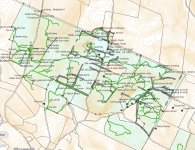
What do you use for GPS? I use either GiaiaGPs or Huntstand to map the trails and tune up stand locations in a Paint app. Here is our 80 acre hunting area.

1666042479724.png
 
   / trail clearing technique and tools #590  
I have tried different levels of construction for trails, and finally settled on what works best for me. For trail use, I want them to be usable for foot traffic, bicycle traffic, and ATVs or side by sides. I don't allow motorized traffic other than by permission for a couple of neighbors who I know are careful operators. Otherwise the trail damage is too great.

But the bigger demand on the trails is both my mechanized building of them in the first place, plus maintenance. I have learned over the years that when I go through to clear a trail, I should cut it back as far as the machines will comfortably reach, and take out all saplings and trees and branches that are reaching into the trail. Beeches are the worst. They want to grow horizontally right into the trail, so I'm very aggressive about nuking them.

I also want the "roadbed" to be wide enough and clear enough that subsequent maintenance can be done with a brush hog in two passes, one out and one back. That makes it really easy to maintain the trails for about 5 years before things have choked in from the sides enough to need another pass with the mulcher. I also try to level the trails so it's not uncomfortable or too tippy to ride them on a side by side since that's how I get around on them.

Stream crossings are common, so I end up having to install culvert pipes. If traffic is very light you can ford small brooks, but I find the damage accumulates, so I usually just put in culverts. And in general, water control is important, especially in steep terrain of which I have quite a lot. Loggers put in water bars when the close out the trails, and I try to preserve most of them, but often have to reconfigure them a bit so they are more passable. And I have had to add a bunch, especially on any longer runs where water flow builds up. If you don't have good water flow control, the trails will wash out really quickly.

All this has evolved into a set of mental guidelines for trail construction.

Next, the actual process of creating the trail....
 
   / trail clearing technique and tools #591  
What do you use for GPS? I use either GiaiaGPs or Huntstand to map the trails and tune up stand locations in a Paint app. Here is our 80 acre hunting area.

View attachment 766711
I've been using Gaia as well, and have historically been doing my map work in ArcGIS. But recently I switched to QGIS for mapping which I really like. I haven't tried it yet, but it's available to run on an iPad so my goal is to get map creation and field work all on a single platform. So far that has been elusive, but I'm optimistic that I am close to getting there.

Here's an example map with top lines. I can also overlay on sat photos, etc.

sample.jpg
 
   / trail clearing technique and tools #592  
I like doing the planning and mapping. I probably have 40% more trails than I originally planned, but when I finish one, I think "just one more" ...
 
Last edited:
   / trail clearing technique and tools
  • Thread Starter
#593  
We had our Stihl BR-800 C-E MAGNUM leave blower on the trails today. This is a powerful machine and we should have got one years ago. This beast will blow wet leaves, rocks and branches off and the dogs will stay clear of its blast! :ROFLMAO: .
P1130276.jpg
P1130212.jpg
P1130230.jpg
 
   / trail clearing technique and tools #594  
I've never used one of those blowers. Can you switch back and forth left hand right hand? I imagine there's a bit of pressure pushing on you, and may tire the arm some.
 
   / trail clearing technique and tools
  • Thread Starter
#595  
I've never used one of those blowers. Can you switch back and forth left hand right hand? I imagine there's a bit of pressure pushing on you, and may tire the arm some.
No, since the air tube goes to ones right, I can't see how to use it with your left hand. :unsure:
 
   / trail clearing technique and tools #596  
Make handlebars, like a brush cutter, but offset a bit.

Bruce
 
   / trail clearing technique and tools #597  
I've never used one of those blowers. Can you switch back and forth left hand right hand? I imagine there's a bit of pressure pushing on you, and may tire the arm some.
I haven't used one either, but from what I see the air rushing out of the tube will push it backwards and possibly put a torque on the whole person, but the hand it more just directing the flow left/right/up/down. Seems like it would be a lot less stress than using a hand-held blower where the entire stabilization requires the whole arm from the wrist on up - the handheld induces stress everywhere even just holding it steady, while I'd think the backpack unit wouldn't affect the arm much except to move the nozzle around? @ArlyA will have to tell us ;)
 
   / trail clearing technique and tools
  • Thread Starter
#598  
I haven't used one either, but from what I see the air rushing out of the tube will push it backwards and possibly put a torque on the whole person, but the hand it more just directing the flow left/right/up/down. Seems like it would be a lot less stress than using a hand-held blower where the entire stabilization requires the whole arm from the wrist on up - the handheld induces stress everywhere even just holding it steady, while I'd think the backpack unit wouldn't affect the arm much except to move the nozzle around? @ArlyA will have to tell us ;)
Here is some "close ups" of the blow tube and its controls. I'm not seeing how "handle bars" would change this setup to be on your left. This machine does indeed push back and twist on the operator but I got used it in about 3 steps. The controls are nice and require little effort.

blower30256.jpg
P1130285.jpg
 
   / trail clearing technique and tools #599  
Handlebars wouldn't put it on the left, but would somewhat share the load with both arms.

Bruce
 
   / trail clearing technique and tools #600  
Handlebars wouldn't put it on the left, but would somewhat share the load with both arms.

Bruce
I think handlebars would actually increase the load for both arms in this case, because there's so little load in the first place and handlebars have mass of their own.
The end of the blower controlled by the right hand is lightweight and most of the thrust goes to the backpack.
 

Tractor & Equipment Auctions

2446 (A60432)
2446 (A60432)
2014 AMERITRAIL LAY FLAT HOSE TUGGER TRAILER (A58214)
2014 AMERITRAIL...
2022 FORD F-250 STX CREW CAB TRUCK (A59823)
2022 FORD F-250...
2020 DRAGON ESP 150BBL ALUMINUM (A58214)
2020 DRAGON ESP...
2015 Freightliner M2 106 AWD Altec AT37G 37ft. Insulated Bucket Truck (A60460)
2015 Freightliner...
New/Unused Quick Attach Bale Spear (A57454)
New/Unused Quick...
 
Top