Question about steel strength??

   / Question about steel strength?? #121  
go sit on LD1's 1100 lb bush hog that'll clear it up! :laughing::laughing::laughing:
 
   / Question about steel strength?? #122  
I may have to change my opinion! I think I will do a little more work on it first before I do so, just to be absolutely sure. (I'm stubborn!) Either way, I'll be back to either gloat or eat crow.


At least you are thinking about it again.

I know there have been many threads on the topic, and many people just a stubborn. If I may ask, what was said that finally convinced you to think about this again? I know there have been many different examples and wording of basically the same thing.
 
   / Question about steel strength??
  • Thread Starter
#123  
LD1...A battle almost won! Almost had to take this one outside.

Working on final design/material list and have a couple of questions.

For the forks, how do the strenght comparrison numbers differ between a
3x2 x 1/4 wall.... and a.... 3x2 x 3/16" wall?

Receivers: What dimension can be used for the receivers for the 3x2" forks?
I see a 3.5x2.5 x 3/16" tube which will leave an 1/8" gap...gap too large?
3/16" thickness may not be strong enough for the receivers?

Or, I could build receivers out of two 4.5" steel plates with welded 1/4" dividers.
Would the weld joints along the dividers get in the way when sliding the
forks in and out of the receivers?

1/4" thick plates strong enough for the receivers?

Thanks
 
   / Question about steel strength?? #124  
John, since you are building your own, consider this design.

It would be lighter than all the extra receivers. You can still make the forks from tubing.

P3250012.JPG


P8080003.JPG
 
   / Question about steel strength?? #125  
think about how a forklift mast works. shifting the load farther out on the forks doesnt increase the downward force on the hydraulic cylinder. But does increase the forces on the rollers.

This is a good example. If the input distance is the same as the output distance, the leverage, and thus the forces, are the same. (incremental!)

In reality the 3-pt actuator mechanism produces a position-dependent output, and the unequal lengths of the //ogram produce another position-dependent output too, but the basic premise of the forklift mast-vs-//ogram is a good comparison.

========================

As said before 3x1.5x3/16,,,,, the i4=.466 and 2x2x1/8 was .456, these sections have the same bending strength. 3x1.5x1/4, the i4 is .541, strength increase of 18% ( but weight is double the 2x2x1/8 ) You can compare strengths in a basic way with the i4. (as in i4 = .541 is 18% more than .466)

I will guess that Mike69440's yellow forks are 3x1.5x1/4" (post #78 on page 8 ) and you can see what load it takes to bend i4=.541 Now try to imagine what load it takes to bend i4=.91,,,,, or 1.00 :shocked:

The rect tubes have a generous outside radius. I do not see the welds touching the rounded corners of the rect tubes. Making the sockets from 1/4" is strong. There is no "structural need" for 1/4" anywhere but the attachment points ought to be thicker (3/8) or braced 1/4", because they can get knocked around in the yard especially if the attachment is "heavy".

It can get difficult to weld inside those receiver pockets.

You can use tubing with slop. It actually works better in the end. You weld "beads" on your fork tines at the four (or 6) contact points. Grind it flat to the proper thickness. This too is dependent on the craftsmanship of your neighbor, but it's very easy to do and takes a fraction of the time to construct the sockets, which will NOT be adjustable.
 
   / Question about steel strength??
  • Thread Starter
#126  
Sodo-What I was looking for is the numbers for the 3x2 x3/16" wall and 3x2x 1/4" wall dimensions
to fill in the list that LD1 posted for comparrison.

Looking at the chart, I did not see a rectangular tube dimension that the 3x 1.5 would fit into?

Here's what he posted:

Using the moment of inertia calculators isnt exact for tubing, cause it assumes squared corners (more material than rounded). So lets use actual numbers.

3 x 1.5 x 3/16 tubing I= 0.488

2x2x1/4 ..................I= 0.77

2x4x1/4...................I=1.54

I would also assume the max load on 1 fork, to represent a real world worst case scenario. Never know when you are gonna be lifting a log or something to the max, and 1 fork may slip off, putting all the load on the other.

So......here we go.

3x1.5 fork 48" long @ 1000# will deflect 2.6"
................28" fork..............................0.5"

2x2x1/4........48" long...........................1.65"
...................28"............................ ........0.33"

2x4x1/4.........48"..................................0.82"
.....................28".......................... .......0.16"
 
   / Question about steel strength?? #127  
3x2x1/4 is 1.15 and weighs 7.11# per ft
3x2x3/16 is .977 and weighs 5.59# per ft
 
   / Question about steel strength?? #128  
Joe, sorry I'm just now getting back - tax time, etc...

That 2.53 stuff you've been drooling over, AFAIK is ONLY available in SQUARE tube because that's what standard hitch receivers use.

My suggestion is something I've used a couple times with good results - build your OWN custom sized receivers, as many as you need, and weld them into your frame. This way you get the amount of clearance YOU need AND a receiver that isn't the weak link AND a PITA.

Here's how I do it - and if you're not experienced enough to know where, when and how much to weld and you're gonna have an experienced weldor do it, that's fine - I don't know what you're capable of, so take this sketch for whatever it's worth to you... Steve
 

Attachments

  • CustRecvrFab.JPG
    CustRecvrFab.JPG
    84.8 KB · Views: 92
   / Question about steel strength??
  • Thread Starter
#129  
Working on the final details. Just measured the 3ph lower arms in the lowest
position. To the center of the pins it measures 11 1/8" off the ground.

In locating the mounting brackets on this set of forks, how much should
I add to this dimensions?

I was thinking of adding 2" (13 1/8") in order to
gain an additional 2" of reach if the tractor was not on level ground.

Is an additional 2" correct?

And, which of the 2 holes in the lower arm mounting bracket should I use for this
measurement? I'm thinking the lower holes for the lower arm bracket?

Which hole should I use in the upper link mounting bracket at the parallel position?
 
   / Question about steel strength?? #130  
2" sould be plenty. But I dont know how un-even your terrain is.

The lower link hole for measurements...whichever one you use most frequently

Top link, I would go for parallel in the top hole. Then using a lower hole will cause the fork tips to pitch up more. I cannot think of a time where you would ever want the fork tips to pitch down when raising.
 
   / Question about steel strength?? #131  
This looks like a lot time spent on something fairly simple. A couple of years ago I had a shop build me a toolbar with a pair of forks. the toolbar is overbuilt but I wasn't totally sure of what all i would use it for. It is T-shaped of 4x4x0.25" steel tubing and 60" wide. The forks are 3x2x3/16" steel 42" long. They have a C-shaped 1/4" thick plate welded on the base end with a 3/4" hole drilled through on the front side of the toolbar for a bolt to clamp them in place. Now I can have the forks almost 60" wide if I want to or whatever width I want to. Just loosen the 1/4" bolt and slide them. I have had enough load on it that the 3PH would not lift it - no issue for the forks. I have had over 2000#s on the forks and lifted it and carried it.

With this design I use the toolbar for making the raised beds in my garden. I am sure I will come up with other uses in the future but have not yet.

With all this being said the 3X2X3/16" tubing for the forks is plenty as my tractor has more lifting capacity than what the OP has. The question is how the forks are attached to the toolbar or frame. I do not like the receiver concept because of the tendency to concentrate the load at the back edge of the receiver tube. Your forks will bend much quicker with this concentrated loading. that is why I opted for tight clevis with a bolt for attaching the forks. The stress is in shear on the bolts and fully distributed bending.
 
   / Question about steel strength??
  • Thread Starter
#132  
LD1-

"Top link, I would go for parallel in the top hole. Then using a lower hole will cause the fork tips to pitch up more. "

Think you referring to the top hole-machine side?

Sorry, I was asking about the holes to use on the upper mounting plates, on the attacment.

The attachment upper mounting plates will have 2 drilled holes. I was thinking that when the top link is parallel to the lower links,
I should attach the upper link into the lower hole on the mounting plate?

Changing to the upper hole would have the same effect as if I was changing to the lower hole on the machine side?
 
   / Question about steel strength??
  • Thread Starter
#133  
Creamer-

Any chance you can post some photos before I have this built?

Would like to see what you did with the forks and how they are mounted. Thanks.

This looks like a lot time spent on something fairly simple. A couple of years ago I had a shop build me a toolbar with a pair of forks. the toolbar is overbuilt but I wasn't totally sure of what all i would use it for. It is T-shaped of 4x4x0.25" steel tubing and 60" wide. The forks are 3x2x3/16" steel 42" long. They have a C-shaped 1/4" thick plate welded on the base end with a 3/4" hole drilled through on the front side of the toolbar for a bolt to clamp them in place. Now I can have the forks almost 60" wide if I want to or whatever width I want to. Just loosen the 1/4" bolt and slide them. I have had enough load on it that the 3PH would not lift it - no issue for the forks. I have had over 2000#s on the forks and lifted it and carried it.

With this design I use the toolbar for making the raised beds in my garden. I am sure I will come up with other uses in the future but have not yet.

With all this being said the 3X2X3/16" tubing for the forks is plenty as my tractor has more lifting capacity than what the OP has. The question is how the forks are attached to the toolbar or frame. I do not like the receiver concept because of the tendency to concentrate the load at the back edge of the receiver tube. Your forks will bend much quicker with this concentrated loading. that is why I opted for tight clevis with a bolt for attaching the forks. The stress is in shear on the bolts and fully distributed bending.
 
   / Question about steel strength?? #134  
LD1-

"Top link, I would go for parallel in the top hole. Then using a lower hole will cause the fork tips to pitch up more. "

Think you referring to the top hole-machine side?

Sorry, I was asking about the holes to use on the upper mounting plates, on the attacment.

The attachment upper mounting plates will have 2 drilled holes. I was thinking that when the top link is parallel to the lower links,
I should attach the upper link into the lower hole on the mounting plate?

Changing to the upper hole would have the same effect as if I was changing to the lower hole on the machine side?

Yes..
 
   / Question about steel strength?? #135  
You know this thread seems long, but I find it interesting with all the different ideas on the forks and their material. It's too bad all we have to work with is standard steel from the steel mill. It seems to me there is a whole other area that the big manufacturers can use that we can't; Metal that has been formed and folded. And of course the forged forks also. Am I correct in saying a piece of 1/4" flat steel that is folded around in a u-shape would be a lot stronger than a comparable piece of channel?
 
   / Question about steel strength?? #136  
Am I correct in saying a piece of 1/4" flat steel that is folded around in a u-shape would be a lot stronger than a comparable piece of channel?

Flat plate bent into a channel is probably weaker than the comparable channel. Open sections (channel, angle) are not nearly as strong as closed sections (tubing) for any given weight.
 
   / Question about steel strength?? #137  
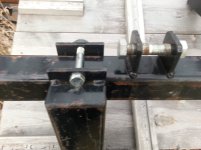
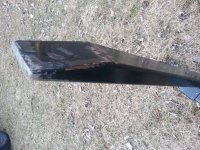
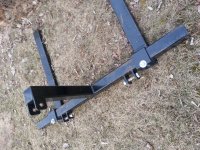
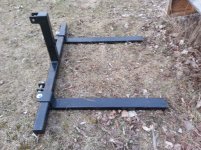
Here are a few pictures of the Forks I had built. The fab shop built this for $400 including paint a couple of years ago. I misstated the fork size in my earlier post - my memory is failing. The forks are 4x2x.156" wall. Also the Cs to attach the forks to the tubes are on top of the tube as shown. As you can see by the photos the ends are all capped for no water, i.e. interior rust. The tips of the forks are tapered as well. I have not weighed them. They are heavy but I can pick the assembly as shown and carry it so am sure they aren't over 150 lbs. I just used bolts for tractor connection for cost reasons but I use them so much I wish I would have put standard pins in.

Picture 1 and 5 are overall views. Pics 2 &3 are close-ups of the Forks attachment to the frame and the connection for the lower 3 pt arm. Pic 4 shows the tapered end of the fork.

Pallet Forks.jpgPallet Forks - Attach.jpgPallet Forks - Attach2.jpgPallet Forks - Tip.jpgPallet Forks Iso.jpg
 
Last edited:
   / Question about steel strength?? #138  
Flat plate bent into a channel is probably weaker than the comparable channel. Open sections (channel, angle) are not nearly as strong as closed sections (tubing) for any given weight.

I am not sure I agree. That's why truck frames are not channel, they are bent and formed from flat material. I am sure tubing is stronger than channel, but I was comparing store bought channel to formed channel just as a comparison.

Chevy was using hydroforming to make part of their truck frames(they used to). From what I understand they took a piece of pipe, put it inside a big form, and blew it up with water pressure, expanding the pipe to the form. Besides bending it and forming the frame like you need it, working the metal cold makes it work harden and makes it much stronger than a comparable piece of steel that was "hot rolled".
 
   / Question about steel strength?? #139  
Truck frame employs channel with strength axis in its "strong" direction. Truck frame also has 'blocking' wherein the opposing channel provides support to create a system strong like a closed section. Also truck frame is highly engineered to provide structure and mounting points for a few other components. :). Not to mention higher grade steel. And engineered amnt of torsional flex.

Not really a good comparison because the subject of this thread uses A500 channel in its "weak" direction (wide not tall). The other part of your query was related to steel grades, but I really dont think there are many other options,,,,A500 series is whatcha get. However Rect tubing is often A513 which is a stronger material than the A500 channel, which takes more stress (more flex) before permanent bend.

For a fork tine best bet is a closed section (tubing) or if lift capacity of tractor exceeds intended cargo capacity (+ weight of lift attchmt) then solid section is OK.
 
Last edited:
   / Question about steel strength?? #140  
I am not sure I agree. That's why truck frames are not channel, they are bent and formed from flat material. I am sure tubing is stronger than channel, but I was comparing store bought channel to formed channel just as a comparison.

Chevy was using hydroforming to make part of their truck frames(they used to). From what I understand they took a piece of pipe, put it inside a big form, and blew it up with water pressure, expanding the pipe to the form. Besides bending it and forming the frame like you need it, working the metal cold makes it work harden and makes it much stronger than a comparable piece of steel that was "hot rolled".

Well, truck frames aren't channel because you couldn't bend it the way frames bend while keeping the same profile/strength/etc... and it's a consistent thickness vs steel channel where the web tapers. They are also high-strength steel and designed with a certain amount of flex/give in mind. Of course, the highest strength comes from two vertical members... i.e., a boxed frame.

I'm pretty sure the new frames are still hydroformed. The boxed frames I'm pretty sure would have the "boxing" welded in, just as you would do to an existing "C" frame.
 

Tractor & Equipment Auctions

2005 JLG Skytrack 10054 10K Capacity Telehandler (A59213)
2005 JLG Skytrack...
PENDING SELLER CONFIRMATION  READ BEFORE BIDDING (A56438)
PENDING SELLER...
HYDRAULIC TILTING BUCKET FOR MINI EXCAVATOR (A58214)
HYDRAULIC TILTING...
CASE IH STEIGER 400 HD TRACTOR (A58375)
CASE IH STEIGER...
2008 CHEVROLET C8500 DUMP TRUCK (A59823)
2008 CHEVROLET...
2020 Nissan Rogue SUV (A59231)
2020 Nissan Rogue...
 
Top