Question about steel strength??

   / Question about steel strength?? #41  
I am not sure why the reciever design is needed. What do you plan on doing with the frame with the forks off?
 
   / Question about steel strength?? #42  
Thanks for all the great information.

I did not expect that the loss of strenght would be that great.

With the limited lift capacity of my 30hp Kubota B7800, I am attempting to
eliminate weight wherever possible. Around 760 lbs. on the FEL and 1650 on the 3PH.

I also like the profile of the 3 x 1.5" steel for the forks.

What if I milled some quality/straight grain lumber and inserted the lumber tightly into
the open cavity in each tine. Straight grain lumber can be good and stiff and add some
addtional strength to the steel? Bad idea?

Bad idea because the two materials would move independently of each other. You'd have to laminate them together with epoxy to get them to work together.
 
   / Question about steel strength??
  • Thread Starter
#43  
What if I inserted 2 bolts through them to keep them from moving?
 
   / Question about steel strength??
  • Thread Starter
#44  
I am not sure why the reciever design is needed. What do you plan on doing with the frame with the forks off?
LD1-I am planning to put 3 or 4 receivers on each side in order to gain adjustability. Being that this set of forks is going to be mounted
on the FEL, as well, the adjustability will be helpful.

With the forks off, I will use this (per design) as a log skiidder, trailer hitch, and boom use.
 
   / Question about steel strength?? #45  
The 2x2" forks insert into 4 1/2" cut pcs of 2.5 x2.5" x 1/4" tubing, acting as receivers. I there any way, or need, to improve upon this receiver design?

I have a B2710 & don't know the difference betw 2710 and 7800, might be identical for all I know. I'm glad you posted this because I will build something similar, soon - maybe tomorrow :D. You've inspired me, maybe I will do a little tine engineering.

Here's my thoughts.

I'd use 3 or 4 sockets too. I'd use it for a log skidder, and with a receiver hitch, to move trailers around. I have other uses too, plans for a clamping sawbuck too.

That is made for a large tractor. It would dominate a B-series. I would make it smaller, lighter. I would definitely make the times removable, with the a socket arrangement. When you add 43 inches to the length of a compact tractor, they are going to be in the way, you will wipe stuff out! They will be as far back from the rear axle as your radiator guard up front. You will be very happy to have them removable, stowable. Otherwise you will be inclined to remove the whole thing. Then ------ where is it when you need it? ---- Well it's setting way over there, because it's too darn big, awkward and too heavy too. If you make the tines removable your device will remain on the tractor, ready for use anytime. And when off the tractor, it can be leaned against the wall not taking up as much space as a whole pallet.

417745d1427073054-question-about-steel-strength-farmit_rear_forklift-jpg
 

Attachments

  • farmit_rear_forklift.jpg
    farmit_rear_forklift.jpg
    137.2 KB · Views: 250
   / Question about steel strength?? #46  
What if I inserted 2 bolts through them to keep them from moving?
The wood will provide very little bending stiffness even if attached to the steel continuously along the length. Two reasons... first the Modulus of Elasticity (stiffness... maybe 20 to 1) is much lower for wood than Steel and second, the wood is near/at the neutral axis of bending. This is why I beam shapes are designed/used. They have most of their material at the farthest from the center/nuetral axis of the cross section. I beams are great in bending but not torsion... closed walls such as tubes are much better in those cases.
 
   / Question about steel strength??
  • Thread Starter
#47  
I will scan in my initial sketch tomorrow. Like you to take a look at it and hoping you will do the same so I can see your ideas.

So far, this is what I am thinking..
-add a hitch receiver to the top (between the frame and chain slip)
-design a boom to insert into the upper hitch receiver.
-add a hole on each side of the chain slot for ratchet strap hooks
-not sure how to pin the forks on-don't want the pins to stick out below the lower frame and get in the way?
-not sure how to design the lower frame-2 plates of steel with welded uprights spaced for the forks?
-how will you scale this frame down for our tractors? The 2710, 2910, and 7800 are all the same frame-specs are close.
-add FEL mounting plates on the outside of the frame welded to the frame uprights and the extended width bottom frame.
-I am hoping to add the Kubota "quick coupler" into this mix in order to quickly change over from the bucket to this fork set on the FEL.
-will be drilling a hole on the outside/top corner of the mounting plates for strap hooks and cutting a chain slot on top of the plates, as well.
-really like the idea of being able to slip the forks into holders on the backside of the frame when not in use. They are always there when you
unexpectedly need them deep in the woods!
-make a wood dolly for easy storage.
-like to also see what you come up with for forks and receivers.

Thanks-
John
-
I have a B2710 & don't know the difference betw 2710 and 7800, might be identical for all I know. I'm glad you posted this because I will build something similar, soon - maybe tomorrow :D. You've inspired me, maybe I will do a little tine engineering.

Here's my thoughts.

I'd use 3 or 4 sockets too. I'd use it for a log skidder, and with a receiver hitch, to move trailers around. I have other uses too, plans for a clamping sawbuck too.

That is made for a large tractor. It would dominate a B-series. I would make it smaller, lighter. I would definitely make the times removable, with the a socket arrangement. When you add 43 inches to the length of a compact tractor, they are going to be in the way, you will wipe stuff out! They will be as far back from the rear axle as your radiator guard up front. You will be very happy to have them removable, stowable. Otherwise you will be inclined to remove the whole thing. Then ------ where is it when you need it? ---- Well it's setting way over there, because it's too darn big, awkward and too heavy too. If you make the tines removable your device will remain on the tractor, ready for use anytime. And when off the tractor, it can be leaned against the wall not taking up as much space as a whole pallet.

417745d1427073054-question-about-steel-strength-farmit_rear_forklift-jpg
 
   / Question about steel strength?? #48  
Heres some engineering for ya. You've already moved on but the engineer will still flog you with numbers. :laughing:


I'm going to assume:

1) max you can lift with a B7800 on a 3-point forksith a B7800 is about 1000 lbs
2) using point loads for simplicity; at the tip, and at 28"

If you want to consider all the 1,000lbs on one tine, you can pretty much double the deflections. "Deflection" is the inches it bent due to the load (flex).

==================================
2 x 2 x 1/4" steel (I=.91) 48 inches long, cantilevered load:

1,000 lbs equally on 2 tines (500 lbs per tine)

500 lbs point load at end (48 inches) deflection is 0.70 inches at end.
500 lbs point load at 28 inches, deflection at 28" is .14, deflection at end (48") is .28
==================================

3 x 1.5 x 3/16" steel (I=.71) 48 inches long, cantilevered load:

1,000 lbs equally on 2 tines (500 lbs per tine)

500 lbs point load at end (48 inches) deflection is 0.90 inches at end.
500 lbs point load at 28 inches, deflection at 28" is .18, deflection at end (48") is .37
==================================

2 x 4 x 1/4" steel (I=1.68) 48 inches long, cantilevered load:

1,000 lbs equally on 2 tines (500 lbs per tine)

500 lbs point load at end (48 inches) deflection is 0.38 inches at end.
500 lbs point load at 28 inches, deflection at 28" is .07, deflection at end (48") is .15
==================================

This is not complete engineering, theres a lot more to be done. The load at which the tine (A-500 steel, 46,000 psi yield) will take a permanent bend (not spring back) is the next calculation - I am lazy at the moment but I can get it.
 
   / Question about steel strength??
  • Thread Starter
#49  
Thanks for the data.

Here is the data for our tractors. They share the same frame and have the same
3ph lift capacity.
TractorData.com Kubota B7800 tractor information
TractorData.com Kubota B2710 tractor information

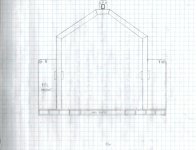
Here is my initial sketch:
farmit drawing.jpg

Being that this will also be used on the FEL,
would it be good to build it in the full dimension
in order to provide a good back support fo use up front?

If I am reading the numbers correctly, the 3x1.5" tube does not increase the
deflection substantially? Any way to modify them to beef them up a bit? They
seem to offer a good profile and I guess we are not going to be lifting over a ton
on these machines.

What do you plan on using for the forks and receivers?
I was thinking of using 2 steel plates sectioned by welded steel dividers for the receivers.

Still have not figured out how to secure the forks in the receivers. I was going to use pins,
but they will fall below the bottom frame which I do not think is a good idea.

One long common pin running horizontal is an idea? Going through the stack of 3-4 receivers.

Looking forward to seeing your ideas.
John
 
   / Question about steel strength?? #50  
The pins' sole purpose is to keep the tines in place. This is an easy task for a pin, it does not have to pass thru bottom of the tube to perform this function reliably. Common pin thru all holes can work if it's plenty loose - build it tight and it will jam up and be a PITA. Doesn't need to be tight, it doesn't hold the load its just a "keeper". Maybe two long common pins - one from each side?

It's looking heavy - if it weighs 150 lbs that's a large percentage of your lift capacity. You might add up all the component weights, see where you're at.

Rated lift capacity of the FEL (LA402 - 402kg) is 900 lbs. With my brush fork (68 lb) plus 520 lb snowmobile ( = 588 lbs) its right at the FEL's limit. This is only 2/3 of 900 lbs. Its also right at the tipping point of a tractor with no ballast (you sitting in the seat is required :D.) Removing the bucket will reduce the need for ballast.

Here's setting the snowmobile on a shelf. Lucky I did not build the shelf at the full height (66 in) of the LA402's specifications, had to build it at 50 inches cuz the loader could only lift the 588 lbs to 50+ inches.View attachment 417765

I guess we are not going to be lifting over a ton
on these machines.

Well that's not wrong :D ,,,,,, but using a half-ton (1,000 lbs) as an upper limit sounds more feasible. These fellers on TBN will all talk about their big tractors :D and some are polite enough not to tell you a B series is a small tractor. Careful getting sucked into overbuilt it will cost usability.

I wouldn't make that thing so heavy, you will burden it and yourself for no benefit except for when you sell it to a guy with a big tractor. I'll start on mine soon, but our usages may be different as I won't use mine on the FEL.
 
   / Question about steel strength??
  • Thread Starter
#51  
How are you planning to scale it back? Where can we cut out weight?
 
   / Question about steel strength?? #53  
How are you planning to scale it back? Where can we cut out weight?

Well mine was going to be a LOT simpler, you're the one who posted a pic of one very versatile device capable of all kinds of useful stuff! :laughing: To do all that it's gonna cost capacity, but if its more useful thats the goal.

All those open slots on the bottom will require some steel. Something to be said for the standard 2.5x2.5 x 3/16" square steel receiver, you just buy it at the store and the 2x2 fits. Aluminum sounds fun but requires a special backyard (for this backyard project).

I might just make my simple one, it's really easy, then keep a thinking cap on for other features.
 
   / Question about steel strength?? #54  
Or, if you're me and you want things shiny AND stout :laughing: (and don't care much about the weight), you buy 2.53" square tube with .250 wall (scroll down the size list, you'll see it)

Ram Steelco Inc. - Salem, Oregon | Steel Sales, Metal Sales and Metal Processing

The stuff I buy is about the middle of that page, cost is about the same as 2.5" but it fits with no hangups - the normal 2.5" stuff has the weld seam so you need a bit of slop for things to fit... Steve
 
   / Question about steel strength?? #55  
Can cut that weld flash out with a sharp chisel if its only 6" or so. That 2.53" would be handy & nice fit, they don't have it at my steel store (although it might get kinda thin after polishing,,,,, :D )
 
   / Question about steel strength?? #56  
Heres some engineering for ya. You've already moved on but the engineer will still flog you with numbers. :laughing:


snip"

Ill use some real numbers.

Using the moment of inertia calculators isnt exact for tubing, cause it assumes squared corners (more material than rounded). So lets use actual numbers.

3 x 1.5 x 3/16 tubing I= 0.488

2x2x1/4 ..................I= 0.77

2x4x1/4...................I=1.54

I would also assume the max load on 1 fork, to represent a real world worst case scenario. Never know when you are gonna be lifting a log or something to the max, and 1 fork may slip off, putting all the load on the other.

So......here we go.

3x1.5 fork 48" long @ 1000# will deflect 2.6"
................28" fork..............................0.5"

2x2x1/4........48" long...........................1.65"
...................28"....................................0.33"

2x4x1/4.........48"..................................0.82"
.....................28".................................0.16"
 
   / Question about steel strength??
  • Thread Starter
#57  
Impressive numbers.
How much more do the 43" forks weight using 2x4 rather the 2x2 stock?

Again, is there a worthwhile gain in using the 2x4 forks with our limited lift capacity??

Can 2x2" stock be used on the frame in place of the 2.5x2.5 pcs.?
How much weight do we cut down and what will be the impact of the strength
used on our size tractors?

*Sodo...don't lean towards the easy side...counting on you to come up with some
great ideas!:cool2:
 
   / Question about steel strength??
  • Thread Starter
#58  
I this square stock available in sizes that will fit both the 2x2 and 2x4 tubes?
Seems like it would be ideal for the receivers?


Or, if you're me and you want things shiny AND stout :laughing: (and don't care much about the weight), you buy 2.53" square tube with .250 wall (scroll down the size list, you'll see it)
Ram Steelco Inc. - Salem, Oregon | Steel Sales, Metal Sales and Metal ProcessingThe stuff I buy is about the middle of that page, cost is about the same as 2.5" but it fits with no hangups - the normal 2.5" stuff has the weld seam so you need a bit of slop for things to fit... Steve[/QUOT
 
   / Question about steel strength?? #59  
Oooops too late, I went simple already :D

It's made of 2x2x1/8" steel, and weighs 15 lbs.

417924d1427163562-question-about-steel-strength-3ptskidder3hitch-jpg


I welded the nut on the backside, then dropped it into the tube and welded all around.

417923d1427163562-question-about-steel-strength-3ptskidder2pin-jpg


417922d1427163562-question-about-steel-strength-3ptskidder1weld-jpg


Current plan: I intend to make a little cradle fork with 2 "tines" about 12-15 inches long (?) for lifting logs. I suppose it will have a crossbar so a smaller log can't drop between the tines. It will poke in just like a receiver hitch, and drop down the 11 inches to ground level. I'll add some chain attach points once I hang a log on it and see where they ought to go.

417925d1427163562-question-about-steel-strength-3ptskidder4-loglift-jpg
 

Attachments

  • 3ptSkidder1weld.jpg
    3ptSkidder1weld.jpg
    166.1 KB · Views: 271
  • 3ptSkidder2pin.jpg
    3ptSkidder2pin.jpg
    145.6 KB · Views: 286
  • 3ptSkidder3hitch.jpg
    3ptSkidder3hitch.jpg
    316.1 KB · Views: 277
  • 3ptSkidder4-loglift.jpg
    3ptSkidder4-loglift.jpg
    325.3 KB · Views: 271
Last edited:
   / Question about steel strength??
  • Thread Starter
#60  
Nice job. Looking forward to seeing the completed cradle fork.
If you welded receivers near the outside ends, would you be able to use this with a set of removeable forks?
 
Last edited:

Tractor & Equipment Auctions

SKID STEER ATTACHMENT PACKER (A58214)
SKID STEER...
2013 FORD F-350 FLATBED (A58214)
2013 FORD F-350...
2009 JACK COUNTY KILL TRAILER (A58214)
2009 JACK COUNTY...
2088 Chevrolet C7500 Altec TA40 41ft. Bucket Truck (A59230)
2088 Chevrolet...
2018 BOBCAT E45 EXCAVATOR (A59823)
2018 BOBCAT E45...
2023 CATERPILLAR 972 WHEEL LOADER (A60429)
2023 CATERPILLAR...
 
Top