Operating Tips

/ Operating Tips #1  

BobRip

Elite Member
Joined
Sep 8, 2004
Messages
4,677
Location
Powhatan Va.
Tractor
2000 Power Trac 422
I would like to start a thread that gives operating tips for the PT. I don't thing this has been covered before, except as scattered over many threads. Please keep these short. Thanks

My favorite is the PT wiggle. If you are stuck in mud or can't make it up an incline or need a little more force to push a bucket you can steer left and right while applying power to the wheels. I can climb about a 25 degree slope with my 422 using this technique. It's slow, but faster than using my boat winch.
 
/ Operating Tips #2  
Steering wheel spinner knob!

I'll chime in with perhaps the most important item for a new user to get. Need to forget that there is even a steering wheel on these articulated machines since they do not respond like a regular vehicle or tractor.

Get used to the "one handed cranking movement" .....just look where you are going and crank away.....much smoother and more natural movement than trying to "steer" like a regular vehicle.
 
/ Operating Tips #3  
If you don't have solid tires on your mower(s), keep them inflated to whatever the sidewall says is the max pressure. Check them frequently, and you won't garner so many mower flats.

Do something about those idiotic inner valve stems before you rip one out, especially if you rough mow or brush hog.

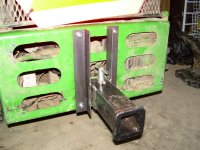
Build an adapter to use a standard hitch receiver on the rear. Pin hitches are a lousy way to tow anything, especially if you have hilly terrain.
 
/ Operating Tips
  • Thread Starter
#4  
SnowRidge said:
Build an adapter to use a standard hitch receiver on the rear. Pin hitches are a lousy way to tow anything, especially if you have hilly terrain.

Like this one attached.
 

Attachments

  • welded assm first pict.JPG
    welded assm first pict.JPG
    506.8 KB · Views: 338
/ Operating Tips #5  
Here's one that someone on here suggested when I first started can't remember who now. Most people don't think it's worth trying, but I now swear by it.

When you accidentally leave put your left foot on the treadle peddle, and jump the PT back about 4 ft before you realize what's going on.

Try this method, just put your toe under the right peddle instead of pushing down on the left peddle, and raise up on the right peddle. Very precise control over reverse.

Since I have been using this method I haven't jumped the PT once, and backing into the garage or in tight spaces it gives me much better control.
 
/ Operating Tips #6  
I know this one will be controversial -- but for most work, I like to leave the throttle at somewhere around 75-80% instead of full throttle -- I'm guessing about 2800-3000 RPM. The tilt circuit, especially, is much smoother at this RPM, and not nearly as sensitive and jerky...

I only run full throttle if I'm using the PTO (finish mower, rough-cut mower, etc.) or if I need the wheelmotor torque to climb hills or to dig, push into piles, etc.

IMO, this RPM puts the engine near the top of its torque curve and still will not overheat it as long as you don't lug the engine. As I began with, I know this is controversial, and may not be totally in synch with other recommendations or operating instructions.
 
/ Operating Tips #7  
My 425 doesn't have the more sensitive treadle controls of the newer machines, and I've read lots of tips about how to manage that sensitivity (lift with toe, add springs, etc.). I don't have a problew with "over-sensitivity" but that may be a factor of the mechanical controls and not my technique.

I operate mine with BOTH feet on the treadles at all times, just like flying an airplane with both feet on the rudder pedals. When I press down on either side I must provide enough pressure to "pry up" the opposite foot and leg. I NEVER operate the PT with only one foot, because I consider pressure on the opposite treadle to be my "brakes"...

If you're operating your PT with only one foot, you may want to give this a try...
 
/ Operating Tips #8  
BobRip said:
Like this one attached.
Not quite. More like the one shown here. It requires no mods to the machine itself, and the pin hitch remains functional.

86235d1190469511-most-least-used-pt-implements-pt_receiver.jpg


86236d1190469536-most-least-used-pt-implements-pt_receiver2.jpg
 
/ Operating Tips #9  
KentT said:
My 425 doesn't have the more sensitive treadle controls of the newer machines, and I've read lots of tips about how to manage that sensitivity (lift with toe, add springs, etc.). I don't have a problew with "over-sensitivity" but that may be a factor of the mechanical controls and not my technique.

I operate mine with BOTH feet on the treadles at all times, just like flying an airplane with both feet on the rudder pedals. When I press down on either side I must provide enough pressure to "pry up" the opposite foot and leg. I NEVER operate the PT with only one foot, because I consider pressure on the opposite treadle to be my "brakes"...

If you're operating your PT with only one foot, you may want to give this a try...
We have different techniques for sure. That's what got me in trouble in the first place. I would have both feet on the treadle, my foot would slip off the right pedal and the weight of the other foot would floor it in reverse. I would be closing in on a tree before I realized what had happened to get er stopped. Since I've been using my toe it hasn't happened once. :rolleyes: I let the hydraulics be my brakes.
 
/ Operating Tips #10  
KentT said:
I know this one will be controversial -- but for most work, I like to leave the throttle at somewhere around 75-80% instead of full throttle -- I'm guessing about 2800-3000 RPM. The tilt circuit, especially, is much smoother at this RPM, and not nearly as sensitive and jerky...

I only run full throttle if I'm using the PTO (finish mower, rough-cut mower, etc.) or if I need the wheelmotor torque to climb hills or to dig, push into piles, etc.

IMO, this RPM puts the engine near the top of its torque curve and still will not overheat it as long as you don't lug the engine. As I began with, I know this is controversial, and may not be totally in synch with other recommendations or operating instructions.
That's the same thing I do. Your right I notice it does seem to run / operate smoother. ;)
 
/ Operating Tips
  • Thread Starter
#11  
When turning on the PTO with the Brush Cutter attached, I slow the engine to just above idle first. This eliminates the clunk on start up.
 
/ Operating Tips #12  
I also, every since I read that MR did it that way. I tried it it and it works a lot better.

Very good idea.
 
/ Operating Tips
  • Thread Starter
#13  
When trying to break ground with the bucket, it is usually better to use the potato plow, stump grinder, trencher, or other ground breaking attachment to break up and loosen the soil and then use the bucket to move the dirt.
 
/ Operating Tips
  • Thread Starter
#14  
If you want to control your low speed or attachment movement very carefully and don't require a lot of torque, slow your engine down. The pumps will pump slower and the controls will be finer adjustments.
 
/ Operating Tips
  • Thread Starter
#15  
If you want to position a trailer to an exact postion, put it on the front of your PT. This makes it easier to watch and manuever. You do have to watch it constantly or it will go off to the side quickly.
 
/ Operating Tips #16  
This "tip" might be obvious; keep mud and rocks out of the footwell.

I was ready to do a major disassembly when my PT425 wouldn't go backwards. Removing the rock that I couldn't see under the left side of the treadle fixed the problem.

Mark H.
 
/ Operating Tips #17  
If the sensitive treadle is still a problem for you even after using one of the already stated "techniques"(or performing the user Fourteen's mod) simply call PT and ask for the springs to be sent to you. A quick 60 second install and my PT has been much easier to use! The springs will take some getting used to.... but I love 'em!
 
/ Operating Tips
  • Thread Starter
#18  
When removing shrubs with large stumps, use the stump grinder to cut the roots and pull it up with the 4 in 1 bucket.
 
/ Operating Tips
  • Thread Starter
#19  
SnowRidge said:
If you don't have solid tires on your mower(s), keep them inflated to whatever the sidewall says is the max pressure. Check them frequently, and you won't garner so many mower flats.

The pressure helps, but I added inner tubes on the brush cutter about 4 years ago and have had not a flat since then versus a flat every 5 minutes without them.
 
/ Operating Tips
  • Thread Starter
#20  
Adding weight to the back of the PT will not only reduce wheel spin, but allows the wheel torque to be used from all four motors giving you greater "push" for the machine.
 
 
Top