Logistics of small sawmill operation

   / Logistics of small sawmill operation #1  

Verticaltrx

Veteran Member
Joined
Dec 30, 2009
Messages
1,908
Location
VA
Tractor
Kubota B3200/L2501/SVL65-2/U35-4, IH 454/656, Ford NAA, Case 1845C/480E/450C LGP
Having just recently purchased a new bandsaw mill, I'm looking for advice on how to get the most out of the whole logs-to-lumber process. This thread is along the same lines as my previous thread Logistics of firewood hauling and splitting? which gave me lots of good ideas and pictures which I enjoyed very much.

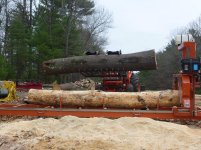
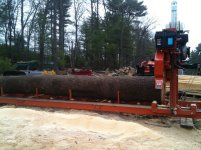
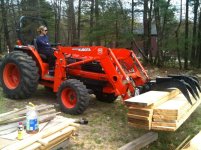
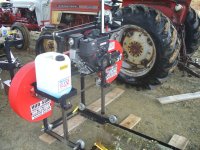
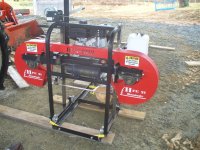
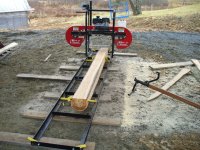
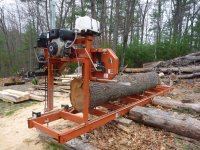
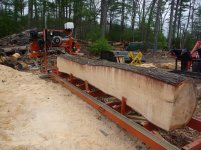
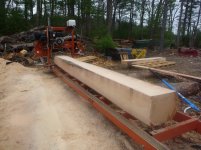
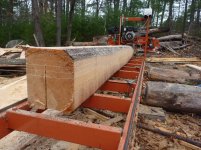
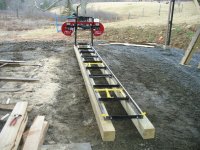
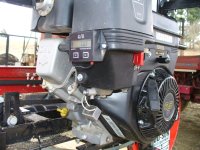
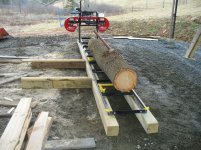
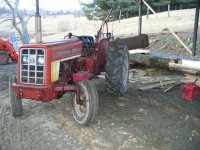
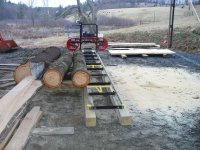
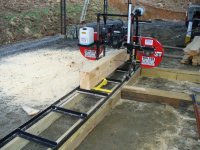
That said, I purchased a little Hud-son Homesteader HFE-21 sawmill to mill up white pine, poplar and red oak for various building projects around the farm. I've only gotten to mill a few logs with it but so far I really like it (I was previously using an Alaskan chainsaw mill.) It isn't terribly fast with only 6.5hp, but get the job done far easier and quicker than with the Alaskan. So far I've just used it with the provided 12' of track, but I built another section of track today so I can mill 16' lumber. A few pics of the mill as currently setup:

P1020066sm.JPG

P1020067sm.JPG

P1020068sm.JPG

P1020072sm.JPG

P1020075sm.JPG

As mentioned, I built some additional track and will be setting the whole unit up on some nice straight 20' long 6x6 posts. I'll probably set some more 6x6 at a right angle to the mill as a place to set logs to bet rolled on the mill.

So, my questions for those will sawmills (stationary or portable, circular or band):

-What kind of equipment do you use to get your logs from the stump to the mill?

-What kind of method or layout do you use to efficiently separate/stack/move lumber, slab wood, sawdust etc away from the mill?

-I'll be stacking and stickering the lumber outside for now, what do you use as a good flat base for your lumber? To cover your lumber stacks?

-Any other advice for a first time sawyer?

Any info and pics will be much appreciated.
 

Attachments

  • P1020066.jpg
    P1020066.jpg
    792.5 KB · Views: 1,253
   / Logistics of small sawmill operation #2  
Nice little saw. I can't answer any of your questions, but how large a diameter log will that thing take?
 
   / Logistics of small sawmill operation #3  
Cool mill -- what do they cost?

I run an Alaskan mill myself, but have spend hours working with a friend's Wood Mizer.

We use a tractor or bobcat with forks to load logs into the mill, and the same to collect cut boards for stacking (when using my tractor, the forks are clamp on which works OK in this case). Use a big scoop style snow shovel to deal with sawdust. Some lumber goes under a pole barn, other goes out in the open. Have plenty of sharp bands on hand -- with the Wood Mizer, we probably go through 2-3 per day (he has about 20 of them and periodically sends them out for sharpening).

A tip -- if you want to avoid stain "stripes" on the boards, use dried stickers when stacking. If you use green stickers, which are typically sawn on site from scrap at the time of milling, you will get stripes. Might not matter if you plane the boards, but if you plan to use the wood rough sawn as-is, stripes can be an issue for things like siding or trim.

Good luck!
 
   / Logistics of small sawmill operation #4  
I've had a mill for over 10 years now. It's great fun to cut your own lumber. I have a pto skidder winch on the back of the tractor with 165 ' of 1/2" cable, which pulls the log to the tractor and lifts the front of the log off the ground for dragging to our staging area.

I use log tongs hanging from a chain hook off the fel, to load the logs onto the trailer or onto the mill. A cant hook to flip the logs while cutting.

Sticker the boards with 1"x1" made from trimming the edges of boards. I usually cut a pair of "bunks" from a "firewood grade" log to pile the lumber off the ground. Try not to mix species of lumber on you piles. They dry at different rates.

Oh ya, dont forget to have some fun! Enjoy. :cool2:
 
   / Logistics of small sawmill operation #5  
My Dad had a Wood-Miser LT HD 40. For bringing logs out of the woods, he used a wagon chassis, with no bed. He made removable bunks/uprights for holding the logs in place out of 2" pipe. Usually just one wagon to haul logs to the staging area. He used a couple of telephone poles spaced maybe 8-9' apart to set the logs on. The mill had a set of self loading arms, so he would roll a few with a cant hook to get them to the loading arms. Then take the loader tractor, and crowd them forward to get close enough to roll them manually again.

He had two other wagon chassis that were used to stack lumber on as he sawed, because usually some was cut 5/4, and other 10/4 out of the same log.

There wasn't much slab wood. He'd saw everything 5/4 after the first initial cut to get the bark off. The smaller narrow pieces were later set up on edge, squared on one side, flipped, then cut into 5/4 X 5/4 sticks for stacking. He always tried to have enough sticks of the same type wood to stick with, so as not to stain the wood.

For what scrap there was + the sawdust, he used an old pto manure spreader with the beaters removed. It was an old one from the farm that the metal was bad back on the beater end. Got a better spreader, so used this one as his scrap wood hauler. He just hauled it back to the woodlot, and had a spot where he'd stop, and let the spreader do the unloading.

He also stacked some outside. Again telephone poles cut to length of 6-8', capped with some odd pieces to keep the creosote from staining the wood. He laid them approx. 24" - 30" apart OC. Did the end ones first, and got them leveled to each other. A straight edge was laid across them, and with a shovel, cut out what was needed to get the ones in the center to match.

He tore down an old barn for a buddy of mine, and got all of the tin off the roof. This is what he covered the lumber with. It was either weighted down with concrete blocks, or like 11 ga. wire ran over the top, fastened to the ends of the sections of poles with spikes.

For logs that had been dragged, he went to flea markets, and bought all the old wide wood chisels, like 2" wide he could find. Got some Chrylsler torsion bars from junkyards, and welded them to the chisels for handles. He used these the chip & peel the bark from the dirty logs. Not easy work, but a lot less mess than power washing, and lots easier on the blades.

He bought one of those de-barkers you put on the end of a chainsaw bar. Used it once, then went back to his chisels, saying he could do it faster that way.

Hopefully, some of how he did it will give you a little food for thought.
 
   / Logistics of small sawmill operation #6  
...I'm looking for advice on how to get the most out of the whole logs-to-lumber process...

IMO, to get "the most" out of "logs" beyond just being able to saw them into rough dimensional sized lumber...you need to be able to dry them to less than 15% (less is better) moisture content and you also need a heavy duty planer (the deeper and wider the better)...
...with the above (along with a mill) you can produce the same quality dimensional (frame or finish) lumber as any retailer/wholesaler...
 
   / Logistics of small sawmill operation
  • Thread Starter
#7  
Wow, lots of good advice already in here, I'll try to add a little info:

For starters I plan to use white pine for 2x framing lumber, poplar for siding, oak for fence boards, roof purlins, etc and black locust for posts and rot resistant lumber (sill boards and so forth). Eventually I'll build a solar kiln, get a good planer and start using the dried/finished lumber for interior carpentry and some small furniture project. For now it'll be just rough cut lumber for barns, sheds and fencing.

I cut a load logs this week and used my skid steer with forks to carry them out of the woods to my truck and trailer to bring home to the mill. The wood lot is on our other farm 2mi away. This setup worked OK, but not great. With the addition of a set of tire chains and a grapple the skid steer would seem to be a good option in the woods. Hauling them out of the woods and to the mill is my concern right now, as my pickup and equipment trailer isn't an ideal setup. As mentioned, a hay rack running gear with some log standards would be good, which I could pull with one of my tractors. I also thought about making a set of log standards for my 2-ton C60 flat-bed dump truck. It would haul a lot more, but not be as good in the woods. My goal is to carry the logs to a truck or wagon and not have to drag any to keep them clean, not sure if that is a realistic goal or not.


For those who asked about the mill, it can handle a 21" dia log and with the stock 12' bed will saw lumber about 9' long. It uses a 6.5hp Briggs Vangaurd engine and the cost was $2800. Not fancy and the bed has to be perfectly level for it to work well, but it saws very well and seems to be quality made (maybe a little more 'refined' than the older Hud-son models).
 
   / Logistics of small sawmill operation #8  
I use a small dump truck to ship logs. Most farms around here have one of those. If you have a grapple on your skid steer on the woods landing you can easily load the truck then unload at the mill by dumping. A dump trailer would work to. If you can justify it a log loader trailer would be the cat's meow.
 
   / Logistics of small sawmill operation #9  
Most of my milling came from logs off my own property so skidding them to the saw wasn't difficult. If I were to look off the property though I'd have to look hard at the right trailer to tow with.

Nice little mill the Hud-son, milled with a comparable mill a friend lent me a few years ago. To answer some of your questions from my experience;

-What kind of equipment do you use to get your logs from the stump to the mill?
Off my own property I use my back blade and chains, with them I can keep the log off the dirt while skidding. If I were to do civiculture from a different property I'd look at a proper winch, on my property I can clear what I want.

-What kind of method or layout do you use to efficiently separate/stack/move lumber, slab wood, sawdust etc away from the mill?

I take waste materials off site, for sawdust I use the loader, slabwood I hand load into my truck and drop off up our road, neighbours that burn wood take it when dry for kindling.

-I'll be stacking and stickering the lumber outside for now, what do you use as a good flat base for your lumber? To cover your lumber stacks?

I use PT 4x4's spaced 4 foot apart on sand bed, spacers are actual half inch PT spacers from the lumber yards, they look to get rid of theirs so I drop by and pick them up whenever I'm in town. As stated, you want to use dry stickers.. To cover initially I use good quality tarps (rubber impregnated) tied off to 8 three foot long pieces of rebar driven into the ground that I welded two large washers to the end of for tie downs.

-Any other advice for a first time sawyer?

A little soap in your cooling water; check your balde tension often on new blades; keep your saw clean; keep your walkway clear of excessive sawdust and debris from the mill and be safe. I try to leave it as log for a year and then as board for a year before we use it. Building inspectors here have to be able to grade lumber, handy when you want to construct something requiring inspection from rough sawn full dimensional lumber.

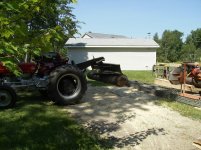
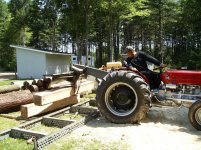
You can sink a lot of money into this kind of work or, if time permits, you can do a lot with some improvisation and a little patience (as seen in the photos). Safety first of course, my wife and I milled enough lumber to build our hay shed, walk in for the horses, my woodworking shop and most recently a barn. Had a LOT of fun doing it! You're off to a good start with a nice little mill, enjoy!

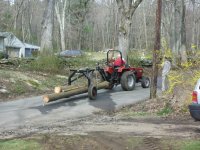
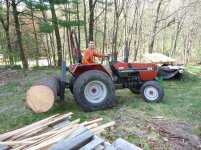
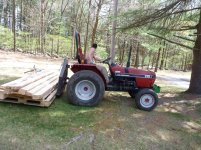
Massey and mill 003.jpgMassey and mill 007.jpgMassey and mill 010.jpg
 
   / Logistics of small sawmill operation #10  
Our mill has a 5 gal. jug for water to drip on the blade. We add a jug of windshield washer to it. Keeps the blade clear of sap and sticky sawdust. (pine/spruce/hemlock)
 
   / Logistics of small sawmill operation #11  
Our mill has a 5 gal. jug for water to drip on the blade. We add a jug of windshield washer to it. Keeps the blade clear of sap and sticky sawdust. (pine/spruce/hemlock)

I heard that works as well.
 
   / Logistics of small sawmill operation
  • Thread Starter
#12  
I've been using windshield washer fluid with about 1oz of dish soap per gallon, seems to be working well.

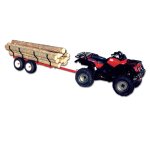
I've been contemplating building a little log trailer like this one below, except tractor size:

ATV+Tandem+Log+++Dump+Trailer_L.jpg

I could pull it in the woods and load it with my B3200, then hook it to the truck to take it back to the mill. For big loads I could use it behind my IH 454 and load it with the skid steer.


For barn grade lumber that is going to be used within a few months, how important are the specifics of stickering? IE, if I just sawed some green 1x1 stacking sticks for my pine would that be acceptable? If guess if I really need to use dry stacking sticks I could rip some kiln dried lumber from the store.
 
   / Logistics of small sawmill operation #13  
Lumber to build a barn out of I wouldn't worry about ripping new stickers, unless you are concerned with the appearance of the lumber, the sticker marks will appear on the lumber if wet. More of a concern for lumber you plan to use for finish work, the stains left from the stickers won't come out.

For your oak I would leave it in log for a year and then mill it, learn about 1/4 sawing if you aren't already familiar with it but make sure you have good stickers when drying that lumber for anything other than the fence boards I believe you mentioned earlier in the post.
 
   / Logistics of small sawmill operation #14  
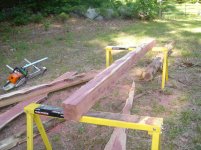
First off, Congratulations on the new mill! It is just as exciting to saw that first board off a new mill as it is to scoop that first pile of dirt with a new tractor! Like you, I started out with an Alaskan Mill, only, you had much more patience than me, I upgraded shortly after milling that very first (and only) log. :laughing:
DSC05103.jpg

After a short period, I ended up with a Woodmizer LT15. I only mill for myself and for the most part, the mill is always stationary, I rarely move it other places. I'll post some of my comments to your questions and try to add a few tips that I've learned over the years of milling off and on.


As mentioned, I built some additional track and will be setting the whole unit up on some nice straight 20' long 6x6 posts. I'll probably set some more 6x6 at a right angle to the mill as a place to set logs to bet rolled on the mill.
I would normally never point this out as it seems "nit picky", but since you now have a sawmill, I figure you should know... :D A horizontal timber is never referred to as a "post". :D


So, my questions for those will sawmills (stationary or portable, circular or band):

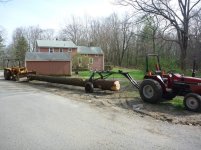
-What kind of equipment do you use to get your logs from the stump to the mill?
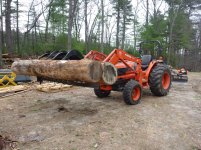
I almost always use my grapple. Usually I can carry the logs in the grapple and place them directly onto my "log bunks". If they are too heavy (mostly to do with length) or they are too long to carry out of the woods without running into trees, I'll use my log arch, although this is rare. The few times I've had to carry numerous logs longer distances, I've used my tractor and grapple to load the logs on a full size trailer, and then the same method to offload them at the mill. I've also used a dump trailer once which wasn't mine. That was a really slick setup but only good for logs less than 14' or so.

I would not have a sawmill without a FEL grapple. (I chose the specific grapple I have based on uses for the mill, let me know if you want "reasons why".)
Here is what I used prior to my new tractor and grapple...
P1000614.jpg P1000627.JPG P1000894.jpg P1000901.jpg

It is 10 times faster with the grapple, and I never have to leave my seat :D
dog house 004.jpg dog house 007.jpg dog house 041.jpg img_0988.jpg


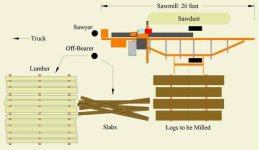
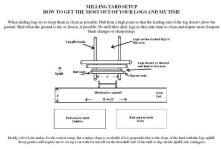
-What kind of method or layout do you use to efficiently separate/stack/move lumber, slab wood, sawdust etc away from the mill?
Here is what works pretty well for me. These are not my pictures, but I find them useful, and they were posted with permission to use elsewhere. I based my mill setup on these suggestions.
Mill_yard_set_up_for_FF.JPG sawmill layout.jpg
Depending on how your site is laid out, or if you have a helper, you may find this works well for you. Otherwise, it's a good start if nothing else.

Milling efficiently is similar to splitting firewood efficiently, material handling (onloading and offbearing/stacking) has more to do with efficiency than the ability of the mill. No matter how nice of a log splitter I have, I still have to load the rounds, move the splits, and stack them properly. Same with milling.

-I'll be stacking and stickering the lumber outside for now, what do you use as a good flat base for your lumber? To cover your lumber stacks?
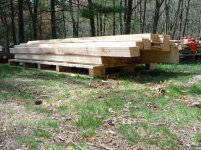
Outside is fine, that is where most of us stack our lumber. If I'm storing some timbers or lumber outside and I don't want them to be discolored by sunlight, then I'll cover them with a tarp, elevated off the timbers, and allowing airflow on all 4 sides. A tarp isn't ideal but it works for short periods. Otherwise though, I really don't cover my lumber, however I always sticker it. Stickering is much more important than covering. Always sticker your lumber, especially pine in really hot/humid weather. Pine will start to "bluestain" within a matter of days if it is not stickered.
I use green stickers when sawing pine, and saw my stickers from the "waste" or when edging boards. Be sure all your stickers are the same thickness in one dimension and always use that dimension for your stickers (within the same row).
You will get stains when using green stickers, and if your using it for framing lumber that will be covered up it is fine. It doesn't affect your lumber structurally but keep in mind, even if you plane the wood, it may not come out. I use dry stickers for timbers or wood that will be used and seen, like flooring.
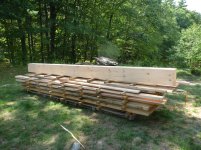
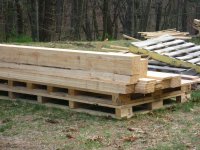
I built quite a few "pallets" for my longer wood, mostly so I could move it around if needed. If your not worried about moving it around, then a flat base of any sort, elevated off the ground will work well. Try to elevate the base of the stack about a foot or more. You'll want to be able to get either a push mower or weed wacker under there if the grass starts growing high around the edges.
P1000694.JPG P1000899.jpg dog house 055.jpg


-Any other advice for a first time sawyer?
This really is an entire forum all on it's own. Spend some time on forestryforum.com, go to google, and search things like "first time sawyer site:forestryforum.com" or "manual mill site:forestryforum.com" and so on.
Check out Sawmill and Woodlot Magazine. There are lot of good articles on their website as well.


When your skidding your logs, keep them off the ground if possible, you'll dull the blade much quicker with dirty logs. This is the one reason I don't own a skidding winch.

When you pile your logs near the mill, always pile them so the small end is towards the front of the mill.

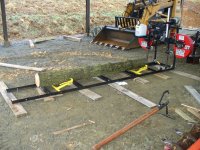
You'll want some sort of log bunks, weather it is a permanent set of bunks set in the ground, or something more temporary like 2 sides sawn off of larger logs. This is what I use. If you have some older logs, or ones that won't produce good lumber, saw off one side on the mill, flip the log 180, saw the other side down, and use this as your log bunks. I used my chainsaw to cut an angle at the beginning of them to help roll logs on, although I never use it since I place them on the bunks with the grapple.

If you don't have a level site, put the sawmill "downhill" and perpendicular to the hill. :D

Keep your log bunks a good 6' apart from each other, so you can drive the tractor between them to place logs on the bunks. Before I had my grapple I used a set of 3 point forks to move around my logs. It worked, but I'll never go back to it. :laughing:


Your going to want a level site if you have one. All 4 sides of the mill can be used. I have a pile of sawdust at the "end" of the mill. I use a snow shovel to push the sawdust into the pile. After sawing your first few logs, and getting a good little pile of sawdust built up at your feet, don't remove that sawdust, instead spread it around a little to create a "walking path" built of sawdust, your feet with thank you. It's like walking back and forth on one GIANT dr. Scholls insert. :D


If you dont' already have one, get a cant hook or log peavey :thumbsup:


-Matt
 
   / Logistics of small sawmill operation #15  
^ wow, great post! Thanks. I hope to get a mill someday.
 
   / Logistics of small sawmill operation #16  
Here are a couple more pics for ya...

Another one of the lumber/timber stickered...
P1020002.jpg

....and a little inspiration for ya...

dog house 008.jpg dog house 011.jpg dog house 014.jpg dog house 016.jpg
 
   / Logistics of small sawmill operation #17  
How does the mill fare being out in the weather and elements? No issues?
 
   / Logistics of small sawmill operation #18  
How does the mill fare being out in the weather and elements? No issues?


I'm mine, the paint is faded and there is some surface rust along the track where the paint gets worn away from use, but a quick rubdown with ATF on the rails and a couple "back and forths" of the saw carriage and it's back to new.

There are no issues with leaving them out in the weather, however I do plan to build a mill shed someday to keep it under.....Well, once I decide where I want it to "live" permanently.

I do always put a tarp over the saw carriage assembly though, and that keeps all moving parts under cover. In winter, I take the water tank in. Also, always bring your blades back inside, they will flash rust instantly if you don't.
 
   / Logistics of small sawmill operation
  • Thread Starter
#19  
Thanks for all the great info and pics, lots of good stuff in there.

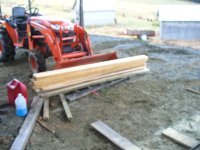
I got a couple hours in today and finally got some worthwhile lumber made. I took the morning to set up the mill on the new timbers ;) along with the new track section. I also installed an hour meter so I can keep track of maintenance. Below are some pics along with observations:

New setup is better leveled and more solid, I can also mill 16' logs now:
P1020082sm.JPG

Hour meter installed:
P1020081sm.JPG

Log on the mill. There are little triangles provided for logs that are too big to be dogged down. They nail on the ends with double headed nails to stabilize the logs. It sounds like a hassle, but it's actually pretty quick to setup, and after the first two cuts you don't need them (didn't get a pic of them on the log):
P1020083.jpg

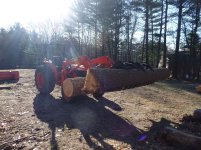
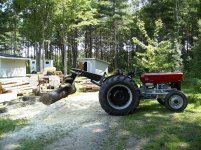
Loading logs with the boom on the back of the International. Not as good as forks or a grapple, but the skid steer is at the other farm for loading logs, this worked OK:
P1020086sm.JPG

Logs ready to be milled, I had to roll them back as the mill carriage wouldn't clear with them all pushed up that far:
P1020087sm.JPG

Sawing some full dimension 2x6's out of a cant:
P1020084sm.JPG


I can definitely see the need for lots of room (and flat ground) around the mill. I'm making 2x6's in 8, 10, and 12' lengths, 1" boards in various widths and lengths (for siding) and I also have a pile of 1" boards that need to be edged. Trying to find enough room to keep everything separated and stacked flat is a challenge.

Piston, what motor is that on your mill, looks like a little diesel? Also, what are your recommendations on a grapple that's ideal for sawmill work?
 
   / Logistics of small sawmill operation #20  
Verticaltrx, what made you settle on this brand of mill? What other options/brands did you consider if I may ask. Also regarding the hour meter, is that an option from the manufactorer or after market?
 

Marketplace Items

2011 CATERPILLAR CP56 PADFOOT ROLLER (A60429)
2011 CATERPILLAR...
MARATHON 20KW GENERATOR (A55745)
MARATHON 20KW...
2013 NISSAN NV3500 CARGO VAN (A59905)
2013 NISSAN NV3500...
2019 Dodge Charger Sedan (A59231)
2019 Dodge Charger...
2019 ALLMAND MAXI-POWER 25 GENERATOR (A58214)
2019 ALLMAND...
1990 21ft Center Console Fishing Boat with T/A Boat Trailer (A59231)
1990 21ft Center...
 
Top