Hydraulic Biomass Press

   / Hydraulic Biomass Press
  • Thread Starter
#21  
I saw some examples of making pellets for heating.
They use roller mills that are basically the same as used to make animal feed under pressure.

For logs I would envision a large roller mill turning out 3" pellets cut at every 12" for the fireplace.

I gathered that no binders are used but results are very dependent on the moisture content.

Today there is no waste at a sawmill.
Chips go to making particle board and sawdust to making artificial fireplace logs.
In fact the artificial logs are consistent as to humidity and BTU content all while being easier to handle and store.
When you purchase firewood you are never sure of the aging, quality or BTU content and very often are shortchanged with the actual quantity, and then what kinds of bugs or even mice come with the firewood.

very true. I think being clean and easy to handle is a huge selling point of the product. Along with the whole saving the earth and recycling appeal.
 
   / Hydraulic Biomass Press #23  
I have thought about doing something using my splitter. High pressure pushing the chips thru and extruder tube. Actually, I think a sq hay bailer setup would probably give the best bang for the buck. Instead of the bailer compacting a large bale of hay, fit a extruder to it and let the bailer bang the saw dust thru it. I guess the only reason I havent treid using my splitter for a press is simply because i dont have enough sawdust to make it worth while.
 
   / Hydraulic Biomass Press #24  
That youtube commercial application uses 1400 Kg-cm-sq which is 20,000 p.s.i. Wow!
 
   / Hydraulic Biomass Press
  • Thread Starter
#25  

Dan,

We are all aware that there are large commercial machines designed to do this. Apparently this is really popular in Europe and there are a few companies doing this in the states. Unfortunately I'm not going to drop the $ for one of those machines just yet and I wanted to see if there was something I could build that might get similar results but on a much smaller scale.This why the thread is the the build it yourself portion of the forum. If you can build something like what was in the video yourself I would gladly pay attention. It is an interesting video. Thanks for sharing.
 
   / Hydraulic Biomass Press
  • Thread Starter
#26  
I have thought about doing something using my splitter. High pressure pushing the chips thru and extruder tube. Actually, I think a sq hay bailer setup would probably give the best bang for the buck. Instead of the bailer compacting a large bale of hay, fit a extruder to it and let the bailer bang the saw dust thru it. I guess the only reason I havent treid using my splitter for a press is simply because i dont have enough sawdust to make it worth while.

That is an interesting thought as well. I have a pretty large supply of free sawdust (probably 20+ yards a month) and an enormous amount of burned timber in my area that is basically worthless at this point.
 
   / Hydraulic Biomass Press
  • Thread Starter
#27  
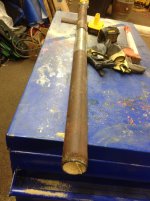
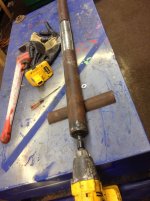
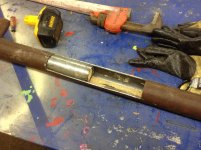
Well I had an idea to test some sawdust pressing with a damaged trailer jack laying in the junk pile (where I go for inspiration). IT was bent but I was able to salvage the guts out of it including the all thread. I tossed the housing and replaced it with a 4 ft piece of pipe with a threaded end and a 2"x1-1/4" reducer. Then cut a slot to add sawdust. I welded a 1/2" square female adapter to the end so I could operate it with an impact wrench. IT did press the sawdust but was not able to push it out with the reducer. Without the reducer it could barely push it out the end and the vibration from the impact wrench caused it to crumble as it exited. It was amazing to see how much sawdust it took to fill the pipe when it was compacted. Probably around 3 gallons of sawdust. What I gathered from the test was that more pressure and likely some heat will be needed to get the wood to bond properly and that a reducer may not be necessary at the end to further compress the biomass as long as the compression tube is long enough. I was amazed by how much resistance you could build with nothing on the end of the pipe. That was the biggest surprise. Adjusting the length of the exit tube is probably important for finding that sweet spot for resistance.
Picture 001.jpg

Picture 002.jpg
Picture 003.jpg
 
   / Hydraulic Biomass Press #28  
Dan,

We are all aware that there are large commercial machines designed to do this. Apparently this is really popular in Europe and there are a few companies doing this in the states. Unfortunately I'm not going to drop the $ for one of those machines just yet and I wanted to see if there was something I could build that might get similar results but on a much smaller scale.This why the thread is the the build it yourself portion of the forum. If you can build something like what was in the video yourself I would gladly pay attention. It is an interesting video. Thanks for sharing.

Yah, I know that machine is big bucks. I just thought it might give someone ideas. Like using an open ended tube, rather than a closed off one etc. Would have liked to seen the inside of the ram and tube assembly. I wonder if the tube is tapered, or straight?
 
   / Hydraulic Biomass Press #29  
Dan, I cant say for sure, but I think the machine uses a extruder tube, most of the ones I have seen, (Utube), that make long logs, are using a extruder. Which is one reason I think a hay bailer setup might work. With a hay baler, you can screw down the clamp and tighten up the bales, making them heavier. One would have to modify the hay packer, ( I guess thats what its called) that tamps the hay in the trough, and modify the trough to either a sq or round tube, it might work. Might also tear up the pto shaft, break shear pins, or a bunch of other stuff. I havnt ever had a bailer apart, or even baled much hay so, just speculating
 
   / Hydraulic Biomass Press #30  
I watched the video of the log compressor and my thought was a hay baler, wonder if the crank type of system and faster ram speed would be of benefit, may be not as long of stroke as a hay baler, but may be better than hydraulic cylinder,

I was thinking about similar and wondered if there would be a problem of keeping the saw dust in the cut open feed part of the cylinder, and the thought that come to me was a two system ram one that closed the cover over the opening to help guide he wood chips into the compression cylinder. and then the compression ram to compress.

may not be a problem if the ram pushes in the compression tube far enough to leave space for the next loose load of wood chips ,
 
   / Hydraulic Biomass Press #31  
W
Well I had an idea to test some sawdust pressing with a damaged trailer jack laying in the junk pile (where I go for inspiration). IT was bent but I was able to salvage the guts out of it including the all thread. I tossed the housing and replaced it with a 4 ft piece of pipe with a threaded end and a 2"x1-1/4" reducer. Then cut a slot to add sawdust. I welded a 1/2" square female adapter to the end so I could operate it with an impact wrench. IT did press the sawdust but was not able to push it out with the reducer. Without the reducer it could barely push it out the end and the vibration from the impact wrench caused it to crumble as it exited. It was amazing to see how much sawdust it took to fill the pipe when it was compacted. Probably around 3 gallons of sawdust. What I gathered from the test was that more pressure and likely some heat will be needed to get the wood to bond properly and that a reducer may not be necessary at the end to further compress the biomass as long as the compression tube is long enough. I was amazed by how much resistance you could build with nothing on the end of the pipe. That was the biggest surprise. Adjusting the length of the exit tube is probably important for finding that sweet spot for resistance.

Looks like a fun project. Thanks for posting it.

Formula for axial force from a screw vs torque are readily available. It's been years but I think the force level hits a wall at some point and then extra torque just gets eaten up in screw friction.

I made a prototype surgical intrument once to jackhammer away bone cement when revising joint replacements. Mounted it my bridgeport mill, clamped some bone cement slugs in the vise and it drove shards of cement for 5 feet. My Dr partner was pretty excited.

Surgery was another matter. The setup wasn't rigid like the bench test and between the low instrument mass and the "give" of the patient, most of the impact was absorbed elsewhere.

Long way of saying that the sawdust might be absorbing the blows from the impact wrench.
 
   / Hydraulic Biomass Press
  • Thread Starter
#32  
Yah, I know that machine is big bucks. I just thought it might give someone ideas. Like using an open ended tube, rather than a closed off one etc. Would have liked to seen the inside of the ram and tube assembly. I wonder if the tube is tapered, or straight?

Big bucks but bad ***** how much pressure it was using. I would have liked to see the inside as well. You are correct about the open ended tube. I really was surprised how much pressure I could build with nothing on the end of the pipe with my little test.

I ran across this
Homemade Hydraulic Sawdust Briquette Press Plan Mechanica | eBay

which appears to be similar to the machine I ran across here. I"m going to call next week and see how much these things run. No idea if they are 10k or 100k.
Biomass BP-100 Automatic Hydraulic Briquette Press | Hermance
 
   / Hydraulic Biomass Press #33  
Well I had an idea to test some sawdust pressing with a damaged trailer jack laying in the junk pile (where I go for inspiration). IT was bent but I was able to salvage the guts out of it including the all thread. I tossed the housing and replaced it with a 4 ft piece of pipe with a threaded end and a 2"x1-1/4" reducer. Then cut a slot to add sawdust. I welded a 1/2" square female adapter to the end so I could operate it with an impact wrench. IT did press the sawdust but was not able to push it out with the reducer. Without the reducer it could barely push it out the end and the vibration from the impact wrench caused it to crumble as it exited. It was amazing to see how much sawdust it took to fill the pipe when it was compacted. Probably around 3 gallons of sawdust. What I gathered from the test was that more pressure and likely some heat will be needed to get the wood to bond properly and that a reducer may not be necessary at the end to further compress the biomass as long as the compression tube is long enough. I was amazed by how much resistance you could build with nothing on the end of the pipe. That was the biggest surprise. Adjusting the length of the exit tube is probably important for finding that sweet spot for resistance.
<img src="http://www.tractorbynet.com/forums/attachment.php?attachmentid=408448"/>

<img src="http://www.tractorbynet.com/forums/attachment.php?attachmentid=408447"/>
<img src="http://www.tractorbynet.com/forums/attachment.php?attachmentid=408446"/>

We have a continuous baler at my work for corrugated paper scrap. It only uses the friction of the outlet "tunnel" to compress the bales. If you ever empty it (which we never do unless we need to work on it) you have the "start" the new bales by placing 2x4's across the tunnel so it can build up the compaction again. Once it builds up enough pressure it will snap the 2x4's.
 
   / Hydraulic Biomass Press #34  
We have a continuous baler at my work for corrugated paper scrap. It only uses the friction of the outlet "tunnel" to compress the bales. If you ever empty it (which we never do unless we need to work on it) you have the "start" the new bales by placing 2x4's across the tunnel so it can build up the compaction again. Once it builds up enough pressure it will snap the 2x4's.

So how would one figure out how long an exit tube to use for sawdust.
I guess start with long, and shorten as needed.
 
   / Hydraulic Biomass Press #35  
So how would one figure out how long an exit tube to use for sawdust.
I guess start with long, and shorten as needed.

Yeah, it would be easy to cut off the end since there is nothing else there. Also, the more you use it the pipe will get smoother and may effect friction
 
   / Hydraulic Biomass Press
  • Thread Starter
#36  
It almost appears that on some of these machines the exit tube is 2 piece the last foot or two. It looks like they can tighten the bolts to adjust the friction or resistance to work properly.
 
   / Hydraulic Biomass Press #37  
It almost appears that on some of these machines the exit tube is 2 piece the last foot or two. It looks like they can tighten the bolts to adjust the friction or resistance to work properly.

That wouldn't be a bad idea. The baler we have (mentioned earlier) has small hydraulic cylinders that will close in the walls on the outlet tunnel. They only engage sometimes, not sure if it's when the cylinder is stroking, or what. I will watch it sometime and pay more attention sometime.
 
   / Hydraulic Biomass Press #38  
if you are still intending to use a log splitter there are people that have done it. In order to get enough pressure for the lignin bond the briquette together you need to think smaller diameter.

I recommend that you to check this out:Alois's wood briquette press

Don
 
   / Hydraulic Biomass Press
  • Thread Starter
#39  
if you are still intending to use a log splitter there are people that have done it. In order to get enough pressure for the lignin bond the briquette together you need to think smaller diameter.

I recommend that you to check this out:Alois's wood briquette press

Don

Wow. That is impressive.
 

Tractor & Equipment Auctions

NEW Woods 6ft Finish Mower (A56438)
NEW Woods 6ft...
2015 KOMATSU WA270-7 WHEEL LOADER (A60429)
2015 KOMATSU...
2021 Chevrolet Silverado 1500 4x4 Crew Cab Pickup Truck (A59230)
2021 Chevrolet...
2025 MACK GRANITE GR64F DUMP TRUCK (A59823)
2025 MACK GRANITE...
2015 FONTAINE 53 DROP DECK (A55745)
2015 FONTAINE 53...
VOLVO EC460CL EXCAVATOR (A58214)
VOLVO EC460CL...
 
Top