Hydraulic Biomass Press

   / Hydraulic Biomass Press #1  

roadhunter

Elite Member
Joined
Mar 23, 2014
Messages
2,621
Location
Wyoming
Tractor
JCB 212SU
I buy lumber from a local sawmill and have become pretty good friends with the family who owns it. They were showing me their waste piles of sawdust and it got me into thinking about making pellets. I did some research and found that there were many variables into getting a solid pellet and the material needed to be pretty clean. The more research I did the more I pictured myself being frustrated getting the material right, moisture right, press operating, temperature right, etc...

I continued to look into ways to utilize sawdust and chips and ran across biomass logs made from sawdust and used like typical firewood. Appears to be more forgiving as fars as the material can have some larger chunks and even chips can be used. I see a couple of manufacturers in Europe and 1 from China but I really can't seem to find where anyone has tried to build their own press. I keep picturing a log splitter with a hopper on top. Hydraulic cylinder going back and forth cramming sawdust in a piece of pipe with each stroke.

This model looks pretty basic
Biomass BP-100 Automatic Hydraulic Briquette Press | Hermance

Pic of finished product
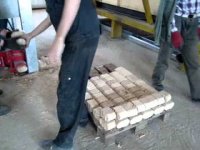
hqdefault.jpg

Any thoughts on how one would go about building a contraption to do this in a simple manner?
 
   / Hydraulic Biomass Press #2  
Search on youtube for briquet making or log making and you will find all kinds of ways to do it, some that look practical and some that don't. I saw one that mixed sawdust and used oil and that looked interesting. I'm not sure how much oil you can add before it would burn too hot.
 
   / Hydraulic Biomass Press #3  
I'd think you would need some sort of binding agent?
 
   / Hydraulic Biomass Press
  • Thread Starter
#4  
I have watched countless videos on this but most were in another country it seemed. For some reason its' not real popular in the states. I saw the video with the guy using oil. Some people make quite the mess to make a fairly small amount of fuel. The ones with people using blenders to chew up magazines are entertaining but something I would never do.

I haven't run across a DIY hydraulic version but there are many with people making a wooden press to make small chunks of biomass in simple forms.

I am envisioning something based on a HF log splitter. Basically looking for ideas on what might work best for a die set or other ideas on how to do this. Maybe press in both directions. Finding a heavy wall pipe like the dies they use might be tough but I can possibly encase pipe in concrete to give it extra strength.
 
   / Hydraulic Biomass Press #5  
I'd think you would need some sort of binding agent?
Presto logs didn't, others did. Presto log - Futurepedia - The Back to the Future Wiki
A Presto log (originally Pres-to-Log) was an artificial fuel for wood-burning stoves developed in the 1930s as a means of recycling the sawdust from sawmills. They were made of clean, dry sawdust, wood shavings and green waste that was formed into logs by machines under great pressure without any binders or glues. Other brands of artificial logs used paraffin or natural binders.

The rest of this post is trivia:

History

Doc Brown developed his own presto logs sometime in 1885 from pressed wood and pulverized anthracite (a hard and dense variety of coal), which he treated with chemicals known only to himself. The logs were color-coded green, yellow and red in increasing order of the amount of heat each produced. Doc used them secretly in the furnace of his blacksmith's workshop to avoid having to continually feed wood to the fire.

These logs were used to power the steam locomotive that pushed the DeLorean time machine up to 88 mph. Each colored log would react differently, getting the fire hotter, thus raising the steam pressure in the boiler, making the train run faster than it ever could on conventional fuels. With each colored log, the train would emit smoke of that color that mingled colorfully with the steam expelled from the smokestack.
Newgauge

The boiler temperature readout gauge.
Redlogdmc

The red log blows.

The green log ignited at 500 degrees Fahrenheit and pushed the train up to 35 mph and a firebox temperature of around 1400 degrees. At this point the yellow log fired and increased the speed all the way to 70 mph, as well as causing the temperature to soar to 2000 degrees. At this point the red log explosively ignited, causing superficial damage to the locomotive's smokestack and headlamp. As the temperature escalated to dangerous levels, the extreme heat blew off the firebox door and produced such a surplus of steam that the boiler began to lose its structural integrity, popping off rivets and threatening to explode. The speed increased to 88 mph just before the train reached the end of the track, causing the DeLorean to enter temporal displacement. This left the locomotive in a wreck of a condition, and it plunged off the end of the incomplete bridge over Shonash Ravine. Just before impact with the ground, the boiler seemed to finally self-destruct. This is quite possible, as the locomotive's fall would have caused all the water in the boiler to surge forward, exposing its firebox crown, which without the cooling effect of the water would have rapidly exceeded its tolerances and imploded, triggering a catastrophic boiler explosion. This suggests that the temperature did indeed briefly reach 2500 degrees Fahrenheit, the point at which the steel/iron firebox of the locomotive would have melted.
 
   / Hydraulic Biomass Press #6  
[/QUOTE=roadhunter;4015070
I am envisioning something based on a HF log splitter. Basically looking for ideas on what might work best for a die set or other ideas on how to do this. Maybe press in both directions. Finding a heavy wall pipe like the dies they use might be tough but I can possibly encase pipe in concrete to give it extra strength.[/QUOTE]

I'm not so sure the pipe needs to be all that heavy. The safe working pressure of schedule 40 (standard wall) pipe in 3" or 4" sizes is around 1500 psi and the bursting pressure around 6000 psi or more. Since the material being compressed isn't fluid, the wall pressure will be less than the end cap pressure. I played around with designs on paper for this but never built anything because I really didn't need it. I was thinking of using a section of 3 x 3 steel square tubing.
 
   / Hydraulic Biomass Press #7  
Any idea on the force or tonnage required to make these Brickets? Would your typically HF log splitter generate enough force?

Is there a hold / cure time required? If yes you would have to modify the typical log splitter circuit to include some form of load holding feature. I.e P.O. Check

Interesting concept though.
 
   / Hydraulic Biomass Press
  • Thread Starter
#8  
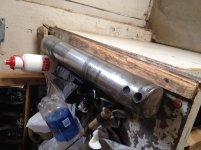
Ran across a piece that I might be able to use for the project. A old bucket pin for an 892 John Deere excavator. Nice big solid chunk of steel that I think might work. Now I need to find a piece of pipe for a sleeve.

IMG_2344.jpg
 
   / Hydraulic Biomass Press #9  
Any idea on the force or tonnage required to make these Brickets? Would your typically HF log splitter generate enough force?

Is there a hold / cure time required? If yes you would have to modify the typical log splitter circuit to include some form of load holding feature. I.e P.O. Check

Interesting concept though.

It would all depend on the cross section of the briquet, but the videos on the web show people using relatively small hydraulic jacks and even by hand with a lever, so I would think any log splitter would be more than adequate. There doesn't seem to be any hold time in the mold although they require drying after if water is used as a binder.
 
   / Hydraulic Biomass Press #10  
Ran across a piece that I might be able to use for the project. A old bucket pin for an 892 John Deere excavator. Nice big solid chunk of steel that I think might work. Now I need to find a piece of pipe for a sleeve.

<img src="http://www.tractorbynet.com/forums/attachment.php?attachmentid=408116"/>

I wonder if you have a hydraulic shop nearby if they have a scrap cylinder they may give you cheap. Use the piston and cylinder from that. Kinda weird I guess, using a cylinder to compress a cylinder???
 
   / Hydraulic Biomass Press
  • Thread Starter
#11  
Anybody have an idea for what to use on the end of the pipe? Holding that force will take some strength but it also needs to be removable after each stroke so it can spit the chunk out. I'm guessing the commercial units have a hydraulic stop that opens and closes for each stroke. But I could be off as I have never taken one of them apart. Any ideas?
 
   / Hydraulic Biomass Press #12  
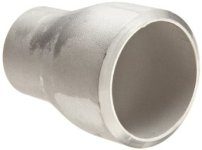
If you're going with 4 inch pipe, just use a reducer at the end. This will force everything to compress pretty good, and it might eliminate the need for an end plate.

41PdF7e021L._SX342_.jpg

Tim
 
   / Hydraulic Biomass Press #13  
most pellet or cubing machines use a rotary system with a wheel that press the product in a die, and use a circular type of die,

rollers press the product in to the die. I have toyed with the idea of using some square tubing and welding up a die, (most likely a set of steel donuts on the out side and the center, of tubes and a roller system to press the product in to the die using a heavy gear box to power the center rollers to press in the product,

my thinking was to put vertical with the die setting at the bottom of a hopper so it would be not be a lot of labor in it. also the shaft could extend up to run an atagator to keep the product falling to the die,

https://www.youtube.com/watch?x-yt-cl=84411374&v=wOOJJEFGuRo&x-yt-ts=1421828030
 
   / Hydraulic Biomass Press #14  
When I was working on a theoretical design (with a square tube) I was going to weld heavy angle on the end to make a slot I could slide a reinforced plate into. With good welding, some simple calcs indicated it would hold. If the calcs weren't correct and it broke, more welding and more reinforcing.
 
   / Hydraulic Biomass Press #15  
Why not leave the pipe / tube open and resting on the log splitter base (wedge on cylinder type). Then support on the side above the base to use the ram to push out the brick / log?
 
   / Hydraulic Biomass Press #16  
I think we ought to sic old BFreaky on it,he would come up with something amazing.
 
   / Hydraulic Biomass Press
  • Thread Starter
#17  
I wonder if you have a hydraulic shop nearby if they have a scrap cylinder they may give you cheap. Use the piston and cylinder from that. Kinda weird I guess, using a cylinder to compress a cylinder???

That is an interesting idea. I'm going to have to give this some thought. I love repurposing junk parts that require little modification and that would certainly fit the bill.

If you're going with 4 inch pipe, just use a reducer at the end. This will force everything to compress pretty good, and it might eliminate the need for an end plate.

View attachment 408121

Tim

I have considered this am and unclear if that would actually work. I guess if it didn't want to come out I could trim the reducer back a little bit to make less resistance. I love the simplicity of that. Could probably rig up a hydraulic knife to make the pieces a uniform length.

most pellet or cubing machines use a rotary system with a wheel that press the product in a die, and use a circular type of die,

rollers press the product in to the die. I have toyed with the idea of using some square tubing and welding up a die, (most likely a set of steel donuts on the out side and the center, of tubes and a roller system to press the product in to the die using a heavy gear box to power the center rollers to press in the product,

my thinking was to put vertical with the die setting at the bottom of a hopper so it would be not be a lot of labor in it. also the shaft could extend up to run an atagator to keep the product falling to the die,

https://www.youtube.com/watch?x-yt-cl=84411374&v=wOOJJEFGuRo&x-yt-ts=1421828030

That machine seems to use larger pieces than just sawdust. Very impressive. That is one of the things that scares me about the pellet presses is how many need perfectly clean and dry sawdust. This one seems to be pretty big. I've also read some negative reviews on the samller chineese PTO powered machines. My understanding is they don't' get hot enough to cause the woods natural glue to activate which is important in creating a durable pellet. Also I believe the moisture content is more crucial in pellets along with letting them dry on racks which was a turnoff for me as I don't' want to handle them unless absolutely necessary. With so many moving parts and having to replace dies that type of setup seemed like more than what I was willing to invest. I'm more of a brute force kind of guy and am fascinated with hydraulics so that also played a role. But if you build it I would love to see how it works.

When I was working on a theoretical design (with a square tube) I was going to weld heavy angle on the end to make a slot I could slide a reinforced plate into. With good welding, some simple calcs indicated it would hold. If the calcs weren't correct and it broke, more welding and more reinforcing.

Interesting. The plate would slide in to compact the material then slide out to allow the chunk of biamass to be removed?

Why not leave the pipe / tube open and resting on the log splitter base (wedge on cylinder type). Then support on the side above the base to use the ram to push out the brick / log?

I thought about that but in my mental picture of that I don't' think there would be enough force to compact the material without something on the end. I think it might work as mentioned above with a reducer to restrict the output and force material to compact as it pushes through. But am just an idiot with a welder so I could be completely wrong. I think some testing is in order. Start with an open pipe. See how it works. Then play with some different restrictions or even a reducer as mentioned above. And keep an eye out for a large used/junk hydraulic cylinder.

Thanks for all the great ideas and keep them coming. I am going to give this a try and will post pics.
 
   / Hydraulic Biomass Press #19  
I saw some examples of making pellets for heating.
They use roller mills that are basically the same as used to make animal feed under pressure.

For logs I would envision a large roller mill turning out 3" pellets cut at every 12" for the fireplace.

I gathered that no binders are used but results are very dependent on the moisture content.

Today there is no waste at a sawmill.
Chips go to making particle board and sawdust to making artificial fireplace logs.
In fact the artificial logs are consistent as to humidity and BTU content all while being easier to handle and store.
When you purchase firewood you are never sure of the aging, quality or BTU content and very often are shortchanged with the actual quantity, and then what kinds of bugs or even mice come with the firewood.
 
   / Hydraulic Biomass Press
  • Thread Starter
#20  
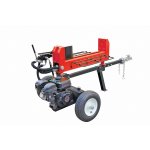
This is what I am thinking of using as the basis of the project. After i do some simple testing with my existing log splitter. I'm just going to use pipe and see what happens.
image_23512.jpg
 

Tractor & Equipment Auctions

iDrive TDS-2010H ProJack M2 Electric Trailer Dolly (A59228)
iDrive TDS-2010H...
2014 CATERPILLAR 627K SCRAPER (A60429)
2014 CATERPILLAR...
2012 DOOSAN G25KW GENERATOR (A55745)
2012 DOOSAN G25KW...
RAKE ATTACHMENT FOR MINI EXCAVATOR (A58214)
RAKE ATTACHMENT...
Willmar 4550 Wrangler Articulating Loader (A56438)
Willmar 4550...
2019 KENWORTH T680 TANDEM AXLE SLEEPER (A59904)
2019 KENWORTH T680...
 
Top