How to fix this crack

/ How to fix this crack #61  
If you have a powerful enough Mig welder, by all means use it. I just love Lincoln's L-56 Mig wire. If you are going to use a stick welder, use 7018!
Now that is just unfair! Almost none of us have welders capable of spray transfer and if we did I bet we could also make beautiful well penetrated welds. I got to use a Miller 350 in a welding class and it made gorgeous welds. Sometimes equipment is the difference.
 
/ How to fix this crack #62  
If you have a powerful enough Mig welder, by all means use it. I just love Lincoln's L-56 Mig wire. If you are going to use a stick welder, use 7018!

Just plain good looking welds. Don't see too many that nice.
 
/ How to fix this crack #63  
So I am going to go with ArlyA fish plate design. Still working on steel thickness, probably a 3/8 piece I have will be the answer.

Still more questions though.

Would you Mig this or Stick this?

Is Co2 / Argon heavier than air or lighter than air? Wondering about the purge I am planning.

Finally, I assume that the fish plate should be a bit (1/4" or so) smaller than the piece I am welding on to. Meaning, I do not want to make the weld from the side but from the top.

Either would do an acceptable job. I'd probably grab stick and do it. Spend the extra money for a 10 lb can of fresh 7018's, probably Lincoln excalibur. It should be in a sealed steel can. While you are doing the repair, keep them in a make shift hot box, a cooler with a light bulb or something to keep the warm and dry. (Hot to the touch will make them weld like butter).

I would use something as thick as the metal thickness, or thicker. I don' think it would hurt if you went with a 3/8" plate, or a 5/16" plate. I'm thinking that tubing is probably 1/4" wall thickness???

Both CO2 and Ar are heavier than air, so it would only need to run a little while to push the O2 out. But I'd think that the main idea is to keep the oil from flashing. IF you have a Oxy-fuel, or even a good propane torch, I'd heat the metal to burn the oil out of the cracks and area of the weld first. It will help to prevent gassing off of the oil and subsequent (Possible) porosity in the weld area. It'd open up the cracks too so you could see how far the extended too if it is a concern.


You want to weld the plate across the top and I'd even weld a complimentary one on the bottom. Slide the plate over so that the inside rolled (radiused) edged of the tubing meets the edge of the "gusset". And while we are calling it a fish plate, it in my mind is really more of a gusset if it is reinforcing the tubing in a corner joint. Fill the weld (multi-pass more than likely) to the outside edge of the tubing and an equal amount high on the plate.

Like I said earlier, you probably want to weld the underside of the plate as well, or at least a few long tacks, an inch or so in length, spaced equally apart.
 
/ How to fix this crack #64  
Now that is just unfair! Almost none of us have welders capable of spray transfer and if we did I bet we could also make beautiful well penetrated welds. I got to use a Miller 350 in a welding class and it made gorgeous welds. Sometimes equipment is the difference.

Just plain good looking welds. Don't see too many that nice.
Thanks guys!;)
Now you realize, I've only been welding a few months now.:D
 
/ How to fix this crack #67  
When you weld do not drain the tank fill it to the very top. Fumes are explosive not liquid gas so by not allowing the fumes a place to accumulate by filling the tank full, it is safer than a partially empty tank

No way I would do that, it's asking for a fire, probably ala blowtorch as the oil heats and sprays out the hole. The safe way to do it is to drain the tank, wash it out with some solvent, followed by soapy water, and then put as much water as you can in the tank.
 
/ How to fix this crack #68  
Actually a better way is to not fill it with water. There could be trapped fume pockets in corners, fill it with a inert type of gas, most common approach is to connect hose from exhaust, (most common being car). Or argon from a mig welder, or CO2.or both
 
/ How to fix this crack #69  
Car exhaust can also be explosive.

Industry may have one using soap, water, heat and follow up with a procedure using inert gas and also checking for explosive gasses with a meter, not a torch.

There may also be cases of a plug and standoff or monitored continuous purge. It's all situation directed.
 
/ How to fix this crack #70  
Lots of good thoughts here, but whatever you end up doing, you've got to grind out ALL of the crack. If you don't, it'll act as an initiation point for new cracks in your repair weld. That's probably what happened to the first repair. Unfortunately, grinding will tend smear metal over the crack and hide it. When you think you're done, use progressively finer grits of sand paper on a backing disk to polish out the crack area in an attempt to remove the smearing. Then use a liquid penetrant test to verify that the crack is gone. LP test kits aren't cheap, so if you're not willing to do it right, find someone that will or you'll be doing it again. A mag particle test would show the crack even if metal was smeared over it, but the equipment to do that is even more expensive than for the LP test.

If grinding the crack all the way out means going all the way through into the tank, you'll have to drain the tank, and I'd recommend some sort of inert gas purge while making the weld. As mentioned, auto exhaust can be explosive if it contains unburned fuel. And since grinding also makes sparks, it would be a good idea to clean and purge the tank before you broke through.

From the looks of the cracks, they're starting at the inside of the corner. I'd guess that the two legs forming that angle are twisting together and apart as the machine rides over rough ground, and that flexing is focused on the corner. I don't think a fish plate on the side is going to help, but triangular gussets top and bottom will distribute the loads over more area. See MossRoad's post #9. What ever else you do, try to end up with a smooth radius on the weld surface on the inside of that corner. Build it up and grind it smooth if you have to, and avoid undercut at the toes of the fillet as well.

I wouldn't have any hesitation using multiple passes with my Lincoln PowerMIG 180 welder on this. Probably end up running it wide open, but I've done way thicker stuff than this. Just make sure you push the wire toward the front of the pool so it impinges on base metal at the front of the weld pool. Lay down a stringer bead to start, then weave as the groove/fillet gets wider. Wouldn't hurt to hit it with a needle gun between passes to try to build some compressive stresses in along the way, but that might just be wishful thinking.
 
/ How to fix this crack #71  
Car exhaust can also be explosive.

Yep, my Grandfather used exhaust from the engine from his welder for many years, until one blew up.

It didn't kill him but he quit relying on that method.
 
/ How to fix this crack #72  
Didn't know that, I guess I could see that if the engine was running rich
 
/ How to fix this crack #73  
Ever seen flame throwers on car exhausts? In a nutshell, they put a spark plug in the tailpipe, hook it to a coil, and when they push the button it re-ignites the un-burnt fuel in the exhaust.

Google
 
/ How to fix this crack #74  
I'd almost bet you today's cars wouldn't do that , all the epa s standards take out nearly all pollution from the leftovers.
 
/ How to fix this crack #75  
Carbon monoxide is an explosive gas. Mixed with the right amounts of air it is combustible. There is no dependance on fuel particles for this to happen.

[video]https://www.mathesongas.com/pdfs/products/Lower-(LEL)-&-Upper-(UEL)-Explosive-Limits-.pdf[/video]

[video]https://www.ccohs.ca/oshanswers/chemicals/chem_profiles/carbon_monoxide.html[/video]
 
/ How to fix this crack #76  
Carbon monoxide is an explosive gas. Mixed with the right amounts of air it is combustible. There is no dependance on fuel particles for this to happen.

[video]https://www.mathesongas.com/pdfs/products/Lower-(LEL)-&-Upper-(UEL)-Explosive-Limits-.pdf[/video]

[video]https://www.ccohs.ca/oshanswers/chemicals/chem_profiles/carbon_monoxide.html[/video]

Learn something every day! I guess we don't see CO burn much because it tends to be generated when there isn't enough oxygen around for complete combustion of fuel.
 
/ How to fix this crack #77  
CO is one of the least listed. If it doesn't burn coming out of a hot exhaust and catalytic converter, I think that is a minor issue.
Modern equipment, especially cars with a normally functioning emission control system, that is up to temp should not put out any significant amount of "rapid burning" gases.
 
/ How to fix this crack
  • Thread Starter
#78  
OK guys - I am halfway through (or maybe done - lets see what you all say).

I found a piece of 1/2" stock that fit perfectly. A bit thicker than I wanted. I did a layout with the fishplate template and it looked good with the marker. But, I have a lot to learn with my Plasma Cutter and it was wonky as a mo fo. Need to learn that when you are cutting cornere you have to be straight up and town, an angle of any sort just does damage

At this point I put some Co2 into the oil tank. Ran a bit of gas from my mig into it to help alleviate any heat worries.

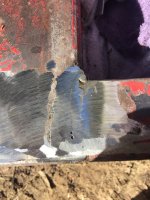
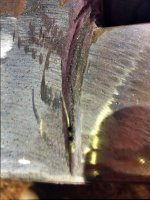
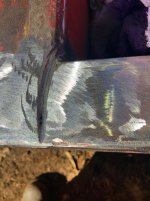
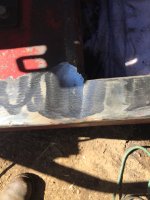
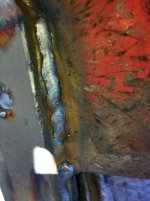
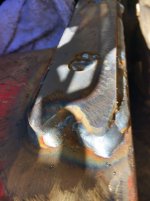
So next I drilled a relief hole and then ground down the crack. The first picture is grinding it flat. THe second picture is grinding into the metal. You will notice two drill holes. Thought I had found the end of the crack but when I ground I found I was off a bit. I then hit the whole thing with a torch. Heated the area up, Hopefully burning out all the oil in the crack.

Flat Grinding
IMG_2981.jpg

Gouging
IMG_2984.jpg

Before the torch and cleaning
IMG_2982.jpg


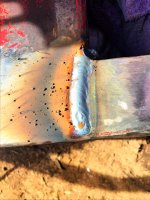
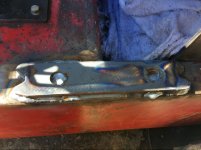
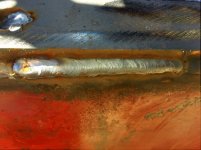
So then I put the Fish Plate down and started welding. I used my Lincoln 180C for this layer of weld. Set the voltage almost all the way and wire feed at 2/3rd. I have found this setting gives me nice penetration but doesn't dump a ton of metal. I welded at 2" at a time per my neigbors instructions. I find this very difficult as I get my mojo going and then when I start again I blow it.

The Weld
IMG_2985.jpg

The grind after the weld
IMG_2986.jpg

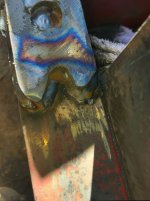
Fish Plate and Details

IMG_2993.jpg

IMG_2995.jpg

IMG_2994.jpg

IMG_2997.jpg

IMG_2996.jpg


So here is my question. Should I do another pass. I am not sure what it gains me but that is because I am an inexperienced welder. On the verticles do I do a strand on either side of the weld tying in the current weld (making the weld wider?) Going to take a lunch break and would love to here your thoughts
 
Last edited by a moderator:
/ How to fix this crack #80  
I would not have run the plate that way. I would have run a triangular plate across the two corners. A right triangle to bridge both sides together. It's a type of fish plate, but the way the joint is, it doesn't do a lot of good to have a long one that really only reinforces both sides. I don't think you've gained much strength or bend resistance running it that way. I could be wrong though. Don't forget to redo the inside vertical weld. There will be problems there too.
 

Marketplace Items

Caterpillar C18 Industrial Diesel Engine - Serial N8F01109 - Arrangement 385-7728 - Pump Takeout (A63689)
Caterpillar C18...
2020 TROXELL CONCEPT 130 BBL STEEL VACUUM TRAILER (A63569)
2020 TROXELL...
Adams Weight Hopper (A63688)
Adams Weight...
John Deere Gator TX4x2 (A62177)
John Deere Gator...
500 BBL FRAC TANK (A58214)
500 BBL FRAC TANK...
Oxy-acetylene Torch and Regulator Rig (A63689)
Oxy-acetylene...
 
Top