You are using an out of date browser. It may not display this or other websites correctly.
You should upgrade or use an alternative browser.
You should upgrade or use an alternative browser.
Hill Climbing Primer
- Thread starter square1
- Start date
- Views: 52463
More options
Who Replied?
/ Hill Climbing Primer
#241
SPYDERLK
Super Star Member
- Joined
- Feb 28, 2006
- Messages
- 12,628
- Location
- VA
- Tractor
- JD2010, Kubota3450,2550, Mahindra 7520 w FEL w Skid Steer QC w/Tilt Tatch, & BH, BX1500
Because it is turning the composite ring gear/wheels forward against resistance outside the tractor body. That part is relevant.Come on Larry, you know it's relevant.
Why is the load on the top of that bearing??
CalG
Super Member
- Joined
- Sep 29, 2011
- Messages
- 9,388
- Location
- vermont
- Tractor
- Hurlimann 435, Fordson E27n, Bolens HT-23, Kubota B7200, Kubota B2601
Maybe this example helps, maybe not.... Looking at Egon's picture of the ring gear and pinion gear. When turning to move the vehicle forward. Where is the greatest load on the pinion bearing closest to the pinion gear??? Top?? Left side?? Right side?? Bottom??
Of course the corollary question, "Where is the greatest load on the ring gear support bearing closest to the pinion. And, is it's magnitude equal to the force on the pinion bearing?"
Of course, equal and opposite..... (give or take vector math)

JWR
Elite Member
- Joined
- Apr 19, 2011
- Messages
- 4,122
- Location
- So MD / WV
- Tractor
- MF 2660 LP, 3 Kubota B2150, Kubota BX2200, MH Pacer, Gravely 5660, etc.
On the 244th post it is very possible you guys are off on some other topic than I know about. This relates most closely, I hope, to SPYDERLK post #213.Course it matters which way it rotates -- the wheels that is. ... Now, - Physics says that a pull point below tire contact rotates the tractor to put more weight on the front wheels. Pull above the ground and the tractor can backtip.
larry
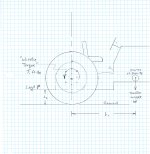 "Is there an engineer in the house ?"
This got way too complicated to get simple answers and insight. Forget for the moment whatever may be going on inside the machine. Also forget for the moment anything dynamic and think static, initially. See the diagram (which you may have to blow up to see.) The relevant torque equation is (W x L1) - T1 - (P x L2) = 0 where T1 is the negative "wheelie torque", WxL1 is positive torque from the weight of the tractor acting over a lever of length L1, and P x L2 is the negative torque from the load acting over a lever of length L2. This equation sets the boundary condition at which the tractor is just balanced ready to rotate about the pivot point where the rear tire touches the ground and later/potentially about the rear axle. In this static circumstance nothing is moving yet. To me this lends a lot of insight into the physics of the problem.
Note that T1 "wheelie torque" is just the very familiar feature of powered vehicles that tends to raise the front wheels preceding and during acceleration. We do not need to delve inside the machine to list that term in the equation. So many things can be learned from the equation. 1) Both the pulling force "load" and the wheelie torque act in the same direction. The Tractor weight over the lever arm L1 is the only term operating clockwise. 2) Thinking incrementally from the static situation, exactly balanced but no motion yet, ANY ADDED LENGTH L2 (raising the pull point) WILL CAUSE NET NEGATIVE TORQUE AND IT WILL START TO TIP BACKWARDS. 3) Any added wheelie torque (e.g. applying more power and starting to create movement) will also tip the machine backwards or start to do so. 4) Any added pulling load will also tip it backwards. 5) Some definite conclusions can be made. The height of the pull point (drawbar) on the tractor certainly matters as do all the terms in the equation. 6) So long as nothing is moving yet, the frame of the tractor is acting as a stiff member whose pivot is NOT the rear axle but rather the tire contact point on the ground.
Once the situation is dynamic and not static, we have a much more complex physics problem. First, all of us talking here realize that as a practical circumstance the tire will slip/spin and the torque amounts all change but clearly with LESS chance of tipping backward. If there is enough traction OR if a sudden event (like popping the clutch) occurs, then tip over backwards can start. If this occurs slowly enough (the Penn State safety study referenced many posts ago says on the order of 3/4 second elapsed time) then the "wheelie torque" will decrease, the front of the tractor will come back down and the next hurdle becomes traction again. If there is still enough traction then potentially the tractor could be tipped backwards. The chances of that traction being adequate to produce backward tipover are very small because the only way that can happen is if the tires have more than 1.0 coef of friction with the ground -- in other words the treads have dug in and gotten hold of something solid enough to pull on and produce significant force. Can't happen on pavement. Could happen on just the right tread depth into just the right hardness of soil and grabs a root or something. "Ain't going to happen." As the Penn State Safety center article pointed out, though, if the machine ever gets tipped back very much, then L1 is decreased and tipping gets easier/more likely to a point of no return. I rest my case.
Last edited:

Egon
Epic Contributor
Thanks for the diagram and static to dynamic conditions.:thumbsup:

ovrszd
Epic Contributor
- Joined
- May 27, 2006
- Messages
- 33,727
- Location
- Missouri
- Tractor
- Kubota M9540, Ford 3910FWD, Ford 555A, JD2210
Of course the corollary question, "Where is the greatest load on the ring gear support bearing closest to the pinion. And, is it's magnitude equal to the force on the pinion bearing?"
Of course, equal and opposite..... (give or take vector math)
As is usually the case,,, I'm not sure what you just said and whether it is relevant. Please just answer the question as to "Top", "Left Side", "Right Side", "Bottom"???
SPYDERLK
Super Star Member
- Joined
- Feb 28, 2006
- Messages
- 12,628
- Location
- VA
- Tractor
- JD2010, Kubota3450,2550, Mahindra 7520 w FEL w Skid Steer QC w/Tilt Tatch, & BH, BX1500
I agree sorta. The rail dragster for instance. But I think there are mental games to play to get a pretty good handle. Huge linear acceleration provides the load. Wheres that pull point? Cant forget the huge initial rotational acceleration of the wheels.On the 244th post it is very possible you guys are off on some other topic than I know about. This relates most closely, I hope, to SPYDERLK post #213.
View attachment 372945 "Is there an engineer in the house ?"
This got way too complicated to get simple answers and insight. Forget for the moment whatever may be going on inside the machine. Also forget for the moment anything dynamic and think static, initially. See the diagram (which you may have to blow up to see.) The relevant torque equation is (W x L1) - T1 - (P x L2) = 0 where T1 is the negative "wheelie torque", WxL1 is positive torque from the weight of the tractor acting over a lever of length L1, and P x L2 is the negative torque from the load acting over a lever of length L2. This equation sets the boundary condition at which the tractor is just balanced ready to rotate about the pivot point where the rear tire touches the ground and later/potentially about the rear axle. In this static circumstance nothing is moving yet. To me this lends a lot of insight into the physics of the problem.
Note that T1 "wheelie torque" is just the very familiar feature of powered vehicles that tends to raise the front wheels preceding and during acceleration. We do not need to delve inside the machine to list that term in the equation. So many things can be learned from the equation. 1) Both the pulling force "load" and the wheelie torque act in the same direction. The Tractor weight over the lever arm L1 is the only term operating clockwise. 2) Thinking incrementally from the static situation, exactly balanced but no motion yet, ANY ADDED LENGTH L2 (raising the pull point) WILL CAUSE NET NEGATIVE TORQUE AND IT WILL START TO TIP BACKWARDS. 3) Any added wheelie torque (e.g. applying more power and starting to create movement) will also tip the machine backwards or start to do so. 4) Any added pulling load will also tip it backwards. 5) Some definite conclusions can be made. The height of the pull point (drawbar) on the tractor certainly matters as do all the terms in the equation. 6) So long as nothing is moving yet, the frame of the tractor is acting as a stiff member whose pivot is NOT the rear axle but rather the tire contact point on the ground.
Once the situation is dynamic and not static, we have a much more complex physics problem. First, all of us talking here realize that as a practical circumstance the tire will slip/spin and the torque amounts all change but clearly with LESS chance of tipping backward. If there is enough traction OR if a sudden event (like popping the clutch) occurs, then tip over backwards can start. If this occurs slowly enough (the Penn State safety study referenced many posts ago says on the order of 3/4 second elapsed time) then the "wheelie torque" will decrease, the front of the tractor will come back down and the next hurdle becomes traction again. If there is still enough traction then potentially the tractor could be tipped backwards. The chances of that traction being adequate to produce backward tipover are very small because the only way that can happen is if the tires have more than 1.0 coef of friction with the ground -- in other words the treads have dug in and gotten hold of something solid enough to pull on and produce significant force. Can't happen on pavement. Could happen on just the right tread depth into just the right hardness of soil and grabs a root or something. "Ain't going to happen." As the Penn State Safety center article pointed out, though, if the machine ever gets tipped back very much, then L1 is decreased and tipping gets easier/more likely to a point of no return. I rest my case.
,,,Where I think static describes dynamic easily and well is in a steady state pull -- no acceleration.
larry

Do you all realize that at this point you all are now getting into minutiae (the small, precise, or trivial details of something) of this?
Basically it boils down that if you hook to the drawbar (or below axle height) with anything you want to pull and are reasonable about trying to drag it you'll be fine. If you hook to the 3PH with no attachment to the drawbar your chances of an flipover are higher but not guaranteed.
If you link to the top link only of the 3PH you are probably doing it wrong.
So just freakin give it up already.
Basically it boils down that if you hook to the drawbar (or below axle height) with anything you want to pull and are reasonable about trying to drag it you'll be fine. If you hook to the 3PH with no attachment to the drawbar your chances of an flipover are higher but not guaranteed.
If you link to the top link only of the 3PH you are probably doing it wrong.
So just freakin give it up already.
JWR
Elite Member
- Joined
- Apr 19, 2011
- Messages
- 4,122
- Location
- So MD / WV
- Tractor
- MF 2660 LP, 3 Kubota B2150, Kubota BX2200, MH Pacer, Gravely 5660, etc.
Spyderlk said: I agree sorta. The rail dragster for instance. But I think there are mental games to play to get a pretty good handle. Huge linear acceleration provides the load. Wheres that pull point? Cant forget the huge initial rotational acceleration of the wheels.
,,,Where I think static describes dynamic easily and well is in a steady state pull -- no acceleration.
larry
Yes mostly agree. I'd comment however that there would not normally be very much rotational acceleration of the wheels unless they slip and suddenly spin. Under what I think are normal circumstances when the static circumstance changes to a a dynamic one, things (should) begin to happen very slowly, too slow for large amounts of rotational torque due to acceleration. The pull point on the tractor in my diagram at least is L2 feet off the ground. Units being in foot-pounds.
,,,Where I think static describes dynamic easily and well is in a steady state pull -- no acceleration.
larry
Yes mostly agree. I'd comment however that there would not normally be very much rotational acceleration of the wheels unless they slip and suddenly spin. Under what I think are normal circumstances when the static circumstance changes to a a dynamic one, things (should) begin to happen very slowly, too slow for large amounts of rotational torque due to acceleration. The pull point on the tractor in my diagram at least is L2 feet off the ground. Units being in foot-pounds.
SPYDERLK
Super Star Member
- Joined
- Feb 28, 2006
- Messages
- 12,628
- Location
- VA
- Tractor
- JD2010, Kubota3450,2550, Mahindra 7520 w FEL w Skid Steer QC w/Tilt Tatch, & BH, BX1500
The Dragster wheels spin up right now. Theyre a sacrificial clutch -- at least used to be. Have they gone to a well controlled spin these days.
ovrszd
Epic Contributor
- Joined
- May 27, 2006
- Messages
- 33,727
- Location
- Missouri
- Tractor
- Kubota M9540, Ford 3910FWD, Ford 555A, JD2210
Do you all realize that at this point you all are now getting into minutiae (the small, precise, or trivial details of something) of this?
Basically it boils down that if you hook to the drawbar (or below axle height) with anything you want to pull and are reasonable about trying to drag it you'll be fine. If you hook to the 3PH with no attachment to the drawbar your chances of an flipover are higher but not guaranteed.
If you link to the top link only of the 3PH you are probably doing it wrong.
So just freakin give it up already.
Which is sillier,,, the discussion continuing or you still reading it???


k0ua
Epic Contributor
Which is sillier,,, the discussion continuing or you still reading it???
Shhhh.. we don't want people to know we are still reading it. (well skimming the highlights anyway)
k0ua
Epic Contributor
Which is sillier,,, the discussion continuing or you still reading it???
Shhhh.. we don't want people to know we are still reading it. (well skimming the highlights anyway)
In the forest area around were I live the only way timber is moved in the forest is by skidding, using a dozer or skidder. Running a vineyard on a steep slop I have to move bins of grapes, 500 lbs. each. I use a four wheel drive tractor and very rarely go up hill as the rear wheels loose traction and going down hill I can drop the load and push it. always in fear of a turn over.
Egon
Epic Contributor
Static conditions only occur if the clutch isn't engaged or the motor is stopped. :thumbsup:
SPYDERLK
Super Star Member
- Joined
- Feb 28, 2006
- Messages
- 12,628
- Location
- VA
- Tractor
- JD2010, Kubota3450,2550, Mahindra 7520 w FEL w Skid Steer QC w/Tilt Tatch, & BH, BX1500
... Which has nothing to do with whether they are predictively identical to a steady drive condition.Static conditions only occur if the clutch isn't engaged or the motor is stopped. :thumbsup:
larry
Egon
Epic Contributor
... Which has nothing to do with whether they are predictively identical to a steady drive condition.
larry
Reads good but doesn't really mean anything other than an attempt at confusion! :laughing:
ovrszd
Epic Contributor
- Joined
- May 27, 2006
- Messages
- 33,727
- Location
- Missouri
- Tractor
- Kubota M9540, Ford 3910FWD, Ford 555A, JD2210
Reads good but doesn't really mean anything other than an attempt at confusion! :laughing:
Reminds me of what my First Sergeant always said when I was in Vietnam about dealing with Officers. "If you can't dazzle them with brilliance, baffle them with bulls***".
CalG
Super Member
- Joined
- Sep 29, 2011
- Messages
- 9,388
- Location
- vermont
- Tractor
- Hurlimann 435, Fordson E27n, Bolens HT-23, Kubota B7200, Kubota B2601
Reads good but doesn't really mean anything other than an attempt at confusion! :laughing:
Some will be confused, some will not
It's a complicated subject ;-)


