Broken Mount For LA724

/ Broken Mount For LA724 #21  
We're dealing with a tractor here, not a china cabinet after all. I doubt that moving it with the bucket bottom flat on the ground would put enough twisting torque into the mounting brackets to break the way they did. If anything, I think they should have broken out of the engine block since that is only bolt threads into cast iron.

From what I've seen of broken Kubota parts on TBN lately, I'm thinking they have a potential problem with steel quality in their attachments. The broken backhoe booms and now the loader bracket make me think there's more to this than just use or abuse. Steel shouldn't break like that, without bending first.

Thank God they aren't building bridges.

Sean

I don't see any abuse in this case either, nor do I think that the OP should have spent the extra money for a 'real' TLB. As far as I'm concerned even the standard Kubota tractors are what I would call commercial grade. Compare their loader and especially backhoe design with other compact tractor makes and it will reinforce this.

Now I'm speaking about the B-series here, because that's the only one that I have directly knowledge/use of. But the B26 is 90% a B2630, with a upgraded loader and backhoe (and third hyd. pump for BH swing). The subframe on the B26 is a little bit heavier, but is essentially the same design as that on the larger B-series. The main difference is that it is one entire weldment on the B26 vs. being bolted together on the standard B-series. The new BH77 is very similar to the BT820, except it has a slightly shorter boom/dipper, and less breakout force. The BH77 actually has more dipper stick force than the BT820 however. The TL500 loader is a good bit more substantial than the LA403 or LA504, but is has to be because of the greater lift capacity.

My point on all this is that the Kubota TLBs really do share a lot in common with the non-industrial tractors. They use some upgraded parts and weldments here and there, but otherwise they just combined parts, features and attachments from different models to make a tractor more desirable to the commercial contractor. Would I rather have a B26 over my B3200, probably not. Would I like to get a B26 in addition to my B3200 someday, definitely. The B26 can't do what my B3200 does, nor could my B3200 do the job of a B26 nearly as efficiently.

Now, the bigger issue here is what appears to be the lack of good materials and/or Quality Control. I may get bashed for this, but I think it has to do with the typical American spirit of buy materials as cheap as you can and build it as quick as you can to turn a good profit. Notice that almost all of the catastrophic metal failures that we read about in the Kubota forum have to do with either loaders or backhoes. Is it a coincidence that they are made in the USA, while the rest of the tractor comes directly from Japan? I can say without a doubt the welds on my LA504 loader are not nearly as nice as those on the tractor itself. I think it's time for Kubota Corporation Japan to have a talk with their American counterparts.
 
/ Broken Mount For LA724 #22  
The material is cast steel that is weldable similar to regular low carbon steel.

Hmmmm interesting. Must be ductile iron. Based on the photo you attached I'm guessing there was a defect (stress concentration) in the casting. That's very unfortunate.

Also the bracket cross section looks a bit undersized for this application. I'm not crazy about those "pockets" in the bracket arm. Not sure why those are there... maybe something to do with the casting process. But more likely an effort to save material or weight.... or dollars. :)

Kubota should certainly be informed of this issue. Sitting here in my arm chair, I believe it maybe a design problem with the brackets. 500 hours is not much for a tractor of this caliber. At 6000 to 7000 lbs your tractor is capable of producing some serious loading on all it's components.... an owner shouldn't be expected to baby a machine. Of course abuse is another story.

My L3830 has brackets that are weldments.... cut and bent metal plate that is welded together. I feel this design and manufacturing method is much more durable for the loader application. Especially when trying to maintain quality control that closely matches design intentions.
 
/ Broken Mount For LA724 #23  
Do you remember the John Deere trade-in thread with the 2520? His tractor was well taken care of, but I'm afraid he has nothing to compare to the care kcender takes of his equipment. I know him, and I can tell you one thing for sure, if it was abuse, which I'm not convinced it was, it was purely accidental.

We're dealing with a tractor here, not a china cabinet after all. I doubt that moving it with the bucket bottom flat on the ground would put enough twisting torque into the mounting brackets to break the way they did. If anything, I think they should have broken out of the engine block since that is only bolt threads into cast iron.

From what I've seen of broken Kubota parts on TBN lately, I'm thinking they have a potential problem with steel quality in their attachments. The broken backhoe booms and now the loader bracket make me think there's more to this than just use or abuse. Steel shouldn't break like that, without bending first.

Thank God they aren't building bridges.

Sean

Do you have the link to the backhoe failure? I would like to study.
 
/ Broken Mount For LA724 #24  
<<<snip>>>
Hmmmm interesting. Must be ductile iron. Based on the photo you attached I'm guessing there was a defect (stress concentration) in the casting. That's very unfortunate.

Also the bracket cross section looks a bit undersized for this application. I'm not crazy about those "pockets" in the bracket arm. Not sure why those are there... maybe something to do with the casting process. But more likely an effort to save material or weight.... or dollars. :)
<<<snip>>>


.

As was mentioned previously, that cast upright was not designed to take large side loads- it was designed to be loaded fore 'n aft. Take a yardstick as an example - it can support a lot more weight on it's narrow edge than on its broad edge.

The pockets in the casting are there for the same reason that an I-Beam isn't a solid, rectangular section: the added material would reduce the strength to weight ratio. It also helps the casting to cool evenly after it's poured; without deforming. Kubota does a pretty good job of wringing weight out of their products without going overboard. I don't think a casting defect is indicated.

It looks to me like the loader had a side load in excess of what it was designed for. Surprisingly, the loader manual makes no warnings about side loading the attachment that I could find. Don't know if the backhoe manual says anything about that as I don't have one ... yet.

I guess the take away from all this is to lift the bucket before moving the tractor with the hoe. My condolences to the OP for having to find this out the way he did. Sounds like he's a more than competent weldor who can set it right if the dealership won't. It's nice to have that skill as an option.

-Jim
 
/ Broken Mount For LA724 #25  
As was mentioned previously, that cast upright was not designed to take large side loads- it was designed to be loaded fore 'n aft. Take a yardstick as an example - it can support a lot more weight on it's narrow edge than on its broad edge.

The pockets in the casting are there for the same reason that an I-Beam isn't a solid, rectangular section: the added material would reduce the strength to weight ratio. It also helps the casting to cool evenly after it's poured; without deforming. Kubota does a pretty good job of wringing weight out of their products without going overboard. I don't think a casting defect is indicated.

It looks to me like the loader had a side load in excess of what it was designed for. Surprisingly, the loader manual makes no warnings about side loading the attachment that I could find. Don't know if the backhoe manual says anything about that as I don't have one ... yet.

I guess the take away from all this is to lift the bucket before moving the tractor with the hoe. My condolences to the OP for having to find this out the way he did. Sounds like he's a more than competent weldor who can set it right if the dealership won't. It's nice to have that skill as an option.

-Jim

Can you explain to me how moving the tractor around with the backhoe produces side loading at the brackets?

There's no way the backhoe can drag the tractor sideways. The tractor will rotate (pivot) about the bucket that is on the ground. This movement will produce a force along the L (length) direction of the tractor... one bracket will have a force towards the rear and one towards the front. Side loading will be very minimal.

Short of pushing hard on the loader brackets from the side, I see no way to side load the brackets when operating the tractor. Hence no need for a safety warning to not side load them from the manufacture.
 
/ Broken Mount For LA724 #26  
Most likely the right hand loader bracket failed AFTER the left hand loader bracket broke completely through.
 
/ Broken Mount For LA724 #28  
Can you explain to me how moving the tractor around with the backhoe produces side loading at the brackets?

There's no way the backhoe can drag the tractor sideways. The tractor will rotate (pivot) about the bucket that is on the ground. This movement will produce a force along the L (length) direction of the tractor... one bracket will have a force towards the rear and one towards the front. Side loading will be very minimal.

Short of pushing hard on the loader brackets from the side, I see no way to side load the brackets when operating the tractor. Hence no need for a safety warning to not side load them from the manufacture.

What if he had the loader in "float", so the weight was actually on the front wheels? When he moves the rear of the tractor to the left (when sitting on the BH seat), the tractor would pivot on the front wheels & the loader bucket would slide to the right (when sitting on the BH seat). The loader bucket could have caught on something when it was sliding, & using the BH to force the front bucket past the obstacle could've put some serious side force on the loader frame.
 
/ Broken Mount For LA724 #29  
What if he had the loader in "float", so the weight was actually on the front wheels? When he moves the rear of the tractor to the left (when sitting on the BH seat), the tractor would pivot on the front wheels & the loader bucket would slide to the right (when sitting on the BH seat). The loader bucket could have caught on something when it was sliding, & using the BH to force the front bucket past the obstacle could've put some serious side force on the loader frame.

Yes in that case it would apply a force AND moment to the loader attachment brackets. Especially if the loader was against a tree stump or large rock.
 
/ Broken Mount For LA724 #30  
Hmmmm interesting. Must be ductile iron. Based on the photo you attached I'm guessing there was a defect (stress concentration) in the casting. That's very unfortunate.

Also the bracket cross section looks a bit undersized for this application. I'm not crazy about those "pockets" in the bracket arm. Not sure why those are there... maybe something to do with the casting process. But more likely an effort to save material or weight.... or dollars. :)

Kubota should certainly be informed of this issue. Sitting here in my arm chair, I believe it maybe a design problem with the brackets. 500 hours is not much for a tractor of this caliber. At 6000 to 7000 lbs your tractor is capable of producing some serious loading on all it's components.... an owner shouldn't be expected to baby a machine. Of course abuse is another story.

My L3830 has brackets that are weldments.... cut and bent metal plate that is welded together. I feel this design and manufacturing method is much more durable for the loader application. Especially when trying to maintain quality control that closely matches design intentions.

The close up of the break is too blurred to tell if it's ductile iron or cast steel. I'm leaning towards cast steel as the reflection off the break is quite shiny.
 
/ Broken Mount For LA724
  • Thread Starter
#31  
The close up of the break is too blurred to tell if it's ductile iron or cast steel. I'm leaning towards cast steel as the reflection off the break is quite shiny.
I am assuming it is cast steel by the orange sparks that come off of it when I touched it with a grinder.Cast iron generally gives a red spark.Also the existing factory welds and the amount of them would lead me to believe it is cast steel.I think cast iron would not be used in this situation because of the difficulty welding it,especially the amount of weld where it is welded to the steel pipe.It could be cast iron but I would be very surprised.
 
/ Broken Mount For LA724 #32  
I am assuming it is cast steel by the orange sparks that come off of it when I touched it with a grinder.Cast iron generally gives a red spark.Also the existing factory welds and the amount of them would lead me to believe it is cast steel.I think cast iron would not be used in this situation because of the difficulty welding it,especially the amount of weld where it is welded to the steel pipe.It could be cast iron but I would be very surprised.

There's 3 materials in question. Cast iron, ductile iron, and cast steel.

The bracket is certainly not cast iron. Cast iron is the weakest of the three and used for things like exhaust manifolds and cooking pots. :)

Ductile iron is used extensively in equipment application and other high load conditions where a casting is needed.

Cast steel has low carbon content and is stronger than ductile iron I believe. Not sure how common it is in the tractor industry.... maybe quite common but I don't know.

So it's either cast steel or ductile iron! LOL But seriously... why not just make the bracket out of 1045 cold roll plate that's bent and welded... instead of going through the trouble of making a casting?

What would be very awesome is a forged loader bracket! That would be a tough customer.

What has Kubota said about this failure?
 
/ Broken Mount For LA724 #33  
What would be very awesome is a forged loader bracket! That would be a tough customer.

Doesn't that just mean it would probably break somewhere else? This may be one of the cheaper "sacrificial" pieces in the loader's structure.
 
/ Broken Mount For LA724 #34  
Doesn't that just mean it would probably break somewhere else? This may be one of the cheaper "sacrificial" pieces in the loader's structure.

I'm not big on "sacrificial" machine parts. And I doubt Kubota considers that loader bracket to be sacrificial.

Using the excuse that a vehicle's poorly designed part is there "to prevent damage to more expensive parts" is BS. That's the line the service writers use at the auto "stealerships" all the time! LOL!!!!
 
/ Broken Mount For LA724 #35  
Interesting, I was at the dealer the other day and noticed that they had changed the loader brackets. It appeared as though they would not be as strong as the older units.
 
/ Broken Mount For LA724 #36  
Interesting, I was at the dealer the other day and noticed that they had changed the loader brackets. It appeared as though they would not be as strong as the older units.

Yeah I was looking at my 3830 too. It's brackets are very beefy! U shaped bent steel plate. They look bomb proof. Kubota may have "flub their dubs" on the new brackets. Will be interesting to see how this develops.
 
/ Broken Mount For LA724 #37  
kcender. I would have someone inspect both brackets, mag particle would be my choice. It's possible you could have cracked the other bracket or have a second crack.
 
/ Broken Mount For LA724 #38  
kcender. I would have someone inspect both brackets, mag particle would be my choice. It's possible you could have cracked the other bracket or have a second crack.
Apparently you missed it where the OP said:

"After looking at the other bracket I noticed that it has a crack in it as well ....."

See pic no. 5 in the OP :D
 
/ Broken Mount For LA724 #39  
After taking a closer look at the design of the pillars, I've gotta say I think it's a design problem. It reminds me of the Deere loader setup on some of their smaller tractors, like the 2305 for example.

Mine (about the same HP and a LOT less loader capacity), is a bent steel U-channel that the loader fits into. I really don't know the reasoning behind building a loader bracket this way, but I think it's on the light duty side of the fence for a tractor with that much HP.

Any side load at all is going to put some stress on that cast steel structure that it's not formed to take.

Sean
 
/ Broken Mount For LA724 #40  
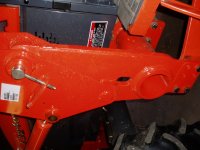
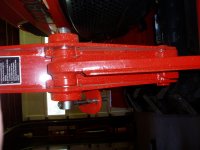
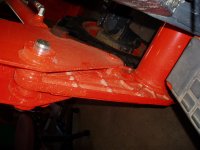
Strange ... looking at the OP's original photos ... and then at my FEL, which was bought in July 2007, there appears to be a difference. My cast uprights have a heavy (sheet steel?) "flitch" plate, 3/16 or 1/4 inch thick; filet welded to the web of the casting. This reinforcement runs almost the full width of the upright and extends almost a foot vertically. I don't see any evidence of it on the OP's, or maybe I just can't see it?:

P7020004.JPG

P7020005.JPG

P7020006.JPG

I may have to eat crow about Kubota wringing out weight without going overboard ...

Kcender, does your FEL have these plates, and is it newer than mine, or older?

-Jim
 
Last edited:

Marketplace Items

2014 BMW 28I AWD SUV (A61569)
2014 BMW 28I AWD...
2023 John Deere 9RX 640 Track Tractor (A63109)
2023 John Deere...
2012 Range Rover SUV (A61569)
2012 Range Rover...
TAKEUCHI TL12R2 SKID STEER (A62129)
TAKEUCHI TL12R2...
2016 Ford F-150 Ext. Cab Pickup Truck (A61568)
2016 Ford F-150...
2013 International WorkStar 7400 Altec Bucket Truck (A61568)
2013 International...
 
Top