
Always fun opening up the old logging trails on the steep hills on my land in southern Ohio.Ya, it was a few weeks ago Amazsona did a price drop and I grabbed three of them. I did post it here in trail tools and clearing thread...
You are using an out of date browser. It may not display this or other websites correctly.
You should upgrade or use an alternative browser.
You should upgrade or use an alternative browser.
Battery powered chainsaw
- Thread starter kenmac
- Start date
- Views: 291058
More options
Who Replied?
/ Battery powered chainsaw
#501

ArlyA
Super Star Member
- Joined
- Mar 18, 2016
- Messages
- 14,540
- Tractor
- Outlander1000 6x6, Ego lawn mower and shopping for tractor
Pole-saws are your freind. I think I have three now.Always fun opening up the old logging trails on the steep hills on my land in southern Ohio.
View attachment 820681View attachment 820682

John_Mc
Elite Member
- Joined
- Aug 11, 2001
- Messages
- 4,819
- Location
- Monkton, Vermont
- Tractor
- NH TC33D Modified with belly pan, limb risers & FOPS. Honda Pioneer 520 & antique Coot UTV
Old loggin roads on steep hills are often a problem on my property. The roads often sit in the bottom of a bit of a depression (leftover from previous erosion). The gully-washing storms we've been getting just run right down the road and tear things up. Most of the time I end up having to reroute the ones on steep hillsAlways fun opening up the old logging trails on the steep hills on my land in southern Ohio.
View attachment 820681View attachment 820682

Eagle1
Epic Contributor
- Joined
- Jul 4, 2003
- Messages
- 27,913
- Location
- Viburnum, MO
- Tractor
- Kubota BX2200, LS XG3135H, Grasshopper and Yazoo Zturns
Never ending battle in the hills, anything that makes driving easier becomes the easiest way for water to move.Old loggin roads on steep hills are often a problem on my property. The roads often sit in the bottom of a bit of a depression (leftover from previous erosion). The gully-washing storms we've been getting just run right down the road and tear things up. Most of the time I end up having to reroute the ones on steep hills
John_Mc
Elite Member
- Joined
- Aug 11, 2001
- Messages
- 4,819
- Location
- Monkton, Vermont
- Tractor
- NH TC33D Modified with belly pan, limb risers & FOPS. Honda Pioneer 520 & antique Coot UTV
Any new trails I'm building I try to route so there is less than a 10% grade - less than 7% if I can get away with it. When under 10%, I can usually make a broad-based dip work for erosion control. (I can drive right through a broad-based dip, unlike a good waterbar, which often is more than some of my vehicles can handle.) It makes for longer trails, but done right they take MUCH less maintenance to keep up.Never ending battle in the hills, anything that makes driving easier becomes the easiest way for water to move.
Eagle1
Epic Contributor
- Joined
- Jul 4, 2003
- Messages
- 27,913
- Location
- Viburnum, MO
- Tractor
- Kubota BX2200, LS XG3135H, Grasshopper and Yazoo Zturns
True but even those trails need to kept free any obstruction that cause water to flow down or across during a 10" rainfall will do lots of damage. I'm good at restoring and grading trails...... 20 years of practice..Any new trails I'm building I try to route so there is less than a 10% grade - less than 7% if I can get away with it. When under 10%, I can usually make a broad-based dip work for erosion control. (I can drive right through a broad-based dip, unlike a good waterbar, which often is more than some of my vehicles can handle.) It makes for longer trails, but done right they take MUCH less maintenance to keep up.
Dad has a tractor he usually can take care of them grading and doing the wash outs etc. But one year called in a friend with his bulldozer to straighten things out up there. Plus a creek on the flat too.Old loggin roads on steep hills are often a problem on my property. The roads often sit in the bottom of a bit of a depression (leftover from previous erosion). The gully-washing storms we've been getting just run right down the road and tear things up. Most of the time I end up having to reroute the ones on steep hills
Top looking out. That valley has a live spring that runs out at bottom too.
Eagle1
Epic Contributor
- Joined
- Jul 4, 2003
- Messages
- 27,913
- Location
- Viburnum, MO
- Tractor
- Kubota BX2200, LS XG3135H, Grasshopper and Yazoo Zturns
Pretty county. A lot like here....Dad has a tractor he usually can take care of them grading and doing the wash outs etc. But one year called in a friend with his bulldozer to straighten things out up there. Plus a creek on the flat too.
Top looking out.
View attachment 820716
Grumpycat
Super Member
Put a tracker on it at CamelCamelCamel.com to get an email when price drops to something interesting.Ya, it was a few weeks ago Amazsona did a price drop and I grabbed three of them. I did post it here in trail tools and clearing thread...
ArlyA
Super Star Member
- Joined
- Mar 18, 2016
- Messages
- 14,540
- Tractor
- Outlander1000 6x6, Ego lawn mower and shopping for tractor
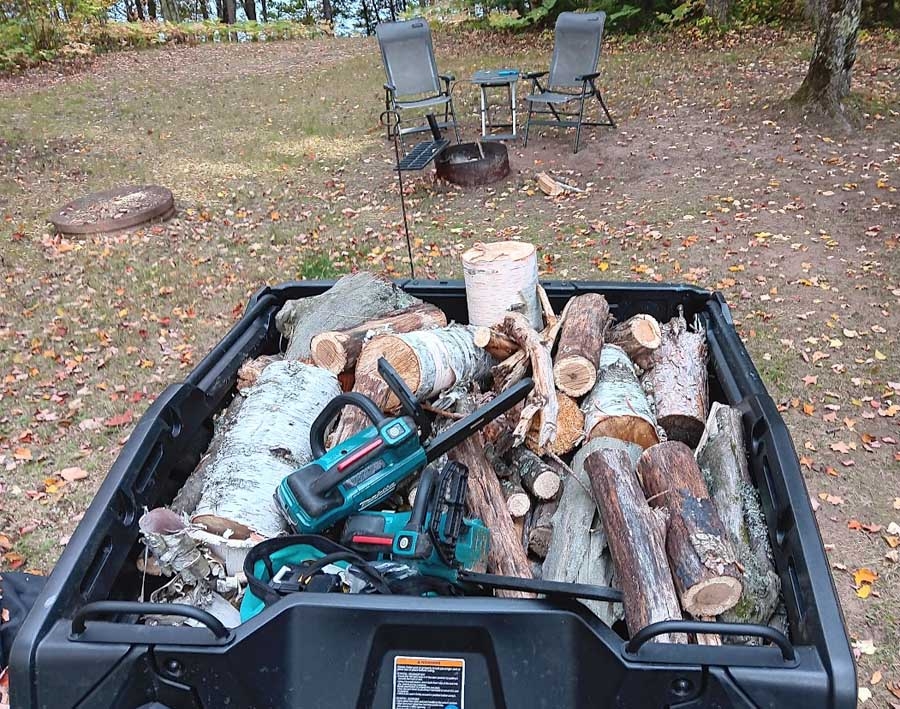
How we cut firewood over the weekend.
ning
Elite Member
Arly, how often do you replace batteries - not recharge, but have to buy a new one?How we cut firewood over the weekend. View attachment 823520
ArlyA
Super Star Member
- Joined
- Mar 18, 2016
- Messages
- 14,540
- Tractor
- Outlander1000 6x6, Ego lawn mower and shopping for tractor
None so far and I might have 5 to 7 of them. Some are makita brand. I use them daily so they really are worked. The aftermarket ones are not 6 amphour as claimed!Arly, how often do you replace batteries - not recharge, but have to buy a new one?
Last edited:

KennyG
Super Member
Lithium ion batteries should be good for at least 1000 charge cycles. If you have a business and charge the battery daily, you should be good for at least 4 years. If you are a homeowner and charge less frequently, they may be time limited but should be good for at least 10 years.Arly, how often do you replace batteries - not recharge, but have to buy a new one?

5030
Rest in Peace
- Joined
- Feb 21, 2003
- Messages
- 28,967
- Location
- SE Michigan in the middle of nowhere
- Tractor
- Kubota M9000 HDCC3 M9000 HDC
That entirely depends on the build quality of the cells themselves. Cheap cells won't last nearly as long as quality built cells and the quality of the internal circuitry that controls the charge and discharge rate as well.
Additionally, Li-Ion cells are adversely impacted by ambient temperature which is what happened last winter with EV users not being able to charge their toasters. The charge stations monitor a lot of variables, the really important one is ambient temperature. Now, I keep my cordless tools and batteries in my heated and air conditioned shop. Not that my prime concern is them but my machine tools require a stable and low humidity atmosphere to maintain their accuracy. When dealing with tolerances in the millionths of an inch, repeatable accuracy is vitally important as well as stable humidity. Humidity causes corrosion and not just on visible surfaces either.
Additionally, Li-Ion cells are adversely impacted by ambient temperature which is what happened last winter with EV users not being able to charge their toasters. The charge stations monitor a lot of variables, the really important one is ambient temperature. Now, I keep my cordless tools and batteries in my heated and air conditioned shop. Not that my prime concern is them but my machine tools require a stable and low humidity atmosphere to maintain their accuracy. When dealing with tolerances in the millionths of an inch, repeatable accuracy is vitally important as well as stable humidity. Humidity causes corrosion and not just on visible surfaces either.
5030
Rest in Peace
- Joined
- Feb 21, 2003
- Messages
- 28,967
- Location
- SE Michigan in the middle of nowhere
- Tractor
- Kubota M9000 HDCC3 M9000 HDC
I will say that Harbor Freight sells only rechargeable battery packs that are produced with quality cells and I know because I look. They use Toshiba cells by the way and their physical linking is also top quality. Not crimped on but soldered on. Been inside others, mainly DeWalt and they use generic cells with crimped on links.

WinterDeere
Super Star Member
- Joined
- Sep 6, 2011
- Messages
- 15,192
- Location
- Rural 'burbs, north of Philly
- Tractor
- John Deere 3033R, 855 MFWD, 757 ZTrak; IH Cub Cadet 123
I'd be really surprised if Harbor Freight has any standardization on whose cells they're using, in building their battery packs. The ones you opened happened to be Toshiba, likely because Toshiba was the company with an overrun that month. I'd expect it's probably a different manufacturer with each purchasing cycle, driven by pricing, when it comes to any bargain-basement supplier like Harbor Freight.I will say that Harbor Freight sells only rechargeable battery packs that are produced with quality cells and I know because I look. They use Toshiba cells...
Spend your money, roll the dice...
5030
Rest in Peace
- Joined
- Feb 21, 2003
- Messages
- 28,967
- Location
- SE Michigan in the middle of nowhere
- Tractor
- Kubota M9000 HDCC3 M9000 HDC
All the packs that I have looked in (and I tend to look in them all) have been Toshiba cells. so I don't find your comment viable. besides, none of the Li-Ion cell makers ever have over runs. They produce what the market demands. Li-Ion cells are always in great demand as the materials used to produce them are not in over abundance anyway.
Even their Braun line of LED lights (I have 2 of them) use Toshiba cells for power and I purchased them far apart too. I actually depleted the original light to the point where the cell would not accept a full charge and I went looking for a Toshiba replacement with no luck so I bought a generic one. Hopefully it lasts long enough (discharge-recharge) cycles to defray the cost. Fingers crossed on that.
Even their Braun line of LED lights (I have 2 of them) use Toshiba cells for power and I purchased them far apart too. I actually depleted the original light to the point where the cell would not accept a full charge and I went looking for a Toshiba replacement with no luck so I bought a generic one. Hopefully it lasts long enough (discharge-recharge) cycles to defray the cost. Fingers crossed on that.
ArlyA
Super Star Member
- Joined
- Mar 18, 2016
- Messages
- 14,540
- Tractor
- Outlander1000 6x6, Ego lawn mower and shopping for tractor
I might get some LabTEC Lithium Batteies who Farm Project guy tested and found to the best of aftermarket batteries..Arly, how often do you replace batteries - not recharge, but have to buy a new one?
5030
Rest in Peace
- Joined
- Feb 21, 2003
- Messages
- 28,967
- Location
- SE Michigan in the middle of nowhere
- Tractor
- Kubota M9000 HDCC3 M9000 HDC
From personal experience I find that some of his reviews lack merit and like I said I base that on personal experience.
His last review of MIG welders and multi process welders, I don't agree with and I've been semi production welding for decades in my owned shop using a variety of equipment in every welding aspect including SMAW (stick metal arc welding) using both an engine drive (Lincoln) as well as a plug in SMAW multi process (TIG, SMAW with low hydrogen electrodes), TIG welding aluminum and stainless as well as cast iron and other exotic metals, MIG, both solid wire and flux cored with short circuit arc welding and spray arc globular transfer, and because I had the best teacher and his mentoring was free for me it was well worth it.
The only process I'm certified in (AWS) certification is TIG welding exotic metals in process piping, the rest I'm not and really don't need to be and he certified me in TIG as he can do that as he is the person who certifies welders working on Nuclear refits all over the country and a good friend too.
His last review where he had someone else experienced in MIG welding tells me he's not trained or has the expertise to review any welders and surely not to recommend a cheap Chinese made machine as better than the domestic offering like Miller or Lincoln any others. You buy cheap, you get cheap, no exception but unlike the home shop welder, I depend on my machines performing every day with only my lack of experience holding them back. Believe me, no low buck welder can perform or have the duty cycle like a well built and engineered machine will have.
His last review of MIG welders and multi process welders, I don't agree with and I've been semi production welding for decades in my owned shop using a variety of equipment in every welding aspect including SMAW (stick metal arc welding) using both an engine drive (Lincoln) as well as a plug in SMAW multi process (TIG, SMAW with low hydrogen electrodes), TIG welding aluminum and stainless as well as cast iron and other exotic metals, MIG, both solid wire and flux cored with short circuit arc welding and spray arc globular transfer, and because I had the best teacher and his mentoring was free for me it was well worth it.
The only process I'm certified in (AWS) certification is TIG welding exotic metals in process piping, the rest I'm not and really don't need to be and he certified me in TIG as he can do that as he is the person who certifies welders working on Nuclear refits all over the country and a good friend too.
His last review where he had someone else experienced in MIG welding tells me he's not trained or has the expertise to review any welders and surely not to recommend a cheap Chinese made machine as better than the domestic offering like Miller or Lincoln any others. You buy cheap, you get cheap, no exception but unlike the home shop welder, I depend on my machines performing every day with only my lack of experience holding them back. Believe me, no low buck welder can perform or have the duty cycle like a well built and engineered machine will have.
Remember, that is his PERSONAL experience and may not reflect the actual end use longevity which is entirely dependent on how you use them and what they are used in.I might get some LabTEC Lithium Batteies who Farm Project guy tested and found to the best of aftermarket batteries..


