Basement Wiring?

/ Basement Wiring? #1  

dieselscout80

Elite Member
Joined
Nov 17, 2007
Messages
2,597
Location
South Carolina
Tractor
New Holland TC45DA
I'm working on my basement and I had been planning and running all the circuits from the main breaker box. I hadn't thought about putting a sub box/panel in the basement until recently. The basement part of the house is only under part of the house and it is on the opposite end of the house from the main breaker box/panel.

Basement rooms are:
Bed rooms 2 - (per bed room) 6 outlets; ceil fan with light (wired for separate fan switch), light in closet (wiring is done 12 ga for outlets and 14 ga for lights.

Bath room - 2 or 3 outlets GFI, 2 lights on separate switches (one light may have multiple bulbs) and vent/exhaust fan on its own switch.

Recreation/family room - 8 outlets, 10 lights.

Circuits:
One 20 amp circuit for the bed room outlets total of 12 outlets
One 15 amp circuit for all the lights and fans (does this need to be 20 amp)
One 20 amp circuit for the rec/family room outlets

I first I was going to use four circuits, but can I use just three circuits or do I need that fourth circuit?

The main box has plenty of open breaker slots some room in the main box/panel is not an issue.

Would I be better off installing small sub box/panel in the basement vs running back to the main box/panel for the basement circuits?

If I run a sub box/panel what do I need to do it?

Here is how I want the switches for the rec room and stair lights.
http://www.tractorbynet.com/forums/projects/180082-5-switches-control-3-lights.html

Here is link to my bath room circuit question.
http://www.tractorbynet.com/forums/projects/199483-bath-room-electrical.html
 
/ Basement Wiring? #2  
If you want to put in a separate panel in the basement, just run a single 220v line to carry the necessary (55 amps; you show) amperage. Then put the breakers in the basement.

Check your amperage requirements, but I think you'd be into 8 gauge multistrand wire. This is relatively easy to run, as my electrician put in a generator feed line with this wire. It's much more flexible and easier to work with than 10 gauge (think it's only good for up to 30 amps) wire.

Ralph
 
/ Basement Wiring? #3  
I'm an amateur, but I'd say it's not worth the subpanel for 3 circuits. You're into it for the cost of the wire, the panel, and the breakers. I don't think there will be much of a benefit to you if you have plenty of room in the main panel.
 
/ Basement Wiring? #4  
I think you will need at least 4 circuits. I don't like the idea of all the lights on a level being on 1 circuit. Also, your bathroom outlet circuit should be 20 amps because of the potential use of hair dryers/blowers.

We've been having another discussion on common neutral circuits. You could run two 12/3 (220 volt) lines (or one 12/3 line and one 14/3 line) to the basement area and then split off to four 12/2 20 amp lines (or two 20 amp and two 15 amp lines).

Think about a 20 amp circuit for the bedroom outlets and one side of the family room, a 20 amp circuit for the bathroom and the other side of the family room and two 15 amp lighting/bathroom fan circuits.

Just a note that up north here, bedrooms don't meet code unless they have two means of egress - two doors or a door and a window you can get out of.
 
/ Basement Wiring?
  • Thread Starter
#5  
I think you will need at least 4 circuits. I don't like the idea of all the lights on a level being on 1 circuit. Also, your bathroom outlet circuit should be 20 amps because of the potential use of hair dryers/blowers.

We've been having another discussion on common neutral circuits. You could run two 12/3 (220 volt) lines (or one 12/3 line and one 14/3 line) to the basement area and then split off to four 12/2 20 amp lines (or two 20 amp and two 15 amp lines).

Think about a 20 amp circuit for the bedroom outlets and one side of the family room, a 20 amp circuit for the bathroom and the other side of the family room and two 15 amp lighting/bathroom fan circuits.

Just a note that up north here, bedrooms don't meet code unless they have two means of egress - two doors or a door and a window you can get out of.

All the outlet circuits are 20 amp sorry if I wasn't clear about that.

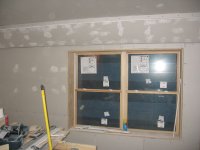
Do these windows work? ;) Each room has one.
 

Attachments

  • IMG_3649.JPG
    IMG_3649.JPG
    664.2 KB · Views: 390
/ Basement Wiring? #6  
Just curious - Is your basement mostly out of the ground or do you have huge retaining walls? Those don't look like the usual "basement windows".
 
/ Basement Wiring?
  • Thread Starter
#7  
Just curious - Is your basement mostly out of the ground or do you have huge retaining walls? Those don't look like the usual "basement windows".

We are on a hill one side of the basement is fully in the ground with no windows (bath room is on that side) and the other side you walk out with no stairs.
 

Attachments

  • IMG_3368.JPG
    IMG_3368.JPG
    948.8 KB · Views: 424
/ Basement Wiring? #8  
You are plenty fine for circuits with the 3 you have described, IMHO. You won't come near 15A with lights and fans. Most ceiling fans are about the draw of a 60W light bulb - not much. I like 20A circuits for outlets too - good choice. Future-proofing. 15A is nicer for lights as the wires on many fixtures are so small that 12ga wire is a bear to connect to, but 14ga (15A circuits) are not too bad. Plus lights and fixtures just don't draw much, unless you have some monster kleig lights in the fam room.

But the bathroom outlets need their own 20A circuit. I know they changed the code slightly on this some years back, but I think that is still the case, and a good idea.

If you do the split neutral suggested by KennyG, you need to tie the breaker handles together so you don't leave half of the circuit live by accident. Easiest way is to use a 220V breaker for that.

Check codes on egress windows, if you are concerned. There are a couple simple requirements on sill height and clear window opening sizes. Many sources on the web show the specs. Search "egress window" and you will find it, easy peasy.

Disclaimer: All IMHO. I am not an electrician, but I have played one in 3 of my houses so far :)
 
/ Basement Wiring? #9  
If you do the split neutral suggested by KennyG, you need to tie the breaker handles together so you don't leave half of the circuit live by accident. Easiest way is to use a 220V breaker for that.

Can someone explain this further, as I mentioned in the other E thread I have several shared neutral circuits but they are all on single breakers.

Can power go thru neutral some how from the live circuit, if you were working on a shut down circuit, if both were sharing the same neutral?
Is it code?

Thanks JB.
 
/ Basement Wiring? #10  
Can someone explain this further, as I mentioned in the other E thread I have several shared neutral circuits but they are all on single breakers.

Can power go thru neutral some how from the live circuit, if you were working on a shut down circuit, if both were sharing the same neutral?
Is it code?

Thanks JB.

Code requires a double pole breaker because, at some future date, if you trip one breaker and open up the box, you could still have one live circuit in the box. It's not just a shared neutral issue. Anytime you have more than one circuit in the same box, they should be ganged to prevent you accidentally having power in a box you thought was tripped.
 
/ Basement Wiring? #11  
There are several issues you have.
1. You cannot run 14 awg on a 20 A circuit.
2. Code change 2011, you can not share a neutral anymore, ie. No handle ties or 2 pole breakers for a 12/3 120v circuit.
3. All breakers supplying 120v circuits must be arc fault. ( bathroom and kitchen not included )
 
/ Basement Wiring? #12  
You may have it different down there, but up here your common duplex outlets and switches are only rated for 15 amps. Using them on a 20 amp breaker is verboten. You CAN get 20 amp outlets for kitchen/workshop use but they are a different critter.
I'd just run 14/2 for all the 15 amp circuits, including the one in the bathroom(but keep it on a separate circuit). If you don't think 15 amps is enough for an area, run more circuits.
If you are running a circuit for a sump pump or freezer, add a hall light to the circuit so you can tell if it blows/trips. Other than that, try not to have your room lights on the same circuit as the plugs in that room, just in case you wind up in the dark when a breaker does trip because of a faulty heater/hair dryer/or whatever.
 
/ Basement Wiring? #13  
Code requires a double pole breaker because, at some future date, if you trip one breaker and open up the box, you could still have one live circuit in the box. It's not just a shared neutral issue. Anytime you have more than one circuit in the same box, they should be ganged to prevent you accidentally having power in a box you thought was tripped.

So you are talking about that first box where both circuits come into? I get that, but what about after they come out, working in a box down line where just one of those circuits feeds (the one that's tripped off) any risk there?

Any idea if that was always code? It would be very simple to change over if needed.

JB.
 
/ Basement Wiring? #14  
Hi,
Here are a couple of things to keep in mind:

The bathroom receptacle must be a 20 Amp circuit that does not supply anything outside of the bathroom. The bath lights may also be on this circuit, or they may be on a circuit that supplies other lights & recepts. in other parts of the house.

All the rooms mentioned, except for the bathroom, must be put on arc-fault circuit breakers. Keep in mind that only a couple of breaker manufacturers produce 2-pole arc-fault breakers, so I would avoid running multiwire circuits (using 3-wire to supply 2 circuits with a shared neutral) as some others have suggested. I've never actually seen a 2-pole AFCI, and I'm an electrician.

You may find that adding a sub-panel saves you a lot of work, but that's often a judgement call. In general, if you have more than 4 circuits, then it's worth at least considering. Your subfeed will need to have 3 insulated condutors plus a ground. Generally, aluminum (SER cable) will be less money than copper (NM or "romex" type).

One poster mentioned that you cannot use 15-amp rated switches and receptacles on a 20-amp circuit. That is incorrect. So long as there is more than a single device (a duplex outlet counts as two devices) on a 20-amp circuit, then they may be rated at 15 amps.

Use the code that is in effect when you are doing the work: In Maine, the 2011 NEC will not be adopted until late summer or early fall. Until then, the 2008 NEC is still the rule.

Don't forget smoke and CO alarms. Check with your fire marshal or code enforcement officer to understand your local requirements. Likely that they'll want alarms in each bedroom, interconnected with other hardwired units in the house, if they exist.

Lighting circuits: add up the total wattage of all the fixtures. All fixtures have a maximum wattage rating; use that number. Circuits may only be loaded up to 80% with lighting (includes general receptacles). So a 15-amp circuit can handle 1440 watts, a 20-amp circuit can do 1920 watts.

Without seeing the plans and evaluating the installation, I might be inclined to install a subfeed to a remote panel. Then run:
1 20-amp circuit to the bath outlets.
1 20-amp AFCI circuit to both bedrooms.
1 20-amp AFCI circuit to the family room.
1-2 15 amp AFCI circuits to all lights, depending on the total of the light loads.
Smoke alarms should be installed on an existing smoke alarm circuit (extend from the existing basement smoke alarm) or if there is no existing smoke alarm circuit, they may go on the light circuit, or on a dedicated circuit -- your choice.

Remember, you cannot install a remote panel (aka "sub-panels") in a bathroom or in a closet.

I hope some of this is helpful.
Cheers, Mike
 
/ Basement Wiring? #15  
id pop in my 2¢ worth.... but it looks like you've gotten some great responses already.

i am a fan of sub-panels though. it all depends on how far main panel is from sub-panel.

and just because you have 2 x 20 amp circuits and 1 x 15 amp circuit DOES NOT mean you need a 55 amp sub-panel. you need to do a simple load calc. A 30 amp 240 sub-panel MAY be enuf....depends on connected load.

this is where your money spent on an electrician may save you $$$ in the long haul. But then again..I'm biased, as im an electrical contractor hehe :laughing: :laughing: :laughing:
 
/ Basement Wiring? #16  
Can someone explain this further, as I mentioned in the other E thread I have several shared neutral circuits but they are all on single breakers.

Can power go thru neutral some how from the live circuit, if you were working on a shut down circuit, if both were sharing the same neutral?
Is it code?

Thanks JB.

Hi JB,

Couldn't you ask an easier question? That's a good one. Part of the problem is, the NEC has been changing the requirements for multiwire circuits several times over the last few codes, so we're all a little confused.

Answer to one of your questions is yes. If you have a multiwire circuit and only shut of one of the two breakers, the neutral (white) wire that is shared can give you a nasty surprise! That's why multiwire circuits need to have provisions for simultaneously shutting off both hot wires.

The 2008 NEC is particularly vexing because it seems to contradict itself. I don't really want to get into that because we're trying to explain things here, not make them more difficult to understand.

The main point is to be able to simultaneously disconnect both hot wires of multiwire circuit.

The 2011 NEC does a better job. It wants the circuit to originate either at a double-pole breaker, or at two adjacent single-pole breakers with "identified" handle ties. (That means Square D handle ties for Square D breakers, GE handle ties for GE breakers, etc. No more using a bit of #10 copper, or a small nail as a handle tie!!)

One other requirement of multiwire branch circuits has to do with the neutral (white) wire. It is not allowed to rely on a device (such as a receptacle) for it's continuity. What that means is, while you may "feed in" and "feed out" the hot wires at the terminals on a receptacle, the neutral wires must be wirenutted together and a white pigtail used to connect the receptacle to the neutrals. A little hard to explain, so I hope this is clear enough.

Multiwire circuits have certain advantages, but with the requirements of Arc-fault breakers in houses now, if you're going to run a multiwire circuit you'd better make sure that you can get a double-pole AFCI for your panel. They are only available for a few makes of panels, and are rare as hens teeth. Note: you cannot handle-tie two single-pole AFCI breakers. It absolutely will not work.

I hope this was helpful in answering your question.
Mike
 
/ Basement Wiring? #17  
As for the neutral, since neutrals aren't switched by the breaker, it always can complete a circuit back to the panel. If one hot side in a 3-wire circuit is tripped, but the other hot side is not, then the neutral will still be carrying any "return" current from the still-hot side back to the panel, so it is essentially hot for practical purposes. Unless you trip the other hot side and then the neutral will not have any current to "return" to the panel.

And what Kennyg said about killing all circuits in a box is part of the issue too. They are related.
 
/ Basement Wiring? #18  
Hi JB,

The main point is to be able to simultaneously disconnect both hot wires of multiwire circuit.

The 2011 NEC does a better job. It wants the circuit to originate either at a double-pole breaker, or at two adjacent single-pole breakers with "identified" handle ties. (That means Square D handle ties for Square D breakers, GE handle ties for GE breakers, etc. No more using a bit of #10 copper, or a small nail as a handle tie!!)


My shared circuits are one above the other so I'll have to get some of those ties, never seen them before.


One other requirement of multiwire branch circuits has to do with the neutral (white) wire. It is not allowed to rely on a device (such as a receptacle) for it's continuity. What that means is, while you may "feed in" and "feed out" the hot wires at the terminals on a receptacle, the neutral wires must be wirenutted together and a white pigtail used to connect the receptacle to the neutrals. A little hard to explain, so I hope this is clear enough.

I hope this was helpful in answering your question.
Mike


Thanks Mike, and all others, good info here.

I think I know what you are saying here, "Never use a device as a connector"

I had that drilled into me by an electrician that was helping me on a job.
You're saying it in relation to the shared neutral scenario, but I never take load off a receptacle, I pigtail everything, (hot and neutral) except for off a gfi of course. I thought it must be code the way he was so adamant about it?


For OP the only thing I would say is don't install any 15 amp receptacles, just go all 20 amp, 15A just for lighting. If I'm gonna go thru the trouble to install a new outlet, it's not worth it to make it a 15 IMO. Wouldn't doubt it that someday there will be no more 15a outlet circuits in new construction.

Good luck, JB.

JB
 
/ Basement Wiring? #19  
Hi,

One poster mentioned that you cannot use 15-amp rated switches and receptacles on a 20-amp circuit. That is incorrect. So long as there is more than a single device (a duplex outlet counts as two devices) on a 20-amp circuit, then they may be rated at 15 amps.

That poster was in Ontario, so Canadian codes may differ from NEC on that point.

Great info, Mike!
 
/ Basement Wiring? #20  
Saw a job recently passed and the device was not used as a connector for the neutral and neither were pigtails used.

The neutral was continuous and only had the insulation stripped under the device screw.

My question is this an acceptable alternative in other places?

Working with lots of prewar WWII and WWI homes over the years... I don't imagine any part of the original service would meet muster today.

Seen a lot of open knife switches for the main before the meter that switched the neutral as well as the hot on original 30 amp non 240 home services.
 
 
Top