Water Well Drilling Rotary or Pounder

/ Water Well Drilling Rotary or Pounder #21  
Who would be the ones wanting to do that? and why?
Basically, it reduces water losses due to evaporation by reducing the surface area from two reservoir surfaces to one.

I would not characterize it as a political move, although with more than one person, I think you always have some amount of politics. It is an engineering / hydrology move in my view. The dams were built in a time of relatively wet years and low demand. Now that we know more of the hydrological history of the Western US, we now know how unusual the early 1900s were from a rainfall perspective.

By allowing the water to bypass lake Powell, less of water would be lost to evaporation, resulting in more water for the residents in the area, the ecosystem, and downstream users.

There might be an extended discussion about the wisdom of growing irrigated water intensive crops like alfalfa and cotton in deserts, but in a few decades, it will be moot as the desert air evaporates more water and increases soil salinity beyond the tolerance of the crops. Still, there are better places to grow these crops, and more profitable areas, if the actual water cost, rather than the state and federally subsidized cost of water prevailed.

I'm all for farming the right crops in the right place, like bees on goldenrod in Missouri or the driftless region of Wisconsin.

Las Vegas recycles an enormous fraction of its water. 40% of its water is used indoors, and 99% of that is recycled in a variety of ways. Las Vegas residents use less than 200gpd (GPCD), one of the absolute lowest in the US. It has been ratcheting up the pressure to reduce all outdoor uses of water that isn't rain fed.

All the best,

Peter
 
/ Water Well Drilling Rotary or Pounder #22  
I visited Payson Az. several times 13+ years ago. The city recycled their water back then but the townsfolk were leery about drinking it so they decided to build a lake in a nice park for fishing. I don't know if things have changed by now or not.
 
/ Water Well Drilling Rotary or Pounder #23  
So reduce the hydro electric capacity and any flooding control and river flow stabilization so california can have more water.
 
/ Water Well Drilling Rotary or Pounder #24  
So reduce the hydro electric capacity and any flooding control and river flow stabilization so california can have more water.

It would be great if there was enough water to fill both reservoirs. I would love to have seen it.

The low rainfall has killed the hydroelectric power already. There isn't enough flow or head left. Current thinking actually favors less river stabilization and, yes less flood control, though in this particular case, I think it is largely theoretical. I can think of many other rivers that have extensive settlement in flood zones. That is a different story about the relative merits of flood control, and whether folks should occupy flood prone areas. But that is a different conversation.

But big picture, dams have a lifetime. They fill up with sediment and / or the reinforced concrete /earth degrades to the point of unsafe. When the time is up on a dam, excavation of the sediments is rarely a feasible option. That leaves letting the river go back to being a river, flooding the sediments downstream, without flood control, arguably better for the environment. Lots of dams were built in the 1800s and 1900s, and many of them are at or beyond their lifetime. Even if you wanted a dam in the same location, due to the accumulation of sediment, a new dam may not be feasible due to the cost of removing the prior century or so of sediment.

So, yes, I suspect that Lake Powell is end of life. Not from a sediment fill, and not from corrosion and lack of safety, but just because the water isn't there. It doesn't snow as much, there are fewer forests in the drainage basin so more of the water that does fall evaporates, and more humans take the water upstream for cities and farming. Net, net, there is no longer enough water and there is not a viable route to more water that I can see. I would love to be wrong on this, but I don't see the upstream lands going back to more forests, nor do i see large numbers of people abandoning those states.

Sad but true. This isn't one state vs another, just a different set of weather patterns compared to when the dam was planned and built. There are some good books on the dams and the changing rainfall/drainage, if you are interested.

All the best,

Peter
 
/ Water Well Drilling Rotary or Pounder #25  
So reduce the hydro electric capacity and any flooding control and river flow stabilization so california can have more water.
Nope, Nevada and Las Vegas.
 
/ Water Well Drilling Rotary or Pounder #26  
Start haunting the bigger equipment classified and auctions they do come up for sale at times, the pounders can be forund as trailer or truck mounted units. The worst part is getting 20 ft sticks of caseing lined up and threaded on straight.
 
/ Water Well Drilling Rotary or Pounder #27  
I think everyone should try their hand a drilling a well. it will teach you more about the laws of physics than you can ever learn in school. Lol! A large diameter well 100' deep is a pretty good undertaking. But it can be done. Normally you don't add pipe as you go with a spudder or cable tool rig. The cable and tool pound all the way to the bottom, then you pull out the tools and add the casing. It is not as easy as digging an extra deep post hole. Sealing and developing the well so it will make plenty of good and clean water can be an art of its own. Every area is different. it depends on what you drill into that decides how this goes. Best of Luck!
 
/ Water Well Drilling Rotary or Pounder #28  
It would be great if there was enough water to fill both reservoirs. I would love to have seen it.

The low rainfall has killed the hydroelectric power already. There isn't enough flow or head left. Current thinking actually favors less river stabilization and, yes less flood control, though in this particular case, I think it is largely theoretical. I can think of many other rivers that have extensive settlement in flood zones. That is a different story about the relative merits of flood control, and whether folks should occupy flood prone areas. But that is a different conversation.

But big picture, dams have a lifetime. They fill up with sediment and / or the reinforced concrete /earth degrades to the point of unsafe. When the time is up on a dam, excavation of the sediments is rarely a feasible option. That leaves letting the river go back to being a river, flooding the sediments downstream, without flood control, arguably better for the environment. Lots of dams were built in the 1800s and 1900s, and many of them are at or beyond their lifetime. Even if you wanted a dam in the same location, due to the accumulation of sediment, a new dam may not be feasible due to the cost of removing the prior century or so of sediment.

So, yes, I suspect that Lake Powell is end of life. Not from a sediment fill, and not from corrosion and lack of safety, but just because the water isn't there. It doesn't snow as much, there are fewer forests in the drainage basin so more of the water that does fall evaporates, and more humans take the water upstream for cities and farming. Net, net, there is no longer enough water and there is not a viable route to more water that I can see. I would love to be wrong on this, but I don't see the upstream lands going back to more forests, nor do i see large numbers of people abandoning those states.

Sad but true. This isn't one state vs another, just a different set of weather patterns compared to when the dam was planned and built. There are some good books on the dams and the changing rainfall/drainage, if you are interested.

All the best,

Peter
Grand Coulee has a design lifetime of 150 years. That seemed like forever 80 years ago. I don't know the design lifetime of Hoover, which was built a few years earlier.
 
/ Water Well Drilling Rotary or Pounder
  • Thread Starter
#29  
It's interesting this came up in suggestions. Amateur buys a cable tool rig and drills a well deeper. The Primary Water Well Locator folks tell them how deep to go in an exiting well. Things go south about the 40 minute mark. It's a long arse video so I had to skim quite a bit of it.
 
/ Water Well Drilling Rotary or Pounder #30  
Not a fan of the channel but Diesel Creek had a percussion rig drill his well at his shop in an episode last week.

1:25 minute mark.
Diesel Creek should be on this site. I enjoy watching him, if nothing else than for yelling at the TV "Why did you just do that, JR.?". "Pick up a real wrench and put that rattle wrench down", what in the heck are you gonna do with that POS" and the infamous "That ain't gonna work". He seems to ignore me.....:unsure:
 
/ Water Well Drilling Rotary or Pounder #31  
I've had good results with rotary drilling, especially in sandy soils where a pounder might struggle. A big factor is the depth you need and the type of formations you're going through. One thing I’ve learned is that experience matters as much as the method. Island Well Service knows how to handle different ground conditions, and they can help figure out what works best for your location.
 
Last edited:
/ Water Well Drilling Rotary or Pounder #32  
When I had my well put in way back in '96 or '97 I researched wells, how they are drilled, how they develop, etc. I called the state for advice and spoke with many people who had wells put in. In the end I had my well done with a cable tool. In my area the price per foot was the same, rotary or cable tool. I chose the cable tool for several reasons. But the two major reasons were that a cable tool usually gives you more water because it fractures the rock as it goes through and doesn't use drilling mud. The rotary rigs either use high pressure air or mud and both methods tend to clog the pores in the rock. Also, I was warned by not only the state but by several folks that had rotary rigs drill their wells that the rotary rigs drill so fast that they can shoot right through a water bearing layer and drill deeper to another water bearing layer. And you pay by the foot. The cable tools go slower and when they hit water they don't blast through it. I tried drilling my own well with one of those Hydra Drill rigs. Everything went great for the first ten feet or so. Then I hit hardpan which was almost as hard as sandstone and the damn thing just wouldn't drill. I was only getting about an inch an hour. So I got the well done with a cable tool. They went through 40 feet of hardpan before they hit the aquifer. It took them 5 days to get through it. I'm glad I was paying by the foot. I get 15 gallons per minute or more. so I'm happy.
Eric
 
/ Water Well Drilling Rotary or Pounder
  • Thread Starter
#33  
Cable tool drillers are still out there but can't say I know of any in MO or AR.
 
/ Water Well Drilling Rotary or Pounder #34  
Cable tool drillers are still out there but can't say I know of any in MO or AR.
I don't know the difference between a pounded well and a cable tool. They seem to be used interchangeably but I think they may be different. When I looked into getting my well done there were only several rotary well drillers and one cable tool well guy. The cable tool would drop from high and fracture the ground. It would then retract and in doing so would grab the fractured material and bring it to the surface. I have heard of "drill points" which are just a point of some sort affixed to the end of a pipe which is driven into the ground until you hit water. I have only seen these used for shallow wells in soft ground. But I am no kind of an expert. I can only tell you about what I did when I had my well done.
Eric
 
/ Water Well Drilling Rotary or Pounder #35  
I don't know the difference between a pounded well and a cable tool. They seem to be used interchangeably but I think they may be different.
They are the same, also called driving a well.
But the two major reasons were that a cable tool usually gives you more water because it fractures the rock as it goes through and doesn't use drilling mud. The rotary rigs either use high pressure air or mud and both methods tend to clog the pores in the rock. Also, I was warned by not only the state but by several folks that had rotary rigs drill their wells that the rotary rigs drill so fast that they can shoot right through a water bearing layer and drill deeper to another water bearing layer.
This is my understanding as well. I worked for a drill for a few years, we used a rotary, but towards the end we setup a cable rig to use in some cases. Another advantage of a cable rig is that it has a small footprint so you can wiggle one into areas that you can't get to with a traditional rotary as they are big.

There are downsides to a cable as well. If there is a softer formation on top of a harder formation and the delineation is at a steep angle it will push the bit sideways until the bit can penetrate the hard formation. This creates a dogleg making it difficult/impossible to put the casing in and if left an open bore (no casing) it creates a hazard that can catch a pump / drop pipe causing them to get stuck in the well. Cable rigs suck in hard rock. Your always having to sharpen the bit and it is difficult to trip in and out as you have to screw several lengths of rod to the bit to give it enough weight to break the rock.

There are three major types of drill bits used on rotary rigs. The first two bits use drilling mud to provide lubrication, remove cuttings, and keep the bore open. In normal circulation mud is pumped down the drill stem and circulated up the annular between the stem and the bore wall. Cuttings then fall out in the mud pit before the drill mud is recirculated.
Drag bits are used in soft non consolidated soils such as gravel, and sand. These bits have a fast cutting action and are relatively inexpensive.
For more consolidated formations such as sand rock, fractured rock and mixed formation a tricone bit is used. They are more complex than a drag bit and therefor cost more to run.

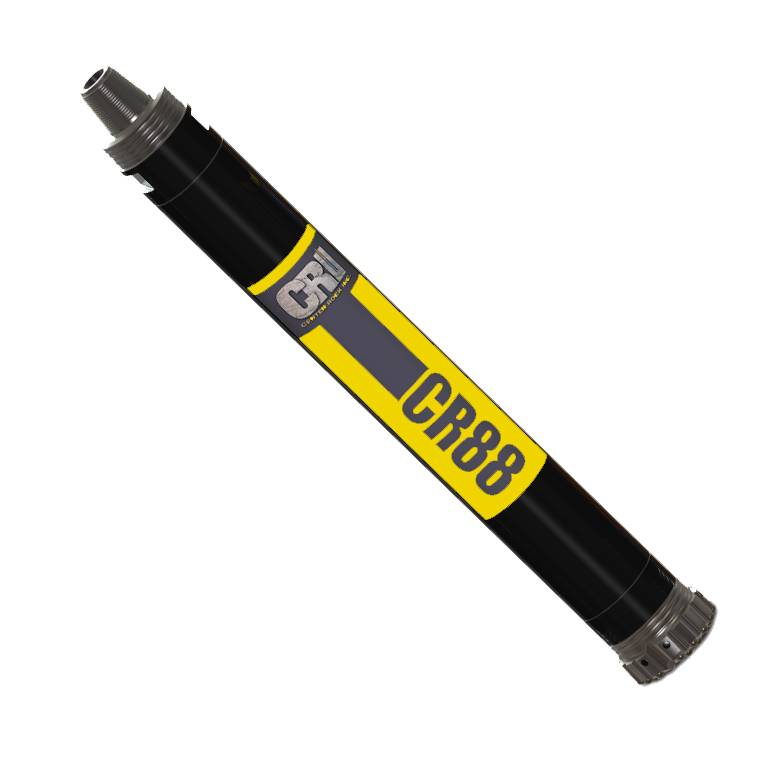
The third drill bit is a Down The Hole Hammer (DTH). They are air powered and the air exhaust pushes the cuttings out of the hole. It is like a jack hammer that is being spun slowly by the drill rig. Water is used to help cool the bit but because the formation is hard enough to require a DTH it does not require drill mud to apply hydraulic pressure to the bore wall to keep the hole open. This is the most expensive way to drill a well as the bits and hammers are major money.

Hope this helps.
 
/ Water Well Drilling Rotary or Pounder
  • Thread Starter
#36  
I've heard some call them pounders, some call them cable tool or percussion rigs.

I grew up in a subdivision just outside the city limits. We had city sewer but everyone was on wells. As it expanded you could hear the cable tool/pounder rig echoing throughout the neighborhood.
 
/ Water Well Drilling Rotary or Pounder #37  
I've heard some call them pounders, some call them cable tool or percussion rigs.

I grew up in a subdivision just outside the city limits. We had city sewer but everyone was on wells. As it expanded you could hear the cable tool/pounder rig echoing throughout the neighborhood.
They also call them churn drills, spudders, and donkey rigs, there is probably a dozen names for them.

Was working in a fancy area and decided to set the casing (put casing in the well) on Thanksgiving morning. It should have been a quick couple of hours, but the bore had partially collapsed. We ended up pounding the casing in with the hoist line and a 800lb drive block. Took us all day, I am sure the neighborhood appreciated the incessant pounding until 9:00 that night when we finally got the casing in. Its hard to find days that are not frozen in November in Minnesota, sometimes you have to do what needs done.
 
/ Water Well Drilling Rotary or Pounder #38  
If your area has a lot of loose sand or gravel, rotary might handle it better. Pounders are great for rock, but they take longer. Depth and soil type matter a lot.
Around my neighborhood the soils are deep glacial till with layers of impermeable hardpan. Lots of huge boulders are buried in it. There are several water bearing layers in it, some good, some not so good. Most of the wells are at a depth 60-100'. Some pounded, many rotary.
When our next door neighbors well was drilled they started with a hammer rig. The spud got jammed between boulders about 30' down. The driller finally ended up snapping the cable while trying to pull it loose. They had to bring in a rotary rig and drill a new hole. From what I saw of the cuttings bed rock is way below the wells around here.
 
/ Water Well Drilling Rotary or Pounder #39  
From what I saw of the cuttings bed rock is way below the wells around here.
Here on the south end of Whidbey Island the glacial till formation is 3000 feet thick. So the bedrock is way down below. And you never know when you will hit water because of the mixed up nature of the glacial till. You also never know what kind of stuff will be in the water. It may be stinky from sulfur, it may be hard, it may have arsenic in it, etc. All of the wells around me are more than twice as deep as mine, some only produce about 6 gpm, some are stinky.
Eric
 
/ Water Well Drilling Rotary or Pounder
  • Thread Starter
#40  
I'm actually trying to call around to get some quotes on a drilled well.

Nobody answers their phone anymore. 4-5 calls and at least two gave me a prerecorded message like their inbox was full??

Missouri DNR keeps a map of drilled wells and several in my area are 300'+ I finally called someone who is almost outside the area and she thinks I am within their drilling area but she needed some info to be sure and to look at the map to see what success others have had. She was driving so would have to get back to em later.

Yeah a little off topic but I started the thread so....😁😁
 

Marketplace Items

HUSTLER RAPTOR SD ZERO TURN LAWNMOWER (A60430)
HUSTLER RAPTOR SD...
(2) 3"X24" HYD CYLINDERS (A60430)
(2) 3"X24" HYD...
UNUSED PAIR OF MINI RUBBER TRACKS (A52706)
UNUSED PAIR OF...
2019 Allmand Night-Lite V-Series 7 kW S/A Towable Light Tower (A55973)
2019 Allmand...
2019 MACK PINNACLE (A55745)
2019 MACK PINNACLE...
BURCH 2 ROW FERTILIZER/PLANTER (A60430)
BURCH 2 ROW...
 
Top