Convert wounded GM 6.0 into a compressor?

/ Convert wounded GM 6.0 into a compressor? #1  

strantor

Platinum Member
Joined
Jun 20, 2018
Messages
966
Location
Brazoria co., TX
Tractor
LS XR4140H
I want a whisper quiet high volume, high pressure air compressor. Something like this or a pair of these. Since it's just a want, not a need, I can't justify spending the money (nor do I even have the money). And since I like building things, I thought maybe I would make one.

Before I go further, let me clarify: I want to turn an automobile engine into a piston air compressor. Yes it can be done; there are examples all across the internet. Yes I know it will require modifications to the valves, et. al. And I want to turn the whole engine into a compressor (electric driven); not the monoblock 4 combustion cylinders/4 compression gas-powered compressor scheme.

I have a 2005 Yukon Denali in my driveway with a blown 6.0 V8 engine; threw a rod through the side of the block. By my (probably bad) math, if the other 7 cylinders are intact, then I should be able to get 25cfm @ 150psi out of it right around 1385rpm. By my (probably bad) logic, if a GM V8 engine idling high around the target RPM is quiet enough to carry on a conversation beside it while there are >5500 explosions per minute occurring inside, then it should be totally possible (possibly by reusing/reconfiguring the donor vehicle's intake & exhaust components) to make the resulting compressor equally or more quiet in the absence of those explosions.

My reason for posting is, I've never had enough time or curiosity to dissect a lost cause engine for science and rate the damage to the other cylinders on a 1-10 scale, nor do I know anyone else who has either. Has anyone here? What are the odds that the other cylinders are good? I suppose a compression test would tell me, but before I can do that, I'll have to at minimum drop the oil pan and clear the shrapnel from around the crank, and I don't even know if it's worth the time. Could I do it without rotating the engine? Could I just hook an air line to each cylinder one at a time from the little 1hp compressor I've already got, inflate it to max PSI, block it off, and see if it bleeds down?


Also I've never built a compressor from an engine, and I know at least one person on this forum has, and I'm curious how far off base I am about the pressure, flow, RPM figures and the noise level.
 
/ Convert wounded GM 6.0 into a compressor?
  • Thread Starter
#2  
/ Convert wounded GM 6.0 into a compressor? #3  
Being a gearhead, such ideas have occurred to me as well. After clearing debris from the crankcase you would need to modify a connecting rod, fixing the lower section and bearing on the journal of the cylinder that threw the rod so that the oil pump can build pressure to keep things lubricated. Main thing with the valvetrain would be to drive the cam at 1 to 1 ratio with the crankshaft to eliminate the unneeded compression stroke. I see in one of your linked videos how the individual converted to two stroke in another fashion, interesting ingenuity.
Achievable, but I am not sure I would bother except to satisfy my curiosity. Let us know how it works out.
 
/ Convert wounded GM 6.0 into a compressor? #4  
That would take a pretty serious electric motor. Do you have something already available?
 
/ Convert wounded GM 6.0 into a compressor? #5  
If you threw a rod through the block, that means there's a hole in the block. You're going to have to contain the oil in the bottom end of the engine, so you'll have to plug the hole, or you'll be hemorrhaging oil all over the place.

Also, the engine is now out of balance since one cylinder is gone. How are you going to get it back in balance? Stuff like that I'd be thinking about before investing any money. Your time is free (if you don't put a value on your time) so tear into it and see how badly things are jacked up in the bottom end. Then remove the heads and check the top ends of the cylinders.
 
/ Convert wounded GM 6.0 into a compressor?
  • Thread Starter
#6  
Being a gearhead, such ideas have occurred to me as well. After clearing debris from the crankcase you would need to modify a connecting rod, fixing the lower section and bearing on the journal of the cylinder that threw the rod so that the oil pump can build pressure to keep things lubricated.
Thanks, I hadn't considered that.
 
/ Convert wounded GM 6.0 into a compressor?
  • Thread Starter
#7  
That would take a pretty serious electric motor. Do you have something already available?
Right now I have a 5hp motor I could put on it for proof of concept. Geared down to where it could turn the crank, it would (assuming the whole concept isn't fatally flawed) put out the air at the pressure I want, but CFM would be way shy of target. From there I can upgrade to the 15/20HP motor this demands, and i can get a used one cheap or free in my line of work, just haven't had cause to lug one home until now.
 
/ Convert wounded GM 6.0 into a compressor? #8  
If you had it patched up enough to work you could probably run it on 4 cylinders. Why not just use the 4-4 or in this case 4-3 compression idea. I think an electric driven v8 would be a horribly inefficient. If you go that approach I think you’d be better off to remove the cam shaft, close all the valves and put a check valve in the spark plug hole. It can suck air in and every stroke is a compression stroke. You could take it a step farther and trade the heads for a flat plate which would increase the compression ratio and increase the air pumped per stroke. You could probably find an old industrial compressor and be off to a lot better start. I’m not sure how you’d go about calculating the CFM. It’s not as simple as a liter to CF conversion times rpm divided by compression strokes. The problem is due to compression it’s not moving 6 liters per compression stroke on every cylinder.
 
/ Convert wounded GM 6.0 into a compressor? #9  
The more that I think about it modifying the heads to close the headspace to pretty much zero would be a must do otherwise you’re wasting most of the compressed air.
 
/ Convert wounded GM 6.0 into a compressor? #10  
If you study normal air compressors design, they don't use a cylinder head as such, but a "valve plate". Its a much simpler way to go about it than trying to modify an internal combustion engine and its original poppet valve train.

A valve plate is just a flat sheet of metal bolted directly to the top of the cylinder block, there is no large combustion chamber space, its just a flat steel plate. You could bore two holes into that plate for the intake and exhaust valves. Both valves are just flat reed valves, or something very thin and flexible and springy. The exhaust valve is just a springy flap that sits on top of the valve plate. As the piston comes up, air forces the flap valve open.
As there is zero combustion chamber volume, its VERY efficient at pumping all of the the air out, especially against the high constant back pressure that a compressor normally has.

The intake is a similar thing, but the flapper valve is mounted flush under the valve plate, and opens by itself as the piston moves down the bore. Its all very easy to make, especially if you buy proper reed valve replacement parts for an existing commercial air compressor. Trying to do something clever with the original cylinder head and camshaft is still a lot of work, and its never going to work as efficiently.
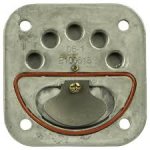
valve plate.jpeg In this picture the exhaust flapper is on top surrounded by an orange O ring. The five upper holes feed the intake flapper located underneath (that you cannot see).

An alternative arrangement that has several advantages is to place the intake reed valve on the top surface of the piston crown. As the piston moves down, inertia tends to help open the intake valve, as well as air pressure. As the piston goes back up, inertia helps slam the reed valve shut. The induction air all must come through the crankcase, which is not a problem.

The top of the valve plate then just has only the exhaust valves. Its then a lot easier to fabricate a sealed box over the whole valve plate as a combined exhaust manifold.
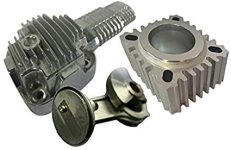
Induction reed.jpg This picture shows a very small air compressor with the induction reed valve placed on top of the piston, which is quite a common design.
It would be very easy to do with an automotive piston, especially if its slightly dished.

If you go about it this way, it will be vastly more efficient than trying to use an original cylinder head with a large combustion space. So much more efficient, that the compressor can be run at greatly reduced rpm (but at a higher drive torque). But the lower drive speed will definitely help with noise.
 
/ Convert wounded GM 6.0 into a compressor? #11  
I don't know but feel the other poster mentioning the size of motor needed might be correct. Probably any such capacity compressor would use a 480/600volt 3 phase motor, as it has exceeded anything practical for single phase.

From that standpoint, a project using half the motor to run it, for occassional use, would make more sense.
 
/ Convert wounded GM 6.0 into a compressor? #12  
The original poster wants to keep it very quiet, so an electric motor and an unusually low compressor rpm might go a long way towards that goal.

I agree with you though, that running half the engine, and using the other half as a compressor makes perfect sense for portable applications. The difficulty with that would be getting sufficient Hp to drive the compressor side. Even the mighty 6.0 liter LS engine might struggle to produce enough power at only 1,200 to 1,500 rpm with a high flow and discharge air pressure. It should be very capable though at much higher engine rpm, but that might not be what is wanted in this case.

A good approximation of just the very basic thermodynamic power required to compress air, neglecting all the various mechanical and flow inefficiencies would be Hp = psi x CFM divided by 229.

I don't know what the original posters flow requirements are, but 50 CFM at 120 psi would be 6,000/229 or 26 Hp. The real shaft drive horsepower required might approach twice that. That is a BIG electric motor.
 
/ Convert wounded GM 6.0 into a compressor?
  • Thread Starter
#13  
If you had it patched up enough to work you could probably run it on 4 cylinders. Why not just use the 4-4 or in this case 4-3 compression idea. I think an electric driven v8 would be a horribly inefficient. If you go that approach I think you壇 be better off to remove the cam shaft, close all the valves and put a check valve in the spark plug hole. It can suck air in and every stroke is a compression stroke. You could take it a step farther and trade the heads for a flat plate which would increase the compression ratio and increase the air pumped per stroke. You could probably find an old industrial compressor and be off to a lot better start. I知 not sure how you壇 go about calculating the CFM. It痴 not as simple as a liter to CF conversion times rpm divided by compression strokes. The problem is due to compression it痴 not moving 6 liters per compression stroke on every cylinder.

The more that I think about it modifying the heads to close the headspace to pretty much zero would be a must do otherwise youæ±*e wasting most of the compressed air.

My math for CFM/PSI is an unsanctioned extension of Boyle's law in reverse, looks something like this:
Goals:
150 PSI
25CFM

25 cubic feet at 150PSI converted to uncompressed air (absolute)(1 atmosphere):
Boyle's law: P1V1 = P2V2
Rearranged: V2 = (P1V1)/P2
P1 = 150PSI
V1 = 25ft^3
P2 = 14.7PSI

V2 = (150*25)/14.7 = 255ft^3

So I'm considering this engine to be equivalent to a blower of uncompressed air, capable of 255CFM.

7/8 of a 6.0 engine is a 5.25L engine. 5.25L = 0.1854 cubic feet (of uncompressed air, pumped in a single rev)
255ft^3 / 0.1854ft^3 = 1375 revolutions (per minute)

I'm not sure how many laws of physics or internal combustion engine principles that violates, but it's what I'm operating under. Feel free to correct any glaring false assumptions.

I did all that math many times, different versions of it, more complicated versions, versions involving pumping air from two cylinders into one for a 2-stage (or 3 stage, perhaps optimal use of 7 cylinders), versions factoring in volume of the chambers in the heads, and I reached the same conclusion about eliminating head space. I agree that a blocked-off head is the way to go. A flat plate with a couple of check valves is what I have in mind.
 
/ Convert wounded GM 6.0 into a compressor?
  • Thread Starter
#14  
Sell the GMC as-is and use the proceeds to buy a compressor.
If you want something to do, fix the GMC and then sell it or use it.

boring...
(probably sound advice though)
 
/ Convert wounded GM 6.0 into a compressor?
  • Thread Starter
#15  
I don't know but feel the other poster mentioning the size of motor needed might be correct. Probably any such capacity compressor would use a 480/600volt 3 phase motor, as it has exceeded anything practical for single phase.

From that standpoint, a project using half the motor to run it, for occasional use, would make more sense.

Available compressors delivering 25CFM/150PSI are using 7.5 - 10HP motors (example - 7.5HP). I assume mine will be much less efficient; requiring perhaps double the motor, as was mentioned earlier by others. I'm tentatively planning on needing a 15-20HP motor as I said previously. If the stars align I might be able to get away with 10HP? I don't know... but you're right, I'll need a 3 phase motor, and that's the other part of this story I didn't get into. I plan to put it on a variable frequency drive running a PID loop so that it maintains an exact pressure without cycling on/off and causing rolling brown-outs for my neighbors. If I just blast a little air or use a die grinder for a few seconds and system pressure drops by a few PSI, the compressor will slowly chug-a-chug at a few RPM for a minute to get it back up to setpoint. If I open a valve and just start blasting my air investment across the shop, the motor quickly accelerate from chug-a-chug to full chooch, trying to catch up.

I don't want to use half the engine for combustion power, because... I could list reasons but you or others would probably try picking them apart and I'd eventually just have to throw up my hands and say "look, just because. I just want to do it this way because that's what I want, and I'm stubborn." So I'll just get that out of the way now. I just want it to be electric, and as quiet as possible.
 
/ Convert wounded GM 6.0 into a compressor?
  • Thread Starter
#16  
The original poster wants to keep it very quiet, so an electric motor and an unusually low compressor rpm might go a long way towards that goal.

I agree with you though, that running half the engine, and using the other half as a compressor makes perfect sense for portable applications. The difficulty with that would be getting sufficient Hp to drive the compressor side. Even the mighty 6.0 liter LS engine might struggle to produce enough power at only 1,200 to 1,500 rpm with a high flow and discharge air pressure. It should be very capable though at much higher engine rpm, but that might not be what is wanted in this case.

A good approximation of just the very basic thermodynamic power required to compress air, neglecting all the various mechanical and flow inefficiencies would be Hp = psi x CFM divided by 229.

I don't know what the original posters flow requirements are, but 50 CFM at 120 psi would be 6,000/229 or 26 Hp. The real shaft drive horsepower required might approach twice that. That is a BIG electric motor.

Your calculation in my case yields (25cfm * 150PSI)/229 = 16.4HP; way higher than the motors put on marketed compressors (7.5-10HP) - see example I just posted previously. That discrepancy is exactly why I suspect your formula is accurate. I know compressor manufacturers are full of shrap, worse than vacuum manufacturers (or does my "5.5HP" 120V shopvac defy physics running on a 15A breaker? LOL). I guess what I'm after isn't strictly 150 PSI at 25CFM; what I'm after is a compressor comparable to the commercial units advertised to deliver 150PSI/25CFM. Maybe that means 150PSI max and 25CFM @ 90PSI? Or worse? Probably.
 
/ Convert wounded GM 6.0 into a compressor? #17  
I’m thinking a v twin lawnmower engine converted to pump every stroke would be a lot better candidate for this. The v8 has huge parasitic losses and and weighs like 800 pounds. I don’t think a commercial built air compressor that pumps the volume you want has anything close to 6 liter displacement.
 
/ Convert wounded GM 6.0 into a compressor? #18  
The Hp figure I quoted was from an authoritative book on sizing and driving superchargers which has proven reliable in most of its other claims.

Most common shop air compressors fall typically into the 100psi to 120psi class, and intermittent duty cycle. So a 25CFM compressor might require about 10.9 to 13.1 Hp on that basis. But the motor would not be expected to run continuously for that type of service, so an actual 7.5Hp to 10Hp motor rating sounds quite reasonable sizing for a competitive commercial product. Electric motors are rated for continuous service, so they can be pushed a bit harder for intermittent service.

Now how much air your compressor will actually flow is determined by how much NEW air can be inhaled each cycle (volumetric efficiency).
There are two aspects to that. Flow restriction through the intake valves, and how much compressed air is left over in any clearance volume in the cylinder head, that expands back as the piston descends. No new air is going to enter the cylinder until the cylinder pressure falls below atmospheric.

A converted gas or diesel engine is going to have a huge combustion chamber space that is totally detrimental to operation as an air compressor.
That is where a valve plate design really pays off, with absolutely minimal dead volume at top dead centre.
 
/ Convert wounded GM 6.0 into a compressor? #19  
A converted gas or diesel engine is going to have a huge combustion chamber space that is totally detrimental to operation as an air compressor.
That is where a valve plate design really pays off, with absolutely minimal dead volume at top dead centre.
Which is why I suggested removing the head and replacing it with a flat piece of steel. It wouldn’t be that hard.
 
/ Convert wounded GM 6.0 into a compressor? #20  
I’m thinking a v twin lawnmower engine converted to pump every stroke would be a lot better candidate for this. The v8 has huge parasitic losses and and weighs like 800 pounds. I don’t think a commercial built air compressor that pumps the volume you want has anything close to 6 liter displacement.

Many other candidates such as motorcycle or small air cooled stationary engines. Belt driven refrigeration compressors in the larger sizes should not be overlooked either. These already have a valve plate, their only disadvantage is that some of them don't have oil scraper rings and can blow a lot of oil fog into the air stream. That might be an advantage for air tools, but not for spray painting !
 

Marketplace Items

2012 Caterpillar Warren Power Systems WCW204MH 20KW Towable Light Tower (A64194)
2012 Caterpillar...
John Deere 980 28' Field Cultivator (A66285)
John Deere 980 28'...
Aluminum Bear (A65583)
MILLER BOBCAT 250 PORTABLE ARC WELDER (A64276)
MILLER BOBCAT 250...
Case 2090 Tractor (A66285)
Case 2090 Tractor...
New/Unused ATS T460 Mini Skidsteer (A65583)
New/Unused ATS...
 
Top