I like those trusses and the 2x4's for the roof are interesting. Someone knows what they are doing. I need to learn more about what you did.
The purlins are 2X6X10s.
I like those trusses and the 2x4's for the roof are interesting. Someone knows what they are doing. I need to learn more about what you did.

You somehow have to get the frame braced before going any farther. That big of a building will move allot with no bracing even in a light wind. Builders will always brace the frame work as they put up the walls.and leave them up until they get the sheating or siding installed. As Loaderman 22 said...put the X braces on the inside of the frame that way they won't be in the way as you put the siding up. We all have a schedule we like to use in building, but sometimes what you plan to do tomorrow or the week-end can turn into a week or 2 later. Getting a building back to square due to racking is a pain in the arse !
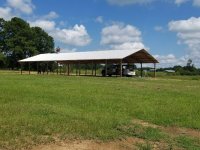
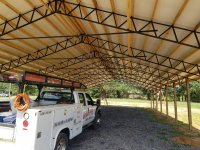
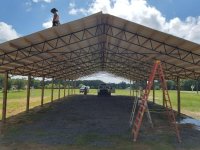
Forgive the obvious newbie questions............is it okay to use 2X4s for the cross-bracing? If I calculate it correctly, I can cut 2X4X12s to 11'6" and 30 degree angles to fit. Then, do that at all 4 corners. Is that correct or do I need more? BTW, I don't remember if I posted any pics of the finished product.
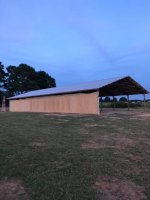
View attachment 616200View attachment 616201View attachment 616202

Forgive the obvious newbie questions............is it okay to use 2X4s for the cross-bracing? If I calculate it correctly, I can cut 2X4X12s to 11'6" and 30 degree angles to fit. Then, do that at all 4 corners. Is that correct or do I need more? BTW, I don't remember if I posted any pics of the finished product.
View attachment 616200View attachment 616201View attachment 616202
You don't give a location but those trusses look like the kind used in poultry house in East Texas. The building looks like it could be the beginning of a poultry house.
Very nice! Hope to see the pictures of the finished product.
TBS
It's in Alabama and it definitely will not be a chicken house. The intention is to use this as an event center for wedding receptions.

Looking at the design of your building, the fact that the poles are set in the ground, and that the trusses are tied into the posts, and that the roof is already on, I see no reason to start adding bracing to this structure. All those components of the structure tie it together to hold it in place.
From what I've read in the comments, the confusion seems to be in how a stud wall is built, instead of how a pole barn is built. Think more along the lines of how a gazebo is engineered.
Diagonal bracing will reduce the amount of movement that you will have in the structure. Does it need this? Not at this time, because there isn't anything to worry about. No sheetrock, now doors or windows, nothing is going anywhere. Why install something that isn't needed? Once you build your walls and get your siding on the exterior, that will create more sheer strength then diagonal bracing. To me, the bracing issue is a distraction that doesn't need to be addressed.

Its called 'temporary' bracing until you get the siding or sheating installed. Then you take it off when siding is finished. To each is own....but I don't want the frame to rack back and forth while putting the siding on.
All the pole barns that I have seen put up in recent history have had more bracing than that, they have all had bracing going up from the uprights to the header on every post even though most of them had siding put up the same day as the poles went up.Not knowing the kind of winds you get but I'm kind of in Eddie's camp on the need or lack there of, for bracing. Surely can't hurt though if you were to diagonal brace the four sections on the ends if it is going to go unfinished for an extended amount of time.
With 3 purlins attached to the posts, does that mean your plywood is attached at the top, bottom and the middle? or more importantly, there is a four foot span from purlin to purlin for your plywood?
This is really confusing. How will you keep the weather out, or stop water from getting through the edges of your plywood?
Will there be any windows on that wall?
It's about 40" inches between the stud boards. The panels overlap, so it has a good seal. Besides that, there's also house wrap underneath the panels. I'm fairly confident that I'll be able to keep the weather out.


