48x39x14 shop build

/ 48x39x14 shop build #141  
Richard
I understand. It took me a year of full time study to get a background knowledge of the issues and then a 6 hour lecture by one of the top building science professors of our time to congeal it into gut level understanding. I then spent a year developing the ways to overcome the challenges with cost effective strategies and about another 2-3 years before all my buildings were transitioned to the new system. I refused to implement any methods that were not economically viable even though the budgets of my buildings could sustain methods that are not able to be strictly economically justified. As I have said before, this is a big subject and it can't really be covered in posts on a tractor forum but I will say this;

2" polyisocyanurate foam board which is one of the exterior insulations I use is around 65 cents per square foot. That is more than fiberglass but less than spray foam. As a part of an overall system, it can be done for a very reasonable cost. The measures we currently use to air tighten and insulate buildings are mostly a hodge podge of whackamole where we address each problem that is created by applying one more layer of sealing technique or strategy. The things I no longer need to pay for on my buildings include, sealing at the plate line, sealing wire penetrations, weatherstripping and insulating attic access, IC rated recessed cans, sealing recessed cans to the drywall, sealing and gasketing electrical boxes, attic ventilation and other things. The biggest benefit however is that there is no safer way to build a building from a durability and indoor air quality standpoint and the cost of no failures can't be overstated.

But I get it. There is a lot of new info to digest and it takes time. Just take your time and if you are interested dig a little deeper as time allows. What matters isn't knowing what product to use where. What matters is to understand the forces at play and how they affect our buildings. After that, the rest becomes clear. I must admit that I would have gotten to a better understanding sooner if I had ignored products and strategies when I first started trying to learn about this and focused on the basic science instead. The implications of the Second Law are the key. Enjoy the journey.

Ray,

I think you just might be my hero! Our next house is going to be built similar to how you have described in some of your earlier post. I wish I had a fraction of the knowledge and experience you do on this subject but I have been following the airtight movement in Europe for a while now and have been fascinated by the technology! However, every builder I have talked to locally will not build an "airtight" building with exterior insulation because they either say it cant be done or its all wrong.

Our current house sits on top a "new" (15 years old now) basement made from ICF's (insulated concrete forms), with foam under the slabs and radiant heat in the slab. The first level of the house was built in the 50's and when the local college expanded, the house was moved to its current location, fully intact. When we first purchased the house (2 more owners later), it needed major remodeling in the older section and so we moved into the basement. After spending a couple years in the extremely well insulated basement, it was evident that controlling air flow and insulating in the proper places makes all the difference in how a building maintains temperatures and uses energy. BUT without doing to much research we replaced all the windows decided on spray foam for the upper level so the insulation would "match" that of the basement. A year later all the walls were back up and the inside of the house remodel was completely finished. We left the attic with standard blow in because the house does not have a ERVS (energy recovery ventilation system) and would have been very hard and expensive to install... Then set our sights to re-siding and re-roofing the house. But now that its all done and I am a bit more educated in the "smarter" way to insulate a house, I realize that I should not have torn out all the walls of house and I should have just resided with insulation under the siding and roof. However, our windows already turn to sheets of ice every winter which forces us to leave the shades open at the top and bottom. But had I done the outside insulation air tight shell, I would have needed the ERVS for sure.

Now that we have spent few years in the "finished" house, There is differently a noticeable difference... but could it have been better? I am not upset about the doing the spray foam though. It has added a rigidity and soundness to the house which wasn't there before, you can hardly tell when the wind is gusting outside now (40-50 mph). Our summers can reach 100+ degrees and the house will stay in the 70's, with no AC installed as long as you open all the windows at night to cool it back down to 60's. From spring to fall, we use $50 a month in natural gas and $120 in the dead of winter ( Nov - Mar ) to heat the 2500 sqft house (and DHW) with temps down to -20... Where as before it was nearly $300+/- per month from Sep - May but we also replaced our boiler and water heater with a 95% efficient ones. It may not be the most economical way to insulate a house but it needed remodel anyways and we only spent $2500 for all the spray foam work (not counting my time to tear out and replace all the Sheetrock.)

I will certainly take what I have learned here and apply it to my next place.

I am curious to know what your thoughts are on SIPs? It seems you can achieve a well insulated and airtight house very quickly this way.
 
/ 48x39x14 shop build
  • Thread Starter
#142  
I'm so far behind on posting progress that I had to read back to my last pic..... Sorry.....

Here's a pic of the outside finished. I'll try to take more. For some strange reason I only have one....


20180914_115914 (1280x720).jpg
 
/ 48x39x14 shop build #144  
Nice combination of colors. I might have forgotten, but what size is your garage doors? I don't seen an opener for them on the ceiling, is that coming or are you using something different? I'm kind of curious how you are doing that.
 
/ 48x39x14 shop build
  • Thread Starter
#145  
My best Buddy Don, who's like a Brother to me, pulled his camper trailer onsite and stayed for a month. He was invaluable help. He stayed thru the process of finishing the inside.

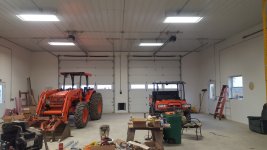
After we had hung the 1/2" OSB wall sheathing we caulked all of the splices that weren't tight. We had elevated the OSB 1/4" off the concrete floor for moisture protection and caulked that crack as well. Then we rolled on two coats of paint. Very time consuming but was worth it. Really brightened up the place.


20181003_144551.jpg


20181004_162754.jpg
 
/ 48x39x14 shop build #146  
Looking good :thumbsup:.
 
/ 48x39x14 shop build
  • Thread Starter
#147  
We built a 12'x7' bathroom in the corner. Built the ceiling at 7'. This left 7' of overhead room. Set the door at a 45 degree angle in the inward corner. Makes it easier to access and frees up wall space. Inside will be the normal stool, sink as well as the electrical panel, floor heat system and Air Compressor. I'll use an electrical small tankless heater for hot water at the sink. They fit under the sink taking up no space and provide an endless supply of hot water for hand washing etc. The bathroom is a bit cramped but I didn't want to lose anymore shop floor space than I had to. Built the room "bull" strong with studs on 16" centers. Ceiling joists are 2x6 also on 16" centers. I'll build storage shelves on the walls above the room with a retractable ladder access.

These pics are early on and I've not made much progress. I'll update them when I get it finished inside.


20181004_162649.jpg


20181007_153318.jpg


20181007_153342.jpg
 
/ 48x39x14 shop build
  • Thread Starter
#148  
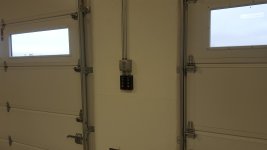
Then we started hanging conduit and running electrical. Used 1/2" for all the 110V stuff. 3/4" for the 220V stuff such as Welder plugs. Also used a wire trough above the bathroom with a 2" conduit going down thru the ceiling into the top of the panel. Then came out of the trough with conduit. I've added more since these pics were taken. I'll try to get some updated shots.

I'm not an electrician. I have a basic understanding of it all. Running conduit is also something I'm not experienced at.

Don and I spent a lot of time making drawings and trying to not miss anything. Had to run a circuit to the overhead doors. A circuit for the lights with 3 way switches at the two walk in doors. Additionally I added a 220V contactor at the Air Compressor plug in. This contactor is tripped by the overhead light circuit. Dusk/Dawn security light. Outside light over each walk in. A

Also ran 1 1/4" conduit with 2-2-4 wire from the trough to the opposite side of the building, LB box going thru the wall to another LB on the outside of the building, then down the exterior wall to buried conduit over to the machine shed next to the shop. This allows me to have adequate power in that building without needing a separate meter. My electric coop charges $30 per month just to have a meter. I currently have four. When the dust settles on this build and we move I'll be down to one.


20181007_153416.jpg


20181007_153443.jpg
 
/ 48x39x14 shop build
  • Thread Starter
#149  
Nice combination of colors. I might have forgotten, but what size is your garage doors? I don't seen an opener for them on the ceiling, is that coming or are you using something different? I'm kind of curious how you are doing that.

Eddie, the doors are 12x12. The doors are insulated and lined with steel.

They each have Liftmaster trolley openers. I wanted torsion spring openers. Even went so far as to call Hormann about it. They discouraged it. Said they have had a lot of problems with the cables momentarily getting slack and tangling.

I have remotes for both openers. They too are Liftmaster. The range is completely unacceptable. If outside you actually have to walk up to the door and place the remote on the glass before they'll signal the doors to open. Went back to the distributor and they are sending an antenna extender kit. They claim the range will be measured in yards then. They said if it doesn't work satisfactorily I don't have to pay for the kit. If it fixes the problem I'll get a second one.
 
/ 48x39x14 shop build #150  
Thanks for the info on the doors.

Why did you run all your electrical in conduit and not inside the all cavities?
 
/ 48x39x14 shop build
  • Thread Starter
#151  
Thanks for the info on the doors.

Why did you run all your electrical in conduit and not inside the all cavities?

Because I always end up adding something later. And, my supplier said it's cheaper.

Conduit is quite a challenge. Just when I think I've got it, I miss a bend by 2-3". :)
 
/ 48x39x14 shop build #152  
Eddie, the doors are 12x12. The doors are insulated and lined with steel.

They each have Liftmaster trolley openers. I wanted torsion spring openers. Even went so far as to call Hormann about it. They discouraged it. Said they have had a lot of problems with the cables momentarily getting slack and tangling.

I have remotes for both openers. They too are Liftmaster. The range is completely unacceptable. If outside you actually have to walk up to the door and place the remote on the glass before they'll signal the doors to open. Went back to the distributor and they are sending an antenna extender kit. They claim the range will be measured in yards then. They said if it doesn't work satisfactorily I don't have to pay for the kit. If it fixes the problem I'll get a second one.

I have (3) Hormann Orion 3200 garage doors in my new shop. I also have (3) Liftmaster openers that are the LM8500 jackshaft drive.

Sorry about the trouble you have with openers.

I use my built-in Homelink openers in both GM vehicles and key phob openers on the tractor and gator good range and only a few times did the Homelink require a second push and hold to activate. I have special adapters from Liftmaster for my Homelink openers as each of them are different for my vehicles due to their age. I also use the MQLink for iPhone access to open, close and monitor from anywhere.

IMG_2789.JPG

You can see that the jackshaft works from either side so you can mount them on whatever side is convenient. The lights are remote and plug into outlets that would have been installed for a traditional garage door opener. I use the second outlet plug for the Homelink module for each truck.

Lessons learned. Run conduit for your garage door opener wires. This was messy and while I was able to tuck it in most areas it is not what I would have done had I planned for it. Hence the plastic wireway down the wall by the door. Ugh...
 
/ 48x39x14 shop build #153  
Because I always end up adding something later. And, my supplier said it's cheaper.

Conduit is quite a challenge. Just when I think I've got it, I miss a bend by 2-3". :)

The reason that I used OSB on my shop walls was that I screwed them on, so I could remove them when I needed to. So far, I've had to do that above my panel box to add two new lines. Just unscrew the wood and run the wires inside the wall to the attic, then to where I wanted it to go. I also modified my drain line for my AC and had to remove a section of OSB to get to the back side of the unit. It was fast and easy by just unscrewing it.

I understand some of the reasons that electricians like to run conduit, but cheaper isn't one of them.

Are you going to paint your conduit to blend in with your walls?

By the way, the walls look fantastic with the paint on them!!!!
 
/ 48x39x14 shop build
  • Thread Starter
#154  
Your doors look just like mine. That's the opener I wanted

I ran the electrical to my openers in conduit. Ran conduit on the ceiling between the two doors to the wall and down the wall to the opener controls. Can only see the control wires for 18" between the motor boxes to the conduit box. I wired my openers using a wall duplex box and cord. I wouldn't even have to turn off the power to remove or repair an opener.

20181104_120235.jpg

20181104_120317.jpg
 
/ 48x39x14 shop build
  • Thread Starter
#155  
The reason that I used OSB on my shop walls was that I screwed them on, so I could remove them when I needed to. So far, I've had to do that above my panel box to add two new lines. Just unscrew the wood and run the wires inside the wall to the attic, then to where I wanted it to go. I also modified my drain line for my AC and had to remove a section of OSB to get to the back side of the unit. It was fast and easy by just unscrewing it.

I understand some of the reasons that electricians like to run conduit, but cheaper isn't one of them.

Are you going to paint your conduit to blend in with your walls?

By the way, the walls look fantastic with the paint on them!!!!

Thanks Eddie.

Good idea about the screws!!!! I used an air stapler. Can't think of a reason I'd hafta remove any since there's nothing in my walls.

Imagine that, my supplier misled me about material costs.

No plans to paint the conduit.
 
/ 48x39x14 shop build #156  
I like the conduit. Wish I had done that
 
/ 48x39x14 shop build
  • Thread Starter
#157  
I like the conduit. Wish I had done that

Thanks Kenny.

I like it too. I was OCD about running it. Tried to keep the spacing between runs equal. Carried a small piece of OSB in my tool belt for a guide. I've got a couple short run elbows that aren't quite right but I'm the only person that sees it. My own worst critic....
 
/ 48x39x14 shop build
  • Thread Starter
#158  
Ed Dedic,

Took anothe look at your doors. They must be 10x10?

I was told by Hormann that I could have used jackshaft openers if my doors were only 10ft tall. Or if I had 16ft ceilings I could have used different track at the elbow and ceiling. The other track would park the open door at more of an angle rather than horizontally flat. This would have the door trying to roll closed all the time and elimate the slack cable problem.
 
/ 48x39x14 shop build #159  
Love the ceiling! Are you going to put a porch or awning over the man door? We could never get away with out one because of the snow here.
 
/ 48x39x14 shop build #160  
I've been using Hormann Doors and Openers for 25 years in Austria... so far so good.
 

Marketplace Items

378908 (A61166)
378908 (A61166)
Linx EQ7018RS Trailer (A65640)
Linx EQ7018RS...
2012 FORD F-550 CAB AND CHASSIS(INOPERABLE) (A65643)
2012 FORD F-550...
HYUNDAI HL770-9A WHEEL LOADER (A65053)
HYUNDAI HL770-9A...
SANY SY155U EXCAVATOR (A63276)
SANY SY155U...
500 gal Fuel Barrel (A66408)
500 gal Fuel...
 
Top