You are using an out of date browser. It may not display this or other websites correctly.
You should upgrade or use an alternative browser.
You should upgrade or use an alternative browser.
Pull from the front or the rear?
- Thread starter strantor
- Start date
- Views: 38945
More options
Who Replied?
/ Pull from the front or the rear?
#161


Reb954
Platinum Member
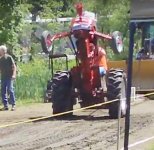
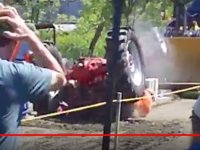
I think the FBI should investigate this roll over phenomenon.

rScotty
Super Member
- Joined
- Apr 21, 2001
- Messages
- 9,979
- Location
- Rural mountains - Colorado
- Tractor
- Kubota M59, JD530, JD310SG. Restoring Yanmar YM165D
Does that analysis include the torque that the pinion gear is exerting against the ring gear?
I believe that it does. The pinion reaction is added to the weight and distance moment part of the overturning moment for the CG of the tractor; that of the ring gear is added to the forces at the interface of of the tire with the ground.
There are always problems when you go from a static to a dynamic analysis, because every time any component reaches a limit everything changes.
Basically I believe we can describe the problem this way:
If the drawbar is above the point where the tire touches the ground, the potential for overturning exists. After that, it's just a matter of how much force we need to make it happen.
rScotty.

RoyJackson
Rest in Peace
- Joined
- Nov 17, 2001
- Messages
- 24,646
- Location
- Bethel, Vermont
- Tractor
- John Deere 4052R Cab,, Deere 855D UTV, Z920A Zero Turn Mower and assorted implements
How does a drawbar rise up above the rear axle when itç—´ mounted below the differential
Andy
I think some of the posters are confusing the tractor's drawbar with one that's mounted on the 3PH.
A tractor mounted (below the rear axle) drawbar will tend to pull the front end of the tractor down....much less likely to result in a rear rollover
Last edited:
RoyJackson
Rest in Peace
- Joined
- Nov 17, 2001
- Messages
- 24,646
- Location
- Bethel, Vermont
- Tractor
- John Deere 4052R Cab,, Deere 855D UTV, Z920A Zero Turn Mower and assorted implements
Good question. Towed implements get towed from the drawbar, and 3pt implements get attached to the two lift arms and top-link. I never found a use for the 3 point drawbar when I had a machine with a 3pt hitch.
I have towed a trailer using a 3PH drawbar...looks something like this:
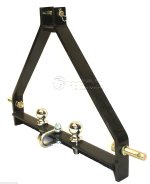
Used it to tow a smaller trailer (probably a quarter ton) when we lived in Pennsylvania.
Nice trailer, and I've regretted leaving it in PA.
Anyway, a drawbar such as shown in the picture works great for trailers, but if I was towing or pulling something without wheels, I'd use the tractor mounted drawbar most tractors have below the rear axle.

goeduck
Super Star Member
Exactly. Which is why tractor pull tractors do not flip over (that 8n was hitched high). The front tires bob on and off of the ground.I think some of the posters are confusing the tractor's drawbar with one that's mounted on the 3PH.
A tractor mounted (below the rear axle) drawbar will tend to pull the front end of the tractor down....much less likely to result in a rear rollover

California
Super Star Member
- Joined
- Jan 22, 2004
- Messages
- 16,938
- Location
- An hour north of San Francisco
- Tractor
- Yanmar YM240 Yanmar YM186D
That's how I visualize it.If the drawbar is above the point where the tire touches the ground, the potential for overturning exists.
But then I wonder if the tractor is standing vertical, drawbar just touches ground, and the driveline still applying torque, what happens?
RoyJackson
Rest in Peace
- Joined
- Nov 17, 2001
- Messages
- 24,646
- Location
- Bethel, Vermont
- Tractor
- John Deere 4052R Cab,, Deere 855D UTV, Z920A Zero Turn Mower and assorted implements
That's how I visualize it.
Maybe...but you're not correct...
Visualize a pull from a point directly below the rear axle (that is, a tractor mounter drawbar). Pulling a heavy load from below the axle will tend to counteract any tendency to lift the front end.

MossRoad
Super Moderator
- Joined
- Aug 31, 2001
- Messages
- 67,344
- Location
- South Bend, Indiana (near)
- Tractor
- Power Trac PT425 2001 Model Year
Basic physics - even known when I got my engineering degree and available through every states dept of agriculture. Modify your tractor so the coefficient of traction approaches infinity and it痴 going to flip backward. The diagram I posted is from a basic tractor engineering book. Pivot point is bottom of rear tires. Multiply force times lever arm to get the opposing moments. Pull times pull height is opposed by mass at CG times lever arm. If the traction is poor the pull cannot reach the point where the front end will lift. If the traction is high the front end will lift, just like shown in all these tractor pull pictures. Same thing in the picture I知 sure everyone has seen of the driver who chained logs to his wheel. Every time a log hit the ground the tractor front raised.
Is the pivot point the bottom of the rear tires? Everyone thinks its the center of the wheels where it connects to the hub.
Pivot Point is defined as the center point of any rotational system.
CalG
Super Member
- Joined
- Sep 29, 2011
- Messages
- 9,429
- Location
- vermont
- Tractor
- Hurlimann 435, Fordson E27n, Bolens HT-23, Kubota B7200, Kubota B2601
Is the pivot point the bottom of the rear tires? Everyone thinks its the center of the wheels where it connects to the hub.
Pivot Point is defined as the center point of any rotational system.
Now, there is a thought problem! ;-)
Consider the extreme conditions.
First, Engine off , Transmission in neutral, a "tractor jack" (fork lift, hoisting crane, I don't care) Lifting the front axle of the tractor. Rear wheels are "chocked" with 8X8 blocks. Raising the front end, would show that the tractor "pivots" on the rear axle.
Second, Same conditions regarding the tractor, but instead of a hoist out front, put a long bar out back, ridgidly fixed to the tractors axle implement mounting pads. Pressing DOWN on the lever arm causes the front of the tractor to rise. The whole shebang pivoting around the rear axle center. The WHEELS are still chocked!
Third. Put the mechanical transmission in low, Lock the engine flywheel and don't let anything "inside" the tractor turn.
Remove the chocks. Any lifting of the front, or levering down out back will have the tractor pivoting about the TIRE CONTACT PATCH. At Ground level!
Actually, It would be difficult to arrange a situation that is a cross between the pivot points that present themselves in the above "Thought Problem".
So, for my money, When pulling an "over load". The engine torque can act at as a locked transmission, rolling the tractor around the ground contact point. But any difference in speed over the ground relative to wheel rotation (slip + or -) manifests as a pivot about the axle.
The important for safety aspect would be to keep the slip going in the correct direction. i.e. slipping clutch, or hydro drive if fitted.
A nice long draw bar sticking out past the rear wheels answers every requirement. 3pt pulling is deadly.

MHarryE
Elite Member
- Joined
- Feb 15, 2009
- Messages
- 2,983
- Location
- Northeastern Minnesota
- Tractor
- Kubota M7-171, M5-111, SVL75-2, RTV900XT & GR2120; CaseIH 1680 combine
Ah, but 3 point pulling is not deadly. The obvious example is the 8N. Have a plow attached to the 3 point and the end of the plow becomes the tipping point. However the drawbar pinned between the lower links turned it into a dangerous tractor. Back in the old days the 8N was the demo tractor for backward rollover and tricycle types with loader for sideways rollover. I’m old enough to remember coming home from school and asking dad why so and so doesn’t have a father. The top 2 answers were kicked in the head by work horse or tractor rollover.
MossRoad
Super Moderator
- Joined
- Aug 31, 2001
- Messages
- 67,344
- Location
- South Bend, Indiana (near)
- Tractor
- Power Trac PT425 2001 Model Year
Now, there is a thought problem! ;-)
Consider the extreme conditions.
First, Engine off , Transmission in neutral, a "tractor jack" (fork lift, hoisting crane, I don't care) Lifting the front axle of the tractor. Rear wheels are "chocked" with 8X8 blocks. Raising the front end, would show that the tractor "pivots" on the rear axle.
Second, Same conditions regarding the tractor, but instead of a hoist out front, put a long bar out back, ridgidly fixed to the tractors axle implement mounting pads. Pressing DOWN on the lever arm causes the front of the tractor to rise. The whole shebang pivoting around the rear axle center. The WHEELS are still chocked!
Third. Put the mechanical transmission in low, Lock the engine flywheel and don't let anything "inside" the tractor turn.
Remove the chocks. Any lifting of the front, or levering down out back will have the tractor pivoting about the TIRE CONTACT PATCH. At Ground level!
Actually, It would be difficult to arrange a situation that is a cross between the pivot points that present themselves in the above "Thought Problem".
So, for my money, When pulling an "over load". The engine torque can act at as a locked transmission, rolling the tractor around the ground contact point. But any difference in speed over the ground relative to wheel rotation (slip + or -) manifests as a pivot about the axle.
The important for safety aspect would be to keep the slip going in the correct direction. i.e. slipping clutch, or hydro drive if fitted.
A nice long draw bar sticking out past the rear wheels answers every requirement. 3pt pulling is deadly.
So the pivot point is anywhere between the center of the wheel and the point where the tire contacts the ground, depending on traction and internal mechanical slippage?
CalG
Super Member
- Joined
- Sep 29, 2011
- Messages
- 9,429
- Location
- vermont
- Tractor
- Hurlimann 435, Fordson E27n, Bolens HT-23, Kubota B7200, Kubota B2601
So the pivot point is anywhere between the center of the wheel and the point where the tire contacts the ground, depending on traction and internal mechanical slippage?
I would say that the position is binary, not analog. That is, either one or the other. Never half of one and half the other.
goeduck
Super Star Member
Tractor pull tractors do not flip over. They are drawbar hitched below the rear axle.
CalG
Super Member
- Joined
- Sep 29, 2011
- Messages
- 9,429
- Location
- vermont
- Tractor
- Hurlimann 435, Fordson E27n, Bolens HT-23, Kubota B7200, Kubota B2601
Pulling tractors must usually play by the rules. Some have adjustable height hitch points.
They also have the safety benefit of running on table top smooth and flat pulling grounds.
That single detail would likely reduce working tractor flips to ZERO!
They also have the safety benefit of running on table top smooth and flat pulling grounds.
That single detail would likely reduce working tractor flips to ZERO!

4570Man
Super Star Member
- Joined
- Apr 7, 2015
- Messages
- 19,212
- Location
- Crossville, TN
- Tractor
- Kubota M59, Kubota L3800, Grasshopper 428D, Topkick dump truck, 3500 dump truck, 10 ton trailer, more lighter trailers.
Pulling tractors must usually play by the rules. Some have adjustable height hitch points.
They also have the safety benefit of running on table top smooth and flat pulling grounds.
That single detail would likely reduce working tractor flips to ZERO!
Maybe because regular tractor tires can’t get enough grip on the hard packed slick dirt, but other than that I don’t see how it helps with flipping over backwards.
goeduck
Super Star Member
Pulling tractors must usually play by the rules. Some have adjustable height hitch points.
Right, and hence they do not flip over backwards. Always below the axle.
CalG
Super Member
- Joined
- Sep 29, 2011
- Messages
- 9,429
- Location
- vermont
- Tractor
- Hurlimann 435, Fordson E27n, Bolens HT-23, Kubota B7200, Kubota B2601
Maybe because regular tractor tires can’t get enough grip on the hard packed slick dirt, but other than that I don’t see how it helps with flipping over backwards.
If one were working a tractor on table top smooth and flat grounds, what would catch up and cause the load to unexpectedly flip the tractor? The operator would know at starting off if the load was too much. No surprise! No catastrophe.
Unless you feel that the typical tractor operator is incapable of making adjustments that might extend his or her life span.
go back to post 140, click on the link, and watch how DIFFICULT it is to flip a tractor over backwards.
It takes three things to conspire to make a really bad wreck. And the first one is usually "I was not paying attention when....".

the old grind
Super Member
- Joined
- Jul 21, 2012
- Messages
- 5,308
- Location
- Mid-Michigan
- Tractor
- NH T-1520 HST, NH TC33DA HST, Case DX26 HST, .Terramite T5C, . NH L785
The gist of what CalG said in post #171 that effective pivot point is not always fixed .. again what I've offered in support .. and what Moss asked to be clarified in #173 (... and for any who haven't read/processed every post in this thread) ...
Playing 'by the rules' here, (hitched below the axle, no?) suggesting that there are other forces/vectors/axes at play than only pulling the front wheels down by hitching point location ... (also level ground, wheels not chocked ...)
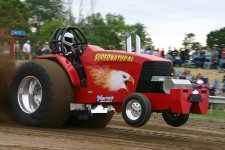
Is this proof of magic?
Playing 'by the rules' here, (hitched below the axle, no?) suggesting that there are other forces/vectors/axes at play than only pulling the front wheels down by hitching point location ... (also level ground, wheels not chocked ...)
Is this proof of magic?


