Spray arc...

/ Spray arc... #1  

Dadnatron

Veteran Member
Joined
Mar 24, 2016
Messages
1,185
Location
Versailles, KY
Tractor
JD 5100e with FEL
Just took my 1st official welding 'class'. Actually, its basically just proctored booth time.

I was introduced, on my 1st day, to Spray arc. Now, this was a very interesting technique, of which I've heard but have no experience. He set up the machine in such a way, because I had told him my goal in this class is to become more proficient at farm repair with some fab work thrown in.

I was only there for about 2hrs and during that time, I was simply running beads on scrap plate.

My questions for you are:

1. What is the most 'portable' size machine which would be likely capable of spray arc technique? I understand the 'basics' however, I don't know what sort of 'size/amperage/voltage' machine would be required. I was using a Miller 350P, I believe. Actually, I guess what I am asking, is what 'voltage' is typically required to get spray arc with a given wire size. And, while I was using .045 wire yesterday, is there a benefit to doing so, on a farm. The wire was larger than any I've seen used before, but I've also not used that 'heavy' of a machine before. What wire size would you 'max out' at for a typical farm repair for a novice?

2. I understand that spray arc requires good metal cleaning. And I understand that most things that can be done with spray arc can also be done with short circuit. Is there a benefit to one or the other? I really liked that there was essentially no spatter, and even I could make a decent looking weld, after a few tries. (my travel speed inconsistency certainly would show up easily).

3. I've read the 'spray arc' threads (or at least what has been linked) on Welding web. I really liked the technique, and felt relatively confident in it after a bit. However, if the 'machine required' is simply more and or more $$$ without really giving me, as a farm repair with some fab work, a real benefit, I don't want to head down that path right now. In a perfect world I'd have a portable machine for field repair and a big machine in my shop. However, my current shop is a storage shed and all welding is done outside.

4. I also recognize the heat developed, and that it cannot be used on thin material. But how 'thin' is typically 'too thin' for spray arc? I recognized that the gloves they had available weren't really designed for a lot of spray arc welding. I just noticed a very small blister on my left wrist, which must have been too close to the heat for too long.

Basically, is spray arc worth my time, given my situation?
 
Last edited:
/ Spray arc... #2  
There may be a few exceptions, but typically a 200-250 amp machine with 10% or less CO2, rest being Argon and maybe a small % of a third gas -

Upsides of spray - much faster deposition so used in production welding a lot. Hotter so a bit easier to get good penetration.

Down sides - more expensive gas than short circuit, mainly flat or slight incline, NOT good in out of position, pretty easy to burn thru anything less than about 1/4", needs a more expensive machine AND a heavier torch if used for long welds or it can burn up the torch - That 350 you were using is about a $5k machine, my mm252 starts at around $2500 and I've done spray with it, don't think I'd want any less -

Most smaller welders don't usually (if ever) have a high enough voltage output for spray -

Try changing the parameters in this calculator, it'll tell you when you get too thin for spray -

MIG Solid-Core Welding Calculator - MillerWelds

you'll see that recommended voltages are higher with spray, even WITH a small % of O2, which seems like a bad idea anyway - I was always taught to keep O2 OUT of my welds...

Anyway, I looked into this a fair amount and decided to just stick to C25 gas/short circuit, even with my mm252 - for one thing, I couldn't find an AFFORDABLE welding positioner that would rotate my 12,000 pound backhoe so I could weld FLAT :laughing: ...Steve
 
/ Spray arc... #3  
Basically, is spray arc worth my time, given my situation?
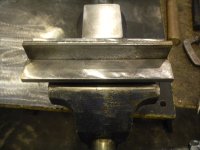
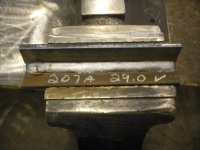
No! Spray arc is only good for high production work. Basically, it is a pain:thumbdown:. Metal has to be really clean. I played with it some, I was impressed with the speed:cool:. But it is not worth it to me!:thumbdown:
 

Attachments

  • clean.JPG
    clean.JPG
    225.6 KB · Views: 330
  • A 29.0.JPG
    A 29.0.JPG
    458.8 KB · Views: 349
/ Spray arc... #4  
No! Spray arc is only good for high production work. Basically, it is a pain:thumbdown:. Metal has to be really clean. I played with it some, I was impressed with the speed:cool:. But it is not worth it to me!:thumbdown:
When SA speaks, welder hacks should listen. I was sort of curious about the whole spray arc thing as well. Case closed for me.
 
/ Spray arc... #5  
You were using a 350P for Spray Arc? Hopefully they showed you the Pulse process that the machine was made for. Much better. You really don't need a 2-300 amp machine to do spray or something very similar. You can also drop down in wire size and up the volts with the right gas and achieve similar results you just wont be welding anything very thick. Spray is one of the many things you should be aware of but with the newer technology of the newer machines you can get beautiful welds with short arc and or pulse. Spray Arc is a dated process in my opinion. Good Luck learning though. You have a lot of reading and practice ahead.
 
/ Spray arc... #6  
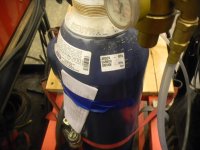
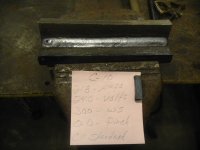
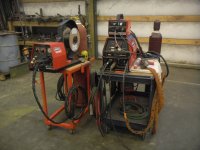
If you want some speed, check out metal core. A guy on Welding Web sent me a spool of metal core. This is very fast, and the metal doesn't need to be near as clean.:thumbsup:
 

Attachments

  • C bottle.JPG
    C bottle.JPG
    238.6 KB · Views: 262
  • C3 Best.JPG
    C3 Best.JPG
    225.9 KB · Views: 313
  • 350 Set.JPG
    350 Set.JPG
    236.8 KB · Views: 259
/ Spray arc... #7  
If you want some speed, check out metal core. A guy on Welding Web sent me a spool of metal core. This is very fast, and the metal doesn't need to be near as clean.:thumbsup:

Carl. Why would a retiree/hobbyist like yourself be concerned with "speed"?
 
/ Spray arc... #9  
I think it is rare that spry arc with .045 wire is needed for farm use, when you start getting into that size or bigger, it's mostly for high production and multi pas welding, .045-.052 is the main wire size at the shipyard, use on pulse mode and spray/mig on Miller 350s. I mostly use .030-.035 70s at home.
 
/ Spray arc... #10  
Interesting, showing my age now. Never seen the process for structural work. Back in my day Spray Arc was used for building up worn parts for re-machining to restore it back to original specification. We sent out compressor parts to specialty shop. We had problems with the new layer peeling off do to poor bond. That was caused by sloppy cleaning. They found parts had to be cleaned and pickled for best results. On shafts they cut the bearing surfaces down several thousands to get a heavier layer; still had to clean before welding. Overall it was a good process when done right.

Carl do you have the equipment to do spray arc? I would like to come over and watch it done. May Mark would also.

Ron
 
/ Spray arc... #11  
Interesting, showing my age now. Never seen the process for structural work. Back in my day Spray Arc was used for building up worn parts for re-machining to restore it back to original specification. We sent out compressor parts to specialty shop. We had problems with the new layer peeling off do to poor bond. That was caused by sloppy cleaning. They found parts had to be cleaned and pickled for best results. On shafts they cut the bearing surfaces down several thousands to get a heavier layer; still had to clean before welding. Overall it was a good process when done right.

Carl do you have the equipment to do spray arc? I would like to come over and watch it done. May Mark would also.

Ron
Shoot... count me in!
 
/ Spray arc...
  • Thread Starter
#12  
No! Spray arc is only good for high production work. Basically, it is a pain:thumbdown:. Metal has to be really clean. I played with it some, I was impressed with the speed:cool:. But it is not worth it to me!:thumbdown:

What would be your recommendation, as a good technique for my needs?

I want to insure that I've at least learned and understood the rudiments of a technique which will allow me to repair and fabricate farm equipment. Some lighter fabrication as well, but at this point, I'm mainly wanting to insure that if something breaks, I have the technique understood well enough to have a good chance of adequately repairing it.

I'd also like the skill/knowledge, to be able to fabricate something, should I so choose. At this point, I have 18hrs more in the class, and I'd like to use it to 'master' (yes I say that tongue in cheek) a good all around technique in multiple ways, in order to maximize my ability to stick a couple of pieces of metal together.

I'm thinking MIG, btw.
 
/ Spray arc... #14  
What would be your recommendation, as a good technique for my needs?
I'm thinking MIG, btw.
Buy a good quality Mig welder for general fab work. If you have to weld outside make sure to get a self shielded flux core gun. I've run flux core in Alaska in 90-MPH wind.
 
/ Spray arc... #15  
Buy a good quality Mig welder for general fab work. If you have to weld outside make sure to get a self shielded flux core gun. I've run flux core in Alaska in 90-MPH wind.

I agree - standard solid wire mig, and self shielded flux core, are the most versatile for general home/farm work if you aren't going to stick weld.

Both wires are available almost everywhere.
Solid wire shielding gas of 75/25 argon/co2 or 100% co2 are commonly stocked.
 
/ Spray arc...
  • Thread Starter
#16  
Here is a question that I thought I understood, but some have made comments to make me wonder.

Flux core is basically MIG wire with a flux imbedded in the center of the wire.?.

I've seen people speak of 'Self shielded Flux core' but my impression is that is exactly what all Flux Core is... the essential basis is that it has its own 'flux' hence 'shielding. Is there 'another' type of flux core wire?

I understand (or thought I did) the concept of 'dual shielded flux core', but my thought was that it was simply Flux core wire which also was utilizing regular 'MIG' gas as a dual shield. Is this not the case?

1. Are there different 'flux core wire' types? Non-self shielding?
2. Is dual shielded different than my conception above? And why use dual shielding in such a manner if you/I can use Flux Core in 89mph winds. (I'm sure I couldn't handle 90mph)
3. What is a 'flux core gun' vs a standard Mig gun? Is it simply a MIG gun without the gas port? Is there an advantage?

I thought I had a tenable hold on this stuff, but now it seems I have less grasp than I had believed.
 
/ Spray arc... #17  
Dual shield has gas coverage. It produces a heavy slag. Some dual shield wires can run on 75% argon, and 25% CO2. Other dual shield wires require 100% CO2.

Self shielded flux core wire does not need gas coverage.

If your Mig gun has a 1/16-inch liner in it, you might get away with running .045-inch self shielded wire. Self shielded wire is real stiff. And when it gets hot it will expand, and freeze up in most Mig gun liners.

First picture is a Lincoln K-126 self shielded flux core gun.
Second Picture is Lincoln's NR-212 self shielded wire.
 

Attachments

  • K126 gun.jpg
    K126 gun.jpg
    880.3 KB · Views: 174
  • Best NR 212.jpg
    Best NR 212.jpg
    286.8 KB · Views: 185
/ Spray arc...
  • Thread Starter
#18  
I see.

So Self shielded flux core and dual shielded flux core are DIFFERENT types of wire? I didn't recognize this was the case. I suspect it is the specific flux in dual shielded wire which results in the large slag deposit.

What are the benefits for dual shielded vs either Self shielded or MIG. I suspect, given gas is required, that MIG and Dual shielded would have to have the same basic 'environment'.

And to be clear, you point about the guns is that flux core wire is typically stiffer and therefore, might require or run better in a gun designed for the stiffer/bigger wire? As opposed to a MIG gun which is designed predominately for a more malleable MIG wire?

At what point would you purchase a Flux Core gun rather than use a MIG gun? Basically, is running flux core through a MIG gun only a problem with big wires or are there other issues that are likely to show up, if flux core is used. I ask, because at this point, I was thinking that Flux Core would be the most common technique for me in the near future, given that most of my welding will be done outside.
 
/ Spray arc... #19  
When you run dual shield, or self shielded flux core wire you need serrated drive rolls inside the wire feeder.
Dual shield wire will work fine in a Mig gun. Bigger self shielded wire will not work in a Mig gun! Like I said before, you might get .045-inch self shielded wire to work in a Mig gun with a 1/16-inch liner.
If I'm not mistaken dual shield is considered low hydrogen filler. A lot of self shielded wires, like NR-211, NR-212, Hobart's 21B are T-11 wires. Which is not low hydrogen filler. Self shielded wire like NR-232, NR-233, ESAB's Coreshield 8, are T-8 wires, which is low hydrogen filler.
Before the Northridge earthquake in California, we ran T-11 wires on everything. Now any seismic welding requires T-8 wire.
 
/ Spray arc... #20  
I see.

So Self shielded flux core and dual shielded flux core are DIFFERENT types of wire? I didn't recognize this was the case. I suspect it is the specific flux in dual shielded wire which results in the large slag deposit.

What are the benefits for dual shielded vs either Self shielded or MIG. I suspect, given gas is required, that MIG and Dual shielded would have to have the same basic 'environment'.

And to be clear, you point about the guns is that flux core wire is typically stiffer and therefore, might require or run better in a gun designed for the stiffer/bigger wire? As opposed to a MIG gun which is designed predominately for a more malleable MIG wire?

At what point would you purchase a Flux Core gun rather than use a MIG gun? Basically, is running flux core through a MIG gun only a problem with big wires or are there other issues that are likely to show up, if flux core is used. I ask, because at this point, I was thinking that Flux Core would be the most common technique for me in the near future, given that most of my welding will be done outside.

My take, in order:

Yes, self shielded vs. dual shield (also called outer shield) are 2 different types.
Both have flux cores, but the dual shield also needs a shielding gas.

Dual shield lays down more wire faster and "hotter" - I have not used it yet, saw the video and am now an expert :D
(my first roll of it just came in)

Mig guns are rated for amps and duty cycle based on 100% co2 (at least all the one's I have are).
When used with argon/co2 they heat up faster and it reduces duty cycle.
Same for self shielded wire - no gas going through it at all in that case so they heat up fast.

Get a flux core gun if yours can't keep up without overheating (in my opinion).
I use my regular M-25 miller mig gun for .035" flux core sometimes and it has survived so far.
 

Marketplace Items

LMC Ag 25 Gallon Sprayer (A60463)
LMC Ag 25 Gallon...
1454 (A57192)
1454 (A57192)
Hypac C530AH Compactor Specs (A61567)
Hypac C530AH...
2018 CATERPILLAR 320GC EXCAVATOR (A60429)
2018 CATERPILLAR...
HYDRAULIC THUMB CLAMP FOR MINI EXCAVATOR (A58214)
HYDRAULIC THUMB...
CAT D8 (A58214)
CAT D8 (A58214)
 
Top