
J_J
Super Star Member
- Joined
- Sep 6, 2003
- Messages
- 18,973
- Location
- JACKSONVILLE, FL
- Tractor
- Power-Trac 1445, KUBOTA B-9200HST


man..you are messing all it up..
The pump flows we have being talking are rated for 1500 rpm..my electric motor have 1470 rpm..
and JJ, are you telling me that the mathematical formula for TORQUE is WRONG..is that it..?
..later iエm going to post the hydraulics again..to much things going on at the same time..
Mudstopper, YES you are right!! the thing is I have to put this machine working ..I have no firewood drying..as soon as i have the time, i will put some oil flow in the F11-010..maybe I will try to put my twin pumps doing it..i donエt know if that is possible, but i am going to ckeck it out..
And guys, yesterday we were testing all moving parts manually, i was hable to mesure times and discovered my "twin Pumps" for splitter work exactly like your 28 GPM 2 stage pumps..mine works like this: 30 GPM at low pressure (I can set the relief up to pumps limit pressure, but it will work at 1000 PSI or so) and 12,5 GPM at high pressure (my limit is 4000 PSI for pump ratings, but only have 25HP, have to work with max 3000 PSI) (I Know 2 stage pump usually work with a 4:1 flow ratio, well, mine have 2,5:1 ratio)
I almost have 40 Tonnes of splitting force, i think this part is no bad..the extend and rectract times are not to bad too..

(I TRYING TO RESOLVE PROBLEMS, AND I WAS ABLE TO RESOLVE SOME, THANKS TO YOU AND OTHERS, AND MY SELF TOO..I DON´T WANT TO MAKE MYSTAKES..BY DO WAY: WHAT MYSTAKES DO YOU THINK I AM DOING, OR PLAN TO DO?Either you are not understanding or don't want to, but your numbers do not add up.
Your motor and pump can not make 30 GPM at 3000 psi. That volume and pressure would require about 58.3 HP. (I KNOW THAT SINCE...)
If you used the 4000 psi number to compute HP, it would take about 77.8 HP. (SURPLUSCENTER AGAIN? OK....)
To get 30 GPM at 1470 motor rpm, you need a pump with a displacement of 4.71 cu in. You could spread the displacement across multiple pumps, but the rpm will be the same. (i HAVE TWO PUMPS COMBINED WITH exactly 4,71 cu in, don´t understand what you mean with spreadind displacements and same rpm's..)
You still need 58 HP or 77 HP depending on pressure. (DON´T TELL ME...THAT WAS YOU THAT TEACH ME THAT..NOW I KNOW IT JJ)
If you want 30 GPM using your electric motor, then you have to limit the pressure to 1300 psi using 25 HP. (WHAT AM I SAYING FOR DAYS?)
You should also know that any pressure developed is dictated by the load, and the HP requirements will vary through the psi range.
Go to the calculators page on Surplus and plug in the numbers and you might see what we are trying to tell you. (WHAT ARE YOU TRYING TO TELL ME? I´m more and more confused...)
Maybe I should quit trying to help and let you make all the mistakes you want to.
yes, i know..this is all in theory..the true is that the data we have been work is the MAX theoreticall system settings and without counting with loses, heatings, flows issues, mechanicall efficiency, etc, etc..I just don't believe he can pump 30 GPM at 3000 psi.
Yes, he can split something, but how much pressure was developed.
I can also lift the arms on my loader at about 400 psi or less with no load all day.
Just about any amount of hyd can do some work, but to what extent.
Just for fun, throw a log in crossways, and see if the load can cause the cyl to build up relief pressure and see how the electric motor reacts.
Show us a video with pressure gauge and the sound of the electric motor. (soon i would do that, i promise
If you have an amp meter, put it on the motor to see full draw. (i was able to check 100 AMP pikes, but normally electrics work with 20-25 amp)
I want to see the 3000 relief psi on the gauge.
If I see 3000 psi on the gauge and the motor not straining, then I will concede.
But then, I would like to see correct data on all pumps.
Can you show me flow in GPM's using a hyd flow meter , which will show GPM's. ( don´t ask me to put pressure anf flow gauges in all pipes please..don´t have the time for that..i need my firewood drying soon..)
Just saying the capability, dose not make it so.

I have been designing a processor in my head for years and I have to keep walking away from using a hydraulic saw because I can not afford the HP it would require to run it (it would be different if it was for commercial use). This never makes sense to me because a large chainsaw is around 6 HP but you need closer to 30 HP or more for a processor chain saw. I think part of that is because you can easily control the amount of "bite" on a traditional hand held chainsaw so it does not require as much HP.
Ken
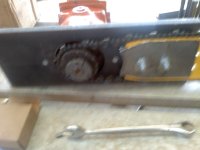 My hydraulic saw. Using a 1.3 cuin axial piston motor/ with case drain and bearings on shaft, and 13 tooth sprocket and .404 chain.
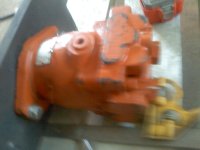 30gpm@ 5331 rpm (motor rated for 4600rpm) chain speed of 4660ftmin at 17.25ftlbs torque and 17.5hp@1000psi
I think you can control the "amount of bite" in processor saws..if your saw cylinder work with very low pressure (think harvesters work somewhere between 40 and 80 PSI depending on systems specs and chain), it will be the saw that "decides" the bite that is going to be taken of the wood..adjusting flow for saw cylinder will change saw down and up velocity..you even could have high down into the wood velocity, but if the pressure is rated for that low PSI, is the torque or HP output that is going to "decide" the velocity of the cut when chain get into the wood..obviously, the saw is going to slow down in the midlle of the log, and speed up at the end, depending if it have "more or less wood" at time to cut..I have been designing a processor in my head for years and I have to keep walking away from using a hydraulic saw because I can not afford the HP it would require to run it (it would be different if it was for commercial use). This never makes sense to me because a large chainsaw is around 6 HP but you need closer to 30 HP or more for a processor chain saw. I think part of that is because you can easily control the amount of "bite" on a traditional hand held chainsaw so it does not require as much HP.
Ken
View attachment 433487 My hydraulic saw. Using a 1.3 cuin axial piston motor/ with case drain and bearings on shaft, and 13 tooth sprocket and .404 chain.View attachment 433491 30gpm@ 5331 rpm (motor rated for 4600rpm) chain speed of 4660ftmin at 17.25ftlbs torque and 17.5hp@1000psi
I believe that every hyd circuit should have a relief valve to protect the pump.
If the circuit does not have a relief, you could blow the pump, valve , fitting, damage yourself, etc.
Somewhere in earlier post, you said you had reliefs set at 3000 and 4000 psi. If you do not have relief, the motor and pump will try and pump fluid until it can't. (YES, that's why my electric motor want to turn off when the pressure rise up 5000 PSI)
In your PDF, I saw a pressure of 1233 psi for the splitter pressure. Is that your goal? I thought you were going to build a super splitter, using such large cyl. A 6 in cyl at 1233 psi = 34,862, or 17 ton. ( I send you that PDF as an example of what output my spreadsheet can give, i keep messing around with input data all the time, i even't remember what imput data i have for that PDF) (my splitter isn't a supersplitter, it has theoretical 37 Ton of force)
We have $1000 to $ 2000 engine driven log splitters just about every where, splitting with 4 in cyl with pressures to 3000 psi, at about 37,690 lbs, or 18 ton, or 30 ton spitting just about anything thrown at it, using a 5HP or a Honda 200 cc engine. .
Tractor hyd can do the same thing.
Powerhorse 3-Pt. Horizontal/Vertical Log Splitter — 22 Tons | Log Splitters| Northern Tool + Equipment
I never did hear your expectations as to the tonnage desired, and speed. (My expectations were always blocked by the system input HP limits. Currently, for a 19 inches amount of travel, i have an extend time of 5.3 seg and a retract time of 3,6 sec, at low pressure mode. In hight pressure mode the extend time is 12 sec and retract time is 8 sec - obviously, the retract will always be in low pressure, so I have always a 3,6 sec retraction) (I have @1300 PSI -low pressure mode- 17 tonnes of force, and @2900 PSI - high pressure mode - 37 tonnes) [I was able to measure the retract and extend time at low pressure, and i measure 5 sec to extend and almost 4 sec to retract, so this part matches the theory, meaning that my flows are wright]
I did look back and found this quote. (FORGET THE PAST,I thought you had realized that as this post was evolving, I was evolving too..I start from 0 here, most of my data was given by people that are not so understud as they should be)
[ Off hand I would think the splitter would work at 30 tons but (i think i was tell that at 3000 psi it would be working with 40 Tons ]
I think you can control the "amount of bite" in processor saws..if your saw cylinder work with very low pressure (think harvesters work somewhere between 40 and 80 PSI depending on systems specs and chain), it will be the saw that "decides" the bite that is going to be taken of the wood..adjusting flow for saw cylinder will change saw down and up velocity..you even could have high down into the wood velocity, but if the pressure is rated for that low PSI, is the torque or HP output that is going to "decide" the velocity of the cut when chain get into the wood..obviously, the saw is going to slow down in the midlle of the log, and speed up at the end, depending if it have "more or less wood" at time to cut..
as mudstopper say, if you haven't start building that saw, i think you should listen is calculations, you should be able to have a decent cut without lots and lots of source HP..
What is your limits in this source HP?


