Hill Climbing Primer

/ Hill Climbing Primer #81  
Really? Maybe use a teeter toter as an example. Just change the weight of the Totters. Same as two spaners.:)

How about a static force diagram?
Computer graphics are too much of a PITA so that wont happen. The info is all there to experience when you use dueling levers of different length. Forget rotation around the axle. Driving force is at the ground. The tip lever is the wheel radius. The anti tip lever is the distance from the axle down to the pull point. When the anti tip lever is as long or longer than the tip lever no amt of traction will tip the tractor in a smooth pull. The tractor will stall or break with hardly a twitch.
larry
 
/ Hill Climbing Primer #82  
Computer graphics are too much of a PITA so that wont happen. The info is all there to experience when you use dueling levers of different length. Forget rotation around the axle. Driving force is at the ground. The tip lever is the wheel radius. The anti tip lever is the distance from the axle down to the pull point. When the anti tip lever is as long or longer than the tip lever no amt of traction will tip the tractor in a smooth pull. The tractor will stall or break with hardly a twitch.
larry

Are you saying the anti tip lever hits the ground and stops the backflip?:confused:

You should maybe consider all those gears involved in getting force to the tire ground contact point. It don't work like a teeter totter. Remember them that let you change the centre point to adjust for different weight at the end?:D

Something makes them tractors go over backwards on level ground.:thumbsup:


Richard explains it well. The gears do count.:D

Re: Hill Climbing Primer
Originally Posted by Egon
Back Flips:Enough torque, enough traction and the tractor will rotate around the rear axle. Don't mater how low you hitch.

Yep. The rear axle pinion gear is trying to climb up the front of the rear axle ring gear. Same thing happens in any rear wheel driven vehicle when engine power is applied. That's why Dragsters use wheelie bars even though they have no load hitched to the rear of the car.
Richard


Kubota M9540, Lr
 
/ Hill Climbing Primer #83  
Are you saying the anti tip lever hits the ground and stops the backflip?:confused:

You should maybe consider all those gears involved in getting force to the tire ground contact point. It don't work like a teeter totter. Remember them that let you change the centre point to adjust for different weight at the end?:D

Something makes them tractors go over backwards on level ground.:thumbsup:


Richard explains it well. The gears do count.:D

Re: Hill Climbing Primer
Originally Posted by Egon
Back Flips:Enough torque, enough traction and the tractor will rotate around the rear axle. Don't mater how low you hitch.

Yep. The rear axle pinion gear is trying to climb up the front of the rear axle ring gear. Same thing happens in any rear wheel driven vehicle when engine power is applied. That's why Dragsters use wheelie bars even though they have no load hitched to the rear of the car.
Richard
Kubota M9540, Lr
No. That is something that sounds good but a total myth. All those forces are consolidated within the tractor so their net effect on tipping the tractor is zero. Absent acceleration the only effect to tip the tractor comes from the force it exerts rearward on the ground. This acts thru the lever equal to the tire radius -- the axle to ground distance ... the drive lever. Any resistance to tractor motion applied below the axle has a countering effect on the ability of the drive lever to tip the tractor. A tractor drawbar is not low enuf to fully counter this. -- We wouldnt like it if it did, because it would prevent weight transfer to the main drive wheels. We want to have a good bit of weight transfer to the rear for traction. ... So the drawbar is carefully placed an appropriate distance below the axle to provide this transfer. Good if its not too much for safety. ... So the thinking designer manipulates the drawbar length extending behind the axle factored against its height so that the backtip providing weight transfer is moderated due to a simultaneous progressive lowering of the pullpoint. Physics can be analogous to free money to the attentive designer.;) ... Still, this passive system has its limitations. >The drawbar must extend back beyond the tire circle for best effect. Some do some dont. It depends on 3pt arm length and placement. A long drawbar may interfere - or may be set short for one function and not lengthened for an aggressive pull. For an aggressive pull you want a long drawbar so that the end comes to ground early enuf in tip cancelling the drive lever soon enuf to fully protect against inadvertent very aggressive traction or drive lever changes ... [think a sudden hook up where the tractor rips itself out of the hole youve dug trying to pull. Force points are shifting and the momentum of a quick tip may not be possible to arrest.
.....As far as the dragster quote:
Compare and contrast highly accelerative conditions with a steady state pull. Weight distribution considerations will receive extra credit.
 
/ Hill Climbing Primer #84  
So; you're saying all those turning gears don't mean nothing to the backflip??:(

They are all consolidated in the tractor. Ain't the tires and consolidated into the tractor unit also?
 
/ Hill Climbing Primer #85  
So; you're saying all those turning gears don't mean nothing to the backflip??:(

They are all consolidated in the tractor. Ain't the tires and consolidated into the tractor unit also?

The tires interact with the ground. The pullpiont also interacts with the ground. Its effect is governed by its position [^ v < >] wrt the axle. The gears acting and reacting thru everything in the chassis give you a torque output onto the pivot of the drive lever - axle. This yields a rearward force on the ground from the end of the lever in inverse proportion to the levers length. If theres no resistance theres ~no torque. The tractor just glides ahead. With resistance comes torque. Depending on where that resistance is applied to the chassis the tip torque on the chassis can be either proportionally increased or offset. A pullpoint between axle and ground offsets ... and at ground level fully cancels tip.

... Whats the pull point of a dragster?
larry
 
/ Hill Climbing Primer #86  
Sounds good for static situation but this is dynamic. With both rear wheels stopped by good traction with load applied below the axle and enough torque the front will rise rotating about the rear axle. Gears in the differential.

Why would a dragster have a pull point? Maybe a tow point.
 
/ Hill Climbing Primer #87  
Sounds good for static situation but this is dynamic. With both rear wheels stopped by good traction with load applied below the axle and enough torque the front will rise rotating about the rear axle. Gears in the differential.

Why would a dragster have a pull point? Maybe a tow point.


1] No. Depends on distance below axle that load is applied.
2] Everything must have a point at which the load acts. It may move during an event.
 
/ Hill Climbing Primer #88  
Larry, I've read every one of your posts. Trying to educate myself in varbal application.

If you don't concur with the pinion gear trying to climb up the front side of the ring gear affecting the lightness of everything in front of the drive axle, then I must brain dump all you've said. Lengthy replies with a varied amount of words rarely used have lost their power of persuasion with me. So I'll just continue to be ignorant. Tomorrow I'm going wheelin. Someone in the group will break something in regards to their chassis or driveline because of the climbing affect. Must be fairies. :)
 
/ Hill Climbing Primer #89  
I am going to propose something that is not practical but takes what SPYDERLK is saying a little further.

Lets say there is an object that is to heavy or is theoretically immovable. Now lets dig a trench out from this object. Now fabricate a hitch that has the pull point below ground level. Now back the tractor up to the immovable object so that the trench is between the tires so that the hitch can be installed without dragging. Now pull on the immovable object with the tractor.

Will the tractor lift the front tires and tip over backwards? No it will not, in fact it will do just the opposite and actually force the front tires into the ground.
 
/ Hill Climbing Primer #90  
and what if the object hitched to is not immovable?
 
/ Hill Climbing Primer #92  
I am going to propose something that is not practical but takes what SPYDERLK is saying a little further.

Lets say there is an object that is to heavy or is theoretically immovable. Now lets dig a trench out from this object. Now fabricate a hitch that has the pull point below ground level. Now back the tractor up to the immovable object so that the trench is between the tires so that the hitch can be installed without dragging. Now pull on the immovable object with the tractor.

Will the tractor lift the front tires and tip over backwards? No it will not, in fact it will do just the opposite and actually force the front tires into the ground.

As soon as the tire's stop moving the front of the tractor goes up. It requires sufficient torque and the rear must have enough traction so they rotate more slowly than normal for the gearing being used.:thumbsup:

The force contributed by the drive shaft must be included in the sum of forces and acts at the point the pinion contacts the ring gear.p:thumbsup:

Why do some four wheel drive tractors have weights on the front when just the fact the tractor is hitched low and pulling would do the same thing?

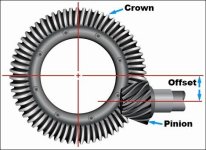
Do yourselves a favour and look at a picture of a ring gear and pinion. What happens when the ring gear is locked in position as would be the case with sufficient traction!:D

image.jpg
 
Last edited:
/ Hill Climbing Primer #93  
Boy, you guys are waaaaaaaay over analyzing this...
 
/ Hill Climbing Primer #94  
As soon as the tire's stop moving the front of the tractor goes up. It requires sufficient torque and the rear must have enough traction so they rotate more slowly than normal for the gearing being used.:thumbsup:

The force contributed by the drive shaft must be included in the sum of forces and acts at the point the pinion contacts the ring gear.p:thumbsup:

Why do some four wheel drive tractors have weights on the front when just the fact the tractor is hitched low and pulling would do the same thing?

Do yourselves a favour and look at a picture of a ring gear and pinion. What happens when the ring gear is locked in position as would be the case with sufficient traction!:D

View attachment 371314

I can say for certainty that the ring and pinion forces are completely resolved INSIDE the tractor. The pinion climbing the ring can absolutely NOT cause the front of the tractor to lift.
All rotation is due to the reaction with the tires on the ground. PERIOD! (the wheels are commonly driven by a ring and pinion, but there are alternate configurations.)

Using the example suggested by Egon and the photo.

Quote:
Do yourselves a favour and look at a picture of a ring gear and pinion. What happens when the ring gear is locked in position (as would be the case with sufficient traction!) [end]

But this time, lock the ring INSIDE the differential housing, weld the tractor axles to the cases somehow ;-) Just don't allow the torque to get out.
The ring gear is LOCKED in position, but does the front of the tractor lift? NOT A FRACTION it doesn't. Something will break, but the tractor won't show a thing in it's motion or weight bias.
Any and all "ring climbing" is resolved within the transmission housing.


Hmm.. What keeps two wheeled tractors from being nothing more than a lumpy roto-tiller ? Is the pulling reaction taken out to the draw bar some how? A sleeve hitch or the like?
 
/ Hill Climbing Primer #95  
I can say for certainty that the ring and pinion forces are completely resolved INSIDE the tractor. The pinion climbing the ring can absolutely NOT cause the front of the tractor to lift.
All rotation is due to the reaction with the tires on the ground. PERIOD! (the wheels are commonly driven by a ring and pinion, but there are alternate configurations.)

Using the example suggested by Egon and the photo.

Quote:
Do yourselves a favour and look at a picture of a ring gear and pinion. What happens when the ring gear is locked in position (as would be the case with sufficient traction!) [end]

But this time, lock the ring INSIDE the differential housing, weld the tractor axles to the cases somehow ;-) Just don't allow the torque to get out.
The ring gear is LOCKED in position, but does the front of the tractor lift? NOT A FRACTION it doesn't. Something will break, but the tractor won't show a thing in it's motion or weight bias.
Any and all "ring climbing" is resolved within the transmission housing.


Hmm.. What keeps two wheeled tractors from being nothing more than a lumpy roto-tiller ? Is the pulling reaction taken out to the draw bar some how? A sleeve hitch or the like?
:thumbsup: With a little scrutiny it can be noted that within the consolidated chassis every up force has a corresponding down force.

... The 2 wheeler has a drawbar extending below and behind the axle. It being below limits the tip lever. When tip causes the bar end to dip, the tip lever is further reduced. When the pull line become // to the bar the tip is counteracted more. And then theres the operator on those long handles to resist tip by pushing straight, or at the cost of traction, lifting.

Whos going to tackle the dragster problem? Still looking for the pullpoint? F=MA :confused3:
larry.
 
/ Hill Climbing Primer #96  
(Any and all "ring climbing" is resolved within the transmission housing.)

The transmission dose not resolve anything. It transfers torque!
 
/ Hill Climbing Primer #97  
(With a little scrutiny it can be noted that within the consolidated chassis every up force has a corresponding down force.)

Do a summation of forces and remember the torque figures in.
 
/ Hill Climbing Primer #98  
I cannot recall the number of times I've hitched at tractor to an object, applied power to the rear tires and had the front tires lift off the ground.

Every time the hitch point is high enough to cause the rear tires to attain the necessary amount of traction required to lift the front tires, they will lift.

If you have never experienced this, then I suggest that you do your own experiments with your own tractor hitched to an object it cannot pull and you will too experience this function. Put a 3pt drawbar on your tractor, hitch it to a tree or something it cannot pull, put the tractor in low gear, with the 3pt lowered and start pulling. The tractor will spin it's tires. Start slowly raising the 3pt while spinning. Eventually the front tires will lift off the ground. More height, more front tire lift. What is causing that??

There's no magic or long drawn out explanations with graphs and charts, there's just nature. The pinion gear will climb the ring gear and the front of the vehicle will rise.

I am surprised that mechanical oriented persons would not know this simple fact of nature.

No flaming here. Just simple logic experienced over many years of mechanical use.

Same laws apply when I've got my buggy on a vertical incline trying to climb it, specific application of power is required to avert disaster. Wonder why that is?? It's because the pinion gear is climbing the ring gear, which will ultimately tip the vehicle over backwards. Have experienced that. It's not pretty. Has nothing to do with being hitched to anything. Just simple mathematics.
 
/ Hill Climbing Primer #99  
I cannot recall the number of times I've hitched at tractor to an object, applied power to the rear tires and had the front tires lift off the ground.

Every time the hitch point is high enough to cause the rear tires to attain the necessary amount of traction required to lift the front tires, they will lift.

If you have never experienced this, then I suggest that you do your own experiments with your own tractor hitched to an object it cannot pull and you will too experience this function. Put a 3pt drawbar on your tractor, hitch it to a tree or something it cannot pull, put the tractor in low gear, with the 3pt lowered and start pulling. The tractor will spin it's tires. Start slowly raising the 3pt while spinning. Eventually the front tires will lift off the ground. More height, more front tire lift. What is causing that??

There's no magic or long drawn out explanations with graphs and charts, there's just nature. The pinion gear will climb the ring gear and the front of the vehicle will rise.

I am surprised that mechanical oriented persons would not know this simple fact of nature.

No flaming here. Just simple logic experienced over many years of mechanical use.

Same laws apply when I've got my buggy on a vertical incline trying to climb it, specific application of power is required to avert disaster. Wonder why that is?? It's because the pinion gear is climbing the ring gear, which will ultimately tip the vehicle over backwards. Have experienced that. It's not pretty. Has nothing to do with being hitched to anything. Just simple mathematics.
No. You are misinterpreting your experiences. That easy explanation is wrong. Its the combination of drive lever and load lever as explained in prior posts.-- And on hills the position and height of the center of mass becomes much more important than in level situations because it affects the load lever.
larry.
 
/ Hill Climbing Primer #100  
As soon as the tire's stop moving the front of the tractor goes up. It requires sufficient torque and the rear must have enough traction so they rotate more slowly than normal for the gearing being used.:thumbsup:

The force contributed by the drive shaft must be included in the sum of forces and acts at the point the pinion contacts the ring gear.p:thumbsup:

Why do some four wheel drive tractors have weights on the front when just the fact the tractor is hitched low and pulling would do the same thing?

Do yourselves a favour and look at a picture of a ring gear and pinion. What happens when the ring gear is locked in position as would be the case with sufficient traction!:D

View attachment 371314
]Matching downward force on the ring gear face and bearings.] Net effect Zero
 

Marketplace Items

Farmall Cub Tractor (A62613)
Farmall Cub...
2004 Cadillac Eagle Ultimate Hearse, Eagle Coachbuilders, Hearse Collector Special (A63689)
2004 Cadillac...
PT Wheel Driven Fertilizer Spreader (A64119)
PT Wheel Driven...
213098 (A64276)
213098 (A64276)
Fuel Tank (A64119)
Fuel Tank (A64119)
2009 INTERNATIONAL WORKSTAR BUCKET TRUCK (A63276)
2009 INTERNATIONAL...
 
Top