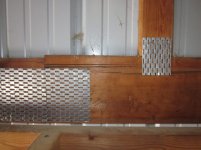
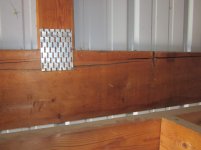
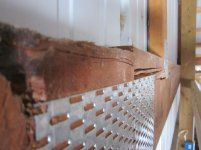
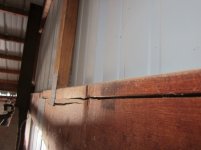
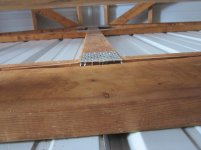
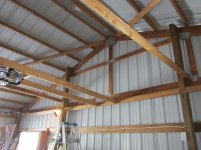
How to fix this?

/ How to fix this?
  • Thread Starter
#11  
I would use a 2X and gorilla glue (the expanding type) on both sides of the break. Cut the lumber of same width as existing and long enough to go past the splits on both ends at least 4". Squeeze glue on the 2 brace pieces on one side. Using c clamps to clamp both sides in place and then run several screw through both sides. So that when u are finished the original board will be sandwiched between the 2 new repair boards. If u have never used gorilla glue, don't run a thick bead or it will squeeze out and make a mess. I would either put c'broad or something under the repair to catch any drips.

It would be nearly impossible to do it on both sides unless you took off the side metal walls, correct?
 
/ How to fix this? #12  
Are the new posts fastened to the bottom cord?...just curious...but engineered trusses are not meant to have additional (beyond the design) bearing points...
 
/ How to fix this? #13  
I'm in the camp of using 3/4 solid core plywood (not OSB) and GOOD Construction Adhesive such as PL400 and a but load of screws.

Cut a hunk of plywood higher than the truss bottom cord and higher up onto the vertical joint where it broke out (big triangle)


Glue the joint that is split/cracked put bottle jack under the low point of the truss.
jack up slowly to compress the joint into the glue.
apply good amount of glue to the clean truss and slap on the 3/4" and screw it down with a bunch of #10+ size screws.

Mark
 
/ How to fix this? #14  
Not to step on any toes...but nails should be the preferred fastener IMO...when the most force is shear...screws work best under tension their shear strength can't compare to nails

easiest with a nailer but even a $25.00 palm nailer would limit the labor and is actually easier than using screws and a cordless...again...IMO...
 
/ How to fix this? #15  
Remove the existing gusset plate and put a longer one that reaches the bottom of the beam in it's place.
 
/ How to fix this? #16  
I'm in the camp of using 3/4 solid core plywood (not OSB) and GOOD Construction Adhesive such as PL400 and a but load of screws.

Cut a hunk of plywood higher than the truss bottom cord and higher up onto the vertical joint where it broke out (big triangle)


Glue the joint that is split/cracked put bottle jack under the low point of the truss.
jack up slowly to compress the joint into the glue.
apply good amount of glue to the clean truss and slap on the 3/4" and screw it down with a bunch of #10+ size screws.

Mark

I agree with the plywood and adhesive, don't over think or over engineer the problem.
 
/ How to fix this? #17  
Not to step on any toes...but nails should be the preferred fastener IMO...when the most force is shear...screws work best under tension their shear strength can't compare to nails

easiest with a nailer but even a $25.00 palm nailer would limit the labor and is actually easier than using screws and a cordless...again...IMO...

Pine the SCREWS are there to pull the GLUE JOINTS and Plywood together & hold it till the glue drys.

Once dried you could probably remove the screws with little ill effects as the glue will pull the plywood & truss apart prior to giving up it's bond.

The Screws are not best in sheer as they are harder than nails is true however.

Around here codes have grown so that Lag Bolts or THRU bolts are used on ALL of the top/rim joists to the poles. No longer just Nails on them.
Mark
 
/ How to fix this? #18  
Pine the SCREWS are there to pull the GLUE JOINTS and Plywood together & hold it till the glue drys.

They are not best in sheer as they are harder than nails is true however.

Around here codes have grown so that Lag Bolts or THRU bolts are used on ALL of the top/rim joists to the poles. No longer just Nails on them.
Mark

You are right about the glue (if of good quality like you mentioned...)...

however even drilling a single 1/2" hole (let alone a series of them) in an engineered truss member can void the liability of the truss manufacturer/engineer...many girder etc. trusses are designed to have either extra members and or flitch plate bolted to the bottom cord and always come with drilling instructions as per the engineer's design...
 
/ How to fix this? #19  
If you know which plant the trusses came from you can take pictures with dimensions to them. They can send it in for a repair. They may charge you but we do them for free usually. It should be painless just do it exactly as they say. It will not be sheetrock screws and plywood. Most likely a scab with a specific nail pattern. Just make sure you use the pattern and the nails they spec.
 
/ How to fix this? #20  
Doesn't look like a problem to me. It's on the end wall where even the siding would carry some of it's load, so the simple fix would be to sister on a 2X and if you're still worried about it, just run another 2X under it down to the girts. That would carry way more load than the original truss.
 

Marketplace Items

GENIE AWP-24 MAN LIFT (A60736)
GENIE AWP-24 MAN...
JOHN DEERE 50G EXCAVATOR (A62129)
JOHN DEERE 50G...
2023 Chevrolet Tahoe FL SUV (A59231)
2023 Chevrolet...
Crown SP3550H-30 Stand-On Electric Forklift (A59228)
Crown SP3550H-30...
2014 Jacobsen Groom Master II Bunker Rake (A59228)
2014 Jacobsen...
2018 Freightliner M2 106 AWD Altec AA55 56ft. Insulated Material Handling Bucket Truck (A60460)
2018 Freightliner...
 
Top