What is "dirty electric"?

/ What is "dirty electric"? #1  

John White

Gold Member
Joined
Dec 7, 2006
Messages
488
Location
Newark, Oh
Tractor
Bob Cat Ct335
I have seen this term used term used when talking about generators. I have a few questions? What is the minium and max. range a gen should operate at? Should your speed be set so that it shows 60 cyles? What do you do if your voltage is too high or too low at that setting. Will one of those gauges you see advertised on e-bay for $20 that is supposed to show voltage and cycles work in setting your gen? My old gen always showed 120 volts under load or on load. I never checked the fequency of it. I purchased a Kubota diesel light plant (like the ones on the highway for night lights) I noticed my lights a little briter than my other gen. so I checked it and it was putting out 130 volts. I reduced the engine speed a little, back down to 120, but when a load was applied,(1500 watt heater) it didnt appear to speed up and pick up the load. Does the Kubota D850 have a governor? I ordered one of those voltage frequincey meters off e-bay last night to try and montor my generators a little better. My older generator (De velbiss) always seemed to work ok and I even watched tv with using it, and even ran a older computer (which I hear is a no, no) that seemed to work ok. Noticed I said my old one, not my new one. I hear tv's and computer and microwave ovens are pretty sensitive to voltage. Any help appreciated.
 
/ What is "dirty electric"? #2  
It sounds like your governor control on the Kub is not working properly. I don't know that generator at all, so can't suggest how to diagnose it - best to get a service manual, if you are hands-on inclined, remembering that lethal voltages are involved ! Any doubts, tow it to a qualified generator repair shop.

With that wide a voltage swing, I wouldn't run that Kub on anything more valuable than a light bulb, and not indoors (meaning the bulb).

Homepower.com is usually a good goto source for general alternative power information. "Dirty" can refer to the grade (electrical quality) of the output power, or to the fact that you are burning fossil fuel to run it - depends on the context of the statement as to which applies.

Rgds, D.
 
/ What is "dirty electric"? #3  
With regard to a generator, "dirty electricity" usually refers to the quality of the AC power coming out of the generator. When I first heard the term, I thought you were referring to "dirty" vs "clean" electricity in the environmental sense, but now I don't.

AC energy should be a perfect sine wave. The AC energy coming out of a conventional generator is usually not a perfect sine wave, for various reasons, including the quality of the stator/rotor (consistency of the windings, for example) and the quality of the governor on the engine (can it run at a perfect 3600 RPMs, or does it vary slightly). This is because conventional generators simply consist of a motor that drives a rotor that spins in a stator. So there is basically no fancy cleaning or regulation of the AC output. The engine is tuned at the factory to spin at 3600 RPMs, which causes it to output 120-volt / 60 Hz power, which is then sent out to the breakers and receptacles.

An alternative to conventional generators is "inverter" generators. These generators output three-phase AC from the stator/rotor, which is then rectified to DC, which is then converted back to AC by an inverter. They put out near-perfect waveforms and are much more fuel-efficient and quiet than conventional generators, but they're also much more expensive.

For perspective, here is the output of two different conventional generators:
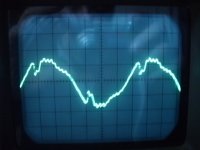
Costco_gen.JPG Dayton_gen.JPG

Notice that one is cleaner than the other, but neither is perfect. Here is the output of an inverter generator, for comparison. This is also comparable to what you would see coming out of your wall, from the utility:
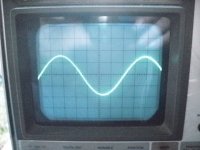
Honda_2000i.JPG

Now, you will hear people talk all day long about how "dirty power" from conventional generators damages "sensitive electronics" like computers. I think these claims deserve some skepticism. For one thing, modern computers all have switching power supplies, and have for the last ten years or so. This means that the first thing the power supply does is convert the incoming electricity to DC, then convert it to high-frequency AC, then convert it to whatever form the appliance needs. This means that these devices are very tolerant of incoming signal that is not quite in spec. Devices with analog PSUs might have more problems with out-of-spec power, and might be more likely to be damaged.

But wait! I have done a substantial amount of research on this topic (although I'm just some guy) and anecdotally speaking, here is what I have found. In nearly every case I have found where a person claims that a generator damaged their equipment, they were overloading their generator. If you're overloading your generator, then the voltage is going to drop, and consistent low-voltage conditions WILL damage all electronic equipment that is attached to them.

This is why I'm very skeptical of the "sensitive electronics / dirty power" claim. You never hear the people making this claim tell you that modern "sensitive electronics" have switching PSUs that probably aren't going to be damaged by "dirty power". So it just makes me wonder what else they don't know or aren't telling me. And then you do some research and find out that all these people who are blaming their generators' "dirty power" on destroying their equipment were overloading their generator. Guess what? It doesn't matter if you're using an inverter generator or a conventional one, if you overload the genny, you're going to get low voltage conditions.
 
/ What is "dirty electric"? #4  
Joshua, good explanation, and I liked you O' scope screen shots.

James K0UA
 
/ What is "dirty electric"? #5  
Dirty electric is is basically less than pure clean voltage so to speak. The power you get from the grid is a clean sine wave but some genny's depending on how their tuned or condition can put out dirty power. My genny puts out about 130 volts w/ no load but drop close to normal under load. I have never tested it while I was running several items in the house. I know my ceiling fans don't like the genny, they hum and last power outage our microwave was damaged. It worked but sounded like it lost a lot of its power. So maybe I have an issue with my genny as well. Using my TV, computer and everything I saw no issues.
 
/ What is "dirty electric"? #6  
Joshua, good explanation, and I liked you O' scope screen shots.

Thanks, James. Credit where credit is due, I just pulled those off the web somewhere.

I think the bottom line is that if your genny is putting out 120/60, or thereabouts, you are probably fine. I shouldn't have said "in nearly every case, the person was overloading their generator." In some cases, the generator was operating out of spec. But my point is that I can't find a single case where a conventional generator destroyed some equipment AND was basically operating in spec (putting out 120/60). Either it was overloaded, and was undervoltage, or it was running out of spec and was putting out 50 Hz instead of 60, or 130 volts instead of 120, or what-have-you.
 
/ What is "dirty electric"? #7  
With most generators the Hz, frequency, cycles (all the same) should be Hz. If you speed up the engine then the Hz will rise, slow the engine down then the Hz will drop. The acceptable range is 59Hz-61Hz and ideally 60Hz. The voltage in most newer generators are controlled be an AVR(Automatic Voltage Regulator). So the governor is to make sure that the frequency does not vary to much under load.
 
/ What is "dirty electric"? #8  
Thanks, James. Credit where credit is due, I just pulled those off the web somewhere.

I think the bottom line is that if your genny is putting out 120/60, or thereabouts, you are probably fine. I shouldn't have said "in nearly every case, the person was overloading their generator." In some cases, the generator was operating out of spec. But my point is that I can't find a single case where a conventional generator destroyed some equipment AND was basically operating in spec (putting out 120/60). Either it was overloaded, and was undervoltage, or it was running out of spec and was putting out 50 Hz instead of 60, or 130 volts instead of 120, or what-have-you.

I totally agree with your thoughts and message. To provide further response to the OP, an inexpensive frequency/voltage meter such as a found on eBay and other places is a great tool for setting generator speed/output. It is entirely possible that the 1500 watt 'load' was not enough to cause voltage drop, a decrease in engine/generator speed, or a noticeable reaction from the engine's governor.
 
/ What is "dirty electric"? #9  
Thanks, James. Credit where credit is due, I just pulled those off the web somewhere.

I think the bottom line is that if your genny is putting out 120/60, or thereabouts, you are probably fine. I shouldn't have said "in nearly every case, the person was overloading their generator." In some cases, the generator was operating out of spec. But my point is that I can't find a single case where a conventional generator destroyed some equipment AND was basically operating in spec (putting out 120/60). Either it was overloaded, and was undervoltage, or it was running out of spec and was putting out 50 Hz instead of 60, or 130 volts instead of 120, or what-have-you.

Thanks from me too. I've always wanted to know more about those things.
Can you tell me how one determines when a generator is overloaded or how much of the rated watt output you can use before it becomes questionable? Furthermore, how would one go about sizing a generator?
 
/ What is "dirty electric"? #10  
Thanks from me too. I've always wanted to know more about those things.
Can you tell me how one determines when a generator is overloaded or how much of the rated watt output you can use before it becomes questionable? Furthermore, how would one go about sizing a generator?

In general, I think it's safe to assume you can use 100% of your generator's rated capacity. But it's certainly true that a generator running at 100% capacity is going to wear out sooner than one running at a lower capacity. That's true of any engine. Keep in mind that appliances with motors (including the compressor in your fridge or chest freezer, or your AC unit) have a surge draw when the motor starts up that is 3x or more the normal running draw. That's why generators have surge rating as well as continuous rating. However, if two or more appliances kick on at the same time, the amount of draw can increase a surprising amount, and overload your generator.

IMO, the simplest way to be sure you're not taxing your generator is to check the quality of the AC it's putting out. If it's 120 volts at 60 Hz, then you're probably okay. What will happen when the motor in the genny can't keep up with the draw is, it will begin to bog down, and the voltage that's put out will start to drop. If your generator has a volt meter built in, you can see this there, or you can buy a Kill-A-Watt for $25 or so and leave it plugged in to an outlet being fed by the generator. I highly recommend owning a Kill-A-Watt anyway, if you're going to be using a generator.

Regarding sizing a generator, what you do is add up all the wattage of all the things you want to run at the same time, and buy a generator at least that big, but IMO, I would buy one maybe 25-50% bigger than that, or maybe even up to 2x as big, because like I said, you don't want to be running at 100% all the time, and you will probably end up finding more things to run once you get started. When you add up the wattage, you also have to take into account surge watts. It can be hard to know how many watts things draw, so once again, the Kill-A-Watt comes in handy, because it can show you in real time how much any 120-volt appliance is pulling. For example, my chest freezer pulls a few hundred watts when the compressor kicks in, but only for a few seconds, and then it immediately drops down to something much lower (don't remember what).

If you seriously believe that you will be working your generator at close to its rated load a significant portion of the time, I would recommend either sizing up significantly, or look into one of the 1800 rpm diesel generators. Since they are running at a much lower RPM and are diesel, my intuition is that they are much more tolerant of heavy, long runtime. If you buy a bargain-basement generator that just barely meets your needs, and then run it hard for days at a time, don't be surprised if it needs repair after only a few hundred hours, or maybe less.
 
/ What is "dirty electric"?
  • Thread Starter
#11  
Thanks fellows for educating me. Really appreciate the information.
 
/ What is "dirty electric"? #12  
One more thing: your generator will have a breaker that should protect it in over-current situations, but that assumes that your generator is actually capable of delivering full wattage to all outlets/breakers. In other words, if you have a 5000 watt generator, at 120 volts, that is 41.6 amps. If you have two 20-amp breakers, that adds up to 40 amps, and you should be good to go. But let's say you had a 2500 watt generator. That's 20 amps or so, total, at 120 volts. If that generator had two breakers, perhaps they would be 15 amps each, in which case the generator's capacity could be overdrawn without flipping any of the breakers.

The real question, and I don't have an answer to it, is whether it is common practice to always spec breakers with a low enough capacity that the generator can't easily be over-taxed. And, of course, that assumes that the breakers are working properly in the first place! I know I have heard stories of people overloading their generator, so the breakers alone can't tell the whole tale.
 
/ What is "dirty electric"? #13  
One more thing: your generator will have a breaker that should protect it in over-current situations, but that assumes that your generator is actually capable of delivering full wattage to all outlets/breakers. In other words, if you have a 5000 watt generator, at 120 volts, that is 41.6 amps. If you have two 20-amp breakers, that adds up to 40 amps, and you should be good to go. But let's say you had a 2500 watt generator. That's 20 amps or so, total, at 120 volts. If that generator had two breakers, perhaps they would be 15 amps each, in which case the generator's capacity could be overdrawn without flipping any of the breakers.

The real question, and I don't have an answer to it, is whether it is common practice to always spec breakers with a low enough capacity that the generator can't easily be over-taxed. And, of course, that assumes that the breakers are working properly in the first place! I know I have heard stories of people overloading their generator, so the breakers alone can't tell the whole tale.

I may have just learned something here. Maybe you can help me understand something a bit more. I have a 5500 watt/8250 surge genny. At the moment I can't remember if the 120 receptacles have their own breaker as well as the 240 volt receptacle. The genny just has one toggle switch that says "breaker on/off"

Anyhow, If I remember correctly the 240V plug is rated at 30 amps. So if I'm feeding my panel off the 240V receptacle the most I can produce is 30 amps to run house hold things??
I ask because based on your calculations above my genny is rated for 45.8 amps. I saw no where in the specs my genny is capable of 45 amps.
 
/ What is "dirty electric"? #14  
I may have just learned something here. Maybe you can help me understand something a bit more. I have a 5500 watt/8250 surge genny. At the moment I can't remember if the 120 receptacles have their own breaker as well as the 240 volt receptacle. The genny just has one toggle switch that says "breaker on/off". Anyhow, If I remember correctly the 240V plug is rated at 30 amps. So if I'm feeding my panel off the 240V receptacle the most I can produce is 30 amps to run house hold things?? I ask because based on your calculations above my genny is rated for 45.8 amps. I saw no where in the specs my genny is capable of 45 amps.

The breaker setup will vary depending on the generator, and I don't know if it's possible to generalize too much. My generator has a single 240-volt receptacle, and two pairs of 120-volt receptacles. It has four 20-amp breakers: one for each pair of 120-volt receptacles, and one for each leg of the 240-volt receptacle. Since the generator has about 40 amp capacity total, you can see that it would be possible to draw 80 amps without tripping a breaker, but only if both the 240 and the 120 lines were being used at the same time, and this usage is not common. Usually, if you're using the 240, you're plugged into an RV or a transfer box or something, and you're not pulling any extension cords direct off the generator. Alternatively, if you're using extension cords off the 120 receptacles, you're probably not pulling anything off the 240. So this is a reasonable generator design, with 40 amps total capacity, and 40 amps of breaker capacity in most common use cases.

Your generator, with a single breaker switch, it's hard to say what exactly is going on behind the scenes. But it would be really silly to have a 46 amp generator without at least 46 amps of breaker capacity, so I would say the most likely scenario is that there is a single on/off/reset switch that controls multiple breakers. But, and this may be too obvious to even mention, let's be sure you're referring to your breakers and not to the main on/off ignition switch, which... I don't know, in some strange world, might be labeled "breaker on/off," although that would be kind of unexpected. I have never seen a generator with multiple breakers that had a single master-switch for them, but that doesn't mean it doesn't exist.

Another question that may give you useful information is whether it is even possible to have the two legs of a 240 volt circuit on the same breaker. In other words, if your generator's total capacity is 46 amps, maybe the manufacturer would just put the entire generator on a 50 amp breaker and be done with. All receptacles on the same breaker and GO. But if one of the circuits is 240, I'm not sure that's even an option. An electrician would have to speak up. My understanding is that the way it is usually wired is the two legs of a 240 circuit are each wired to a separate 120 breaker, but I don't know for sure whether it HAS to be that way.
 
/ What is "dirty electric"? #15  
K7LN;2929029That 5500 watts at 240 volts would give you 22.9 amps total. That's for both legs which is where you get the 45.8 figure (120V@22.9A x 2). Your single toggle switch is probably a 240 volt breaker that will handle both legs of 120 volts.[/QUOTE said:
That sounds more like it. I think I remember my genny manual stating 23 amps. I just don't understand the "both legs" terminology. I'm gonna check the manual again and I'll post a pic of the power panel of the genny. As soon as my movie is over :) Its a troy built briggs & stratton model. There is an on and off switch AND a breaker on and off switch though. No visible breakers
 
/ What is "dirty electric"? #16  
I have seen generators run at 62 Hz at no load. This is pretty normal and I would not adjust the no load frequency to 60 Hz. It will then droop to 58 Hz and low voltage when loaded.
 
/ What is "dirty electric"? #17  
A small genny that runs at 3600 rpm to produce 60hz at full load may run at 3750 no load. that is referred to as governor droop. The engine rpm determines the frequency of the output. A 2 brush genny runs at 3600 rpm to produce 60 hz, a 4 brush genny turns at 1800 to produce 60 hz. Several appliances will operate at 50-60 hz per the label. American power generation is at 120-130 V and 60 hz, European systems are 230-240 V and 50 hz.
 
/ What is "dirty electric"? #19  
That sounds more like it. I think I remember my genny manual stating 23 amps. I just don't understand the "both legs" terminology.

"Both legs" refers to how 240 volts is made. A 120 volt line consists of a 120 volt potential between ground (0 volts) and positive (120 volts). A 240 volt line (such as an electric dryer or stove would run off of) is made by combining two 120-volt lines, one at +120 and one at -120. The potential difference between them is, therefore, 240. Each of the 120 volt lines is a "leg" of the 240 volt line that is made from them.

You might ask, why not just make a 240 volt line, with 240 volts of potential between hot and ground? Well, an electrician could give you a better answer than I can, but the layman's answer is that it's simpler and better if everything is consistent. So you want 240, you just run two 120 volt lines all the way out to the receptacle and away you go.
 
/ What is "dirty electric"? #20  
That 5500 watts at 240 volts would give you 22.9 amps total. That's for both legs which is where you get the 45.8 figure (120V@22.9A x 2). Your single toggle switch is probably a 240 volt breaker that will handle both legs of 120 volts.

What may not be obvious to John is that the amp draw is determined by watts divided by volts. So 1000 watts at 120 volts = 8.3 amps. 1000 watts at 240 volts = 4.16 amps. When you talk about a generator's capacity, it's usually in watts, but when you get down to the nitty gritty, you usually end up talking in amps, and it's important to be clear about whether one is referring to 120 or 240.

K7LN, if he has a 240 breaker, does it internally consist of two separate 120 breakers? It seems like it would have to because that's how 240 is made--from two 120 legs. Is that right?

I suppose it wouldn't be out of the question to have a single-leg 240 circuit, with a single 240-volt breaker, but I don't know of anywhere that's actually done. Is there such a place?
 

Marketplace Items

500 BBL FRAC TANK (A58214)
500 BBL FRAC TANK...
2014 International WorkStar 7300 4x4 Altec AA55E 55ft. Material Handling Bucket Truck (A60460)
2014 International...
2017 Ram 5500 Bucket Truck (A61307)
2017 Ram 5500...
Case-IH 165 Puma (A57148)
Case-IH 165 Puma...
2009 Kubota M108S (A60462)
2009 Kubota M108S...
2019 Chevrolet Tahoe SUV (A61569)
2019 Chevrolet...
 
Top