Moving a 35x70x18 metal barn

   / Moving a 35x70x18 metal barn #1  

patrick_g

Elite Member
Joined
Jul 24, 2006
Messages
4,248
Location
South Central OK
Tractor
Kubota Grand L-4610HSTC
I have a 30 plus year old metal shop/barn with 14 foot wide 14 foot high overhead doors at opposite long ends and a small office room on the side in the middle on the north side sticking out like a wart on a pickle.

There are three regular size (people) doors in the building proper on the south, east, and north sides. The door on the north side opens into the office which has yet another door on its north side. The building is situated with the long dimension running E-W.

There is a HD jib crane in the middle of the south wall with an electric hoist on a rolling car.

This building is located on state highway frontage a quarter mile from my house and its attached metal and wood shops.

I have prepared a pad to receive this building. This is located just east of my 3 car garage approximately in line with the long dimension of my house. There are 10 each 6 5/8 OD pipe columns supporting 5 trusses plus there are C purlin columns framing the doors and taking a small load.

The pad has been prepared with 14 piers that are 18 inches in diameter and 12-15 feet deep with larger (flat topped mushroom shaped) upper ends affixed with weld plates set into the top of the rebar reinforced piers with J bolts. The weld plates are were adjusted by LASER level to the same height.

When the building is moved it will be set down on these piers. There is no slab floor at the new location and there may never be one. As the existing slab has provision for the siding to extend a few inches down lower than the top of the slab (for rain shedding and weather seal) I will have to extend the columns sufficiently to not "CRUNCH" the siding when lowering the building into place.

The building movers came and placed large I beams through the building as wide as the 14 ft door opening would allow. Then they placed I beams transverse to those with one under each of the trusses except the center truss which got to transverse beams.

The top of the transverse beams is in contact with a horizontal pipe welded with its bottom extent at 25 inches above the slab. These horizontal braces encircle the entire periphery of the building connecting all the vertical columns. In addition I have welded 20 ft pipe/braces from near the top of the wall to the transverse I beams. That is 10 diagonal braces. Another brace runs horizontal about 5 feet above the transverse beams and has two triangulating braces down from it to the transverse I beams. The mover requested the diagonal braces but I added the additional horizontal brace with 2 each diagonal triangulating braces to reduce the flex of the transverse I beams near the center of the span.

The vertical columns are cut about 70% of the way through at the level of the top of the slab. We will cut the rest of the way through just prior to lifting the building as it is not prudent in Oklahoma to hope for a long period of light wind and just take your chances.

The movers will jack up the bottom beams and insert sets of wheels. They wile then drive across the pasture 1/4 mile south and set the bld with long dimension again running E-W but turned 180 degrees so what was the south side will face north. The office has been cut free and will not be moved. I will disassemble it for materials. The siding will be used to patch the holes cut for the over length transverse beams.

For those of you who are still awake... there are some attached photos.

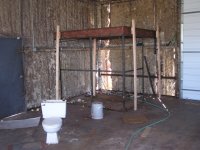
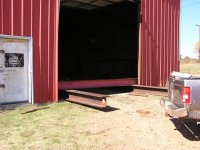
The picture showing red siding is of the east overhead door opening. You can see the I beams which will be used to lift the bld. The "cage" in the picture with the photogenic toilet was the angle iron frame of the bathroom after the walls were removed. (New location will not have water and no toilet but will have electricity.)


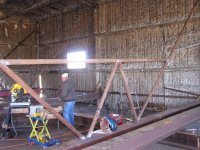
The picture with the glaring window in the middle shows the "W" bracing between the 20 foot diagonal braces.

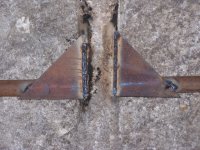
The close up of the two triangles shows the details of how the horizontal pipe braces were attached. The gussets and the bottom of the pipes are both at 25 inches above the top of the slab and provide the point at which the lifting I beams will contact the bld.

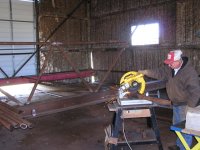
The guy with the red and white cap is a helper who was cutting angles on the ends of the pipes to make welding easier. We used a Harbor Freiight electronic protractor to set up the saw and check the cut ends and so forth. It works really good.

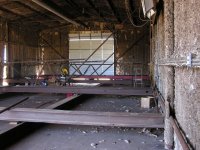
The picture with the white rectangle in the center (overhead door 14x14 feet) also shows some of the bracing we welded in.

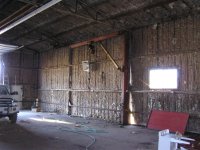
The picture of the south wall shows the jib crane as well as the horizontal bracing 25 inches above the slab.

The next installment will be pix of the building being lifter, hauled and positioned over the piers. Later we will weld the bld to the weld plates of the piers and cut all the braces loose so the mover can have his beams back.

Given the difficulty of getting good trustworthy labor to disassemble and reassemble the building, I found it to be less risk and maybe less $ to move it intact. I got bids differing by a factor of 2 for this job. First contractor dropped out and did not do the deed, another wanted twice as much, but the third guy seems to want to do a good job and is only a few $ over the low (non performing) bidder.

Pat
 

Attachments
  • East Door.jpg
    East Door.jpg
    243.3 KB · Views: 457
  • Ex bathroom.jpg
    Ex bathroom.jpg
    262.7 KB · Views: 372
  • Middle looing NW.jpg
    Middle looing NW.jpg
    295.6 KB · Views: 348
  • Shop-barn south wall.jpg
    Shop-barn south wall.jpg
    272.4 KB · Views: 563
  • North looking west.jpg
    North looking west.jpg
    286.7 KB · Views: 400
  • Cutting braces.jpg
    Cutting braces.jpg
    267.4 KB · Views: 330
  • Pipes and Gussets.jpg
    Pipes and Gussets.jpg
    289 KB · Views: 394
Last edited:
   / Moving a 35x70x18 metal barn #2  
Seems like a pretty big job. What equipment are they going to use to move it. Curious what is the cost of the move? Make sure you take lots of pictures of the move that will definately be a sight. I have seen an old church moved about 5 miles from me. It was only moved from one side of the street to the other but took a whole day becuase of the age of the building 150+ years old and they had to move alot of electrical wires. They uses 2 big dozers.
 
   / Moving a 35x70x18 metal barn
  • Thread Starter
#3  
JDEERKID, They will lift on the I beams with hydraulic jacks to raise the building after I cut the columns the rest of the way through. They will insert sets of wheels under the bottom layer of I beams (running length of building) and then hitch up to it with a large Mac truck. They will back up for a couple hundred feet to allow pulling forward while turning south through a section of removed fence. They will drive it 1/4 mile south through pasture and then make a sweeping rit turn of 90 degrees and position it over the piers on the pad. After they get it placed they can pull straight ahead to get to my drive way and exit.

My bids were $6K and $12K. I selected the $6K who turned out to be an overly independent flake who wasted lots of my time and lost me a lot of lead time but did nothing beyond talk. I found another bidder at $6.8K and he showed up with HD truck, BIG steel, and experienced crew supervised by the owner's son-in-law.

The Mac tractor is a BIG sucker, large as you will see on the interstate. It has a fifth wheel hitch and a winch on the back. They will use the winch. The intended route through the pastures varies from level to slightly down hill so I don't foresee a power problem as they will not go very fast.

EVERYONE around here who knows of the impending move wants to see it happen or pix of the event. I could sell admission tickets and run a snack concession!

One of my main concerns is rain. I hope I get into their busy schedule and get it moved before we get significant rain. Right now the intended path is just fine but with only a little rain would be a slick nightmare and with significant rain a show stopper.

Part of the deal was that I pay for the dozer to pull them out if they get stuck.

I hope to have pix to document the operation.

As if I didn't have enough projects... I was thinking of maybe building a mezzanine floor in at least part of the building. Wall height is 18 feet so headroom would not be a problem.

I have received various suggestions of what to do with the slab floor being left behind. It is 12-16 inches thick I think. It withstood BIG Caterpillar tractors with no problem. I thought roller rink. Other suggestions included farmer's market. It doesn't get cold enough for an ice rink unless I put down rigid foam insulation. Landing pad for helicopter or VSTOL aircraft or ultralight. Model A/C flight ops. Glaze the surface and put in shuffle board. Marble shooting rings. It is two small for a basketball court (84 or 94 ft long.) It will be in a pasture for cattle, actually part of a maturnity ward and nursery for cattle about to give birth, recently gave birth and their young calves. Cattle tend to avoid walking on the pavement so It doesn't do anything for them and it is way too much work to remove it.

Pat
 
   / Moving a 35x70x18 metal barn
  • Thread Starter
#4  
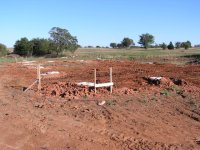
Not much to see but pier tops and batter boards but here is shot of pad.

Careful observers will see my "catfish" pond that I stocked with 200 channel cat at about 4 inches in length. they are about 16 inches now.

Pat
 

Attachments

  • Pad.jpg
    Pad.jpg
    276.8 KB · Views: 542
   / Moving a 35x70x18 metal barn #5  
Betcha that old concrete pad would be an excellent spot to erect a large storage shed!:D
 
   / Moving a 35x70x18 metal barn #6  
Betcha that old concrete pad would be an excellent spot to erect a large storage shed!:D

egon, that must be the ns way of thinking. ya just beat me too it.... i'd move that shed off them posts and onto that nice big concreat slab.............
 
   / Moving a 35x70x18 metal barn #7  
egon, that must be the ns way of thinking. ya just beat me too it.... i'd move that shed off them posts and onto that nice big concreat slab.............

That concrete slab with a nice shed on would probably make for a good place to store hay bales ehh.:p
 
   / Moving a 35x70x18 metal barn #8  
The pad has been prepared with 14 piers that are 18 inches in diameter and 12-15 feet deep with larger (flat topped mushroom shaped) upper ends affixed with weld plates set into the top of the rebar reinforced piers with J bolts. The weld plates are were adjusted by LASER level to the same height.

Pat
12-15 feet deep? Thems some serious pads?

Wedge
 
   / Moving a 35x70x18 metal barn #9  
Maybe I missed it, but why are you moving it? There is a slab where it is and you're moving it to a site without a slab. Looks like you'd want to keep it on the slab?
 
   / Moving a 35x70x18 metal barn #10  
Where the footings engineered or by-gosh that should work?

I'm guessing given a little knowledge of your SOP, at least some what engineered. I'm also guessing uplift is the reason for such monster footings?
 
Last edited:
   / Moving a 35x70x18 metal barn
  • Thread Starter
#11  
2many rocks and Chillimau:

18 inch diameter piers because that is the size auger the winning bidder had and recommended (very experienced and highly recommended contractor) and I liked it.

12-15 feet deep to get to: 1. undisturbed soil (below the fill I used to make pad and 2. to get to the layer of sand rock (not sandstone) that forms a shelf below the area. Piers get a lot of support from friction between irregular walls and soil, not just support from the bottom area of the pier. So getting into undisturbed soil is a GOOD THING.

The building isn't really all that heavy. The steel used temporarily to brace and support it while moving probably weighs more than the bld.

It is moved now, positioned pretty good over the piers (pix to follow when the operational tempo subsides.)

Last night after the movers left I started making steel boxes to connect the not to accurately placed weld plates to the column bottoms. I am using HD 8 inch channel. It is 2 inches high. Two pieces will be welded together to make a box 8 inches wide and 4 inches tall. The process is:

Cut a square hole in the channel to fit the weld plate. Orient the hole to position the direction of the channel to be under a column. Weld in place. Add another piece of channel on top of the first to make the 4 sided steel box with two open 4x8 inch ends. Weld the two long seams.

Now you have an 8 inch wide flat metal surface on which to lower and set the 6 5/8 inch diameter columns (10 each and the sodes of the door frame (4 each). This raises the bld 4 inches above the weld plates and makes it about 4 inches taller than when on its slab. This accommodates the overhang of the sheet metal.

After it gets light (note the time of this post) I will take my transit and shoot the locations of where the columns were cut off at the slab. This will give me any elevation differences of where the columns used to sit. The weld plates of where it is about to be placed are all at the same height (rotary laser.) I can shim with sheet steel to accomodate the differences in elevation.

Move went well. Mover commented on how stable the bld was, much more that typical due to the serious bracing we welded inside.

Why move it? It was over a quarter of a mile (as crow flies) from the house through muddy pasture after rain or much further by our paved driveway and public roads in inclement weather (convenience issue.) It was next to a state highway (security issue.) Now it is close to our house and convenient. I will walk out of the house to the BIG RED BARN and drive out on the tractor with whatever implement and not need to drive a vehicle to get to the barn. I can store the tractor and all implements in it plus my trailers and "spare vehicles" like my dune buggy. I will be changing implements indoors out of the rain and snow, wind and cold, or sun and heat. everything will keep nicer stored indoors. 21x48 ft shed on the side of the garage/shop will not be used for tractor stuff and is being enclosed to become a metal shop (with some storage for drying lumber etc.)

I have 2 each 20ft shipping containers which I can move down near the barn or sell if I decide I don't need them. They make good little sheds.

With 18 ft + wall height I can put a mezzanine floor over part of the RED BARN if I want more storage room and my wife can access it easily not having to drive to get there.

Egon, I don't want to put a shed over the slab as that would destroy the ambiance of the skating rink (roller in summer and ice for a short while in winter, some winters when it freezes enough.) It would make a great model airplane aerodrome or mini-airport for an ultralight. Maybe draw circles and have a a marble tournament or smooth the surface and put in shuffle board or...

Pat
 
   / Moving a 35x70x18 metal barn #12  
Gotcha, I didn't think about it being that far to GOOD DIRT. Glad the move went well. Looking forward to the pics.
 
   / Moving a 35x70x18 metal barn #13  
Shipping containers, concrete slab, now there is a combination for some storage rental units or maybe a small three or four level condo complex!:D:D

All facing in-wards to the rink!:D
 
   / Moving a 35x70x18 metal barn
  • Thread Starter
#14  
So here are some pix of the barn move.

1. Barn in tow coming through pasture

2. Made the turn to align with the piers (Big truck, huh)

3. Getting lined up over piers.

4. Checking to ensure cut off column bases are in alignment with the piers. Note excess steel I beams sticking out.

5. Pier is 18 inches in diameter with "mushroom" top. The 6x6 weld plates were not well located by cement guy's low dollar help so some were dead on and some were off by varying amounts. I devised a mating system that accommodated considerable imprecision in weld plate location. Pix to follow on that.

6. Here is the Mac after the steel was removed from the building and reloaded for transport. The longer beams were 80 feet and the shorter ones 50.

The longer ones were running longwise of the bld with the shorter ones transverse atop the long ones.

Lateral resistance to wind forces was supplied by the 3 ft of 6 5/8 inch pipe columns (5/16 wall thickness) buried below the slab surface into a large footer. As I attached the bottoms of the severed columns to the top of the piers (will act like a hinge) there is little wind resistance and the entire bld could be collapsed like a parallelogram by a decent wind. So... I welded braces between the columns and the roof trusses to form triangles to resist lateral loading. These are high enough up to not get in the way of most operations.

Another issue is the 2 ton pivoting jib crane with traveling car and electric chain hoist. Down forces on the crane when supporting a load (with crane at right angles to the supporting wall) are converted to a torque trying to pull the central column to which the vertical I beam supporting the crane is attached out of column. The torquing moment translates to a compressive force trying to force the roof truss to push the column over on the other side of the building. To stiffen the building to accept these forces non-destructively I will place even more and heavier triangular bracing between the central roof truss and the central column opposite the crane.

It will be relatively easy to test to see if the bracing is sufficient. I can just hoist successively heavier loads and take a succession of measurements to see how much deflection there is in the structure. So long as I do not approach the elastic limit of any of the structural components there will be no permanent deflection/deformation of the structure. Hopefully with my by guess and by gosh beefing up of the structure it will be stronger than needed to support the 2 ton rating of the crane. I don't want to have to add buttresses to the structure or dead men on chains or cables to handle the crane's loading. I'd limit my hoist weights before doing that. I really don't anticipate needing to go over 1000 lbs on a routine basis and 1 ton rarely, much less 2 tons.

Pat
 

Attachments

  • BarnMove4.jpg
    BarnMove4.jpg
    240.4 KB · Views: 234
  • BarnMove3.jpg
    BarnMove3.jpg
    245.9 KB · Views: 250
  • BarnMove2.jpg
    BarnMove2.jpg
    261.8 KB · Views: 226
  • BarnMove1.jpg
    BarnMove1.jpg
    243.6 KB · Views: 257
  • BarnMove5.jpg
    BarnMove5.jpg
    301.6 KB · Views: 234
  • BarnMove6.jpg
    BarnMove6.jpg
    143 KB · Views: 234
   / Moving a 35x70x18 metal barn #15  
Nice pictures Pat.:D

5. Pier is 18 inches in diameter with "mushroom" top. The 6x6 weld plates were not well located by cement guy's low dollar help so some were dead on and some were off by varying amounts. I devised a mating system that accommodated considerable imprecision in weld plate location. Pix to follow on that.

It would seem that many a year ago I went through through this same type of situation when pouring pad's for a batch asphalt plant. I had squared forms at the top and one reference point was moved unknowst to me by one of the fellows helping me.


Doing it again there would be grid for the square framed top cap with a template with the bolt hole pattern and bolts added after the concrete was poured.

It was more than a little embarrassing.:mad::mad:
 
   / Moving a 35x70x18 metal barn
  • Thread Starter
#16  
Here is some detail on how I "fixed" the mediocre weld plate placement. (and other stuff)

1. In this view you can see inside the box formed by two pieces of 2x8 inch HD channel iron. Inside the box the careful observer can see the 6 inch diameter hole in the channel iron. This allows turning the channel in any direction so that the column will rest on the box. The circumference of the 6 inch hole is then welded to the weld plate affixed to the concrete by J bolts. In this first shot the fit is just fine, the column came down right directly above the weld plate.

2. This shot shows a column not directly over the weld plate but it rests firmly on the channel iron box and the weight is carried by the pier. Lateral strength is more than adequate given the pipe is 3/16 wall and the channel is way heavier (overkill actually but I paid only $2/running foot for the channel so what the heck.)

3. This third shot shows the location of the barn WRT the house. Perspective is quite distorted in the picture as the barn is well over 100 feet from the garage.

4. This is the view from the east end of the barn looking south across the catfish pond (they are gettin' rather big and eat like horses.)

5. Foreground is the nearly flat area at SE corner of the barn the greenest of the grass is all volunteer Bermuda that has grown since the pad was built. view is of the catfish pond dam on the left and a copse of trees beginning to show fall colors along the margin of the 2nd of three backyard ponds (below line of sight in this shot.)

I think when I trench to bring electricity to the barn that I will also run a shop air line for easy tire pressure management of anything in the barn and whatever else I could do with it. I'm not sure what I would do with water but will probably run water and install a couple frost free hydrants because it has always turned out to be handy previously.

I have some "simplex" repeaters and this barn will make a good location for an antenna farm.

Pat
 

Attachments

  • BarnMoveDetails1.jpg
    BarnMoveDetails1.jpg
    292.4 KB · Views: 237
  • BarnMoveDetails2.jpg
    BarnMoveDetails2.jpg
    275.8 KB · Views: 217
  • BarnMoveDetails3.jpg
    BarnMoveDetails3.jpg
    252.9 KB · Views: 211
  • BarnMoveDetails4.jpg
    BarnMoveDetails4.jpg
    258.3 KB · Views: 200
  • BasrnMoveDetails5.jpg
    BasrnMoveDetails5.jpg
    248.8 KB · Views: 178
   / Moving a 35x70x18 metal barn #17  
Makes moving my little 8 x 10 storage building on a roll back truck come Monday morning sound like childs play.

L . B .
2many rocks and Chillimau:

18 inch diameter piers because that is the size auger the winning bidder had and recommended (very experienced and highly recommended contractor) and I liked it.

12-15 feet deep to get to: 1. undisturbed soil (below the fill I used to make pad and 2. to get to the layer of sand rock (not sandstone) that forms a shelf below the area. Piers get a lot of support from friction between irregular walls and soil, not just support from the bottom area of the pier. So getting into undisturbed soil is a GOOD THING.

The building isn't really all that heavy. The steel used temporarily to brace and support it while moving probably weighs more than the bld.

It is moved now, positioned pretty good over the piers (pix to follow when the operational tempo subsides.)

Last night after the movers left I started making steel boxes to connect the not to accurately placed weld plates to the column bottoms. I am using HD 8 inch channel. It is 2 inches high. Two pieces will be welded together to make a box 8 inches wide and 4 inches tall. The process is:

Cut a square hole in the channel to fit the weld plate. Orient the hole to position the direction of the channel to be under a column. Weld in place. Add another piece of channel on top of the first to make the 4 sided steel box with two open 4x8 inch ends. Weld the two long seams.

Now you have an 8 inch wide flat metal surface on which to lower and set the 6 5/8 inch diameter columns (10 each and the sodes of the door frame (4 each). This raises the bld 4 inches above the weld plates and makes it about 4 inches taller than when on its slab. This accommodates the overhang of the sheet metal.

After it gets light (note the time of this post) I will take my transit and shoot the locations of where the columns were cut off at the slab. This will give me any elevation differences of where the columns used to sit. The weld plates of where it is about to be placed are all at the same height (rotary laser.) I can shim with sheet steel to accomodate the differences in elevation.

Move went well. Mover commented on how stable the bld was, much more that typical due to the serious bracing we welded inside.

Why move it? It was over a quarter of a mile (as crow flies) from the house through muddy pasture after rain or much further by our paved driveway and public roads in inclement weather (convenience issue.) It was next to a state highway (security issue.) Now it is close to our house and convenient. I will walk out of the house to the BIG RED BARN and drive out on the tractor with whatever implement and not need to drive a vehicle to get to the barn. I can store the tractor and all implements in it plus my trailers and "spare vehicles" like my dune buggy. I will be changing implements indoors out of the rain and snow, wind and cold, or sun and heat. everything will keep nicer stored indoors. 21x48 ft shed on the side of the garage/shop will not be used for tractor stuff and is being enclosed to become a metal shop (with some storage for drying lumber etc.)

I have 2 each 20ft shipping containers which I can move down near the barn or sell if I decide I don't need them. They make good little sheds.

With 18 ft + wall height I can put a mezzanine floor over part of the RED BARN if I want more storage room and my wife can access it easily not having to drive to get there.

Egon, I don't want to put a shed over the slab as that would destroy the ambiance of the skating rink (roller in summer and ice for a short while in winter, some winters when it freezes enough.) It would make a great model airplane aerodrome or mini-airport for an ultralight. Maybe draw circles and have a a marble tournament or smooth the surface and put in shuffle board or...

Pat
 
   / Moving a 35x70x18 metal barn
  • Thread Starter
#18  
Makes moving my little 8 x 10 storage building on a roll back truck come Monday morning sound like childs play.

L . B .

Unless the roll back truck was a free loan I think I would jack up the 8x10 and back my util trailer under it with some boards, used pallets, or ... to make cribbing and place the bld above the fenders when lowered down. Strap 'er down snug, drive carefully and reverse the process at the other end.

Of course if the truck was free and the driver helps load and unload that would beat jacking it up, supporting with cribbing, etc.

I hope your move goes as smoothly as mine did. The driver and company owner both commented on how well my bld rode on its cross country trip through my pastures. This was due to all the pipe I welded in to triangulate brace it. They said it didn't flex anywhere near as much as that sort of building typically flexes.

(Egon, My wife inquired about using the slab for a tennis court but it is 8 ft too short. Wide enough for singles but a foot too two narrow for doubles.)

Pat
 
   / Moving a 35x70x18 metal barn #19  
My wife inquired about using the slab for a tennis court

Excellent idea. Adding a little concrete should be no problem!:D
 
   / Moving a 35x70x18 metal barn #20  
1*Unless the roll back truck was a free loan.
2* I think I would jack up the 8x10 and back my util trailer under it with some boards, used pallets, or ... to make cribbing and place the bld above the fenders when lowered down. Strap 'er down snug, drive carefully and reverse the process at the other end.
3*I hope your move goes as smoothly as mine did.
Pat
1*The roll back isn't free .
2*That's what I'd do but i don't have a trailer or a truck to tow a trailer with so i had to hire the roll back;
but even at that the cost of the building and the cost of the roll back combined is hundred of dollars less than the cost of a new building like it.
3*Thanks;so do i an i'm glad everything went good for you on your move.
 

Marketplace Items

2023 KRT ST650 STAND-ON SKID STEER (A60429)
2023 KRT ST650...
2008 MACK CHU613 TRI AXLE 16FT DUMP TRUCK (A58018)
2008 MACK CHU613...
2014 Lincoln MKS Sedan (A59231)
2014 Lincoln MKS...
iDrive TDS-2010H ProJack M2 Electric Trailer Dolly (A59228)
iDrive TDS-2010H...
2021 Billy Goat F902H Walk-Behind Debris Blower (A59228)
2021 Billy Goat...
20FT X 30FT STEEL CARPORT (A58214)
20FT X 30FT STEEL...
 
Top