Your towing rigs and trailers

   / Your towing rigs and trailers #3,001  
I'm under the impression that since surge brakes don't come on until the rig is already decelerating, it's entirely up to the truck to begin the slowdown, so for at least a bit (till the surges starting doing their thing), the trailer is pushing the truck as it tries to slow things down.

I don't know if you can adjust surge brakes for different loads, either - my electric controller has a dial that I can easily adjust the magnitude of braking force, so when I've got an unloaded trailer it should use a light touch on the trailer brakes, and a heavier one when it's loaded (I have to adjust it - the controller doesn't know what my load is). Probably not much of an issue for boat trailers because the trailer is probably almost never used without the boat on it...

Surge brakes also can't be operated independently of the truck's brakes, for instance in case of trailer sway. Presumably with a boat on a trailer, there's always a good percentage of tongue weight, since hopefully you can't load the boat on backwards, so perhaps this is a non-issue (for boat trailers).

Today, inertial sensors are very low cost, so a lot of electric controllers have proportional control. The olde school controller on my truck is like yours, you set the voltage (force) manually.

Early surge designs weren't that great...

Overrun brake - Wikipedia

But, the later ones improved. With a telescoping type of coupler, a basic proportional hydraulic controller should be doable. What I like about that approach is the simplicity - very little to go wrong vs. yards and yards of wiring + connectors + fuses + another black box of electronics....

But yes, I'd expect a bit more tow-vehicle brake pad wear vs. a properly set up electric brake system.

Rgds, D.
 
   / Your towing rigs and trailers #3,002  
I'm under the impression that since surge brakes don't come on until the rig is already decelerating, it's entirely up to the truck to begin the slowdown, so for at least a bit (till the surges starting doing their thing), the trailer is pushing the truck as it tries to slow things down.

I don't know if you can adjust surge brakes for different loads, either - my electric controller has a dial that I can easily adjust the magnitude of braking force, so when I've got an unloaded trailer it should use a light touch on the trailer brakes, and a heavier one when it's loaded (I have to adjust it - the controller doesn't know what my load is). Probably not much of an issue for boat trailers because the trailer is probably almost never used without the boat on it...

Surge brakes also can't be operated independently of the truck's brakes, for instance in case of trailer sway. Presumably with a boat on a trailer, there's always a good percentage of tongue weight, since hopefully you can't load the boat on backwards, so perhaps this is a non-issue (for boat trailers).

As far as the 'push' when beginning deceleration, the mechanics of surge brakes is that they are activated by a system in the tongue that is compressed as the tow vehicle's speed slows compared to the trailer speed. While there is a brief time delay between the activation of the truck's brakes and the trailer's in reality it is pretty small because as soon as the trailer begins pushing on the truck the brakes are activated. So there isn't really a 'push situation'.

However, the surge brakes are only engaged proportionally to the differential between the truck and trailer. That means that in slippery conditions surge brakes are not as effective as electric brakes because the truck can't generate much deceleration so the trailer doesn't 'get the message' to slow as fast as it should (i.e. it applies brakes less forcefully than the driver of the truck is actually pressing on the brake pedal because the truck's wheels are slipping. I dislike surge brakes in the winter for that reason.

As you noted in your last paragraph, surge brakes can't be activated separately so you can't use them for trailer sway or as a way to 'pull down' the vehicle combination for instance when you're going down a slippery steeply sloped road (think down a mountain road). Strike two for surge brakes in the winter.

When backing up I thought surge brakes had some means to not activate in reverse? I think it is related to the direction of rotation of the wheels, so it makes sense that you have to get the trailer moving backwards a bit before it releases.

Rob
 
   / Your towing rigs and trailers #3,003  
How does one post pictures on a phone on this site?
 
   / Your towing rigs and trailers #3,004  
How does one post pictures on a phone on this site?

Hit the button I circled in the below picture, select 'From Computer', select 'Choose File', select the photo you want to upload, and select 'Upload File(s)'.

Screenshot_20180728-204034_Chrome.jpg
 
   / Your towing rigs and trailers #3,005  
A few things that haven’t been mentioned about electronic brakes is a lot of manufacturers are integrating Anti-Sway features into their trucks, so when a truck and trailer start to sway, the tow vehicle responds by applying brakes per side independently until the rig is running strait. They have the same features while regular driving in snow, my 07 sierra 1500 took over when I tried to fish tail it in snow and it straitened itself back up.

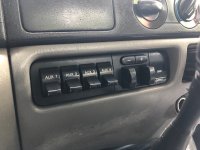
My 05 F350 has a factory installed electronic brake controller, it doesn’t have sway control but it does integrate ABS into the trailer, so when the brakes lock up, it surges the truck and trailers brakes, supposedly for faster and shorter stops. IMG_1302.JPG

Note* the AUX 1-4 is switches for lights, 1 & 2 are for work lights on the bed. To the right of those switches is the brake controller. The Output screen will display a number of 1-14 how hard the brakes are set and being applied.

I’m kinda mad our trailers don’t have parking brakes, that would be a great feature but with the salt they drop around here during the winter, it would seize up in no time. You can’t even get people around here to adjust or grease anything, no way people here would keep up on more maintenance.

It’s not uncommon to see a trailer axle pouring smoke from lack of grease in the hubs. We even have ez lube axles, just pull off a rubber center cap and grease away, no packing bearings or anything.

On this side of the pond we are limited in a few ways, the tow vehicle has its limitations of what it can haul without trailer (GVW (Gross Vehicle Weight)) and trailer is rated also. Combined GVW can’t exceed 26,001lbs, if it does you have to take classes, be tested and obtain a Class A license (commercial in most states) after you have a Class A license you can drive tractor trailers if you want up to 80,000lbs.

For farm use, I can drive a tractor trailer, only exception. No CDL requirements on Farm Use rigs. At least not here in Ohio.

My truck has a GVW of 13,000lbs, truck prob weighs 7k no more than 8k, leaves me with 5-6k of payload, truck and cargo (people and fuel included) can not exceed 13,000lbs. My truck can haul 13,300lbs conventional but to stay under 26,001lbs I can only hook a 13k trailer up, we don’t have 13k rated trailers so I would have to buy a 14k trailer and have the sticker changed to 10k.

Ford says my trucks total combined should not exceed 20,500lbs. Truck is 7-8k so that leaves around 13,300lbs being towed if the truck is basically empty.

Now if I have to pull off to a weigh station or get stopped by a police officer with scales, if my load is over the GVW I get a ticket. So if I put 13,000lbs on a 14k trailer that I had them put 10k stickers on, I get a ticket for being overweight on axles even know I’m within the equipments factory rating, they go by what the sticker says, if they can’t read the sticker they go off the tire rating.
IMG_1320.JPGIMG_1337.JPG

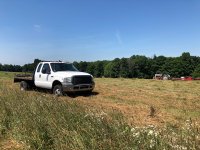
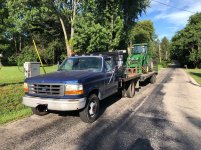
White 05 4x4 dually has a GVW of 13k, blue 1995 2wd dually is 10k, both F350. Also had a 1990 f350 2wd SRW with a GVW of 8800lbs.

IMG_9234.JPG

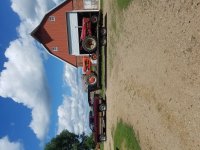
Each round bale is around 700lbs, 11 bales total.
 
Last edited:
   / Your towing rigs and trailers #3,006  
As far as into Anti Sway features, newer trucks come fitted with a Anti Sway feature to use when towing trailers. The system detects whenever the trailer tries to sway and send info to actuate the front brakes independently of each other to counteract the sway movement.

Apparently, there is also a Electronic Trailer Stabiliser kit that can be fitted to the trailers over here. A bit on the expensive side though.

It seems like it has a electronic module with a sensor reading the ground speed (?) mounted in the back of the trailer, and some sort of electronic device that actuates on the trailer brakes.

It will detect when the trailer sways and will try to correct the movement.

Anyway, there is a video on this website about it.

Electronic Trailer Stabiliser
 
   / Your towing rigs and trailers #3,007  
The max GVW that a vehicle can have here is 7700 lbs and the max gross weight of a trailer is also 7700 lbs. This is what a regular driving license allows to drive without needing to get the CDL and a real truck with all that tachograph stuff to deal and have inspected every two years and paying a lot of money to maintain.

Here the situation I had before getting the trailer. I had this Mitsubishi Canter truck with dual tires in the back that I used to move all the machinery before I realize that I was so overloaded that weights 5500 lbs, the max GVW is 7700 lbs, so I could only load 2200 lbs which is nothing for a dually.

But if the truck was registered in the truck category with a tachograph fitted, it would have a 12000 lbs GVW, which would allow to load 6500 lbs. Again, I would need to get the CDL and would have brought way more expenses. I only used about 10 times a year. Same happens with the trailer right now. I had to sell it to get this 4x4 truck and the trailer.

Here is a picture to get the idea. The truck is probably the size of one of your pickup trucks. The box is 11.5 feet long by 6.5 wide. There also longer and wider boxes but the with small cab that takes 3 people instead of 6 like this one.

9gbzJYRl.jpg


Anyway, having 13000 lbs GVW available over here without the CDL would be just a dream. Would be so useful for small companies that don't really need to have a real truck and pay the extra money to a truck driver with CDL.
 
   / Your towing rigs and trailers #3,008  
As far as the 'push' when beginning deceleration, the mechanics of surge brakes is that they are activated by a system in the tongue that is compressed as the tow vehicle's speed slows compared to the trailer speed. While there is a brief time delay between the activation of the truck's brakes and the trailer's in reality it is pretty small because as soon as the trailer begins pushing on the truck the brakes are activated. So there isn't really a 'push situation'.

However, the surge brakes are only engaged proportionally to the differential between the truck and trailer. That means that in slippery conditions surge brakes are not as effective as electric brakes because the truck can't generate much deceleration so the trailer doesn't 'get the message' to slow as fast as it should (i.e. it applies brakes less forcefully than the driver of the truck is actually pressing on the brake pedal because the truck's wheels are slipping. I dislike surge brakes in the winter for that reason.

As you noted in your last paragraph, surge brakes can't be activated separately so you can't use them for trailer sway or as a way to 'pull down' the vehicle combination for instance when you're going down a slippery steeply sloped road (think down a mountain road). Strike two for surge brakes in the winter.

When backing up I thought surge brakes had some means to not activate in reverse? I think it is related to the direction of rotation of the wheels, so it makes sense that you have to get the trailer moving backwards a bit before it releases.

Rob

Good points about Winter - wouldn't be a good choice for a big all-season ATV trailer, or skidoo trailer.

Other than Uhaul for the rental market, mostly I've come across surge on boat trailers. I know someone who used to haul a sailboat to Florida for the Winter, but that's hitting the road before snowfall...

Rgds, D.
 
   / Your towing rigs and trailers #3,009  
I知 kinda mad our trailers don稚 have parking brakes, that would be a great feature but with the salt they drop around here during the winter, it would seize up in no time. You can稚 even get people around here to adjust or grease anything, no way people here would keep up on more maintenance.

Itç—´ not uncommon to see a trailer axle pouring smoke from lack of grease in the hubs. We even have ez lube axles, just pull off a rubber center cap and grease away, no packing bearings or anything.

I like the parking brake feature, but was thinking the same thing re. adjusting the cables and keeping pivots lubed..... most people here confuse Low Maintenance with No Maintenance.....

Sometimes people go too far the other way..... the add-on EZ lube dust caps can create problems (back end incumbent seal is not designed to deal with pressurized grease)..... old travel trailer I bought with them on it had 3 of 4 brakes contaminated with grease, a LOT of grease. Mechanically the brake assemblies were in great shape (very little wear ! :cool:), but I just replaced all 4 assemblies instead of trying to de-grease - not worth the risk re. diminished performance. Those EZ lubers can work OK, so long as appropriate minimal grease gets added vs. mileage run.
Rgds, D.
 
   / Your towing rigs and trailers #3,010  
The max GVW that a vehicle can have here is 7700 lbs and the max gross weight of a trailer is also 7700 lbs. This is what a regular driving license allows to drive without needing to get the CDL and a real truck with all that tachograph stuff to deal and have inspected every two years and paying a lot of money to maintain.

Anyway, having 13000 lbs GVW available over here without the CDL would be just a dream. Would be so useful for small companies that don't really need to have a real truck and pay the extra money to a truck driver with CDL.

Limit here is 10k# for CDL. But, well below that (basically starting with any dual axle utility trailer), the trailer can be targeted for commercial (annual) safeties.

Need Class A or 1 here to tow 10k# plus. Modern 1 ton pickups here can easily tow 15k# or more, so some jurisdictions now have a Restricted Class A - allows driver certification for the tow-weight, but does away with the air-brake endorsement requirement as pickups run hydraulic brakes.

Some States/Provinces have more or less extensive regs.... but in many areas, if you are not going far, the simplest legal way to tow Farm items is on a low-speed trailer (40km/hr or so) with an orange SMV sign on back.

Rgds, D.
 
   / Your towing rigs and trailers #3,011  
Surge brakes are popular on boats since you don稚 have to worry about dunking the electronics. I think you have to get out and do something like insert a pin to lock out the surge brakes.
 
   / Your towing rigs and trailers #3,012  
Correct, as stated above!
My boat has a pin you have to put in to back up in certain situations. It locks out the brakes. I have to use it every time I back in my drive.

There used to be a few companies that made brake kits that tied into your master cylinder and the trailer brake pressure matched the exact pressure applied to the truck. They were great but expensive and a bit more complicated to install.

I’ve had several top end inertia brake controllers and at times they have all had limitations. FWIW.
 
   / Your towing rigs and trailers #3,013  
Surge brakes are popular on boats since you don稚 have to worry about dunking the electronics. I think you have to get out and do something like insert a pin to lock out the surge brakes.
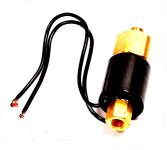
Some also make a solenoid that will tie into the reverse lights so it disables the brakes when in reverse.

Aaron Z
 
   / Your towing rigs and trailers #3,014  
Man that would be slick, my boats an 06 not sure if they made that option then. It doesn’t sound like much but it’s a pain to get out and get back there to put the pin in, then if there is any pressure (like the boat is uphill pushing on the truck) it doesn’t line up.

Thanks for the info, course I’ve been told I’ll never get another boat, lol. But if I ever do I will ask about it.
 
   / Your towing rigs and trailers #3,015  
Man that would be slick, my boats an 06 not sure if they made that option then. It doesn稚 sound like much but it痴 a pain to get out and get back there to put the pin in, then if there is any pressure (like the boat is uphill pushing on the truck) it doesn稚 line up.

Thanks for the info, course I致e been told I値l never get another boat, lol. But if I ever do I will ask about it.
Looks like its just an addon that goes behind the surge coupler: Amazon.com: Trailer Brake Electric Reverse Lock Out Solenoid: Automotive
attachment.php


Aaron Z
 

Attachments

  • 519lWFXNhkL._SL500_.jpg
    519lWFXNhkL._SL500_.jpg
    20.3 KB · Views: 681
   / Your towing rigs and trailers #3,017  
I think all boat trailers made in the last 10 years (at least) will have the reverse lockout valve, but I know quite a few people who don't have the right 5-pin connector on their tow vehicle to pass along the reverse light signal. So that can be a minor complication. If you have a typical 7-pin round connector, that should be carrying reverse and you can get an adapter to go from 7-pin to 5-pin. If you only have a 4-pin on the tow vehicle, or had 7-pin with no adapter, you're out of luck....
 
   / Your towing rigs and trailers #3,018  
It's weird to me that you folks have trailers that have issues when backing them up. I've used various 10K equipment trailers from places I've rented bobcats from in past years (4 or 5 in the past 10 years) and they all had surge brakes and I had zero problems backing them up anywhere. My dad also had a big old Larson inboard/outboard boat back in the 70's that had a trailer with surge brakes and he never did anything special to back it up. Admittedly I don't have tons of experience with trailers with surge brakes but given what I know I'm surprised.

Rob
 
   / Your towing rigs and trailers #3,019  
I have a steep drive to back up when storing the trailers... I was not possible with the surge brakes without locking them out... then no issues.

Moving around on the flat was never a problem.
 

Tractor & Equipment Auctions

2021 SANY SY365C9C5K (A58214)
2021 SANY...
2018 Nissan Versa Sedan (A59231)
2018 Nissan Versa...
UNUSED 89" LAND PLANE (A52706)
UNUSED 89" LAND...
2003 McCormick XTX 185 XtraSpeed Tractor (A56438)
2003 McCormick XTX...
2019 CUSHMAN HAULER PRO ELECTRIC GOLF CART (A58375)
2019 CUSHMAN...
Crown RM6025-45 4,500 LB Stand-On Electric Forklift (A59228)
Crown RM6025-45...
 
Top