what is this ?

/ what is this ? #1  

fxdp

Member
Joined
Jun 19, 2013
Messages
29
Location
nobody,nowhere
Tractor
case/ingersoll 6018
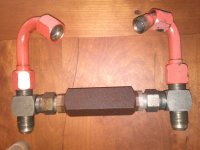
fitting.jpg so im told this is a rare fitting that alows more than one attachment to be used at once ??? huh ? :confused: was told to post it here so hydrive can see it .....hope i dont stump him :rolleyes:
 
/ what is this ? #2  
View attachment 349631 so im told this is a rare fitting that alows more than one attachment to be used at once ??? huh ? :confused: was told to post it here so hydrive can see it .....hope i dont stump him :rolleyes:

OK.... I have looked at it. But I have never seen one before. Therefore, I am stumped.

It appears to be a one-way valve of some kind. It could be a check valve or it could be a relief valve but most reliefs are adjustable. Providing just a single photo isn't very fair if there is a difference in the appearance of the parts on the opposite side. Based on what I see, the alleged description does not jive. The only two attachments that get used at the same time are the hydraulic deck and the Hydra-Vac/Bagger and that only happens on the 3100/4100 Series. None of the other series use a hydraulic deck or for that matter, anything hydraulic that is expected to run at the same time another hydraulic attachment is in use. Even then, the deck and the vac motors are plumbed in series with one another and such a valve is not needed. Just because the paint appears to be Case Power Red does not automatically make those parts as coming from Winneconne. This could be from Racine and have nothing to do with the OPE division.

Is this an item that you own? If so, how did you come by it?
 
/ what is this ? #3  
This symbol is stamped on the valve

Symbol for a Check Valve (Schematic Symbol) -check valve symbol-free flow one direction, blocked flow in other direction.
 

Attachments

  • check valve.gif
    check valve.gif
    184 bytes · Views: 396
/ what is this ? #4  
This symbol is stamped on the valve

Symbol for a Check Valve (Schematic Symbol) -check valve symbol-free flow one direction, blocked flow in other direction.


Thanks J_J, I did not notice that symbol until I read your post and went back for another look. That confirms my previous statement that it looks like a one-way valve. Unfortunately, knowing that it is a one-way valve does not assist me in determining which model of Case or Ingersoll tractor it would have been used on or exactly where in the hydraulic system such a valve would be employed. The inference here is that it is somehow tied into the rear hydraulic PTO valve because all hydraulic implements are powered by that valve. The other inference that this setup will allow TWO hydraulically powered attachments to be used simultaneously also does not compute. I think that someone is trying to yank my chain.:laughing::laughing::laughing::laughing::laughing:
 
/ what is this ?
  • Thread Starter
#5  
well the story goes i bought a 54 plow blade - some plastic case wheel weights (that turn out dont fit) and during the negotiations the gentlman was good enough to through in this fitting he said it was rare and comes in handy for running 2 attachments - im not sure but believe it came off of a 444 - i placed a call to him for more info as im a total novice with hydrolics so any help would be ...helpful -it does say parker hydrolic valve - and looks to be 1/2" (?) flare fittings on the "bottom" with 2 what looks to be 1/2" (?) flare nuts on the "top" - yea the other side looks the same and it does apear to be oem paint so ,,,hmm
 
/ what is this ?
  • Thread Starter
#6  
got this on an other thread >>> G'day they are commonly used as stated in a motor circuit and are there to allow the motor to run down when you release the control lever so the pump doesn't have a sudden stop much nicer on the motor,seals and lines


Jon
 
/ what is this ?
  • Thread Starter
#7  
got this from wdchyd >>>>Yes, usually this arrangement is for mounting directly on a hyd motor to prevent the motor from reversing direction
 
/ what is this ? #8  
What you are NOW explaining is a far cry from what you originally posted. I am not faulting you in any way because you are simply relaying what you were told. So let me put this into perspective for you and anyone else reading this thread.


Case and Ingersoll developed certain attachments that used hydraulic motors spinning at a fairly high RPM to power things such as a three-bladed 48" finishing mower, a 48" rough cut bush hog mower, a 48" snowcaster, a 48" mid-mount mower deck, a chipper shredder, a 3 bag Hydra-Vac vacuum and a vacuum that spit all of the debris leaving the mower deck chute, directly into a dump trailer being towed behind the tractor.

Several of the motors used to power these attachments were having problems with blowing the front shaft seal. initially, they switched over to motors that were equipped with a third hose known as a case-drain line. This line allowed oil that found its way close to the front bearing to leave the motor and return to the low pressure side of the hydraulic system. But that wasn't the total answer needed. Many of these attachments are difficult to get rotating initially and also difficult to bring to a stop when the operator wants to stop using them. Keep in mind the PTO valve that supplies oil to these attachments is the same as the light switch in your house. It is either 100 percent ON or 100 percent OFF. There is no gradual metering of the oil like you find when using the Travel Control Lever.

All of these devices have parts that spin and those parts represent a considerable mass. The flywheel in a standard shift car is a heavy item and once it is rotating, it wants to keep on rotating. You don't get to instantly start or stop a flywheel spinning and therein lies the problem. If the tractor operator has the throttle at full engine speed, then the hydraulic pump is putting out 8 to 10 gallons of oil per minute. All of that flow goes to the rear PTO valve first before going to the Travel/Lift valve. If the operator opens the PTO valve, then he instantly sends 100 percent of that oil to whatever implement that is hooked to it. The hydraulic motor is now hit with 2200 PSI of oil pressure and it wants to spin up to full speed in about a second but while the motor by itself could handle this, it also has to spin up a heavy fan/impeller in the vacuum or three blades and spindles in a mower deck or the auger in the snowcaster.

Alternatively, when the operator shuts the PTO valve, then the flow of oil also stops going to the motor. The problem is, motors and pumps are nearly identical in design. The rotating mass being spun by the motor, now wants to keep that motor spinning and so that mass converts the motor into a pump. But with the PTO valve closed, there is nowhere for the oil inside of the motor to go because both lines connected to the motor are blocked 100 percent. This is known as a "hydraulic lock". Case used hydraulic lock on the 150/190 tractors and the 1967 155/195 models as a method to "brake" the tractor's movement. When you stepped on the brake pedal, a rod actuated a valve that slowly closed off the motor ports preventing oil from entering or leaving the motor. If the pedal was fully depressed, the rear wheel would lock up and skid to a stop.

Ingersoll worked with an Italian hydraulics firm to come up with a special motor that had valving inside which would provide both "soft start" and "soft stop". When the PTO valve was opened or closed, the internal valves would open up at a specific pressure and allow the oil to bypass the motor until it either spun up to speed or spun back down. Presumably, the assembly shown in the photo is attempting to provide a similar oil bypass for the motor. As I see it, that is a one-way valve and it will only allow oil to pass on either the start or the stop but not both. However, it may be that Case or Ingersoll got the valve manufacturer to develop a valve that would work in both directions. This I cannot say to a certainty because I have never seen this valve being discussed on any forum I have been on since 2004. Is it rare? Well, I guess you could say that it is for the reasons I just stated.

If anything, I am surprised that this valve has not surfaced previously on a Hydra-Vac, Hydra-Bagger or a Chipper/Shredder. This must have been used prior to the 3100/4100 All Hydraulic Series being introduce in the early 90's because Bill Parkin (Chief Engineer for Ingersoll) told me that the hydraulic decks and hydraulic snowcasters all used the proprietary soft start/soft stop motors.

So....wdchyd has it wrong... in my opinion. I agree that the arrangement is for mounting directly on a hydraulic motor but I disagree that it was used to prevent the motor from reversing. It was used to prevent the motor from self-destructing.

The reply from Jon is a far more accurate description.

Finally, it has nothing whatsoever to do with running two attachments at the same time.

What I don't understand is WHY this valve was removed from whatever attachment it was originally mounted on. The only reason I can think of is that the motor on that attachment failed and the later proprietary motor with the internal valving was installed, thus negating the need for what is shown in the photo.

OEM Case plastic wheel weights came in two sizes. The K-8 weights were for the 12 inch rims used on the 200/3000/3100 Lo Pro models. The K-10 weights were used on the 400/4000/4100/4200 Hi Wheel models. The K-8's have 5 holes in the middle and the K-10's have 6 holes that line up with the wheel bolts.
 
/ what is this ?
  • Thread Starter
#9  
1-so it is thought that this would be mounted to the motor of an attachment to help prevent damage on older units due to inherent abrupt stop and or start - we arent nessasarily sure if this has been fabricated by an individual or if it is an oem part - have i received your (wicked awesome) information correctly ?
 
/ what is this ? #10  
Yes, you have understood perfectly. In my opinion, this was a limited edition OEM fix because very few hydraulics shops are equipped to make up steel lines like those. I don't know what you can do with it other than hang it on the wall of your garage as a conversation piece.:laughing::laughing:
 
/ what is this ? #11  
That valve is simply a check valve similar to these.

Surplus Center

It can be used in many different configurations.
 
/ what is this ? #12  
I neither agree nor disagree.

However, implements that use motors are connected directly to a hydraulic system that is governed by the relief valve in the rear PTO and it is set at 2200 PSI. If the valve in question cracks open at a pressure lower than the relief, then the motor cannot develop all the torque it should because the oil will bypass. Secondly, there is a dual issue here with both start and stop and in order for this "fix" to be truly effective, it would have to flow oil in both directions but at a pressure higher than the relief setting. If I am right, then this valve would be a custom made proprietary unit, not available from any source other than Case.
 
/ what is this ? #13  
hydriv,

Assuming it's a one-way check valve, it's only going to work if it's oriented to flow from the return line to the supply line, or in other words, from the low pressure side to the high pressure side. So it's going to give a motor a "coast down" or "soft stop" behavior. Used in this way, the motor will develop all the torque it should because the oil will NOT bypass from low side to high side while the operator is sending full pressure fluid down the high side. It's only going to bypass when the operator shuts off the flow but the motor's inertia tries to make the fluid keep going around.

Of course if that's the case then it won't also provide "soft start" behavior.

xtn
 
/ what is this ? #14  
A check valve is not a relief valve.

They usually open at low pressure, say 5 psi to about 65 psi.

Pressure is not sent , it is developed by the load work against the flow.
 
/ what is this ? #15  
Thanks J_J. I do understand your specific statements.

But a check needn't have a high pressure opening point to serve the purpose I described. As long as there is some small load at the motor, the supply side will have a higher pressure than the return side, holding the check closed. If there is no load, it won't matter if the check valve opens a bit. If the operator stops sending fluid to the motor, and the motor and whatever it is turning has inertia, then the supply line leading to the motor is going to be sucked on by the motor and the check is going to open, essentially giving the coasting motor a little loop of hose for it to pump fluid around until it slows to a stop.

I think. :)

xtn
 
/ what is this ?
  • Thread Starter
#16  
ebay item number 121144596180 looks to be a close match to this valve its made by parker possibly to oem spec ?
 
/ what is this ? #17  
Thanks to both J_J and xtn for chiming in on this issue.

As I said previously, the proprietary motors ordered by Case/Ingersoll were designed with valves that would give both a soft start and a soft stop. This prevented damage to the two drive belts that powered the three-bladed mower decks and the single belt that powered the snowcaster. The hydraulically powered chipper/shredder was also belt powered and the chipper had a fairly hefty mass that spun pretty fast. The same could be said about the fan/impeller on the vacuum units because the impeller is mounted directly to the motor shaft. Everything spit out by the mower blades is sucked into the vac unit before being blown into bags or the trailer.

The problem right now is that Eastman is apparently no longer interested in the parts end of the Ingersoll brand. Whether the current recipient of the parts business is will to invest a substantial amount of cash into ordering a quantity of those motors seems doubtful. This is going to leave owners of the 3100/4100 AH tractors in peril if they can no longer buy a new motor or have their existing motor repaired. There has been much discussion about trying to find a suitable substitute motor and then figure out a way to provide the soft start/stop feature. Trying to do it with 1/2 hoses is an obvious pain. Knowing what valve to use is also a mystery. Knowing whether it is possible to use two valves is also a mystery. Essentially you seem to be saying that there is somewhat of a "pilot" aspect to the valve shown in the picture. That is something I was not aware of. Any further information you can supply would be very much appreciated.
 
/ what is this ?
  • Thread Starter
#18  
parker c820s 20mk 5000psi thats the best info i can take off this unit - mr hydriv if your interested in having this item, feel free to send me a private and its yours will mail it out to you np
 

Marketplace Items

2025 SDLANCH IRGC40 Two-Seat Electric Tricycle (A64194)
2025 SDLANCH...
New/Unused Wolverine Quick Attach Hydraulic Concrete Chute (A65583)
New/Unused...
2023 NISSAN ALTIMA SEDAN (A59914)
2023 NISSAN ALTIMA...
2022 EZ-GO ELITE ELECTRIC GOLF CART (A63276)
2022 EZ-GO ELITE...
2013 Ford F550 Bucket Truck w/ Jib (A62613)
2013 Ford F550...
2012 International 4300 Reefer Truck (A63689)
2012 International...
 
Top