weld grinding tips needed

/ weld grinding tips needed #101  
Smooth and easy sounds good to a newbie...what's the first three rods I should buy?

Everyone has their own opinion. Here's mine. PS: I'm a n00b, so take my opinion for what it's worth.

When I first started learning, I started with 6011 because I read that it was a good bread-and-butter rod with excellent penetration and ability to burn through less than perfectly clean surfaces. My welds looked like junk. I had a box of 7018 that someone threw in with a bunch of other stuff I bought, but I stayed away from it because, being a low-hydrogen rod, it needs to be kept in a rod oven, and I don't have one of those. Later, at a welding workshop, someone said, "Ah. Heck with that. Just burn some 7018." Lo and behold, my welds got about 1000 times better. Something about the way 7018 burns means that I'm more able to be successful with it than 6011. With 6011, the slag is hard to clean off and there are usually slag inclusions in the bead. With 7018, the slag usually peels off easily and there are no inclusions.

What about 7018 being a low-hydrogen rod and needing to be stored in a rod oven? It's true. And if you were doing code work, you would need to follow that. But I have heard folks talk of being on large construction projects burning 7018 all day, not a rod oven in sight. Apparently, 7018 still does an okay job if it hasn't been stored in an oven. Not as good a job as if it had been, but still plenty good for lots of stuff. On top of that, if you can get a quality weld with 7018 and a junk weld with 6011, which do you think is going to be stronger, low-hydrogen or not?

Maybe somebody here can link to results of a bend test between 7018 out of an oven and 7018 stored on a shelf. I bet either of them will beat, for example, 6013.

It's true that 7018 has the annoying tendency to form a slag covering over the electrode tip every single time you stop welding. I keep a flat file handy and use it to scrub off the coating every time I restart. This is a real PITA when tacking up, so I usually use 7014 or even 6013 (whatever I have laying around) for tacking. When I'm actually working, I'll typically burn a quarter to a half or even a whole rod at a time, so scraping the tip isn't much of a hassle. If I was doing production stuff, where every minute mattered, I might feel differently.

I mostly run 7018 now, but 7014 is also relatively easy to run. As others have pointed out, you can drag 7014, meaning you touch the tip to the work surface. This avoids having to manage the arc gap, and gives you one less thing to concentrate on when learning. You can drag 7018 as well, but the weld will be colder and you may not get the results you want. 6013 is another common rod. It's relatively easy to produce good-looking welds with 6013, but it's also relatively easy to produce welds that look good but actually have a tunnel of slag in them, or that have poor penetration. So I wouldn't recommend 6013 for a beginner.

Eventually, I plan to really spend some time focusing on 6011 and try to figure out what I'm doing wrong with it, because IMO if there are two rods a weldor should know how to use, it's 7018 and 6011. But for the time being, I still have a lot to learn on 7018. It's said that a beginner should pick one rod and really stick to it until they get some skill. Switching up rods while you're learning means that some of the things you learned on one rod won't transfer over. For example, with 6011, you typically use a whip motion or a circle motion, whereas with 7018, you typically just move the electrode along smoothly, without backing up. Going back and forth between them while you're learning might just confuse you. For me, I'm going to stick with 7018 until I feel I've got a handle on it, then start branching out. I feel like 7018 is a simple enough rod to run that I can start to focus on seeing what the puddle is doing and how what I do affects the bead, as opposed to just trying to keep everything together. By way of analogy, when a person goes to racing school, they don't start them out on a 500 HP monster. The beginner wouldn't even be able to get that car off the line without stalling it, never mind keep it on the track. You start racing with a little four-banger and learn the basics, then move up.

I have heard some folks say that they find 7018 hard to run. I guess it goes to show that each person has different proclivities. Also, as Shield Arc points out, different brands of rod burn differently in different machines. The bottom line, I would say, is find something that you have some success with and stick with it until you get your fundamentals down. When you can consistently produce good welds with your start-up rod, then you should start thinking about branching out to other rods.

That's my two cents! Happy welding!
 
/ weld grinding tips needed #102  
Switches, fans, and diodes are common issues with transformers. Though relatively easy to repair, they aren't cheap, and if you have to pay someone a hundred dollar bill to fix it, then the cost benefit is lost.

Mark makes a good point. I got my welder for $100. I wanted the guy to test it for me, but he didn't even have a 220v outlet. He said he had just taken it from a buddy in trade, and then never gotten into welding. I figured for $100 I would give it a shot. One of the diodes ended up being bad, so the DC output didn't work at first. Fortunately, I can solder, so I was able to replace the diodes myself. I also had to replace the fan. At this point, I've got $200 in the unit, and still consider myself to be ahead of the game. A brand new Lincoln with comparable output runs around $500 and has tapped output instead of infinitely adjustable. But if I had to run it to a repair center for each of those repairs, I wouldn't be so happy.
 
/ weld grinding tips needed
  • Thread Starter
#103  
boy am I making notes like crazy....thanks so much for the helpful hints.
I'm making my list and checking it twice...:thumbsup:
 
/ weld grinding tips needed #104  
boy am I making notes like crazy....thanks so much for the helpful hints.
I'm making my list and checking it twice...:thumbsup:

Too bad your welding book hasn't arrived yet. You might check the local library for a copy.
 
/ weld grinding tips needed #105  
Everyone has their own opinion. Here's mine. PS: I'm a n00b, so take my opinion for what it's worth.


What about 7018 being a low-hydrogen rod and needing to be stored in a rod oven? It's true. And if you were doing code work, you would need to follow that. But I have heard folks talk of being on large construction projects burning 7018 all day, not a rod oven in sight. Apparently, 7018 still does an okay job if it hasn't been stored in an oven.
I have heard some folks say that they find 7018 hard to run. I!
There are some types of low hydrogen with suffix designation LM as in E7018 LM (low Moisture absorption) that can be out of the oven for up to 8 hours without absorbing too much moisture,BUT they start the day coming from a 350F rod oven where they have been dried for at least 12 hours. They do run smoother when heated but that is not the dangerous part of welding with a wet rod. The problem is called hydrogen embrittlement and unfortunately the danger is that it caused underbead cracking where the LH rod fuses to the base metal and may occur hours or weeks after the weld is made. It usually wont be evident visually until the weld fails catastrophically. For this reason they should always be dried even if it is just sticking the rod to heat it up till the moisture boils out as steam and this only takes a few seconds on each rod. That is what I did prior to getting my electrode oven. I kept them in a wooden box under a 100 watt light bulb but it didn't keep them very dry. Other folks have said that they put them in the kitchen oven to dry which would also work if you plan ahead and wife doesn't catch you.

E 7018 rods are possibly the easiest rod to run next to a 7014. It pretty much will run a pretty bead by just striking an arc and laying the holder down and letting it burn. Try it, just put a few twist in the welding lead so it puts down pressure on the rod, strike an arc and just lay the holder down. Three things makes a weld look bad: varying arc length (LH rods require a very short arc length which is why they are harder to weld with on AC, uneven travel speed i.e. speeding up and slowing down, or uneven weave width or all combined.
 
/ weld grinding tips needed #106  
There are some types of low hydrogen with suffix designation LM as in E7018 LM (low Moisture absorption) that can be out of the oven for up to 8 hours without absorbing too much moisture,BUT they start the day coming from a 350F rod oven where they have been dried for at least 12 hours. They do run smoother when heated but that is not the dangerous part of welding with a wet rod. The problem is called hydrogen embrittlement and unfortunately the danger is that it caused underbead cracking where the LH rod fuses to the base metal and may occur hours or weeks after the weld is made. It usually wont be evident visually until the weld fails catastrophically. For this reason they should always be dried even if it is just sticking the rod to heat it up till the moisture boils out as steam and this only takes a few seconds on each rod. That is what I did prior to getting my electrode oven. I kept them in a wooden box under a 100 watt light bulb but it didn't keep them very dry. Other folks have said that they put them in the kitchen oven to dry which would also work if you plan ahead and wife doesn't catch you.

I have read some heated discussions about 7018. Personally, I'm way too much of a novice to have an opinion of my own, so I just repeat what those who are wiser than myself say. And, Gary, let me acknowledge straight away that your contributions here on TBN put you definitively in the category of "wiser than myself," but you're not the only one I've heard talk on the topic. Here's some thoughts that I've had on the topic:

If exposure to moisture in the air is the issue, why are many 7018 rods shipped in non-airtight packages, without dessicant? Perhaps it's assumed that the purchaser will recondition them before use? Okay, fair enough.

My understanding is that the issue is not so much moisture itself getting into the rod, but chemical changes that occur in the flux in the presence of moisture. I've heard it said that heating the rod to drive out moisture (e.g. baking at 200 degrees for a long time) doesn't actually reverse those chemical changes. AWS says reconditioning requires temperature of 500-800 degrees for at least 2 hours. This seems to me to put the lie to the idea that one can fix a 7018 rod by sticking it until it steams. What do you think?

Finally: as I understand it, the point of 7018 is to avoid hydrogen embrittlement that can occur with other rods. But if other rods already incur hydrogen embrittlement, then is it the case that a 7018 exposed to the environment is no worse than any other (non-low-hydrogen) rod?

I'd love to hear your perpsective. Like I said, I'm still soaking up all the information I can get.
 
/ weld grinding tips needed #107  
I am also interested in what other older and wiser heads have to say about the 7018 storage.. We need someone to test weld up some coupons (welded with non oven stored rods) and break them right away, and them break some others a couple of months later to see if there is a difference.. All I know is 7108 makes good looking strong looking welds. but how well they last from hydrogen embrittlement I sure don't know.. My 7018 stays in an airtight canister but that is all, no rod oven here. I have been happy so far with the quality of the welds I have gotten with 7018, like Joshua says, just using 7018 can make your welding look a bunch better in 5 minutes over using 6011. Maybe this is a good project for Chucke2009??

James K0UA
 
/ weld grinding tips needed #108  
As I see it, here is a possible test protocol:

1. Using fresh-out-of-the box 7018, weld two coupons.

2. Recondition the fresh-out-of-the-box 7018 in an oven per AWS guidelines. Weld two coupons. This will help determine if the conditions between manufacturing and opening of the package have an effect.

Immediately bend-test one of each of the (1, 2) coupons. Mark the others and set them aside.

3. Leave the 7018 on an un-heated shelf for some time (perhaps 1-3 months). Weld two coupons.

4. Recondition the shelved 7018 in an oven per AWS guidelines. Weld two coupons.

Immediately bend-test one of each of the (3, 4) coupons, as well as bend-testing the other two of the (1, 2) coupons.

Wait some time (perhaps 1-3 months). Bend-test the other two of the (3, 4) coupons.

This protocol tests for strength of the weld both immediately following the weld and some time later, to allow for hydrogen embrittlement to come into play. What do y'all think?

The only thing I can think of that might be questionable is that the welds are not under any sort of stress while they are waiting. In other words, maybe the hydrogen embrittlement would only really come into play if the coupons were being banged around for a couple months, giving cracks time to form. Maybe the immediate stress of a bend test wouldn't allow the effect of hydrogen embrittlement to manifest. I dunno.

EDIT TO ADD: And I would be happy to perform this testing, except for a few things. First, I'm a beginner welder, so my skill level may factor in to the tests, although I daresay I can put a tolerable bead down a coupon. Second, I don't have any apparatus to perform the bend testing. Third, I don't have a rod oven, but my kitchen oven does go up to 550 degrees, and my wood stove can be coaxed into hitting a surface temp of 600 degrees, so maybe that'd be acceptable.
 
/ weld grinding tips needed #109  
As I see it, here is a possible test protocol:

1. Using fresh-out-of-the box 7018, weld two coupons.

2. Recondition the fresh-out-of-the-box 7018 in an oven per AWS guidelines. Weld two coupons. This will help determine if the conditions between manufacturing and opening of the package have an effect.

Immediately bend-test one of each of the (1, 2) coupons. Mark the others and set them aside.

3. Leave the 7018 on an un-heated shelf for some time (perhaps 1-3 months). Weld two coupons.

4. Recondition the shelved 7018 in an oven per AWS guidelines. Weld two coupons.

Immediately bend-test one of each of the (3, 4) coupons, as well as bend-testing the other two of the (1, 2) coupons.

Wait some time (perhaps 1-3 months). Bend-test the other two of the (3, 4) coupons.

This protocol tests for strength of the weld both immediately following the weld and some time later, to allow for hydrogen embrittlement to come into play. What do y'all think?

The only thing I can think of that might be questionable is that the welds are not under any sort of stress while they are waiting. In other words, maybe the hydrogen embrittlement would only really come into play if the coupons were being banged around for a couple months, giving cracks time to form. Maybe the immediate stress of a bend test wouldn't allow the effect of hydrogen embrittlement to manifest. I dunno.

Somewhere, no doubt buried in some obscure materials science journal, someone has probably already done that experiment. I looked once upon a time for some science behind welding and found even places like MIT do work in this field.
 
/ weld grinding tips needed
  • Thread Starter
#110  
welding coupons are typically small, pre-cut pieces of metal (roughly the size and shape of a "coupon") that are handy for practicing welds. Some welding workshops will have piles of these on which to practice.

sure didn't take you guys long to go way over my head. Funny word, has so many totally different meanings.
So a coupon is a small weld sample that you provide for inspection. And there are super coupons too...
Test Materials ( Weld Coupons)

is Tractor Supply competitive on the small steel pieces they sell, or should I be going to a welding supply house where I'll get
my rods? I need cheap practice material. Junk yard? Most stuff is recycled around here but I likely don't know the good hidey holes.
 
/ weld grinding tips needed #111  
is Tractor Supply competitive on the small steel pieces they sell, or should I be going to a welding supply house where I'll get
my rods? I need cheap practice material. Junk yard? Most stuff is recycled around here but I likely don't know the good hidey holes.


TSC, Home Depot, etc... are the most expensive places you can buy metal. Perhaps 2-3x the price of a steel supplier, and 4-6x the price of a scrap yard. You want to find a scrap yard that sells to the public (some only take metal for recycling). The metal will be rusty, but will be sound. Near New Holland, PA, Delaware Valley Scrap looks promising. I would also check Sullivan Scrap.
 
/ weld grinding tips needed
  • Thread Starter
#112  
TSC, Home Depot, etc... are the most expensive places you can buy metal. Perhaps 2-3x the price of a steel supplier, and 4-6x the price of a scrap yard. You want to find a scrap yard that sells to the public (some only take metal for recycling). The metal will be rusty, but will be sound. Near New Holland, PA, Delaware Valley Scrap looks promising. I would also check Sullivan Scrap.

thanks, I had a suspicion... unfortunately I'm finding the locals are recycle only or non-ferrous. I'll keep looking.
Biggest problem I've found going anywhere near a recycle plant is getting a flat tire; I've had that happen to me and it was an expensive and annoying day.
 
/ weld grinding tips needed
  • Thread Starter
#113  
I'm an idiot...my BIL is an excavator and he does p/t work with his equipment moving scrap around with his smaller equipment, since his shop is two doors down from the recycle place. They normally don't sell, but I think some modest application of cash should get me some decent pickings. This was the place I scored over four hundred pounds of marvelously stackable weights that came off an expensive exercise machine. The rest of the machine was a bent mess but those weights were well worth snagging out of there. Now they occupy my weight box on the back of my Gravely while snowblowing and on the front of my Case IH when using a rear implement. All for a sixpack of Heineken...

I'd like to get some plate steel useful for patching things, maybe 1/8 to 1/4 inch thick. I have some extra weights, they are over an inch thick and weigh fifteen pounds. Hmmm, maybe I could weld a couple together for practice; no one is going to see my amateur hour production hidden down in the weight box...:eek:
 
/ weld grinding tips needed
  • Thread Starter
#114  
Too bad your welding book hasn't arrived yet. You might check the local library for a copy.

This has been a first for Amazon with me, never bought a used item from them, and likely never will again. Wrote two inquiries to seller, totally ignored.
If he sent it at all it went book rate, and I think is MIA. Now more than a month after I ordered and a request going in to Amazon for a refund.
Yes, at this rate, I will head to the local library; I send them a donation every year and used to be the President of the little library, so I bet they could find me
that welding book.

Ordering my equipment now, sure had hoped to be reading and studying long before now.
 
/ weld grinding tips needed #115  
This has been a first for Amazon with me, never bought a used item from them, and likely never will again. Wrote two inquiries to seller, totally ignored.
If he sent it at all it went book rate, and I think is MIA. Now more than a month after I ordered and a request going in to Amazon for a refund.
Yes, at this rate, I will head to the local library; I send them a donation every year and used to be the President of the little library, so I bet they could find me
that welding book.

Ordering my equipment now, sure had hoped to be reading and studying long before now.

Make sure you leave feedback for the book seller.
 
/ weld grinding tips needed
  • Thread Starter
#116  
Make sure you leave feedback for the book seller.

Feedback? Oh yeah, he sold three books and two never got delivered. Wonder if he wrapped them in saran wrap, or perhaps it was all a figment of his imagination. Not replying to two
inquiries tells me the whole story. I asked Amazon to ban him.

off to the library I go.
 
/ weld grinding tips needed #117  
I have read some heated discussions about 7018. Personally, I'm way too much of a novice to have an opinion of my own, so I just repeat what those who are wiser than myself say. And, Gary, let me acknowledge straight away that your contributions here on TBN put you definitively in the category of "wiser than myself," but you're not the only one I've heard talk on the topic. Here's some thoughts that I've had on the topic:

If exposure to moisture in the air is the issue, why are many 7018 rods shipped in non-airtight packages, without dessicant? Perhaps it's assumed that the purchaser will recondition them before use? Okay, fair enough.

My understanding is that the issue is not so much moisture itself getting into the rod, but chemical changes that occur in the flux in the presence of moisture. I've heard it said that heating the rod to drive out moisture (e.g. baking at 200 degrees for a long time) doesn't actually reverse those chemical changes. AWS says reconditioning requires temperature of 500-800 degrees for at least 2 hours. This seems to me to put the lie to the idea that one can fix a 7018 rod by sticking it until it steams. What do you think?

Finally: as I understand it, the point of 7018 is to avoid hydrogen embrittlement that can occur with other rods. But if other rods already incur hydrogen embrittlement, then is it the case that a 7018 exposed to the environment is no worse than any other (non-low-hydrogen) rod?

I'd love to hear your perpsective. Like I said, I'm still soaking up all the information I can get.
All welding rods should be in a hermetically sealed container (heavy plastic bag or metal can) I prefer to get 50# cans with no dents and no holes in them rather than buying the little plastic bags from Lowe's etc. I know there isn't any holes in the cans and the likely hood of the plastic bag having a hole in it to allow moisture to accumulate is pretty high.
The problem with hydrogen embrittlement is that it doesn't always occur even with wet rods, it is just a possibility or probability therefore one should always use dry low hydrogen rods. The difference between the 7018 and lets say 6010 is that the coating on the 7018 becomes a part of the weld metal when it is melted as it has iron powder in it where as the 6010 has a cellulose base (paper) that may absorb water but it all bakes out as the rod is burned AND it doesn't mix with the weld metal so there is not much likely hood of hydrogen contamination. This and the way the rods burn, ie. LH rods need to be held to a very short arc length and the molten metal sometimes freezes before the gases can float to the top whereas a 6010 usually has a much longer arc length and the gas bubbles can more easily float out of the weld metal before it solidifies. The probability that underbead cracking from hydrogen embrittlement will or can occur is why we need to take a little bit of care on using the iron powder/low hydrogen type of welding rods. YOU may have no problem at all using them when you just keep them in a plastic box laying on a shelf in your shop, but then again you may AND when the weld does fail from embrittlement, there is not warning, you wont see a crack starting at the edge like a fracture from overloading as the crack starts under the weld so when you see it, it is already in two pieces.
As for shipping in non-air tight containers, they should never be shipped that way and never buy any LH rods that are not at least sealed in a plastic bag. As I said, I buy mine in 50# metal boxes and they are good for years of shelf life as long as the can is not opened or doesn't rust a hole in it from improper storage (store in a dry area) These metal cans are air tight and the empty cans make good rod stub buckets.
Rebaking of LH rods is only allowed to be done 2 times per AWS. I don't know of any chemical changes other than rusting that takes place and you can bake at a lower temperature for longer periods of time and achieve the same results but not at 200F. AWS give guidelines for baking at lower temps than 800F but I don't recall the specifics of it now so I don't want to quote a temp and time. I keep my rods at 350F while in storage so there is not a chance of any moisture in them. In regard to 200F storage, while it may seem hot and dry, remember water doesn't boil till 212F so I would never go less than 250F for storage.
 
/ weld grinding tips needed #118  
Feedback? Oh yeah, he sold three books and two never got delivered. Wonder if he wrapped them in saran wrap, or perhaps it was all a figment of his imagination. Not replying to two
inquiries tells me the whole story. I asked Amazon to ban him.

off to the library I go.

Try this one, also via Amazon but it sounds like a much better established used book dealer than the one you tried the first time: Welding: Principles and Applications by Larry Jeffus - New, Rare & Used Books Online at Alibris Marketplace They sell a lot of older editions. I have the sixth which is pretty up to date (7th is current but $$$). Ten bucks for a sixth edition paperback in good condition is a bargain. Be careful though, this seller ships from both USA and UK so choose one that ships from USA!
 
/ weld grinding tips needed #119  
My ongoing question to this discussion is am I ever going to weld very light gauge steel, "sheet metal", or aluminum. Unlikely.
But I say that now. I'm guessing that when I get a machine, I'll find more uses for it.
Frankly I've been a little hesitant to get one because I didn't want to do crappy work on my own equipment; I really do know my own limitations,
and I like good work.

My 64th birthday is coming up in March so I'm going to go back to studying machines, and yes, I'll check our "local" products.
Hopefully I'm not getting too old to learn...:)

One of the challenges in learning by observation here is that it's almost impossible to see what's going on when someone is welding. Too bright.
So it looks like one has to practice on little pieces and simply learn how feed rate, pressure, amps, whatever, affects the final job.
Kinda like turn it off and see what you've done. Before I do that on my mower deck, I need some confidence in my welding.

But first, and thank you Jim for the nudge, I have to get a welder and just do it.
Nice to have you guys here for a sanity check. Thanks again.

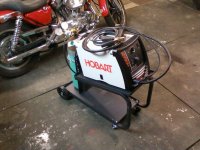
Get yourself a welding helmet(they can be had at tractor supply for about $30 for a cheap hobart with a good size glass) and go watch a welder in action if you want to see an arc in motion. You could get into a decent little MIG setup for under 500 bucks, plus the cost of your gas cylinder...I would recommend if you'll be doing much sheet metal: don't but a flux-core only wire feed machine, they tend to want to burn through. I have a Hobart Handler 140 and I love it... settings are all on the machine(All starting points, you'll have to fine tune a little,) but once you get the hang of the welding thing, it's like riding a bike, it always comes back to you..
Photo-0089.jpg
 
/ weld grinding tips needed
  • Thread Starter
#120  
Got it done...ordered the Everlast 160sth with foot pedal from Mark, and he was very helpful.
Now let's see, when I get it, I plug it in, turn it all the way up, then connect the two leads right? :cool:

Hmmm, July 4th in March.

I have ordered two helmets, one good one (meaning around a hundred bucks) and one cheapo, so my buddy and I can take turns watching the other.
And a couple nice pairs of welding gloves and a nice little pointy gizmo for chipping away at things. I also ordered an inexpensive set of clamps.
When the welder comes in, I'll go shopping for rods, and whatever else I need.

thanks to all for all the good advice. Feel like I'm back in school, taking notes...
 

Marketplace Items

13042tx (A55973)
13042tx (A55973)
1998 INTERNATIONAL 9400 (A58214)
1998 INTERNATIONAL...
2021 SANY SY365C9C5K (A58214)
2021 SANY...
2009 Case CX36B (A60462)
2009 Case CX36B...
2018 BOBCAT E45 EXCAVATOR (A59823)
2018 BOBCAT E45...
CASE INTERNATIONAL 5140 TRACTOR (A52707)
CASE INTERNATIONAL...
 
Top