BRMyers
Platinum Member
OK, I think the OP needs to just get a bucket and rope and get the water out the old fashion way. All this math is hurting my head.
Area of a 2.067" ID pipe = (Pii / 4) x 2.067squared
(3.14 / 4) x 4.27 =
0.785 x 4.27 = 3.354 square inches
Area of a 1.315 OD pipe = (Pii / 4) x 1.315squared
(3.14 / 4) x 1.73 =
0.785 x 1.73 = 1.357 square inches
Volume of 2.067 ID x 100' pipe = 2.067 x 100'
2.067 x 1200" = 2480 cubic inches
Volume of 1.357 OD x 100 pipe = 1.357 x 100'
1.357 x 1200" = 1638.4 cubic inches
Subtract 1638.4 cubic inches from 2480 cubic inches = 841.6 cubic inches.
1 gallon displaces 231 cubic inches
841.6 / 231 = 3.64 gallons
1 gallon weighs 8.34 pounds
3.64 gallons x 8.34 pounds = 30.3576 pounds
Someone double check me, please. I've had some Captain Morgan and Dr. Pepper. :drink:
I ran the number you have on my calculator and came up slightly different, so I rechecked by long multiplication by hand and confirmed what my calculator said - 3.35195 square inches. Then I re-did the calculations using pi to 10 digits and got 3.345871574 but since we started with 3 decimal places for pipe diameter, the result should be 3 also, so 3.346 square inches. I went thru and checked the rest and they're all close enough to what I get, it doesn't matter. I end up with a little over 30 pounds as well.
...
Volume of 2.067 ID x 100' pipe = 2.067 x 100'
2.067 x 1200" = 2480 cubic inches

Volume of 2.067 ID x 100' pipe = 2.067 x 100'
2.067 x 1200" = 2480 cubic inches

OOPS!!! I made a mistake - it's not 30 pounds - it's the 86 pounds.
Here's where the error in the math is:
The 2.067 is the diameter of the pipe not the area. It should be 3.354 * 1200" = 4024.8 cu inches
Then we have 4025 cu in - 1638 cu in = 2387 cu in = 10.33 gallons
10.33 gal * 8.34 = 86.18 pounds
This is where you made your mistake, volume is not diameter x length, it should be area x length. Correct that and you'll get 86.56# (watch your decimals if you don't at least get those two digits of precision).


^^^^^
I had that figured out at the first post, but all of the rest is what's hurting my head. Maybe I need some of that Captain Morgan's...
You need to read the thread to answer in a meaningful way. All of us understand water pressure and head but there is a different question being asked.
If you're using a sucker rod pump with a cylinder at the bottom of the well, you ARE lifting the entire weight of the water above the cylinder, not the static head pressure. The deeper the cylinder the bigger windmill you need to lift the water if the cylinder diameter remains constant.

I have not had any Captain Morgan and Dr. Pepper but I'm to old to scratch this answer out even with a calculator.
So I use a couple of on line conversion calculators to get the weight of water (at 40 degrees F is just a guess for a well) and the answer I come up with is 86.595 pounds.
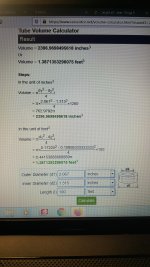
First is for a "Tube Volume Calculator": where d2= 2.067" and d1= 1.315" and the length is 100' which equals to 1.3871353296075 cubic feet.
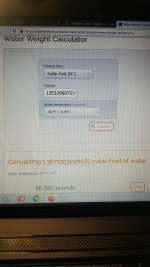
Second is for a "Water Weight Calculator" : where 1.3871353296075 cubic feet equals 86.595 pounds of water at 40 degrees Fahrenheit.
Tube Volume Calculator:
Volume Calculator
Water Weight Calculator:
https://www.thecalculatorsite.com/conversions/common/water-weight.php
Maybe this helps a little and does not confuse the answer the OP was looking for?
Anyway, enjoy your Captain Morgan & Dr. Pepper (I do drink Dr. Pepper),
KC
edit: for the water weight calculator you will have to change the "convert from" to Cubic Feet [ft3], and add in 1.3871353296075 for the volume, and change the water temperature to 40F, and then convert to get the pounds of water answer of 86.595, because the link has wiped out this information.


It's more fun to scratch it out on paper while watching Wheel of Fortune.
Please be a little clearer, highlight it in red or something, as I'm a little bleary eyed.
The OP said only the area between the outer wall of the small pipe and the inner wall of the large pipe would contain water.
So I had to first figure the volume of the large pipe inner cylinder, and remove the volume of the small pipe outer cylinder.
That gave me the volume of the space between the outer wall of the small pipe and the inner wall of the large pipe.
I divided that number by the number of cubic inches in a gallon.
Then I multiplied the number of gallons by the weight of a gallon of water
All that is lifted is a column of water the diameter of the top foot valve.
Yeah, it would - if the big pipe was filled it would reduce the small pipe down force. But it wouldnt be a pump if the small pipe couldnt be moved up/down. That inner check valve is the piston.Will the small pipe have buoyancy if it's attached to the bottom of the big pipe?