Weight of water

/ Weight of water #21  
16.65 pounds
Larger pipe area is inside diameter squared times pi divide by 4 subtract the outside diameter squared times pi divide by 4
Divide that number by 144to convert to square feet multiple by 100 to get cubic feet multiple by 62.4 pcf for water to get answer
Done on cheap small calculator so I probably have fat finger mistake in final answer
Area of a circle is radius squaredytimes pi, not diameter. Perimeter is diameter times pi. In most books it's written as 2 x pi x r.
 
/ Weight of water #23  
The answer to post #6 is a pretty important factor here, and I believe will change the number you need.
 
/ Weight of water #24  
My intention is to push that column of water from the bottom to the top ...

If you know the psi, which you should based on many answers here, why do you need to know the weight? If you install a pump with a greater psi capacity, it will push the water .... what am I missing?
 
/ Weight of water #25  
even simpler in metric, 10 meters of head is 1 bar.
 
/ Weight of water
  • Thread Starter
#26  
Is the water only in the annular space between the two pipes, ie, inside the big pipe but not inside the small pipe? If so, I calculate 86.56 lb of water in that annular space.

Weight = [area, ft^2]*[length, ft]*[density, lb/ft^3] = [(pi/4)*(2.067^2 - 1.315^2)/144] * [100] * [62.4] = 86.56 lb

Now, that said, if you want to size a pump, the weight isn't important, the pressure at the bottom of the water column is. That would be 6240 PSF or 43.3 PSI.

Yes, the water is inside the big pipe and not the small.

I do not want to size a pump, I am building a pump similar to this How To: Home made handpump for water (all parts at Lowe's) - Survival and Preparedness - TNGunOwners.com ( Some of the part numbers are no longer any good and I am using parts of the idea and not following the example ) and also similar to a Peters pump of which I have drawings/schematics.

Peters pump uses rudimentary/primitive hardware.

Both pumps have worthy ideas that I can use.

If the water column becomes too heavy than I will need to do something different with the handle to obtain better leverage.

I also will have to improve the pump with more precision fit components for tighter seals.

Peters pump uses bicycle inner tube as a backflow preventer as an example, if the water column becomes too heavy than an inner tube will not suffice.
 
/ Weight of water
  • Thread Starter
#27  
If you know the psi, which you should based on many answers here, why do you need to know the weight? If you install a pump with a greater psi capacity, it will push the water .... what am I missing?

Ive mentioned its a hand pump. I do not know what its capable of doing until I put it to the task
 
/ Weight of water #28  
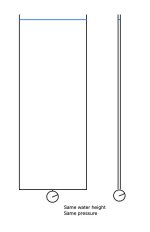
What matters is not the weight of the water in the pipe, but the height of the water and the diameter of the backflow valve.

If the backflow valve is 1 inch diameter, it doesn't matter if the pipe above it is 1 inch diameter or 24 inches, the pressure on the valve is the same if the height is the same.

Bruce

Water-pipe size-pressure.jpg
 
/ Weight of water #29  
What matters is not the weight of the water in the pipe, but the height of the water and the diameter of the backflow valve.

If the backflow valve is 1 inch diameter, it doesn't matter if the pipe above it is 1 inch diameter or 24 inches, the pressure on the valve is the same if the height is the same.

Bruce

View attachment 683557

Ding Ding Ding, we have a Winner. Backflow preventer is pressure sensitive, so pressure at the bottom of the pipe is all that matters. If I was on a submarine, the entire Atlantic ocean above me would squish us if the area or volume mattered.
 
/ Weight of water #30  
1 pound of pressure at the base of a water column will raise the water 2.304 feet. 1' of elevation of a water column will cause a pressure at the bottom of the pipe to be .434 PSI.

A 100' high water source will have 43.4 PSI at the base, regardless if it holds 100 gallons or 100,000,000 gallons. If you open your faucet with no water flowing and put a pressure gauge on it and see 70 PSI then you can assume the top of the water in the tank is (70 x 2.304) or 142.8' above your pressure gauge.

The shape of the container or the number of gallons the container holds is not a factor.

Also, remember that with a check valve, one side will likely be a larger diameter than the other. A check valve that will only allow water to fill the pipe from below and stop the water from flowing back out will have a large surface area on the top side than the bottom. A 1.5" diameter surface are at 1 pound per square inch pressure will have a greater force than a 1" diameter surface at the same 1 psi.
 
Last edited:
/ Weight of water
  • Thread Starter
#31  
The greater the volume of water the greater the force leverage will be required to bring to the surface. I can easily hand pump an 80 ft water column out of 3/4 diam pipe but step up to a 1.5 inch pipe and its not so easy.

I have experienced this.
 
/ Weight of water #32  
I can easily hand pump an 80 ft water column out of 3/4 diam pipe but step up to a 1.5 inch pipe and its not so easy.

I have experienced this.

I don't understand that. You should be pumping against the exact same psi if all other variables are the same.
 
/ Weight of water #33  
I have a 2" PVC pipe with an inside diam of 2.067 that is 100 feet long.

Also within that same pipe is a second sealed 1" pipe that has an outside diam of 1.315 same length.

How heavy will the water be?

My intention is to push that column of water from the bottom to the top and I need to know this answer so I can plan the rest of the pump accordingly.

Please dazzle me with how you came up with the answer. Thank-you

Area of a 2.067" ID pipe = (Pii / 4) x 2.067squared
(3.14 / 4) x 4.27 =
0.785 x 4.27 = 3.354 square inches

Area of a 1.315 OD pipe = (Pii / 4) x 1.315squared
(3.14 / 4) x 1.73 =
0.785 x 1.73 = 1.357 square inches

Volume of 2.067 ID x 100' pipe = 2.067 x 100'
2.067 x 1200" = 2480 cubic inches

Volume of 1.357 OD x 100 pipe = 1.357 x 100'
1.357 x 1200" = 1638.4 cubic inches

Subtract 1638.4 cubic inches from 2480 cubic inches = 841.6 cubic inches.

1 gallon displaces 231 cubic inches

841.6 / 231 = 3.64 gallons

1 gallon weighs 8.34 pounds

3.64 gallons x 8.34 pounds = 30.3576 pounds

Someone double check me, please. I've had some Captain Morgan and Dr. Pepper. :drink:
 
/ Weight of water #34  
Volume of a cylinder = pi times radius squared X height (or length)
Whatever units you units, it will be easy to convert that volume to a # of gallons.
 
/ Weight of water #35  
Pressure at the base of a water supply depends only on the height, volume of water is irrelevant. A tube of water 100' deep but only 6" wide will have the same pressure at the bottom as a lake 100' deep.
 
/ Weight of water #36  
A tube of water 100' deep but only 6" wide will have the same pressure at the bottom as a lake 100' deep.

That's why I don't understand the OP saying he can more easily hand pump a smaller pipe diameter, vs. a larger pipe diameter, if the height/lift is the same.
 
/ Weight of water #37  
That's why I don't understand the OP saying he can more easily hand pump a smaller pipe diameter, vs. a larger pipe diameter, if the height/lift is the same.

Unless he's talking about two different sizes of pump. Then what he says makes sense.
 
/ Weight of water
  • Thread Starter
#38  
I thought it would be clear that I am talking about 2 different size of pumps, if the casing is larger or smaller than the pump is larger or smaller

If you study the link I gave I think you would agree that if the check valve is located at the bottom of the pipe just on the other side of the foot valve ( also a one way valve ) than once the water is sucked thru the foot valve and sucked thru the second one way valve it will require X amount of force to push it too the surface.

Are you suggesting that a 1/2 pipes water volume would require the same amount of energy required as a 4 inch pipe water volume?

How can that be? The water or the amount of water on the exiting side is going to constantly want to flow back downward causing the water at the inlet to require more effort to continue to push its way upward.

This is the only explanation I can give thru my experience. Im not able to go into further detail because I simply cannot explain it any better. Thanks
 
/ Weight of water #39  
I believe he is talking about a cup type hand pump,
on his up stroke he is lifting the entire column of water,
more water flows into the column under his cup.
As the center rod is lowered the cup goes back down to the bottom but the check keeps the water from backing down,
his cup seal only holds in the lifting direction
 
/ Weight of water
  • Thread Starter
#40  
I believe he is talking about a cup type hand pump,
on his up stroke he is lifting the entire column of water,
more water flows into the column under his cup.
As the center rod is lowered the cup goes back down to the bottom but the check keeps the water from backing down,
his cup seal only holds in the lifting direction

Thanks for taking the time to look at the links I posted 2 pages ago
 

Marketplace Items

JLG 660SJ (A58214)
JLG 660SJ (A58214)
2018 WANCO WTSV PORTABLE ARROW BOARD (A60430)
2018 WANCO WTSV...
2007 BOBCAT S250 SKID STEER (A60429)
2007 BOBCAT S250...
BUNDLE OF 2"X8"-13'-19'L METAL FRAME WALL STUDS (A60432)
BUNDLE OF...
2004 Pierce Tilt Crew Cab Enforcer Fire Truck (A59230)
2004 Pierce Tilt...
2019 CATERPILLAR 259D SKID STEER (A60429)
2019 CATERPILLAR...
 
Top