Tractor vs Skid Steer Loader Specs

   / Tractor vs Skid Steer Loader Specs #21  
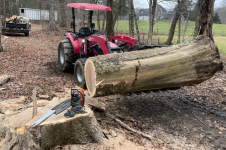
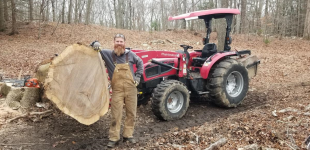
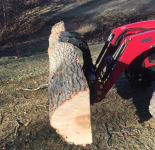
Recently sold some logs and one blown downed walnut tree by creek to a local saw Miller. He uses a steel track over wheels skidsteer at his mill. He is also professional forest hotshot firefighter qualified on many machines.
The walnut 30” tree was high hazard because of the terrain. He was impressed how easy the M59 preformed the work and moves that would have been hard for a skidsteer. Backhoe often swing uphill for balance. Transported logs 1/2 mile to load his trailer. Easily carried him, saws and equipment to/from tree.

Move a lot of brush and trees on my hillside. Being able to grapple a load, get off and trim with chainsaw not really safe with skidsteer. Road and landscape damage lot less. Now with soft ride FEL, time in the saddle kinder on worn bodies.

Never a perfect machine for all but the M59 makes a good dance partner on the farm.
 
   / Tractor vs Skid Steer Loader Specs #22  
There is no such thing as the one perfect machine for all jobs. A skidsteer has very low ground clearance. A skidsteer (except JCB) has to be climbed into and out of. Bigger skidsteers are heavy (more than 7500). Telebooms (versahandler) are really nice but (smaller, JCB 508 etc) lack ground clearance also. Farm tractors with a loader arent designed for heavy construction work.A compact wheel loader could tick off most of the boxes, but are hard to find used.
The OP is using a L47 for comparison, is a backhoe part of the equation too?
 
   / Tractor vs Skid Steer Loader Specs
  • Thread Starter
#23  
I bought a skid to use for logging and to use around my sawmill. I had it 6 weeks and it just wasn't working out, so I sent it down the road! I then bought a loader tractor, what a huge improvement!

It will walk away with a log that the skid would bounce off the ground and do it with MUCH more traction and not tear the ground up so much! Plus, now I can easily tow trailers ect. in snow or mud that would stop the skid, that I would have to drop the log and push myself out with the bucket.

My tractor is a thousand times more versatile!

SR
What model skid steer and what model tractor?

There is no such thing as the one perfect machine for all jobs. A skidsteer has very low ground clearance. A skidsteer (except JCB) has to be climbed into and out of. Bigger skidsteers are heavy (more than 7500). Telebooms (versahandler) are really nice but (smaller, JCB 508 etc) lack ground clearance also. Farm tractors with a loader arent designed for heavy construction work.A compact wheel loader could tick off most of the boxes, but are hard to find used.
The OP is using a L47 for comparison, is a backhoe part of the equation too?
I used L47 for several reasons. My dad keeps his mill at a place with an L47 and he said it occasionally can't lift a log, so that is my starting point for capacity. From what I've read it's built stronger than a typical compact tractor. It's comparable in weight (7k lbs) and used price (~$30-40k) to a mid size skid steer/small CTL. Also, it could potentially replace my tractor and I have some use for the backhoe.

It seems the consensus is if I'm only looking for max lift capacity on a machine I can transport the skid steer is the way to go. The other consideration is that I don't have a lot of other uses for it, a TLB would be much more useful, but that's a personal decision.

Thanks for all the replies.
 
   / Tractor vs Skid Steer Loader Specs #24  
That's not what breakout means. Breakout is the force at the pin at ground level, when using the loader lift cylinders. That force generally decreases as height increases, due to geometry. It's why manufacturers often give both. Breakout matters when you're trying to lift out of a pile, or pick up a pallet or something at ground level.
I’m not sure how to explain this to you. Break out force and lift use different hydraulics, different angles, different ways. For breakout if you laid the bucked flat on the ground and put the breakout number at the far edge of the bucket you could curl the bucket and it would lift the weight but the back/heal of the bucket would be on the ground. If you tried to lift that weight off the ground the loader could not.

If you are most concerned about lifting things you should stop looking at tractors. Get something made to do that like a skid steer, off-road fork lift or telehandler. That’s all there is too it.
That's not what breakout means. Breakout is just the lift capacity (at the pin) at ground level. Using the same loader lift cylinders. Curl is something different.

Due to changing geometry of the loader arms and lift cylinders, the lifting capacity will generally decrease as you go higher. Which is why a manufacturer will give you lift to max height, and breakout force. Both at the pin. As you extend the load further out away from the pin, the capacity will drop (that's true for full height, and ground level lifts)

Check out some spec sheets, some will give you bucket breakout force (what you are talking about), separate from boom breakout. While it's not explicitly stated in many tractor datasheets, boom breakout (at the pins), is what they are showing.

My machine (and most tractor loaders), you'll see this in practice by being able to lift a load a little ways, but not to full height.

5.1.5 Breakout force at pivot pin (Y): Vertical lifting force, in newtons
(pounds), the loader will exert at the bucket pivot pin centerline using the
lift cylinders only, with the bucket horizontal at ground line.

5.1.6 Breakout force (Z): Vertical lifting force, in newtons (pounds), the
loader will exert located 800 mm (31.5 in.) forward of the bucket pivot pin
centerline using the lift cylinders only, with the bucket horizontal at
ground line.

5.1.7 Bucket rollback force at maximum height (VV): Vertical lifting
force, in newtons (pounds), the bucket will exert, located 800 mm (31.5
in.) forward of the bucket pivot pin centerline, using the bucket cylinders
only, with loader at maximum height and bucket horizontal.

5.1.8 Bucket rollback force at 1.5 m (59 in.) lift height (XX): Vertical
lifting force, in newtons (pounds), the bucket will exert located 800 mm
(31.5 in.) forward of the bucket pivot pin centerline using the bucket
cylinders only, with the loader positioned to locate the bucket pivot pin
centerline at 1.5 m (59 in.) above ground line and bucket horizontal.

5.1.9 Bucket rollback force at ground line (ZZ): Vertical lifting force, in
newtons (pounds), the bucket will exert located 800 mm (31.5 in.)
forward of the bucket pivot pin centerline using the bucket cylinders only,
with the loader positioned to locate the bottom of the bucket cutting edge
horizontal at ground line.
 
   / Tractor vs Skid Steer Loader Specs #25  
OP, when comparing spec sheets for lifting at ground level, and breakout forces, one of the reasons that this will be difficult to do is that SS and tractor loaders use different geometry for lifting. Independent of whether the cylinders are larger, you can see in SS geometry that the load stays close to level, even as the load is lifted. That is not true with a tractor. If you did not curl forward as you lifted, your load would be facing nearly vertical on many tractor loaders at full height, and the longer the arc would be that the load needed to travel. So the longer the load gets (i.e. pallets vs loaded bucket), the more the tractor capacity will drop, because the load needs to travel further to complete the lifting arc. So that's why there's some examples of the Kubota SS lifting a pallet when a comparable (on paper) kubota TLB won't do it. It's more complicated than hooking a gauge to the lift pins at ground level and reading what it says. In the real world you generally lift forward of the lift pins, and the further forward you go, the lower your capacity will be. This is more pronounced with tractor geometry.

Regardless of all that - I would look more at overall operating weight and use cases. My neighbor has a New Holland LX665 that I borrow sometimes, and I have a 50 HP tractor that weighs about the same. The lift for a bucket full of material is probably about the same. My tractor when I have heavy counterweight is much more stable, especially over rough terrain. I can get out of the tractor safely with a suspended load. The tractor is less maneuverable, and you can't see the bucket edge. The SS is better at grading both due to visibility and to lift arm stops. I can run a mower on my tractor at the same time I have a grapple attached. The SS has terrible ground clearance and is prone to getting stuck in the mud. The SS is shorter and can be moved on a smaller trailer. The tractor does 13 MPH on the road, where the SS probably does about 5. I can pull a trailer with my tractor. As has been said, implements are cheaper with the tractor.

There are a lot of areas of overlap, but a lot of differences also. For my uses, I greatly prefer the tractor. If I was working in the dirt all the time, I'd probably have a SS. For material handling that you need to get out of the machine with a suspended load, as others have said - the only SS that you can do that safely is a volvo or JCB. Don't get out of a SS under a suspended load.
 
   / Tractor vs Skid Steer Loader Specs #26  
The tractor does 13 MPH on the road, where the SS probably does about 5. .
My wheeled skid steer does 11 mph and the tracked one does 7 mph. It would surprise you how much faster I could shuffle material with the skid steer vs a tractor. I can reach top speed with the skid steer just by clicking the 2 speed button which can shift on the go and pushing the joystick forward more. I can go between traveling at top speed to slowing down to a craw to take the next scoop and speeding back up again. The tractor can’t do that without changing gears. Even the HST tractor can’t do it without changing ranges. If I’m working with the tractor I almost always work in medium range and deal with speed restrictions that imposes. Sometimes I still have to shift into low to scoop. It’s true I can’t use a bushhog and a grapple at the same time but I can swap them in just a few seconds. Much faster than you can put a bushhog on a tractor.
 
Last edited:
   / Tractor vs Skid Steer Loader Specs #27  
What model skid steer and what model tractor?
The skid was a Case 1845, I had to put tracks on it to get any traction in any ground that wasn't dry or hard.

Any 50hp or bigger FARM tractor with a GOOD loader like an ALO brand would out do it for pulling, lifting or just being able to go through snow, mud or pull loads, especially down the road.

These are the jobs that are for woods use, and around the sawmill use...

I don't have any use for a compact tractor for heavy work, I've not had them hold up for me for that kind of use. I'm slowly getting rid of compacts and have replaced them with small FARM tractors. They have been a HUGE improvement.

I'm buying tractors that are tougher, last longer and are cheaper to buy, and if needed, easier to work on...

BTW, my loader tractor does 22mph on the road...

SR
 
Last edited:
   / Tractor vs Skid Steer Loader Specs #28  
My wheeled skid steer does 11 mph and the tracked one does 7 mph. It would surprise you how much faster I could shuffle material with the skid steer vs a tractor. I can reach top speed with the skid steer just by clicking the 2 speed button which can shift on the go and pushing the joystick forward more. I can go between traveling at top speed to slowing down to a craw to take the next scoop and speeding back up again. The tractor can’t do that without changing gears. Even the HST tractor can’t do it without changing ranges. If I’m working with the tractor I almost always work in medium range and deal with speed restrictions that imposes. Sometimes I still have to shift into low to scoop. It’s true I can’t use a bushhog and a grapple at the same time but I can swap them in just a few seconds. Much faster than you can put a bushhog on a tractor.
My only point is that there are numerous differences between the two machines that would make one fit better for an individual, beyond lift capacity. Where I live, I am often moving rocks or logs when I mow, or grabbing briars off of stone walls with the grapple to then mow them with the bushhog. It matters not how long it takes you to swap implements, for what I do in New England having both attachments at the same time is extremely valuable. That may not be true for you, or for the OP.

I've not used a 2 speed SS, that would be a nice feature if I were to ever buy one.
 
   / Tractor vs Skid Steer Loader Specs #29  
I'm trying to compare loader specs and it's hard to do on paper. I don't have experience with skid steers so I'd like some perspective from those that do. Ignoring all other differences between tractors and skid steers, how do you determine which loader is stronger? ROC and tipping load are the common skid steer specs, but how do you compare that to a tractor loader that is rated at lift at a certain height? Breakout force appears to be the only overlapping spec. It would mainly be used for lifting logs onto trailers and mills so max height isn't important. As an example, the Kubota L47 is rated at 2,848 lift to max height and 4,531 breakout force. The SSV75 has ROC of 2,690, tipping load of 5,380 and lift arm breakout of 4,850. On paper the lifting capacity seems comparable, is that correct? Again, I'm ignoring the usual differences between tractors and skid steers. Is there a certain spec that I should use to compare between the two and across brands? Breakout force seems to be more important for my use, should that be what I use to compare?
Do you know the maximum size log you'd want to lift into a trailer? For reference, if it's helpful - here are some logs I have lifted with my machine, rated at 2700 to full height, and 5100 breakout. The white oak log is 9 foot long, something around 4 foot at the one end, and maybe 32" at the small end. It was standing dead so the sapwood was lighter than a live tree. I think it weighed somewhere around 2500-3000 pounds. I managed to lift that into a trailer, but the machine wasn't real happy about it, and if I had a steady diet of moving these then I'd have something bigger, maybe even a full size backhoe.

The other log was too large to get the length we wanted and also be able to lift into the trailer. So I ripped it on site with a chainsaw, which is a pain, but doable if it's a rare occasion.

When shopping for my machine I got about the heaviest tractor I could and have it still be hydrostatic, which is important to me for a variety of reasons. I run it with a 2k pound concrete counterweight when I'm moving big logs.

The grapple I have on there is an EA 54", which is a relatively light weight attachment. Attachment weight cuts in to your lifting capacity. I really prefer the grapple vs forks for loading on to my mill. I also use it for turning logs when they are large.
 

Attachments

  • ScreenHunter 1050.png
    ScreenHunter 1050.png
    1.4 MB · Views: 234
  • ScreenHunter 1051.png
    ScreenHunter 1051.png
    1.7 MB · Views: 218
  • ScreenHunter 1052.png
    ScreenHunter 1052.png
    1.2 MB · Views: 229
   / Tractor vs Skid Steer Loader Specs
  • Thread Starter
#30  
Do you know the maximum size log you'd want to lift into a trailer? For reference, if it's helpful - here are some logs I have lifted with my machine, rated at 2700 to full height, and 5100 breakout. The white oak log is 9 foot long, something around 4 foot at the one end, and maybe 32" at the small end. It was standing dead so the sapwood was lighter than a live tree. I think it weighed somewhere around 2500-3000 pounds. I managed to lift that into a trailer, but the machine wasn't real happy about it, and if I had a steady diet of moving these then I'd have something bigger, maybe even a full size backhoe.

The other log was too large to get the length we wanted and also be able to lift into the trailer. So I ripped it on site with a chainsaw, which is a pain, but doable if it's a rare occasion.

When shopping for my machine I got about the heaviest tractor I could and have it still be hydrostatic, which is important to me for a variety of reasons. I run it with a 2k pound concrete counterweight when I'm moving big logs.

The grapple I have on there is an EA 54", which is a relatively light weight attachment. Attachment weight cuts in to your lifting capacity. I really prefer the grapple vs forks for loading on to my mill. I also use it for turning logs when they are large.

Thanks that real world info is helpful. My dads mill is limited to 36”, but sometimes he wants to cut 12 foot boards or finds something bigger diameter he takes to a place with a bigger mill. He said some logs have been too big to lift with a L47 on forks, which has similar specs to your tractor. Some log charts I’ve seen say a 36” oak at 8 ft can weigh 4,000 lbs. I guess it’s inevitable to find something that’s too big for whatever machine you get so buying for what works 95% of the time makes sense instead of buying something too big or expensive just for the rare situation.

I have the EA 55” grapple on my little tractor so good to know I can keep it if I get something bigger.
 
   / Tractor vs Skid Steer Loader Specs
  • Thread Starter
#31  
Found some great info with a lot more detail on the L47 owners manual. Also seems like Kubotas breakout definition is similar to what jb1390 described because they have different specs for bucket rollback.

IMG_4238.JPG
 
   / Tractor vs Skid Steer Loader Specs #32  
I use to own a bobcat skid steer and use to load logs on a trailer and sawmill I have moved to a pivot steer machine lots of reasons but the main one being on the bobcat you could not get out of the seat with a load on the forks I were forever wanting to position the forks over a load and then hook a chain on or load a trailer and need to reposition a bearer to so I could get my forks out and a dozen other things if you always have a helper not a problem but if you are going to use it by your self get a machine that you can hop off the seat and reposition sling without having to move the load to somewhere where you can get on the ground first
 
   / Tractor vs Skid Steer Loader Specs #33  
I don’t think you can compare by specs alone. When I added a CTL to my fleet, I found it go to in place of my compact tractor for much of the utility work I do around my farm, so I replaced the compact tractor with a 105 HP utility tractor. CTL has no PTO, no 3 point so it couldn’t be a complete replacement. My M7-171 can run things like my roto-tiller but is complete overkill.
 
   / Tractor vs Skid Steer Loader Specs #34  
The skid was a Case 1845, I had to put tracks on it to get any traction in any ground that wasn't dry or hard.

Any 50hp or bigger FARM tractor with a GOOD loader like an ALO brand would out do it for pulling, lifting or just being able to go through snow, mud or pull loads, especially down the road.

These are the jobs that are for woods use, and around the sawmill use...

I don't have any use for a compact tractor for heavy work, I've not had them hold up for me for that kind of use. I'm slowly getting rid of compacts and have replaced them with small FARM tractors. They have been a HUGE improvement.

I'm buying tractors that are tougher, last longer and are cheaper to buy, and if needed, easier to work on...

BTW, my loader tractor does 22mph on the road...

SR
I have to agree here somewhat. I like having a cab with AC, but after that all these bundles of wires and modules and sensors stuffed in every square inch of space is a sign of future downtime.
There’s nothing like a large farm tractor for lifting in open spaces, but 4570 is right that a skid loader is a compact, but very powerful source of lifting power in tight spots, like around foundations on construction sites. But they aren’t good in fields when you have to cover ground fast or need a lot of ground clearance.

IMO, it all gets down to WHERE you operate. If it’s a construction site, a skid steer or even better, a telehandler. The JCB teleskid should always be considered. Its a skid & small tele in one.

If it’s in the fields or woods, a 4WD farm tractor with strong closed center hydraulics and a heavy built loader, like a Quicke or an Alo and 4 big Ag tires.

Telehandlers with tall tires are always gaining popularity because of the loader having a boom, and their traction.

Don’t forget the venerable 4wd full sized backhoe. The dipperstick on a backhoe can drag & curl very heavy weight and the loaders are very strong. About the only downside it you need bigger truck & trailer for a large backhoe. But they are cheap and plentiful. If staying in one spot long term, a backhoe is a great choice.

The OP needs to identify his main tasks, then pick a machine.

Construction site short term- skid steer or teleskid
Construction site deep mud and need to reach high- telehandler
Woods & fields- farm tractor or large tracked skid steer
All around work long term-backhoe.
 
Last edited:
   / Tractor vs Skid Steer Loader Specs #35  
I have Bobcat T870, the lifting capacity is massive, it has a 11,000 lb tipping load. I have a tractor loader which I still use occasionally because I have better visibility and travel speed but that's it. I doubt even a 150 hp tractor could compete with a T870 for loader work. The problem is the CTL is very heavy, can't move it without a double dually trailer and a large dually truck. But there is no comparison, its lifting and pushing power is far greater than a tractor loader.
 
   / Tractor vs Skid Steer Loader Specs #36  
I have Bobcat T870, the lifting capacity is massive, it has a 11,000 lb tipping load. I have a tractor loader which I still use occasionally because I have better visibility and travel speed but that's it. I doubt even a 150 hp tractor could compete with a T870 for loader work. The problem is the CTL is very heavy, can't move it without a double dually trailer and a large dually truck. But there is no comparison, its lifting and pushing power is far greater than a tractor loader.

Agree on loader lift capacity, but Pushing? I would think a 150HP ag tractor would push more than a big skid steer. Especially when the ground gets muddy.
A few years ago, my neighbor was taking down trees and got his chipper truck stuck. They tried to get him out with their big skid steer. The skid steer tires instantly balled-up and that was it. I pulled him out easily with a small 4WD farm tractor. The ag tire paddles are unmatched for traction. Only metal tracks are better in most cases.
 
   / Tractor vs Skid Steer Loader Specs #37  
Agree on loader lift capacity, but Pushing? I would think a 150HP ag tractor would push more than a big skid steer. Especially when the ground gets muddy.
A few years ago, my neighbor was taking down trees and got his chipper truck stuck. They tried to get him out with their big skid steer. The skid steer tires instantly balled-up and that was it. I pulled him out easily with a small 4WD farm tractor. The ag tire paddles are unmatched for traction. Only metal tracks are better in most cases.
You said wheels on their skid steer. I've used the wheeled and tracked versions, they are very different. The wheeled aren't very good for traction but the tracked are great. A T870 would easily push more than a 150 hp tractor in most cases, I've used mine to pull concrete trucks out of mud holes.
 
   / Tractor vs Skid Steer Loader Specs #38  
You said wheels on their skid steer. I've used the wheeled and tracked versions, they are very different. The wheeled aren't very good for traction but the tracked are great. A T870 would easily push more than a 150 hp tractor in most cases, I've used mine to pull concrete trucks out of mud holes.
Yeah tracks are better, but eventually the skid steers bottom out. They have lower ground clearance.
It would be a fun contest to see if my 135HP Challenger @15,000lbs with Ag tires and both axles locked could push more across mud than a tracked skid steer. I think the weight of the tractor would really help. If the mud was 12” deep or more, I’d lean tractor. ;)
 
   / Tractor vs Skid Steer Loader Specs #39  
A skid dealer had a big, tracked skid on his lot, he swore that with a blade a skid would push more dirt than a small dozer. I told him, I have a small dozer, bring the skid over and we will have a timed event, cutting out topsoil and pushing it into a pile.

Whoever wins, owns both machines free and clear!

He wouldn't do it! THAT took care of the BS bragging!

SR
 
   / Tractor vs Skid Steer Loader Specs
  • Thread Starter
#40  
I have to agree here somewhat. I like having a cab with AC, but after that all these bundles of wires and modules and sensors stuffed in every square inch of space is a sign of future downtime.
There’s nothing like a large farm tractor for lifting in open spaces, but 4570 is right that a skid loader is a compact, but very powerful source of lifting power in tight spots, like around foundations on construction sites. But they aren’t good in fields when you have to cover ground fast or need a lot of ground clearance.

IMO, it all gets down to WHERE you operate. If it’s a construction site, a skid steer or even better, a telehandler. The JCB teleskid should always be considered. Its a skid & small tele in one.

If it’s in the fields or woods, a 4WD farm tractor with strong closed center hydraulics and a heavy built loader, like a Quicke or an Alo and 4 big Ag tires.

Telehandlers with tall tires are always gaining popularity because of the loader having a boom, and their traction.

Don’t forget the venerable 4wd full sized backhoe. The dipperstick on a backhoe can drag & curl very heavy weight and the loaders are very strong. About the only downside it you need bigger truck & trailer for a large backhoe. But they are cheap and plentiful. If staying in one spot long term, a backhoe is a great choice.

The OP needs to identify his main tasks, then pick a machine.

Construction site short term- skid steer or teleskid
Construction site deep mud and need to reach high- telehandler
Woods & fields- farm tractor or large tracked skid steer
All around work long term-backhoe.
For my uses a tractor or TLB is was more useful, but looks like with equal weight machines a skid steer will lift more. As others have said, there's no perfect machine for everything. My main problem is finding something that I can haul without buying a new truck and trailer, so it needs to weigh less than 7,500 lbs.
 

Tractor & Equipment Auctions

2002 Chevrolet C8500 Flatbed - CAT 3126 Diesel - Eaton Fuller 8 plus 2 Transmission (A56438)
2002 Chevrolet...
John Deere 5103 (A53317)
John Deere 5103...
2023 Kubota L6060HST Compact Utility Tractor (A56438)
2023 Kubota...
500 BBL FRAC TANK (A58214)
500 BBL FRAC TANK...
2023 KRT ST650 STAND-ON SKID STEER (A60429)
2023 KRT ST650...
iDrive TDS-2010H ProJack M2 Electric Trailer Dolly (A59230)
iDrive TDS-2010H...
 
Top