Sand casting

/ Sand casting #1  

GMtb42

Gold Member
Joined
Jun 11, 2007
Messages
469
Location
Spiro, Oklahoma
Tractor
SOLD Kioti CK20 HST Purchased CK3510SE HST
Has anyone here done any sand casting? I am trying to cast a part from aluminum and want to learn how to sand cast, I have watched Youtube videos of it and it seems rather easily done.
I have the sand mixed with the Bentonite clay (green sand), boxes made for the sand mold, just wondering if there are any tips of the trade and pitfalls to watch for.
 
/ Sand casting #2  
Haven't done it myself but am interested in it and also have watched a ton of youtube videos. Using scrap cast as your material (versus extruded etc), fluxing and degassing seem to be key items. Mostly I like MyfordBoy's casting videos, he has a lot of them and always seems to have a successful pour. What type of furnace have you built/bought?
 
/ Sand casting #3  
Having the sand rammed tight, and controlled moisture content when pour begins too much moisture and it can blow up the cask from steam explosion and shoot metal out the funnel!. Also vibrator shaker to help settle it as well helps then ram and re-fill & plate compress. I worked maintenance at place where brass fixtures were made so lots of hollow cores made and set in between two part casts and the brass poured around them. after cooling shaker knocked loose most of the extra sand and then cut apart into individual bits then cleaned of the sand cores. cut to size and then machines after inspection... lots of work to make a spigot !

Mark
 
/ Sand casting #4  
What spiker said about the moisture.
We would make forms out of styrofoam, and then add a spru (piece you are pouring into). Then we would pour the aluminum right on top of the styrofoam (which was packed in sand) and the stryofoam would vaporize and the aluminum would fill the void.
 
/ Sand casting #5  
What spiker said about the moisture.
We would make forms out of styrofoam, and then add a spru (piece you are pouring into). Then we would pour the aluminum right on top of the styrofoam (which was packed in sand) and the stryofoam would vaporize and the aluminum would fill the void.

That sounds like a good idea!

The vaporizing Styrofoam doesn't cause any issues?
 
/ Sand casting #6  
Only if you breath it in....do it outside and your fine. One thing I noticed was that if you sand the form a bit it will have a better finish.
 
/ Sand casting #7  
Degassing the molten metal is very important...reduces porosity.
Your ingot should be one alloy...don't just throw any aluminum in the pot.
Watch your pouring speed...too fast, you'll get turbulence (results in porosity), too slow and the metal might freeze before the mold is filled which results in shrinkage and a weak casting.
Don't get discouraged if your first attempt doesn't work out....casting is an art as much as it is a science.
 
Last edited:
/ Sand casting #8  
This is an interesting thread. I have never considered trying this, I guess I just assumed it was one of those things that was out of the realm of home projects... and I am usually one of the last to think like that!
 
/ Sand casting #9  
Did this back in the middle to late 60's with my dad. I was a little squirt then, but remember laying out the pattern so there weren't any undercuts. then packing sand in the bottom of the form. I believe the proper terms are the top is the cope and the bottom is the drag. after you have properly pack the sand level, you turned over and removed the sand to create a parting line half way down. You then sprinkled a very fine sand on the surface you created. Then put the top half of the form on and packed it with sand with the sprue plug in place. We found that if you put another plug at the far end of the pour, this would allow the gas to vent and help to completely fill the void. Once that was done, you lift off the top half and hope the pattern is still in the bottom half. you then remove the pattern and cut a runner to the sprue and vent. assemble the mold carefully and you were ready to pour. I have not watched any u-tube videos of this process and am going completely by memory from almost 50 years ago. angled sides of the pattern and additional stock added to the pattern to allow for machine stock has to be taken into consideration. Brings back good memories of the things Dad taught me over the years. Thanks for bringing this up.
 
/ Sand casting #10  
make sure you make your part big enough to allow for shrink
 
/ Sand casting #12  
As a young engineering student many years ago I studied casting and even made a few. To compensate for the shrinkage if you are trying to duplicate an existing part there are special plasters which expand as they set to offset the shrinkage as the aluminum cools. In my case I would go with my molds to a local foundry who were happy to fill them with molten metals.
I can be very dangerous as others have said so having a "real" foundry provide their expertise for the first time would give you a lot of knowledge.
Dave M7040
 
/ Sand casting #13  
As a young engineering student many years ago I studied casting and even made a few. . . .
I can be very dangerous

The world we live in can be very exciting. . . . and dangerous. And I love it that way.
But let's observe caution and proceed!
 
/ Sand casting #14  
Did this back in the middle to late 60's with my dad. I was a little squirt then, but remember laying out the pattern so there weren't any undercuts. then packing sand in the bottom of the form. I believe the proper terms are the top is the cope and the bottom is the drag. after you have properly pack the sand level, you turned over and removed the sand to create a parting line half way down. You then sprinkled a very fine sand on the surface you created. Then put the top half of the form on and packed it with sand with the sprue plug in place. We found that if you put another plug at the far end of the pour, this would allow the gas to vent and help to completely fill the void. Once that was done, you lift off the top half and hope the pattern is still in the bottom half. you then remove the pattern and cut a runner to the sprue and vent. assemble the mold carefully and you were ready to pour. I have not watched any u-tube videos of this process and am going completely by memory from almost 50 years ago. angled sides of the pattern and additional stock added to the pattern to allow for machine stock has to be taken into consideration. Brings back good memories of the things Dad taught me over the years. Thanks for bringing this up.

As I stated in my original post that I had done this back in the 60's got me thinking of the things we cast and the main thing was Dad was a Machinist / Tool Maker, he developed a prototype of a special wallpaper cutter for a cousin that was a painter/wallpaper hanger. We went through several designs and when the design was final, he made a match plate that would form both side of the part at the same time without having to manually shape the parting line. Well us boys tried our hand at it and the one thing I have we made was an aluminum fishing rod handle which I still have. The pattern was taken from another fishing pole that had a plastic handle that was prone to breaking, so we made alluminum ones. I have attached the photos for your enjoyment and my good memories.

Thanks again
 
/ Sand casting #16  
I got into lost foam casting a few years ago. Made a few things like a body for a fly cutter. I use petrobond sand for this. It's a blend of sand and petroleum. Stick together well and Tamps good.
 
/ Sand casting #17  
I got into sandcasting as a hobby with the help of some very knowledgeable people. Can be fun. There's a lot of information out there for the hobbiest on the net. If interested my hobby site is at http://www.schoepp.hylands.net/shop.html . An old site I made while killing time in hotels for work but it may have some useful information.

Al
 
/ Sand casting
  • Thread Starter
#18  
The part I am doing does not have to be machined after, in fact I want to leave rough for the texture.
Yeah the exploding part is not a fun aspect. I feel confident that I can do it (fingers crossed), I know the guy in the video makes it look easy from doing it so much.
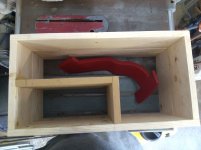
Attached a picture of the part, I have it in halves so as to form a top and bottom, the halves are doweled to match each other and so are the form halves, don't have pictures of the part halves yet but will put up in a few days.
When you say shrinkage about how much? The part can be a little smaller and not hurt.

Thanks for all the replies so far.

0509131355.jpg0805131450.jpg
 
/ Sand casting #19  
This post brings back many memories. I worked at a foundry for 15 years making pipe fittings (Ward). Some of the stories I could tell about molds blowing up from moisture. The most horrible was when the molten metal burned down my shirt and into the front of my pants!!!!! Good luck with your project and keep us informed how you make out.
 
/ Sand casting #20  
This post brings back many memories. I worked at a foundry for 15 years making pipe fittings (Ward). Some of the stories I could tell about molds blowing up from moisture. The most horrible was when the molten metal burned down my shirt and into the front of my pants!!!!! Good luck with your project and keep us informed how you make out.

Sounds scary, hope you weren't burnt too bad.

I remember having a lead pot blow up on me when I dropped a cold damp 5# chunk
of lead in as we were getting ready to pour a couple lead joints. I had been told but
forgot and didn't warm the lead up before putting it in the pot which already was half full
of molten lead. When the moisture in the lead flashed to steam it sprayed molten lead out
and almost caught me in the face. I did not get burnt as it was winter time and I had a
pair of Carhartt coveralls on and they protected me. I was picking lead out of those
coveralls for hte next couple weeks though.

I never forgot to set the lead next to the furnace and warm it up after that.
 
 
Top