You are using an out of date browser. It may not display this or other websites correctly.
You should upgrade or use an alternative browser.
You should upgrade or use an alternative browser.
Pouring concrete in the cold
- Thread starter bdog
- Start date
- Views: 6863
More options
Who Replied?
/ Pouring concrete in the cold
#1

Dave M7040
Elite Member
- Joined
- Dec 10, 2012
- Messages
- 2,757
- Location
- Williamstown Ontario Canada
- Tractor
- Kubota M7040 Nuffield 465
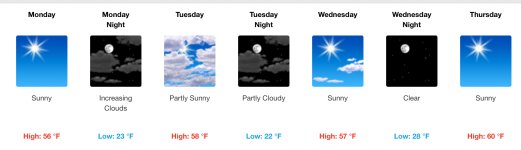
I really need to pour some concrete in the next couple days. Not a big area about 6�12? This is the forecast.
View attachment 536849
Never poured when below freezing temperatures were forecast. What precautions do I need to take?
You should not pour it on a surface which is frozen. Sometimes you have to make an enclosure and heat it to thaw the granulars and soil.
You need to order the concrete heated i.e. made with hot water so when it arrives on the job site it is protected for a while.
Concrete generates heat as it cures, but a limited amount when the slab is thin
You need to have a 6' high wind barrier in place to stop wind sweeping across the surface. I would consider insulating the forms in some fashion. Often straw is used.
You need to have insulated tarps on hand. Essentially like bubble wrap in tarp form. Put them over the surface as soon as finishing is completed.
If it is going to be very cold, the tarps should be elevated above the concrete and heat added to the enclosure.
Do NOT use an open flame heater as they produce CO2 which is harmful to the quality of the concrete.
You need to keep the concrete above freezing for at least 7 days, preferably more as the curing time is 28
The sooner you stop keeping the concrete warm, the curing process stops until the temp rises so it will not have its full strength.
You need to have a way to monitor the temp within the enclosure so if things are starting to get close to freezing temps, you can take more drastic action.
Leave the forms on as long as possible to protect the concrete edges.
Only on large projects would pouring in cold weather be done to stay on schedule. It involves risks and extra costs to wait for a break in the weather.
This link would be a good reference:
Cold Weather Concreting
Dave M7040
Streetcar
Veteran Member
Assuming you are pouring a thin slab.
Do not place concrete on frozen surface.
The day before you place concrete ,cover the area with plastic.
After you pour the concrete, cover it with blankets or straw and plastic.
We remove protection usually at seven days after pour.
Do not place concrete on frozen surface.
The day before you place concrete ,cover the area with plastic.
After you pour the concrete, cover it with blankets or straw and plastic.
We remove protection usually at seven days after pour.
Redlands Okie
Veteran Member
Dave M7040 pretty well covered it.
If you have the skills or manpower most concrete plants have mixes that will cure much faster than 28 days. We often use mixes for 10 days or less. Their not bad in cold weather. Some can even go way faster. You have to ask what the plant can do.
WARNING FAST SET UP MIXES SET UP FAST ! This can get you in a lot of trouble fast if your not prepared and ready to go with skills / help.
If you have the skills or manpower most concrete plants have mixes that will cure much faster than 28 days. We often use mixes for 10 days or less. Their not bad in cold weather. Some can even go way faster. You have to ask what the plant can do.
WARNING FAST SET UP MIXES SET UP FAST ! This can get you in a lot of trouble fast if your not prepared and ready to go with skills / help.
Streetcar
Veteran Member
Bdog
DaveM comments are correct but over kill for your weather forecast.
You could probably pour concrete with no protection and have no problems with your forecast. Slight protection is all you need
DaveM comments are correct but over kill for your weather forecast.
You could probably pour concrete with no protection and have no problems with your forecast. Slight protection is all you need
Rock knocker
Veteran Member
Wish the OP would have told us what he was pouring. Forms are much different than slabs
sdquick
Silver Member
My son works for a fencing contractor. I had never heard of this but they mix antifreeze in the concrete when it is freezing. Of course they are only setting fence posts. not doing slab work.
Thanks guys. It was a slab. 6' x12' x 18" thick. Certainly didn't need to be that thick but the concrete company has a 4 yard minimum and I have an excavator so why not. Truck didn't arrive until 2PM today. We got it poured but when it was getting dark it was still not set as hard as I would like. I went ahead and did the broom finish but it was a little too wet. We bought a a 12x25 insulating concrete blanket and doubled it up and put it over the pour. We will see. The finishing didn't go as well as I had hoped in these cooler temps. Normally we pour in the summer and it is all you can do to finish before it is too late.
Redlands Okie
Veteran Member
Sounds like you got it figured out with the blanket. Best wish’s on the project.
Streetcar
Veteran Member
At 18” thick you will have nothing to worry about. That thickness will generate enough heat to prevent freezing with Your forecast. With 4000 psi mix , the concrete in Ohio has enough strength by day two that freezing is not a concern

kebo
Elite Member
- Joined
- May 16, 2006
- Messages
- 2,931
- Location
- Lexington, SC
- Tractor
- 2001 John Deere 790 4x4, bar tires
You should not pour it on a surface which is frozen. Sometimes you have to make an enclosure and heat it to thaw the granulars and soil.
You need to order the concrete heated i.e. made with hot water so when it arrives on the job site it is protected for a while.
Concrete generates heat as it cures, but a limited amount when the slab is thin
You need to have a 6' high wind barrier in place to stop wind sweeping across the surface. I would consider insulating the forms in some fashion. Often straw is used.
You need to have insulated tarps on hand. Essentially like bubble wrap in tarp form. Put them over the surface as soon as finishing is completed.
If it is going to be very cold, the tarps should be elevated above the concrete and heat added to the enclosure.
Do NOT use an open flame heater as they produce CO2 which is harmful to the quality of the concrete.
You need to keep the concrete above freezing for at least 7 days, preferably more as the curing time is 28
The sooner you stop keeping the concrete warm, the curing process stops until the temp rises so it will not have its full strength.
You need to have a way to monitor the temp within the enclosure so if things are starting to get close to freezing temps, you can take more drastic action.
Leave the forms on as long as possible to protect the concrete edges.
Only on large projects would pouring in cold weather be done to stay on schedule. It involves risks and extra costs to wait for a break in the weather.
This link would be a good reference:
Cold Weather Concreting
Dave M7040
Who knew what pouring concrete in cold weather was so complicated? I guess that is something we don't have to deal with in the south very much.
Tractor Seabee
Elite Member
- Joined
- Oct 5, 2011
- Messages
- 3,911
- Tractor
- Kubota BX25
Hot weather concreting can also be complicated; to get optimum results.
Ron
Ron
Streetcar
Veteran Member
Cold weather requires protection from freezing until concrete has strength to resist ice forces.
Hot weather can cause flash curing
Hot weather can cause flash curing

Texasmark
Elite Member
- Joined
- Apr 24, 2012
- Messages
- 3,766
- Location
- N. Texas
- Tractor
- Ford: '88 3910 Series II, '80 3600, '65 3000; '07 6530C Branson with FEL, 2020 LS MT225S. Case-IH 395 and 895 with cab. All Diesels
You should not pour it on a surface which is frozen. Sometimes you have to make an enclosure and heat it to thaw the granulars and soil.
You need to order the concrete heated i.e. made with hot water so when it arrives on the job site it is protected for a while.
Concrete generates heat as it cures, but a limited amount when the slab is thin
You need to have a 6' high wind barrier in place to stop wind sweeping across the surface. I would consider insulating the forms in some fashion. Often straw is used.
You need to have insulated tarps on hand. Essentially like bubble wrap in tarp form. Put them over the surface as soon as finishing is completed.
If it is going to be very cold, the tarps should be elevated above the concrete and heat added to the enclosure.
Do NOT use an open flame heater as they produce CO2 which is harmful to the quality of the concrete.
You need to keep the concrete above freezing for at least 7 days, preferably more as the curing time is 28
The sooner you stop keeping the concrete warm, the curing process stops until the temp rises so it will not have its full strength.
You need to have a way to monitor the temp within the enclosure so if things are starting to get close to freezing temps, you can take more drastic action.
Leave the forms on as long as possible to protect the concrete edges.
Only on large projects would pouring in cold weather be done to stay on schedule. It involves risks and extra costs to wait for a break in the weather.
This link would be a good reference:
Cold Weather Concreting
Dave M7040
I'm not a concrete guy but I had a slab poured for a room addition to my house and we like to never got it to setup. Contractor said he forgot to tell the pit to add Calcium to the mix.
Texasmark
Elite Member
- Joined
- Apr 24, 2012
- Messages
- 3,766
- Location
- N. Texas
- Tractor
- Ford: '88 3910 Series II, '80 3600, '65 3000; '07 6530C Branson with FEL, 2020 LS MT225S. Case-IH 395 and 895 with cab. All Diesels
Hot weather concreting can also be complicated; to get optimum results.
Ron
I've seen it too covered to keep the sun off it while curing in hot weather. also saw a guy watering down the slab for the same reason I guess.

Tractor Seabee
Elite Member
- Joined
- Oct 5, 2011
- Messages
- 3,911
- Tractor
- Kubota BX25
Water curing is always best. Concrete core samples are stored in a controlled temp water bath up to the time they are tested.
There are projects where piping embedded in concrete and hot water circulated in winter or cold water circulated in summer. The "heat of hydration" generated in concrete can destroy it before it cures unless controlled to save or remove as necessary.
Ron
There are projects where piping embedded in concrete and hot water circulated in winter or cold water circulated in summer. The "heat of hydration" generated in concrete can destroy it before it cures unless controlled to save or remove as necessary.
Ron
I still have the insulated blankets on it. I lifted up a corner yesterday and it is really wet under there. Water droplets on the surface of the concrete and bottom of the blanket. Should make for a really good cure. I plan to remove it Monday which will be 7 days.
Texasmark
Elite Member
- Joined
- Apr 24, 2012
- Messages
- 3,766
- Location
- N. Texas
- Tractor
- Ford: '88 3910 Series II, '80 3600, '65 3000; '07 6530C Branson with FEL, 2020 LS MT225S. Case-IH 395 and 895 with cab. All Diesels
The Hoover dam was an example of planning for, and dealing with that. Interesting how they worked around the problem.Water curing is always best. Concrete core samples are stored in a controlled temp water bath up to the time they are tested.
There are projects where piping embedded in concrete and hot water circulated in winter or cold water circulated in summer. The "heat of hydration" generated in concrete can destroy it before it cures unless controlled to save or remove as necessary.
Ron
dirtydan
Bronze Member
Back in the late 80s I was a batch manager for a Ready Mix outfit that poured weights for a pipeline in northern Minnesota. Our cut off point was 20 below zero anything above that we worked below that we didn't. It takes quite a bit to get things going at 20 below zero trucks ran all night, loader also, and the generator plant did too. We used 190 degree water and lots of calcium cloride. Since oil is lighter than water they needed weights to put over the pipeline when it runs through the swamps. Each weight was two cubic yards. The crew put tarps and heated the weights for I really don't remember how long but a day or two. Our job was just to supply the concrete. As we recirculated the 190 degree water back into the swamp this made turtles and frogs come out of hibernation in the middle of winter in northern Minnesota quite a strange thing.


